Kenya Medical Device Sterilization Market Size, Share & Growth Rate
The Kenya Medical Device Sterilization Market was estimated at USD 1208 Million in 2025 and is projected to reach USD 2014 Million by 2032, growing at a CAGR of 7.6% from 2026 to 2032. This growth trajectory is largely driven by the increasing demand for sterilized medical devices across a rapidly expanding healthcare sector. The heightened awareness of infection control and prevention within healthcare facilities has resulted in a robust need for effective sterilization processes, reinforcing the market's upward momentum.
Kenya Medical Device Sterilization Market Year-wise Growth Rate and Key Drivers
This graph highlights how the Kenya Medical Device Sterilization Market has steadily grown over the years, supported by major growth factors.
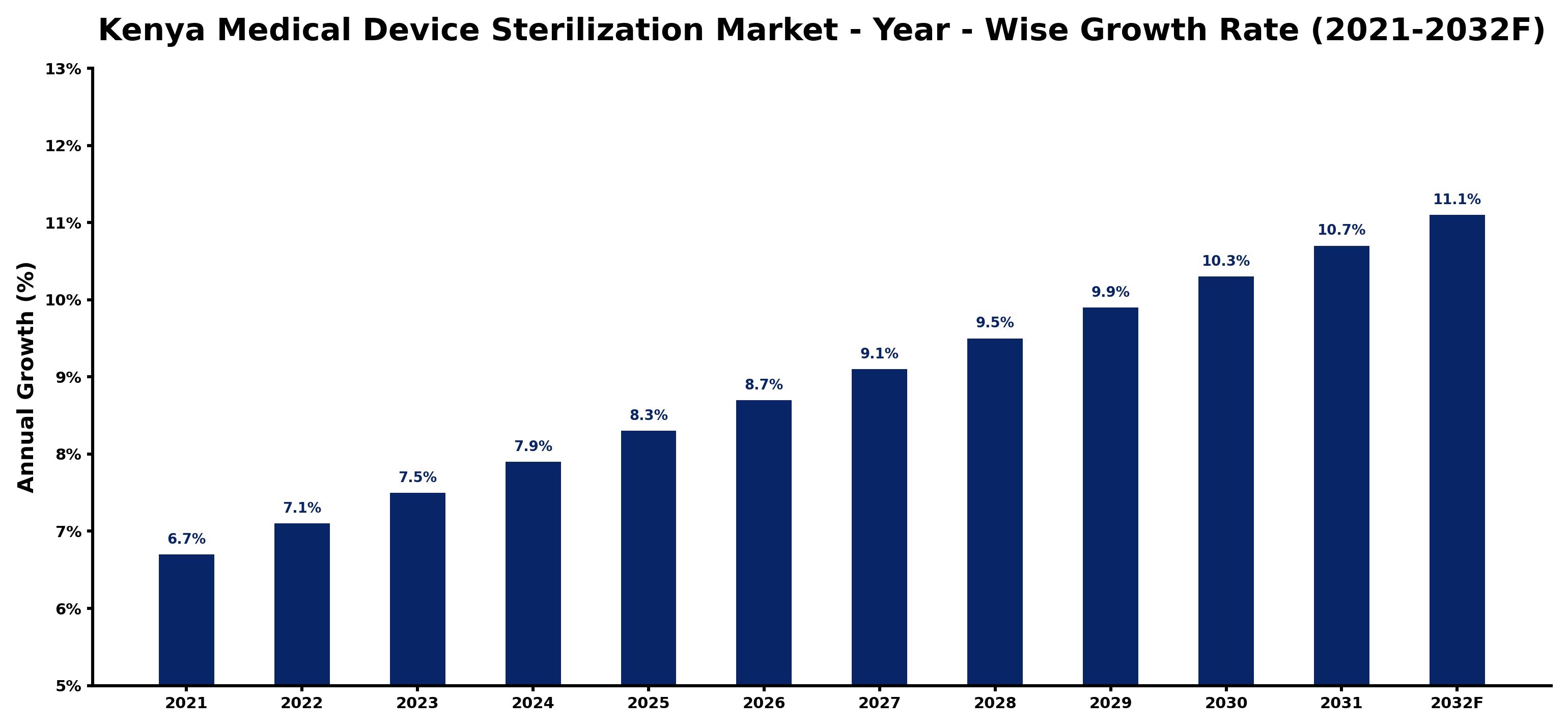
The table below presents the year‑wise growth rates along with the key drivers influencing the market
| Year | Growth Rate | Major Drivers |
| 2021 | 6.7% | Local hospitals invest in advanced sterilization technology adoption |
| 2022 | 7.1% | New sterilization facilities boost local medical device manufacturing output |
| 2023 | 7.5% | Domestic medical device manufacturers ramped up sterilization service capacity |
| 2024 | 7.9% | Manufacturing investments in advanced sterilization equipment drive local production |
| 2025 | 8.3% | Local manufacturers expanded facilities to meet rising sterilization demand |
| 2026 | 8.7% | Export driven sterilization equipment demand boosts local manufacturing capacity |
| 2027 | 9.1% | Local medical device manufacturers boost sterilization equipment production capacity |
| 2028 | 9.5% | New sterilization facility investments boost production capacity significantly |
| 2029 | 9.9% | Modernized sterilization technologies boost local medical device production efficiency |
| 2030 | 10.3% | Hospital procurement drives demand for sterilization equipment investments |
| 2031 | 10.7% | Digital sterilization technologies enhanced healthcare facilities' operational efficiency |
| 2032 | 11.1% | Technological upgrades in sterilization equipment boost local manufacturing efficiency |
Note - Market size estimations and growth projections presented in this report are based on 6Wresearch’s advanced forecasting approach, validated with industry datasets as of June 2026.
Kenya Medical Device Sterilization Market Synopsis
The most significant force shaping the Kenya Medical Device Sterilization Market is the escalating focus on infection control within healthcare facilities. With a rise in healthcare-associated infections, medical providers are under increasing pressure to ensure the highest standards of patient safety, making sterilization paramount.
Moreover, the proliferation of healthcare facilities, including hospitals and diagnostic centers, is enhancing the demand for diverse sterilization methods. As a result, both local and international players are tailoring their services to meet the unique needs of the Kenyan healthcare landscape, fostering a competitive environment.
Kenya Medical Device Sterilization Market Key Takeaways
- The market is poised for significant growth, driven by a focus on infection control and patient safety.
- Advancements in sterilization technologies such as ethylene oxide and gamma irradiation are becoming more prevalent.
- There is a rising demand for eco-friendly sterilization methods among healthcare providers.
- Challenges remain regarding infrastructure, skilled personnel, and the cost of sterilization technologies.
- Investment opportunities are emerging in the expansion of sterilization facilities and innovative technologies.
Evaluation of Restraints in Kenya Medical Device Sterilization Market
Despite its promising outlook, the Kenya Medical Device Sterilization Market faces critical restraints that could impede growth. One significant concern is the inadequate infrastructure in many healthcare facilities, which compromises effective sterilization processes. This deficiency can lead to heightened risks of healthcare-associated infections. Additionally, the shortage of trained personnel with expertise in sterilization techniques undermines the quality of services rendered. Financial barriers also exist, particularly for rural healthcare centers, as the high costs associated with acquiring and maintaining advanced sterilization equipment can deter investments in necessary practices.
Kenya Medical Device Sterilization Market Trends
The Kenya Medical Device Sterilization Market is currently influenced by several key trends. There is an increasing demand for advanced sterilization technologies that efficiently cater to a variety of medical devices. Concurrently, the emphasis on environmentally sustainable practices is driving the exploration of eco-friendly sterilization methods. Furthermore, healthcare providers are increasingly adopting single-use medical devices to enhance safety, necessitating reliable sterilization processes that can keep pace with this trend. As awareness around infection control escalates, the market is expected to adapt accordingly.
Kenya Medical Device Sterilization Market Opportunities
In this evolving market landscape, investment opportunities abound. Stakeholders can capitalize on the rising demand for sterilized medical devices through the establishment or expansion of sterilization facilities. Innovative sterilization technologies, particularly those emphasizing environmental sustainability, present avenues for differentiation and market penetration. Collaborations with hospitals and healthcare providers can further enhance service offerings, reinforcing market presence and operational viability.
Government Initiatives in the Kenya Medical Device Sterilization Market
The Kenyan government is proactive in ensuring the safety and efficacy of medical device sterilization processes. The Pharmacy and Poisons Board (PPB) is instrumental in the registration and regulation of medical devices, including sterilization equipment, ensuring compliance with established safety standards. Additionally, the Kenya Bureau of Standards (KEBS) plays a crucial role in setting guidelines for sterilization processes, which helps maintain the quality and safety of medical devices. Such governmental oversight is pivotal in enhancing public health outcomes through regulated sterilization practices.
Future Insights of the Kenya Medical Device Sterilization Market
Looking ahead to the years 2026-2032, the Kenya Medical Device Sterilization Market is expected to exhibit robust growth fueled by several factors. The continual rise in surgical procedures and an increasing emphasis on patient safety will necessitate the availability of sterile medical devices. Government initiatives aimed at bolstering healthcare infrastructure, alongside advancements in sterilization technology, are set to further stimulate market dynamics. While challenges remain, the overall outlook points towards a promising trajectory for the market.
Kenya Medical Device Sterilization Market Latest Developments (May 2025 - June 2026)
In recent months, the Kenya Medical Device Sterilization Market has seen a shift towards incorporating more advanced technologies and eco-friendly practices. This shift is evidenced by increased collaborations among stakeholders to enhance sterilization methodologies and improve efficiency. Furthermore, there is a noticeable push for more stringent regulations, encouraging healthcare providers to adopt best practices in infection control. These developments collectively suggest a market poised for transformation.
Kenya Medical Device Sterilization Market - Key Attractiveness of the Report
- 10 Years of Market Numbers
- Historical Data Starting from 2022 to 2025
- Base Year: 2025
- Forecast Data until 2032
- Key Performance Indicators Impacting the Market
- Major Upcoming Developments and Projects
Key Highlights of the Report:
- Kenya Medical Device Sterilization Market Outlook
- Market Size of Kenya Medical Device Sterilization Market, 2025
- Forecast of Kenya Medical Device Sterilization Market, 2032
- Historical Data and Forecast of Kenya Medical Device Sterilization Revenues & Volume for the Period 2022-2032F
- Kenya Medical Device Sterilization Market Trend Evolution
- Kenya Medical Device Sterilization Market Drivers and Challenges
- Kenya Medical Device Sterilization Price Trends
- Kenya Medical Device Sterilization Porter's Five Forces
- Kenya Medical Device Sterilization Industry Life Cycle
- Historical Data and Forecast of Kenya Medical Device Sterilization Market Revenues & Volume By Product & Service for the Period 2022-2032F
- Historical Data and Forecast of Kenya Medical Device Sterilization Market Revenues & Volume By Sterilization Instruments for the Period 2022-2032F
- Historical Data and Forecast of Kenya Medical Device Sterilization Market Revenues & Volume By Sterilization Services for the Period 2022-2032F
- Historical Data and Forecast of Kenya Medical Device Sterilization Market Revenues & Volume By Sterilization Consumables for the Period 2022-2032F
- Historical Data and Forecast of Kenya Medical Device Sterilization Market Revenues & Volume By Accessories for the Period 2022-2032F
- Historical Data and Forecast of Kenya Medical Device Sterilization Market Revenues & Volume By End-use for the Period 2022-2032F
- Historical Data and Forecast of Kenya Medical Device Sterilization Market Revenues & Volume By Hospitals & Clinics for the Period 2022-2032F
- Historical Data and Forecast of Kenya Medical Device Sterilization Market Revenues & Volume By Medical Device Companies for the Period 2022-2032F
- Historical Data and Forecast of Kenya Medical Device Sterilization Market Revenues & Volume By Pharmaceutical Companies for the Period 2022-2032F
- Historical Data and Forecast of Kenya Medical Device Sterilization Market Revenues & Volume By Food & Beverage Companies for the Period 2022-2032F
- Historical Data and Forecast of Kenya Medical Device Sterilization Market Revenues & Volume By Others for the Period 2022-2032F
- Kenya Medical Device Sterilization Import Export Trade Statistics
- Market Opportunity Assessment By Product & Service
- Market Opportunity Assessment By End-use
- Kenya Medical Device Sterilization Top Companies Market Share
- Kenya Medical Device Sterilization Competitive Benchmarking By Technical and Operational Parameters
- Kenya Medical Device Sterilization Company Profiles
- Kenya Medical Device Sterilization Key Strategic Recommendations






































