Kenya Permanent Magnets Market Size, Share & Growth Rate
The Kenya Permanent Magnets Market was estimated at USD 188 Million in 2025 and is projected to reach USD 252 Million by 2032, growing at a CAGR of 4.3% from 2026 to 2032. This growth trajectory is propelled by the robust demand from the automotive and electronics sectors, particularly in the context of the shift towards electric vehicles and energy-efficient technologies. Additionally, the increasing focus on renewable energy sources is driving the need for high-performance permanent magnets, particularly in applications such as wind turbines.
Kenya Permanent Magnets Market Growth Rate Analysis (2021-2032)
The Kenya Permanent Magnets market has showcased stable growth, with a yearly increase peaking at 5.3% in both 2022 and 2026. Factors such as rising consumer demand in the electronics and renewable energy sectors have bolstered this market, spurring investments in manufacturing capabilities. The growth slightly slowed to 5.1% in 2025 and 2028, reflecting temporary uncertainties in global supply chains and fluctuating raw material costs. However, the market remained resilient, bouncing back to 5.3% in 2027, driven by advancements in technology and strong government policies promoting the energy transition. Projections indicate a steady growth around 4.8% to 5.1% through 2032, highlighting a promising landscape for stakeholders.
Kenya Permanent Magnets Market Year-wise Growth Rate and Key Drivers
This graph highlights how the Kenya Permanent Magnets Market has steadily grown over the past five years, supported by major growth factors.
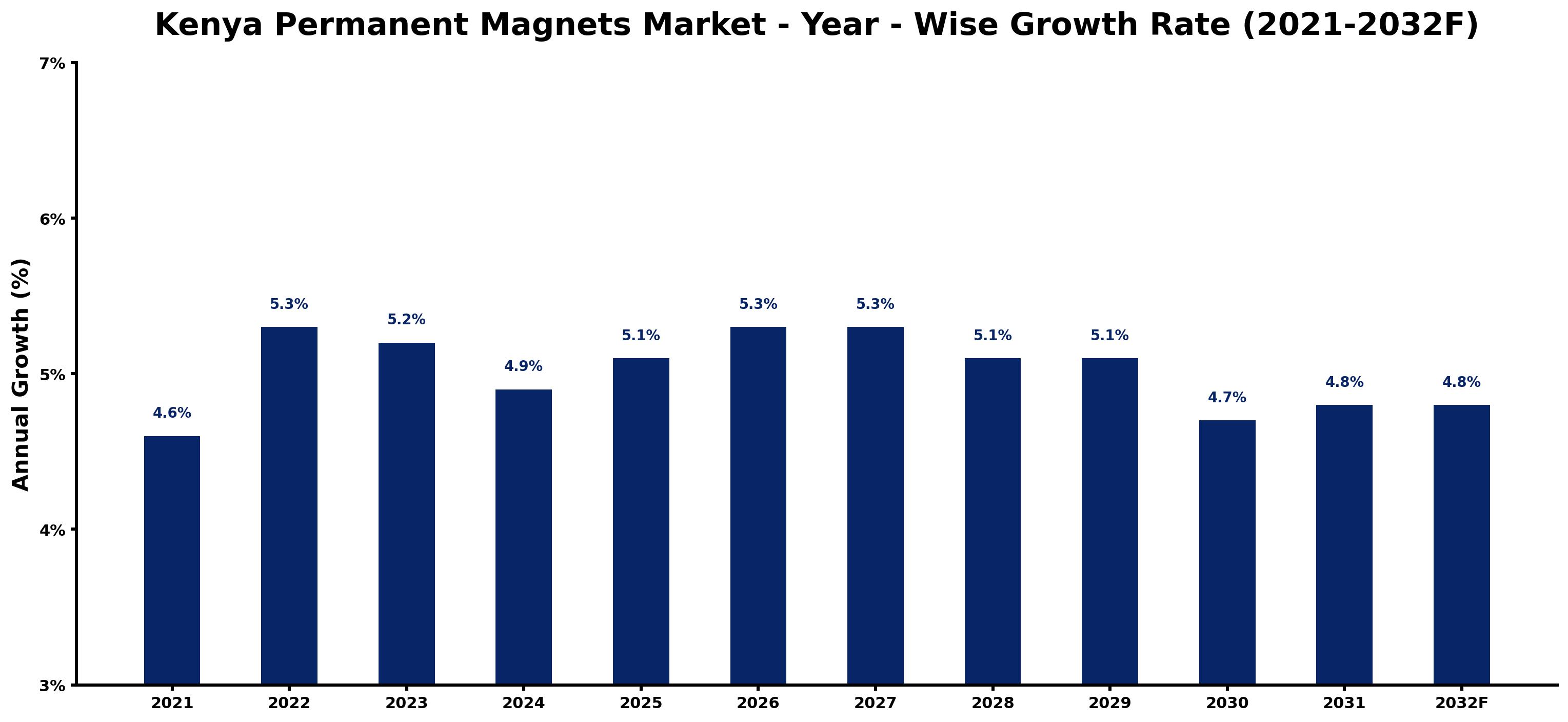
The table below presents the year‑wise growth rates along with the key drivers influencing the market
| Year | Growth Rate | Major Drivers |
| 2021 | 4.6% | Expansion of manufacturing activities |
| 2022 | 5.3% | Expansion of transportation and logistics networks |
| 2023 | 5.2% | Growing renewable energy integration projects |
| 2024 | 4.9% | Rapid growth in telecom and data center sectors |
| 2025 | 5.1% | Rapid growth in telecom and data center sectors |
| 2026 | 5.3% | Increasing industrial infrastructure investments |
| 2027 | 5.3% | Rapid growth in telecom and data center sectors |
| 2028 | 5.1% | Growing renewable energy integration projects |
| 2029 | 5.1% | Growing urbanization and commercial development |
| 2030 | 4.7% | Expansion of manufacturing activities |
| 2031 | 4.8% | Expansion of manufacturing activities |
| 2032 | 4.8% | Increasing industrial infrastructure investments |
Note - Market size estimations and growth projections presented in this report are based on 6Wresearch's advanced forecasting approach, validated with industry datasets as of June 2026.
Kenya Permanent Magnets Market Synopsis
Currently, the most significant force shaping the Kenya Permanent Magnets Market is the rising demand for rare earth magnets, which are critical in high-performance applications across various sectors. This shift is driven by the automotive industry's transition toward electric mobility, which relies heavily on the efficient performance of permanent magnets in electric motors.
Another pivotal factor is the growing emphasis on sustainability and green technologies, which has catalyzed investments in research and development aimed at enhancing magnet efficiency. This trend not only boosts the domestic market but also aligns with global sustainability goals, increasing the competitive edge of Kenyan manufacturers.
Kenya Permanent Magnets Market Key Takeaways
- The market is predominantly driven by the automotive and electronics sectors.
- Ferrite magnets remain a popular choice due to their cost-effectiveness and versatility.
- There is a notable shift towards rare earth magnets for high-performance applications.
- Investment in R&D is essential to address local manufacturing challenges and improve quality.
- Collaboration with local entities can harness existing resources for market growth.
Evaluation of Restraints in Kenya Permanent Magnets Market
Despite the promising outlook, several restraints limit the growth of the Kenya Permanent Magnets Market. A key challenge is the limited technological capabilities in local manufacturing, which affects the quality and competitiveness of the magnets produced. Additionally, the inconsistency in the supply of essential raw materials poses a significant barrier. The lack of a skilled workforce adept in advanced magnet production techniques further exacerbates these challenges. Compounded by infrastructure issues like unreliable power supply and transportation bottlenecks, these factors create a complex environment that requires strategic interventions for growth.
Kenya Permanent Magnets Market Trends
The demand for rare earth magnets continues to surge due to their superior magnetic properties and applicability in cutting-edge technologies. Within the electronics sector, there is a noticeable trend towards the development of smaller, more efficient devices, which necessitates the use of high-performance magnets. Furthermore, as Kenya's industrial landscape evolves, there's a growing interest in renewable energy applications, particularly in wind and solar energy, which are expected to significantly increase the demand for permanent magnets.
Kenya Permanent Magnets Market Opportunities
The Kenya Permanent Magnets Market is ripe with investment opportunities, particularly in the production and distribution sectors. The automotive industry's push towards electric vehicles presents a significant growth avenue, as does the expanding electronics sector. Investors should also consider innovative collaborations with local research institutions to foster advancements in magnet technology. Emphasizing sustainability will further align with global trends, making investments in this area particularly attractive.
Government Initiatives in the Kenya Permanent Magnets Market
While the Kenyan government does not have specific policies for the Permanent Magnets Market, broader initiatives aimed at promoting industrial growth directly impact the sector. The Big 4 Agenda, which emphasizes manufacturing and technological innovation, along with programs like the Kenya Industrial Transformation Program, supports local industries. These initiatives aim to improve infrastructure, access to financing, and create a favorable business environment, indirectly benefiting the permanent magnets market.
Future Insights of the Kenya Permanent Magnets Market
Looking ahead to 2026-2032, the Kenya Permanent Magnets Market is expected to continue its upward trajectory, buoyed by the increasing adoption of clean energy technologies and electric vehicles. The trend towards compact, energy-efficient electronics will further drive demand for high-performance magnets. However, stakeholders must remain vigilant regarding potential fluctuations in raw material prices and competition from alternative materials, which could alter market dynamics.
Kenya Permanent Magnets Market Latest Developments (May 2025 - June 2026)
In recent months, the industry has seen a flurry of activities aimed at enhancing technological capabilities within local manufacturing. Research collaborations between private firms and universities have emerged, focusing on developing innovative magnet applications. Furthermore, investment in infrastructure is gradually improving, facilitating better supply chain logistics. These developments reflect a proactive approach to address existing challenges and leverage growth opportunities in the market.
Kenya Permanent Magnets Market - Key Attractiveness of the Report
- 10 Years of Market Numbers
- Historical Data Starting from 2022 to 2025
- Base Year: 2025
- Forecast Data until 2032
- Key Performance Indicators Impacting the Market
- Major Upcoming Developments and Projects
Key Highlights of the Report:
- Kenya Permanent Magnets Market Outlook
- Market Size of Kenya Permanent Magnets Market, 2025
- Forecast of Kenya Permanent Magnets Market, 2032
- Historical Data and Forecast of Kenya Permanent Magnets Revenues & Volume for the Period 2022-2032F
- Kenya Permanent Magnets Market Trend Evolution
- Kenya Permanent Magnets Market Drivers and Challenges
- Kenya Permanent Magnets Price Trends
- Kenya Permanent Magnets Porter's Five Forces
- Kenya Permanent Magnets Industry Life Cycle
- Historical Data and Forecast of Kenya Permanent Magnets Market Revenues & Volume By Material for the Period 2022-2032F
- Historical Data and Forecast of Kenya Permanent Magnets Market Revenues & Volume By Ferrite for the Period 2022-2032F
- Historical Data and Forecast of Kenya Permanent Magnets Market Revenues & Volume By Neodymium Iron Boron (NdFeB) for the Period 2022-2032F
- Historical Data and Forecast of Kenya Permanent Magnets Market Revenues & Volume By Aluminium Nickel Cobalt (Alnico) for the Period 2022-2032F
- Historical Data and Forecast of Kenya Permanent Magnets Market Revenues & Volume By Samarium Cobalt (SmCo) for the Period 2022-2032F
- Historical Data and Forecast of Kenya Permanent Magnets Market Revenues & Volume By Applications for the Period 2022-2032F
- Historical Data and Forecast of Kenya Permanent Magnets Market Revenues & Volume By Automotive for the Period 2022-2032F
- Historical Data and Forecast of Kenya Permanent Magnets Market Revenues & Volume By Consumer Goods & Electronics for the Period 2022-2032F
- Historical Data and Forecast of Kenya Permanent Magnets Market Revenues & Volume By Industrial for the Period 2022-2032F
- Historical Data and Forecast of Kenya Permanent Magnets Market Revenues & Volume By Aerospace & Defense for the Period 2022-2032F
- Historical Data and Forecast of Kenya Permanent Magnets Market Revenues & Volume By Energy for the Period 2022-2032F
- Historical Data and Forecast of Kenya Permanent Magnets Market Revenues & Volume By Medical for the Period 2022-2032F
- Historical Data and Forecast of Kenya Permanent Magnets Market Revenues & Volume By Others for the Period 2022-2032F
- Kenya Permanent Magnets Import Export Trade Statistics
- Market Opportunity Assessment By Material
- Market Opportunity Assessment By Applications
- Kenya Permanent Magnets Top Companies Market Share
- Kenya Permanent Magnets Competitive Benchmarking By Technical and Operational Parameters
- Kenya Permanent Magnets Company Profiles
- Kenya Permanent Magnets Key Strategic Recommendations






































