Kenya Power Generation Market Size, Share & Growth Rate
The Kenya Power Generation Market was estimated at USD 948 Million in 2025 and is projected to reach USD 1356 Million by 2032, growing at a CAGR of 5.2% from 2026 to 2032. This growth trajectory is primarily driven by the countrys ambitious renewable energy targets and substantial investments aimed at expanding power generation capabilities. With an increasing focus on energy security and sustainability, the market is evolving to reduce dependence on fossil fuels while simultaneously addressing the rising electricity demand across urban and rural areas.
Kenya Power Generation Market Year-wise Growth Rate and Key Drivers
This graph highlights how the Kenya Power Generation Market has steadily grown over the years, supported by major growth factors.
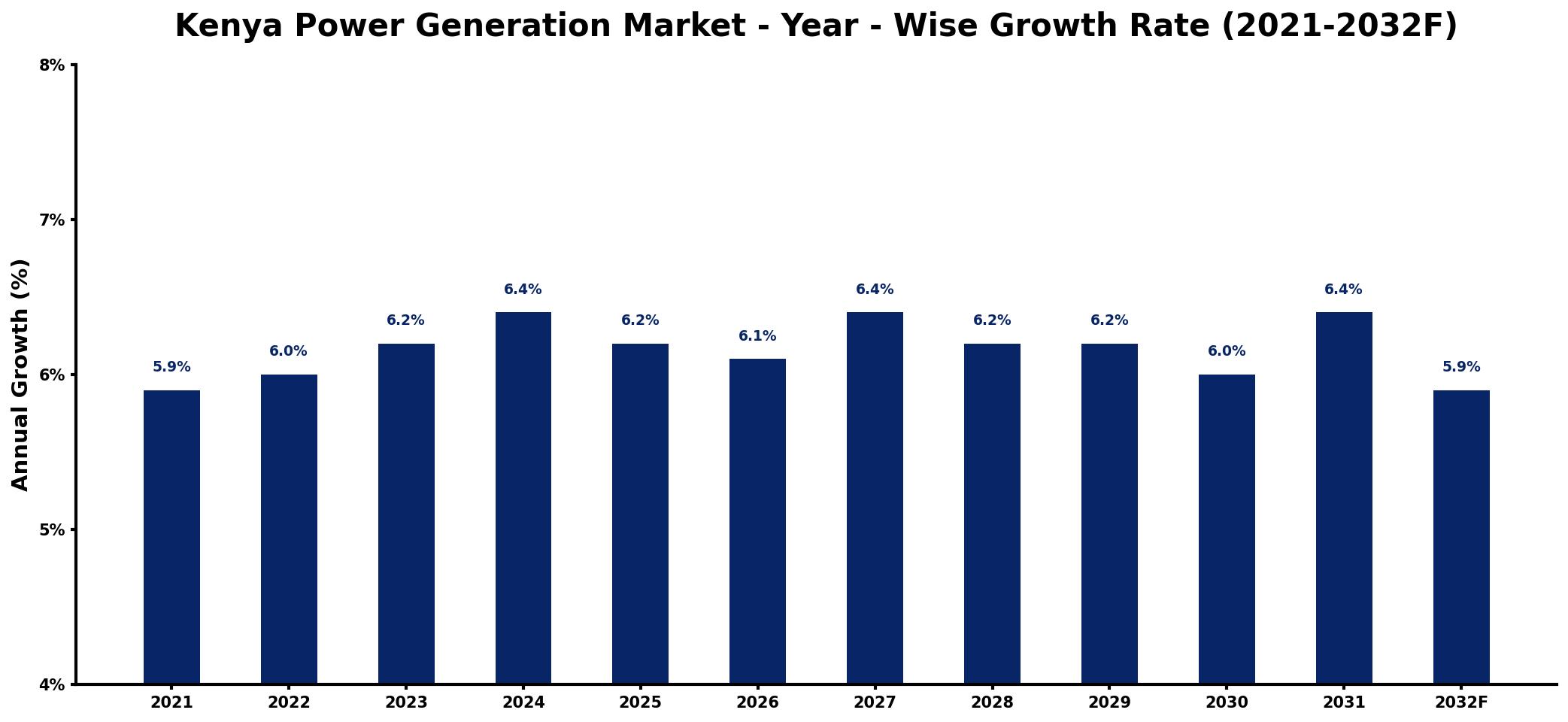
The table below presents the year‑wise growth rates along with the key drivers influencing the market
| Year | Growth Rate | Major Drivers |
| 2021 | 5.9% | Rising residential energy consumption |
| 2022 | 6.0% | Increased foreign investment interest |
| 2023 | 6.2% | Expansion of renewable energy initiatives |
| 2024 | 6.4% | Growing industrial energy demands |
| 2025 | 6.2% | Enhanced infrastructure development projects |
| 2026 | 6.1% | Strengthened regional energy partnerships |
| 2027 | 6.4% | Boost in energy efficiency programs |
| 2028 | 6.2% | Surge in commercial energy needs |
| 2029 | 6.2% | Adoption of smart grid technologies |
| 2030 | 6.0% | Diversification of energy sources |
| 2031 | 6.4% | Growing urban population energy requirements |
| 2032 | 5.9% | Investment in energy storage solutions |
Note: Market size estimations and growth projections presented in this report are based on 6Wresearch's proprietary forecasting methodology, utilizing the latest available industry data, government publications, and primary research inputs.
Kenya Power Generation Market Synopsis
The Kenya Power Generation Market is currently witnessing a transformative shift towards renewable energy sources, spurred by government initiatives and a growing recognition of the need for sustainable practices. Hydroelectric and geothermal energy dominate the landscape, yet wind and solar energy are emerging as vital contributors to the energy mix.
As the nation grapples with infrastructural challenges and the impacts of climate change, the emphasis on diversifying energy sources is becoming increasingly critical. Independent Power Producers (IPPs) are playing a pivotal role in this evolution, bolstering capacity while enhancing the reliability and efficiency of the overall power generation system.
Kenya Power Generation Market Key Takeaways
- The market is shifting towards renewable sources, significantly hydroelectric, geothermal, and wind energy.
- Government policies are fostering private sector investment and participation in power generation.
- There is a notable focus on upgrading transmission infrastructure to reduce losses and improve reliability.
- Investments in energy storage technologies and smart grids are essential for enhancing efficiency.
- Urbanization and population growth are driving electricity demand, creating new market opportunities.
Evaluation of Restraints in Kenya Power Generation Market
Despite the promising growth of the Kenya Power Generation Market, significant restraints continue to impede its full potential. Inadequate transmission and distribution infrastructure contribute to substantial energy losses, limiting the effectiveness of power generation efforts. Furthermore, a heavy reliance on hydroelectric power renders the market vulnerable to climate variability, particularly droughts that can severely impact electricity generation. Regulatory inconsistencies and political interference in tariff settings create uncertainty for potential investors, while inefficient billing and collection processes further strain the financial health of power generation entities.
Kenya Power Generation Market Trends
Current trends indicate a robust movement towards renewable energy solutions, with wind and solar projects gaining traction in line with global sustainability goals. The government's proactive approach to encourage private investments is paving the way for greater participation of Independent Power Producers (IPPs). Additionally, technological advancements in energy storage and grid management are becoming essential to address the intermittent nature of renewable energy sources, ensuring a more reliable power supply for consumers.
Kenya Power Generation Market Opportunities
Investment opportunities are rich within the Kenya Power Generation Market, particularly in the renewable sector. Solar, wind, and geothermal projects are poised for growth, driven by favorable natural resources and government incentives. The increasing demand for off-grid solutions presents opportunities for decentralized energy systems, particularly in rural regions. Furthermore, the ongoing privatization efforts in the energy sector open avenues for private investments in infrastructure development and technology upgrades.
Government Initiatives in the Kenya Power Generation Market
Government initiatives have been pivotal in shaping the Kenya Power Generation Market. Key policies such as the Energy Act provide a robust regulatory framework for the sector, while the Feed-in Tariff Policy incentivizes investment in renewable energy projects. Programs like the Rural Electrification Program and the Last Mile Connectivity Project aim to enhance electricity access for underserved populations, thereby driving market expansion. These initiatives collectively support the diversification of the energy mix and foster an environment conducive to sustainable development.
Future Insights of the Kenya Power Generation Market
Looking ahead to 2026-2032, the Kenya Power Generation Market is expected to thrive amid a backdrop of rising electricity demand driven by urbanization and industrialization. The government's sustained commitment to expanding renewable energy sources will be vital in reducing reliance on fossil fuels and enhancing energy security. As the market evolves, investments in infrastructure modernization and smart grid technology will play a crucial role in improving the reliability and efficiency of power supply, thus positioning the sector for long-term growth and sustainability.
Kenya Power Generation Market Latest Developments (2025 - 2026)
Recent developments in the Kenya Power Generation Market indicate a continued push towards renewable energy investments, with multiple projects in the pipeline. The government is also emphasizing partnerships with private firms to accelerate the implementation of clean energy solutions. Innovations in energy storage technologies and smart grid infrastructure are gaining attention as critical elements for enhancing grid reliability. As regulatory frameworks evolve, they are expected to attract further foreign and domestic investment in the sector, reinforcing Kenya's commitment to a sustainable energy future.
Kenya Power Generation Market - Key Attractiveness of the Report
- 10 Years of Market Numbers
- Historical Data Starting from 2022 to 2025
- Base Year: 2025
- Forecast Data until 2032
- Key Performance Indicators Impacting the Market
- Major Upcoming Developments and Projects
Key Highlights of the Report:
- Kenya Power Generation Market Outlook
- Market Size of Kenya Power Generation Market, 2025
- Forecast of Kenya Power Generation Market, 2032
- Historical Data and Forecast of Kenya Power Generation Revenues & Volume for the Period 2022-2032F
- Kenya Power Generation Market Trend Evolution
- Kenya Power Generation Market Drivers and Challenges
- Kenya Power Generation Price Trends
- Kenya Power Generation Porter's Five Forces
- Kenya Power Generation Industry Life Cycle
- Historical Data and Forecast of Kenya Power Generation Market Revenues & Volume By Application for the Period 2022-2032F
- Historical Data and Forecast of Kenya Power Generation Market Revenues & Volume By Commercial for the Period 2022-2032F
- Historical Data and Forecast of Kenya Power Generation Market Revenues & Volume By Industrial for the Period 2022-2032F
- Historical Data and Forecast of Kenya Power Generation Market Revenues & Volume By Residential for the Period 2022-2032F
- Historical Data and Forecast of Kenya Power Generation Market Revenues & Volume By Source for the Period 2022-2032F
- Historical Data and Forecast of Kenya Power Generation Market Revenues & Volume By Non-Renewable for the Period 2022-2032F
- Historical Data and Forecast of Kenya Power Generation Market Revenues & Volume By Renewable for the Period 2022-2032F
- Kenya Power Generation Import Export Trade Statistics
- Market Opportunity Assessment By Application
- Market Opportunity Assessment By Source
- Kenya Power Generation Top Companies Market Share
- Kenya Power Generation Competitive Benchmarking By Technical and Operational Parameters
- Kenya Power Generation Company Profiles
- Kenya Power Generation Key Strategic Recommendations






































