Steel Market: Kenya vs Top 5 Major Economies in 2027 (Africa)
Kenya's Steel market is anticipated to experience a high growth rate of 10.66% by 2027, reflecting trends observed in the largest economy Egypt, followed by South Africa, Ethiopia, Algeria and Nigeria.
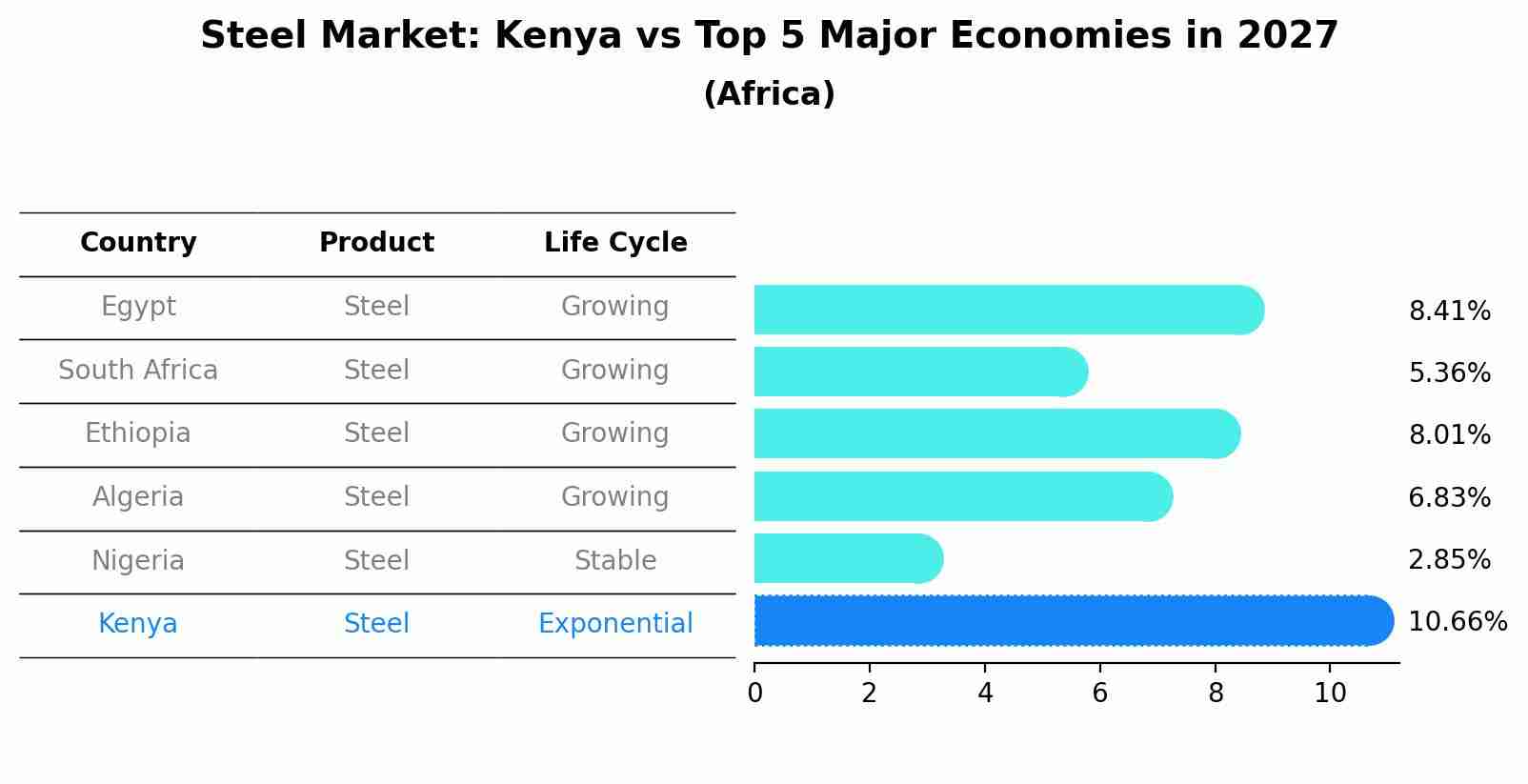
Kenya Steel Market Growth Rate
According to 6Wresearch internal database and industry insights, the Kenya Steel Market is projected to grow at a compound annual growth rate (CAGR) of 6.9% during the forecast period from 2026 to 2032.
Topics Covered in the Kenya Steel Market Report
The Kenya Steel Market report thoroughly covers the market by type, product type, and application. It provides a detailed and unbiased analysis of ongoing market trends, opportunities, challenges, and market drivers, helping stakeholders align strategies with current and future market dynamics.
Kenya Steel Market Highlights
| Report Name | Kenya Steel Market |
| Forecast period | 2026–2032 |
| CAGR | 6.9% |
| Growing Sector | Construction |
Kenya Steel Market Synopsis
Kenya Steel Market is expected to experience significant growth, as it is influenced by the increasing demand for steel products across several industries such as construction, automotive, and electrical appliances. The rising population rate and urban population rate, coupled with a steady rise in construction activities, especially housing, and public infrastructure projects, are likely to increase the demand for steel. Also, the automotive and manufacturing sectors are seeing a shift towards the use of high-quality, durable steel for various applications, further boosting the market development.
Evaluation of Growth Drivers in the Kenya Steel Market
Below mentioned are some prominent drivers and their impact on the Kenya Steel Market dynamics:
| Drivers | Primary Segment Affected | Why It Matters (Evidence) |
| Increase in Infrastructure Development | By Application (Building & Construction) | The rise in public infrastructure development projects has resulted in a massive increase in demand for steel products. |
| Surge in Industrialization & Manufacturing | By Product Type (Structural Steel, Prestressing Steel, Welding Wire/Rod) | As industrialization progresses, demand for steel in manufacturing processes increases. |
| Urbanization and Population Growth | By Application (Mechanical Equipment, Automotive, Electrical Appliances) | Growing urban population rate has increased the demand for durable products, which in turn boosts steel consumption. |
| Growth in Housing Demand | By Product Type (Iron Steel Wire, Steel Ropes, Braids) | There is an increased demand for residential and commercial buildings, which fuels the need for steel products. |
| Government Support for Manufacturing | By Application (All Applications) | Policy support for local manufacturing and construction projects contribute to a stronger domestic steel demand. |
Kenya Steel Market is projected to grow at a CAGR of 6.9% from 2026 to 2032. backed by some major factors, such as infrastructure development and expanding industries in the country. Increased demand for steel in construction, automotive, and electrical appliances is influenced by growing population rate, which increase the need for durable and high-quality steel products. The expansion of manufacturing industries and infrastructure projects, as well as a focus on high-strength steel for structural applications, are increasing the demand for steel products in Kenya.
Restraints in the Kenya Steel Market
Below mentioned are some major restraints and their influence on the Kenya Steel Market dynamics:
| Restraints | Primary Segment Affected | What This Means (Evidence) |
| Changing Raw Material Prices | By Product Type (All Steel Types) | Instability in raw material prices like iron ore and coal affects steel production costs, resulting in price instability. |
| High Dependency on Imports | By Product Type (Flat Steel, Long Steel) | Dependence on imported steel increases costs, making local manufacturers vulnerable to global price changes. |
| Regulatory Issues | By Product Type (All Steel Types) | Stringent regulations on quality standards and tariffs on imported steel may hinder increase costs for local producers. |
| Price Sensitivity | By Application (Building & Construction, Automotive) | The high cost of quality steel may limit demand, particularly among price-sensitive sectors like affordable housing. |
| Environmental Concerns | By Product Type (All Steel Types) | Growing focus on sustainable manufacturing practices and environmental regulations could lead to increased production costs. |
Challenges in the Kenya Steel Market
Kenya Steel Market faces several challenges, including fluctuating raw material prices, which impact production costs and create price instability. There is also a high dependency on imports for certain steel products, which increases costs and exposes the market to supply chain disruptions. Additionally, price sensitivity in sectors like construction and automotive, where cost-effective solutions are crucial, can limit the demand for high-quality steel products.
Kenya Steel Market Trends
The Kenya Steel Market is growing with several notable trends shaping its future landscape. There is a growing focus on sustainable and recycled steel production, which is driven by environmental awareness and regulatory encouragement for eco friendly manufacturing practices. Also, to improve quality and boost operational efficiency, steel manufacturers are increasingly incorporating advanced technologies into their production processes. Another major trend is the demand for specialized steel products, especially in construction, automotive, and mechanical equipment applications, as end users look for materials that offer durability and performance.
Major Investment Opportunities in the Kenya Steel Market
There are some specific investment opportunities for long term growth of the Kenya Steel Market. One such opportunity is the development of local steel manufacturing facilities, which can not only decrease dependency on imported steel but also improve supply chain stability. Investing in innovation and product development, especially for high performance, corrosion resistant, and specialized steel grades, can help manufacturers capture demand in sectors like automotive, construction, and electrical appliances.
Top 5 Leading Players in the Kenya Steel Market
Below is the list of prominent companies leading the Kenya Steel Market:
1. Devki Steel Mills Limited
| Company Name | Devki Steel Mills Limited |
| Headquarters | Nairobi, Kenya |
| Established | 1994 |
| Website | - |
Devki Steel Mills is one of Kenya's largest manufacturers of steel products, specializing in long steel and flat steel products, with a strong presence in the construction and manufacturing sectors.
2. Abyssinia Group of Industries
| Company Name | Abyssinia Group of Industries |
| Headquarters | Nairobi, Kenya |
| Established | 2000 |
| Website | Click Here |
Abyssinia Group of Industries is a leading producer of steel products in Kenya, offering a wide range of solutions including structural steel, reinforcing steel bars, and galvanized steel for various applications.
3. Tononoka Group
| Company Name | Tononoka Group |
| Headquarters | Mombasa, Kenya |
| Established | 1985 |
| Website | - |
Tononoka Group is a key player in Kenya’s steel industry, producing products such as iron and steel bars, wire rods, and steel reinforcement, supplying both local and regional markets.
4. Apex Steel Ltd
| Company Name | Apex Steel Ltd |
| Headquarters | Nairobi, Kenya |
| Established | 1994 |
| Website | - |
Apex Steel is a leading manufacturer of steel products in Kenya, including rebars, wire products, and other steel solutions for the construction and infrastructure sectors.
5. Tuffsteel Limited
| Company Name | Tuffsteel Limited |
| Headquarters | Nairobi, Kenya |
| Established | 1997 |
| Website | - |
Tuffsteel is a prominent manufacturer of quality steel products, including reinforcing bars, wire products, and steel mesh, known for its durable and high-performance materials used in construction and engineering applications.
Government Rules Introduced in the Kenya Steel Market
As per Kenyan government data, here are the following regulations that affect the steel products market, particularly concerning quality standards and the environment. The Kenya Bureau of Standards (KEBS) ensures that steel products must meet safety and quality standards before they are made available for use in construction and other sectors. Along with that, the government is focusing on reducing the environmental impact of steel production and pushing sustainable manufacturing practices. Some policies are promoting local production and limiting the import of substandard steel and these are expected to further support the growth of the domestic steel industry.
Future Insights of the Kenya Steel Market
The Kenya Steel Market share is estimated to increase in the coming years as it will be driven by some major factors, such as the rising infrastructure and construction projects, increasing urbanization, and expanding industrial production. There is a rising development of local steel manufacturing plants and innovations in steel products tailored to specific applications, which will be important to sustaining long-term market growth. As the demand for steel in the automotive, construction, and manufacturing sectors continues to rise, the market will remain an attractive investment opportunity in East Africa.
Market Segmentation Analysis
The report offers a comprehensive study of the following market segments and their leading categories:
By Type – Flat Steel to Dominate the Market
According to Harshita, Senior Research Analyst, 6Wresearch, the Flat Steel category leads the Kenya Steel market on account of its wide range of applications in automotive, construction, and electrical appliances.
By Application – Building & Construction to Lead the Market
The Building & Construction application segment is expected to increase the Kenya Steel Market revenue, driven by an increasing demand for steel products used in residential, commercial, and public infrastructure projects.
Key Attractiveness of the Report
- 10 Years of Market Numbers
- Historical Data Starting from 2022 to 2025
- Base Year: 2025
- Forecast Data until 2032
- Key Performance Indicators Impacting the Market
- Major Upcoming Developments and Projects
Key Highlights of the Report:
- Kenya Steel Market Outlook
- Market Size of Kenya Steel Market, 2025
- Forecast of Kenya Steel Market, 2032
- Historical Data and Forecast of Kenya Steel Revenues & Volume for the Period 2022 - 2032
- Kenya Steel Market Trend Evolution
- Kenya Steel Market Drivers and Challenges
- Kenya Steel Price Trends
- Kenya Steel Porter's Five Forces
- Kenya Steel Industry Life Cycle
- Historical Data and Forecast of Kenya Steel Market Revenues & Volume By Types for the Period 2022 - 2032
- Historical Data and Forecast of Kenya Steel Market Revenues & Volume By Flat Steel for the Period 2022 - 2032
- Historical Data and Forecast of Kenya Steel Market Revenues & Volume By Long Steel for the Period 2022 - 2032
- Historical Data and Forecast of Kenya Steel Market Revenues & Volume By Product Type for the Period 2022 - 2032
- Historical Data and Forecast of Kenya Steel Market Revenues & Volume By Structural Steel for the Period 2022 - 2032
- Historical Data and Forecast of Kenya Steel Market Revenues & Volume By Prestressing Steel for the Period 2022 - 2032
- Historical Data and Forecast of Kenya Steel Market Revenues & Volume By Bright Steel for the Period 2022 - 2032
- Historical Data and Forecast of Kenya Steel Market Revenues & Volume By Welding Wire/Rod for the Period 2022 - 2032
- Historical Data and Forecast of Kenya Steel Market Revenues & Volume By Iron Steel Wire for the Period 2022 - 2032
- Historical Data and Forecast of Kenya Steel Market Revenues & Volume By Ropes for the Period 2022 - 2032
- Historical Data and Forecast of Kenya Steel Market Revenues & Volume By Braids for the Period 2022 - 2032
- Historical Data and Forecast of Kenya Steel Market Revenues & Volume By Applications for the Period 2022 - 2032
- Historical Data and Forecast of Kenya Steel Market Revenues & Volume By Building & Construction for the Period 2022 - 2032
- Historical Data and Forecast of Kenya Steel Market Revenues & Volume By Electrical Appliances for the Period 2022 - 2032
- Historical Data and Forecast of Kenya Steel Market Revenues & Volume By Metal Products for the Period 2022 - 2032
- Historical Data and Forecast of Kenya Steel Market Revenues & Volume By Domestic Appliances for the Period 2022 - 2032
- Historical Data and Forecast of Kenya Steel Market Revenues & Volume By Mechanical Equipment for the Period 2022 - 2032
- Historical Data and Forecast of Kenya Steel Market Revenues & Volume By Automotive for the Period 2022 - 2032
- Historical Data and Forecast of Kenya Steel Market Revenues & Volume By Others for the Period 2022 - 2032
- Kenya Steel Import Export Trade Statistics
- Market Opportunity Assessment By Types
- Market Opportunity Assessment By Product Type
- Market Opportunity Assessment By Applications
- Kenya Steel Top Companies Market Share
- Kenya Steel Competitive Benchmarking By Technical and Operational Parameters
- Kenya Steel Company Profiles
- Kenya Steel Key Strategic Recommendations
Markets Covered
The report offers a comprehensive study of the subsequent market segments:
By Types
- Flat Steel
- Long Steel
By Product Type
- Structural Steel
- Prestressing Steel
- Bright Steel
- Welding Wire/Rod
- Iron Steel Wire
- Ropes
- Braids
By Applications
- Building & Construction
- Electrical Appliances
- Metal Products
- Domestic Appliances
- Mechanical Equipment
- Automotive
- Others






































