Kenya Wooden Furniture Market Size, Share & Growth Rate
The Kenya Wooden Furniture Market was estimated at USD 246 Million in 2025 and is projected to reach USD 346 Million by 2032, growing at a CAGR of 5.0% from 2026 to 2032. This growth trajectory is underpinned by a rapid urbanization trend, as more individuals migrate to cities seeking better living conditions, and a burgeoning middle class that is increasingly investing in quality furniture for their homes and businesses. Additionally, the combination of a flourishing real estate sector and a vibrant hospitality industry further amplifies the demand for stylish, durable wooden furniture.
Kenya Wooden Furniture Market Growth Rate Analysis (2021-2032)
The Kenya wooden furniture market has exhibited stable growth, highlighted by consistent yearly increases of 6.1% in 2021 and 2022, followed by slight fluctuations to 5.8% in 2023 and 5.7% in 2024. This trend can be attributed to rising consumer demand driven by urbanization and a growing middle class, alongside investments in local wood processing technology that enhance product quality. The market is expected to maintain a similar trajectory with growth rates around 5.7% to 6.1% leading up to 2026. Factors such as infrastructure improvements and evolving consumer preferences for sustainable materials continue to bolster the industry's prospects in the coming years.
Kenya Wooden Furniture Market Year-wise Growth Rate and Key Drivers
This graph highlights how the Kenya Wooden Furniture Market has steadily grown over the past five years, supported by major growth factors.
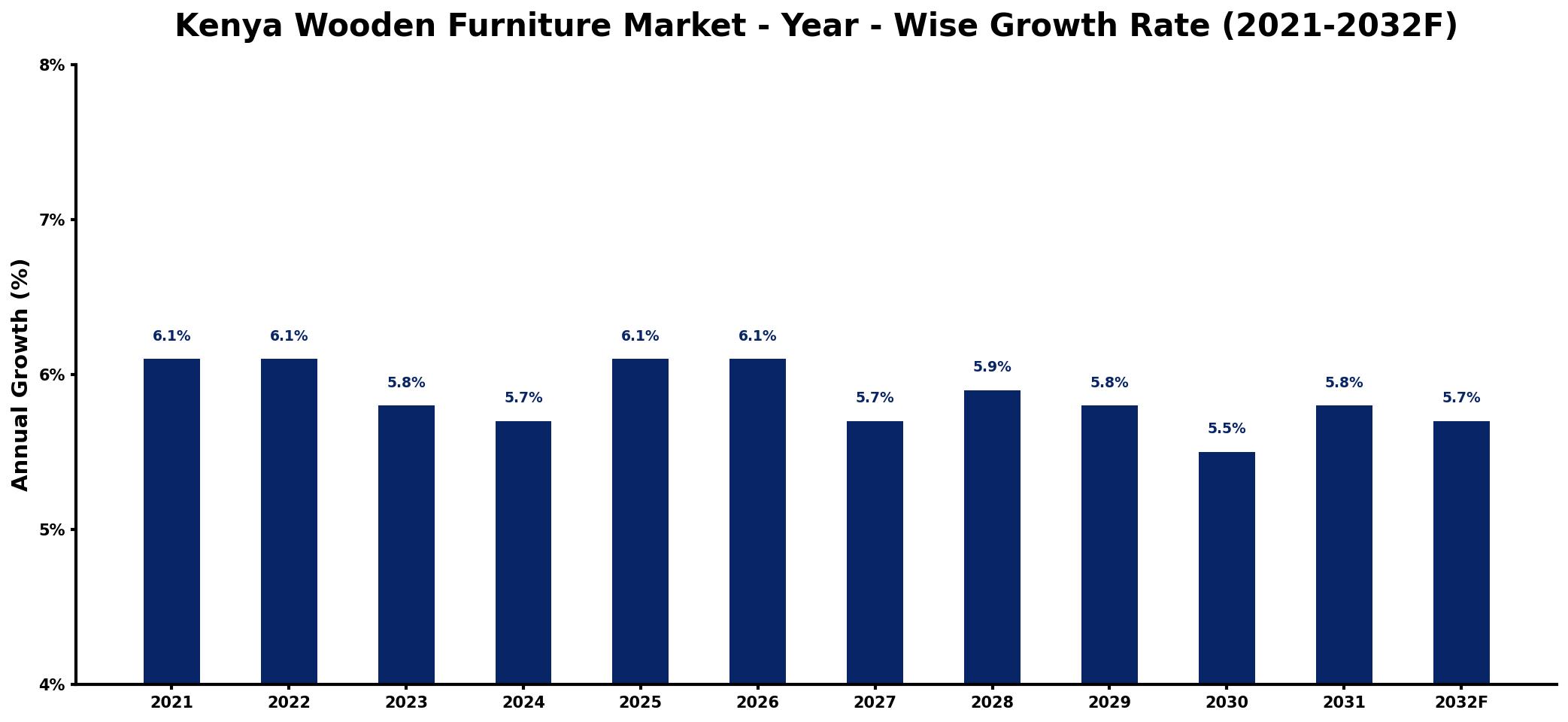
The table below presents the year‑wise growth rates along with the key drivers influencing the market
| Year | Growth Rate | Major Drivers |
| 2021 | 6.1% | Rising disposable income levels |
| 2022 | 6.1% | growing regional consumption patterns |
| 2023 | 5.8% | Growth in real estate sector |
| 2024 | 5.7% | Expansion of e-commerce platforms |
| 2025 | 6.1% | Boost in tourism activities |
| 2026 | 6.1% | Surge in renewable resource investments |
| 2027 | 5.7% | Growing interest in sustainability |
| 2028 | 5.9% | Increase in home renovation projects |
| 2029 | 5.8% | Demand for custom design solutions |
| 2030 | 5.5% | Strengthening local manufacturing capabilities |
| 2031 | 5.8% | Rise in expatriate population |
| 2032 | 5.7% | rising demand from electronics |
Note: Market size estimations and growth projections presented in this report are based on 6Wresearch's proprietary forecasting methodology, utilizing the latest available industry data, government publications, and primary research inputs.
Kenya Wooden Furniture Market Synopsis
In recent years, the wooden furniture market in Kenya has witnessed a remarkable evolution. Driven by changing consumer preferences, there is a noticeable shift towards aesthetically appealing and robust furniture pieces, often handcrafted from locally sourced materials. This aligns with a broader movement favoring sustainability and local craftsmanship among consumers.
Notably, the increasing disposable income among the population is enabling more households to invest in high-quality wooden furniture, further driving demand. The hospitality sector, eager to create inviting environments, contributes significantly to the sectors growth as well.
Kenya Wooden Furniture Market Key Takeaways
- The market is characterized by a dynamic blend of local craftsmanship and an increasing emphasis on sustainable materials.
- Urbanization and the rise of a middle class have catalyzed a preference for durable, aesthetically pleasing furniture.
- Challenges such as high production costs and inconsistent product quality must be addressed for market competitiveness.
- Government initiatives encourage local manufacturing, enhancing the overall market landscape.
- Growth is further fueled by the expansion of the real estate and hospitality sectors.
Evaluation of Restraints in Kenya Wooden Furniture Market
Despite the promising outlook for the Kenya Wooden Furniture Market, several constraints are hampering its growth potential. One of the most significant challenges is the high production costs stemming from reliance on imported raw materials, which also contributes to fluctuating prices. Additionally, limited access to quality local timber affects the availability of suitable resources for manufacturers, thereby impacting production efficiency. Inconsistent craftsmanship standards lead to variability in product quality, diminishing consumer trust and complicating market competitiveness. Together, these factors create hurdles that necessitate strategic intervention to maintain a healthy growth trajectory.
Kenya Wooden Furniture Market Trends
Several trends are currently shaping the Kenya Wooden Furniture Market. A growing inclination towards sustainable practices is prompting both consumers and manufacturers to prioritize eco-friendly materials. Moreover, innovations in design and production techniques are emerging, enhancing the attractiveness of wooden furniture. The rise of e-commerce has also changed how consumers interact with furniture retailers, facilitating greater access to diverse products and styles. There is also an increasing incorporation of technology in production processes, leading to efficiency improvements and enhanced quality control.
Kenya Wooden Furniture Market Opportunities
The Kenya Wooden Furniture Market holds numerous growth opportunities, particularly in the realm of local manufacturing. By investing in technology and training, manufacturers can enhance craftsmanship and product quality, thus boosting consumer confidence. Additionally, focusing on the burgeoning hospitality sector offers substantial potential, as hotels and resorts seek unique, high-quality furniture to enhance their guest experiences. Furthermore, expanding into export markets could provide manufacturers with additional revenue streams, especially as global demand for sustainable and artisan-crafted furniture rises.
Government Initiatives in the Kenya Wooden Furniture Market
The Kenyan government is actively promoting the growth of the wooden furniture market through various initiatives. Policies aimed at fostering local manufacturing and craftsmanship are in place, including regulations that ensure quality and safety standards for wooden products. Additionally, the government is encouraging sustainable forestry practices, providing incentives for furniture makers who utilize certified sustainable wood. These efforts not only support the industry but also contribute to environmental conservation.
Future Insights of the Kenya Wooden Furniture Market
Looking forward to the period between 2026 and 2032, the Kenya Wooden Furniture Market is poised for significant expansion. As urbanization continues, coupled with a burgeoning middle class, demand for quality wooden furniture is expected to rise steadily. The emphasis on sustainable and local products will likely intensify, pushing manufacturers to innovate and adapt. Additionally, with the government's supportive policies, there is potential for increased investment in local production, which may enhance the overall competitiveness of the market. In this evolving landscape, stakeholders will need to remain agile, anticipating shifts in consumer preferences and market dynamics to capitalize on emerging opportunities.
Kenya Wooden Furniture Market Latest Developments (2025 - 2026)
Recently, the Kenya Wooden Furniture Market has seen a noticeable shift towards integrating technology in production, with manufacturers exploring new techniques to improve efficiency and quality. Additionally, local furniture makers have begun to participate more actively in international trade fairs, showcasing their craftsmanship and increasing brand visibility. The industry is also witnessing a growing trend of collaborations between artisans and designers, which enhances product offerings and appeals to a wider audience.
Kenya Wooden Furniture Market - Key Attractiveness of the Report
- 10 Years of Market Numbers
- Historical Data Starting from 2022 to 2025
- Base Year: 2025
- Forecast Data until 2032
- Key Performance Indicators Impacting the Market
- Major Upcoming Developments and Projects
Key Highlights of the Report:
- Kenya Wooden Furniture Market Outlook
- Market Size of Kenya Wooden Furniture Market, 2025
- Forecast of Kenya Wooden Furniture Market, 2032
- Historical Data and Forecast of Kenya Wooden Furniture Revenues & Volume for the Period 2022-2032F
- Kenya Wooden Furniture Market Trend Evolution
- Kenya Wooden Furniture Market Drivers and Challenges
- Kenya Wooden Furniture Price Trends
- Kenya Wooden Furniture Porter's Five Forces
- Kenya Wooden Furniture Industry Life Cycle
- Historical Data and Forecast of Kenya Wooden Furniture Market Revenues & Volume By Type for the Period 2022-2032F
- Historical Data and Forecast of Kenya Wooden Furniture Market Revenues & Volume By Hardwood for the Period 2022-2032F
- Historical Data and Forecast of Kenya Wooden Furniture Market Revenues & Volume By Softwood for the Period 2022-2032F
- Historical Data and Forecast of Kenya Wooden Furniture Market Revenues & Volume By Material for the Period 2022-2032F
- Historical Data and Forecast of Kenya Wooden Furniture Market Revenues & Volume By Plywood for the Period 2022-2032F
- Historical Data and Forecast of Kenya Wooden Furniture Market Revenues & Volume By Laminates for the Period 2022-2032F
- Historical Data and Forecast of Kenya Wooden Furniture Market Revenues & Volume By MDF for the Period 2022-2032F
- Historical Data and Forecast of Kenya Wooden Furniture Market Revenues & Volume By Other Materials for the Period 2022-2032F
- Historical Data and Forecast of Kenya Wooden Furniture Market Revenues & Volume By Product for the Period 2022-2032F
- Historical Data and Forecast of Kenya Wooden Furniture Market Revenues & Volume By Bedroom for the Period 2022-2032F
- Historical Data and Forecast of Kenya Wooden Furniture Market Revenues & Volume By Seating for the Period 2022-2032F
- Historical Data and Forecast of Kenya Wooden Furniture Market Revenues & Volume By Kitchen for the Period 2022-2032F
- Historical Data and Forecast of Kenya Wooden Furniture Market Revenues & Volume By Other Products for the Period 2022-2032F
- Historical Data and Forecast of Kenya Wooden Furniture Market Revenues & Volume By Application for the Period 2022-2032F
- Historical Data and Forecast of Kenya Wooden Furniture Market Revenues & Volume By Residential for the Period 2022-2032F
- Historical Data and Forecast of Kenya Wooden Furniture Market Revenues & Volume By Commercial for the Period 2022-2032F
- Historical Data and Forecast of Kenya Wooden Furniture Market Revenues & Volume By Distribution Channel for the Period 2022-2032F
- Historical Data and Forecast of Kenya Wooden Furniture Market Revenues & Volume By Offline for the Period 2022-2032F
- Historical Data and Forecast of Kenya Wooden Furniture Market Revenues & Volume By Online for the Period 2022-2032F
- Kenya Wooden Furniture Import Export Trade Statistics
- Market Opportunity Assessment By Type
- Market Opportunity Assessment By Material
- Market Opportunity Assessment By Product
- Market Opportunity Assessment By Application
- Market Opportunity Assessment By Distribution Channel
- Kenya Wooden Furniture Top Companies Market Share
- Kenya Wooden Furniture Competitive Benchmarking By Technical and Operational Parameters
- Kenya Wooden Furniture Company Profiles
- Kenya Wooden Furniture Key Strategic Recommendations






































