Kenya Wound Dressings Market Size, Share & Growth Rate
The Kenya Wound Dressings Market was estimated at USD 338 Million in 2025 and is projected to reach USD 476 Million by 2032, growing at a CAGR of 5.0% from 2026 to 2032. This growth is propelled by an increasing prevalence of chronic wounds, which are becoming more common due to lifestyle-related factors and an aging population. Furthermore, the awareness surrounding advanced wound care solutions is on the rise, leading to a more proactive approach to wound management across various healthcare settings.
Kenya Wound Dressings Market Growth Rate Analysis (2021-2032)
The Kenya wound dressings market has shown stable growth, with increases of 5.9% in 2021, followed by 6.0% in 2022, and a slight dip to 5.8% in 2023. This fluctuation can be attributed to varying consumer demand and investments in healthcare infrastructure. Looking ahead, growth is expected to rebound, reaching 6.0% in 2024 and gradually climbing to 6.2% in 2025 as advancements in medical technology and increased healthcare access in urban areas drive demand. By 2032, growth should stabilize at 5.8%, reflecting the market's adaptability and the ongoing need for effective wound management solutions amidst Kenya’s evolving healthcare landscape.
Kenya Wound Dressings Market Year-wise Growth Rate and Key Drivers
This graph highlights how the Kenya Wound Dressings Market has steadily grown over the past five years, supported by major growth factors.
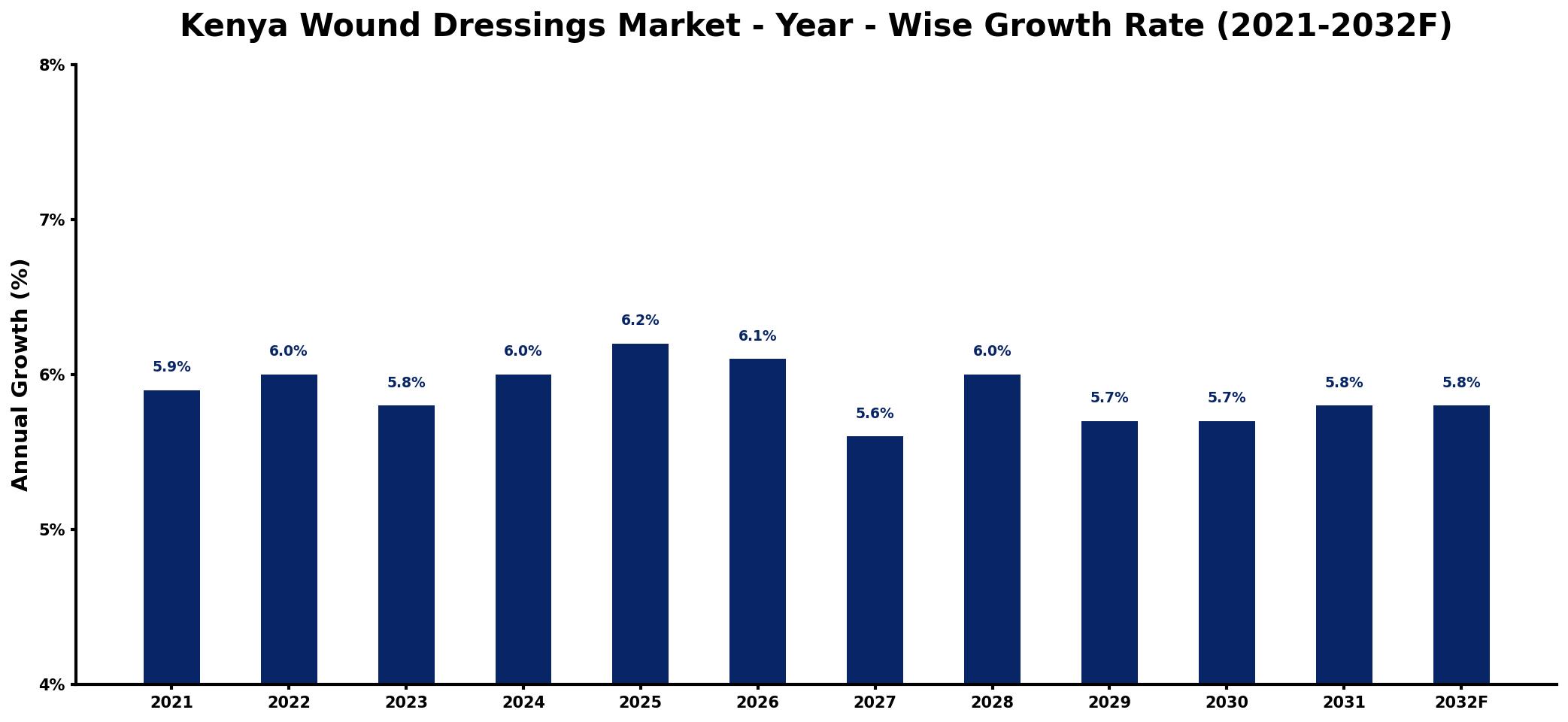
The table below presents the year‑wise growth rates along with the key drivers influencing the market
| Year | Growth Rate | Major Drivers |
| 2021 | 5.9% | Rising healthcare expenditure in hospitals |
| 2022 | 6.0% | Increased prevalence of chronic conditions |
| 2023 | 5.8% | Growth in outpatient surgical procedures |
| 2024 | 6.0% | Expansion of healthcare infrastructure projects |
| 2025 | 6.2% | Adoption of advanced medical technologies |
| 2026 | 6.1% | Surge in elderly population demographics |
| 2027 | 5.6% | Emerging market investment opportunities |
| 2028 | 6.0% | Focus on preventive healthcare initiatives |
| 2029 | 5.7% | Enhanced distribution network capabilities |
| 2030 | 5.7% | Growing awareness of infection control |
| 2031 | 5.8% | Rising demand for innovative solutions |
| 2032 | 5.8% | Increased regulatory support for healthcare |
Note: Market size estimations and growth projections presented in this report are based on 6Wresearch's proprietary forecasting methodology, utilizing the latest available industry data, government publications, and primary research inputs.
Kenya Wound Dressings Market Synopsis
The Kenya wound dressings market has recently gained momentum, reflecting a growing recognition of the importance of effective wound care. This awareness is expected to continue influencing the trajectory of the market as innovative products and technologies emerge. With the ongoing improvement of healthcare infrastructure, the future appears bright for advanced wound management solutions.
However, the market must address certain barriers to achieve its full potential. These include limited access to quality wound care products in rural areas and the need for enhanced education regarding wound management among healthcare practitioners and patients alike. Addressing these challenges will be critical for sustaining market growth.
Kenya Wound Dressings Market Key Takeaways
- The market is experiencing robust growth due to rising chronic wound incidences and an aging population.
- There is a strong shift toward advanced wound dressings that support faster healing and reduce infection risks.
- Investment in innovative materials and technologies, such as bioactive dressings, is becoming more prevalent.
- Government initiatives are playing a pivotal role in enhancing the quality of wound care products available to consumers.
- Personalized wound care solutions are emerging as key drivers of market expansion.
Evaluation of Restraints in Kenya Wound Dressings Market
Despite the positive outlook, the Kenya wound dressings market faces significant challenges that may impede growth. Limited access to advanced products in rural areas means that a substantial portion of the population may not benefit from modern wound care solutions. Furthermore, affordability remains an issue, as many high-quality dressings may be beyond the financial reach of average consumers. The scarcity of trained healthcare professionals in wound management further complicates the landscape, potentially resulting in inadequate treatment outcomes. Addressing these constraints requires a concerted effort from stakeholders to enhance healthcare infrastructure, increase awareness, and provide necessary training.
Kenya Wound Dressings Market Trends
Current trends in the Kenya wound dressings market highlight a significant shift toward advanced wound care products. Healthcare professionals and patients are increasingly recognizing the benefits of these innovative solutions that not only promote faster healing but also enhance patient comfort. The introduction of advanced materials like hydrogels and antimicrobial dressings reflects this evolving demand, as consumers seek products that minimize infection risks and ensure better healing outcomes. Additionally, there is a rising trend toward personalized wound care, where treatments are tailored to the specific needs of individual patients, further driving market growth.
Kenya Wound Dressings Market Opportunities
The Kenya wound dressings market presents numerous investment opportunities fueled by the growing demand for effective wound management solutions. Areas ripe for investment include advanced dressings with features like moisture management and antimicrobial properties that cater to diverse patient needs. The exploration of innovative technologies, such as smart dressings that monitor healing processes, could create significant growth potential. Additionally, establishing partnerships with healthcare facilities and distribution networks is essential for enhancing market penetration and improving product accessibility.
Government Initiatives in the Kenya Wound Dressings Market
The Kenyan government has implemented several initiatives aimed at improving the wound dressings market and ensuring quality standards for healthcare products. Regulatory bodies, such as the Pharmacy and Poisons Board, oversee the registration and distribution of medical devices, including wound dressings, to ensure their safety and efficacy. Additionally, public health campaigns are in place to educate healthcare providers and patients on the importance of proper wound management, fostering a culture of quality care across the nation.
Future Insights of the Kenya Wound Dressings Market
Looking ahead to 2026-2032, the Kenya wound dressings market is set for continued growth, driven by an increasing geriatric population and a rise in chronic wound cases. The ongoing improvements in healthcare infrastructure will further bolster the demand for advanced wound dressings. As patients and healthcare providers become more aware of the benefits associated with early wound treatment, the market is likely to see heightened interest in diverse and effective wound care solutions. Nevertheless, addressing affordability and access in remote areas remains critical to unlocking the full potential of this market.
Kenya Wound Dressings Market Latest Developments (2025 - 2026)
In recent months, the Kenya wound dressings market has witnessed several developments aimed at improving product offerings and expanding distribution channels. Companies are increasingly focusing on enhancing the efficiency of their supply chains to ensure that advanced wound care products reach a wider audience, particularly in rural regions. Moreover, new initiatives have been launched to promote training for healthcare professionals in effective wound management practices, which is expected to improve patient outcomes significantly. Collaborative projects with healthcare facilities are also being established to further enhance the accessibility and quality of wound care products available.
Kenya Wound Dressings Market - Key Attractiveness of the Report
- 10 Years of Market Numbers
- Historical Data Starting from 2022 to 2025
- Base Year: 2025
- Forecast Data until 2032
- Key Performance Indicators Impacting the Market
- Major Upcoming Developments and Projects
Key Highlights of the Report:
- Kenya Wound Dressings Market Outlook
- Market Size of Kenya Wound Dressings Market, 2025
- Forecast of Kenya Wound Dressings Market, 2032
- Historical Data and Forecast of Kenya Wound Dressings Revenues & Volume for the Period 2022-2032F
- Kenya Wound Dressings Market Trend Evolution
- Kenya Wound Dressings Market Drivers and Challenges
- Kenya Wound Dressings Price Trends
- Kenya Wound Dressings Porter's Five Forces
- Kenya Wound Dressings Industry Life Cycle
- Historical Data and Forecast of Kenya Wound Dressings Market Revenues & Volume By Type for the Period 2022-2032F
- Historical Data and Forecast of Kenya Wound Dressings Market Revenues & Volume By Advanced Wound Dressings for the Period 2022-2032F
- Historical Data and Forecast of Kenya Wound Dressings Market Revenues & Volume By Traditional Wound Dressings for the Period 2022-2032F
- Historical Data and Forecast of Kenya Wound Dressings Market Revenues & Volume By Wound Type for the Period 2022-2032F
- Historical Data and Forecast of Kenya Wound Dressings Market Revenues & Volume By Surgical and Traumatic Wounds for the Period 2022-2032F
- Historical Data and Forecast of Kenya Wound Dressings Market Revenues & Volume By Diabetic Foot Ulcers for the Period 2022-2032F
- Historical Data and Forecast of Kenya Wound Dressings Market Revenues & Volume By Pressure Ulcers for the Period 2022-2032F
- Historical Data and Forecast of Kenya Wound Dressings Market Revenues & Volume By Venous Leg Ulcers for the Period 2022-2032F
- Historical Data and Forecast of Kenya Wound Dressings Market Revenues & Volume By Burns and Other Wounds for the Period 2022-2032F
- Historical Data and Forecast of Kenya Wound Dressings Market Revenues & Volume By End User for the Period 2022-2032F
- Historical Data and Forecast of Kenya Wound Dressings Market Revenues & Volume By Hospitals, ASCs, and Clinics for the Period 2022-2032F
- Historical Data and Forecast of Kenya Wound Dressings Market Revenues & Volume By Home Care Settings for the Period 2022-2032F
- Historical Data and Forecast of Kenya Wound Dressings Market Revenues & Volume By Other End Users for the Period 2022-2032F
- Kenya Wound Dressings Import Export Trade Statistics
- Market Opportunity Assessment By Type
- Market Opportunity Assessment By Wound Type
- Market Opportunity Assessment By End User
- Kenya Wound Dressings Top Companies Market Share
- Kenya Wound Dressings Competitive Benchmarking By Technical and Operational Parameters
- Kenya Wound Dressings Company Profiles
- Kenya Wound Dressings Key Strategic Recommendations






































