Kuwait AI in IoT Market Size & Growth Rate (2026-2032)
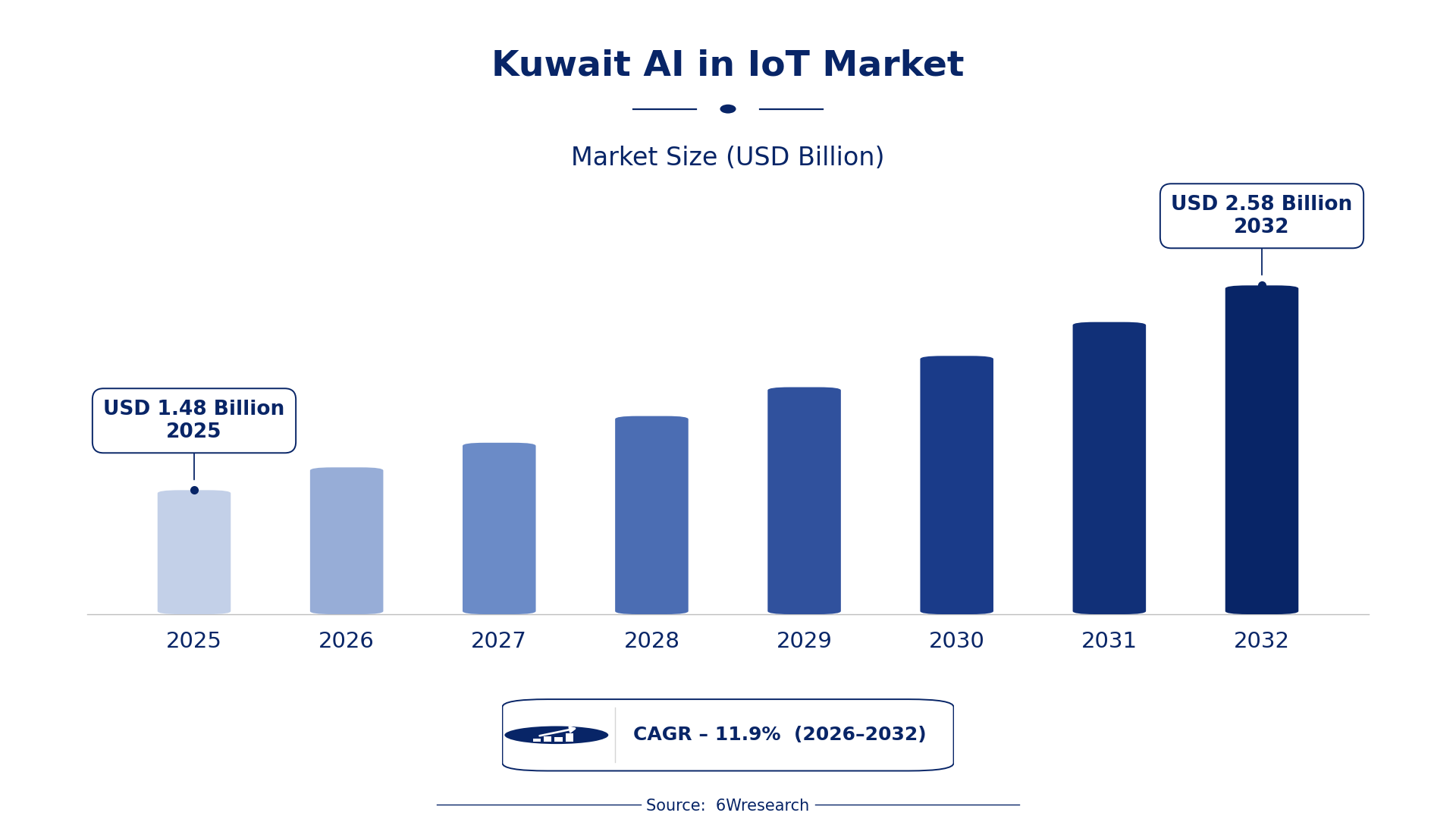
The Kuwait AI in IoT Market was estimated at USD 1479 Million in 2025 and is projected to reach USD 2577 Million by 2032, growing at a CAGR of 11.9% from 2026 to 2032.
Kuwait AI in IoT Market Synopsis
The Kuwait AI in IoT market is on an upward trajectory, propelled by the rapid integration of AI technologies within IoT applications across various sectors. This momentum is set against a backdrop of increasing digital transformation initiatives in the country, paving the way for a more interconnected and intelligent infrastructure.
As industries in Kuwait, such as healthcare, manufacturing, and transportation, embrace smart technologies, the demand for AI-driven IoT solutions is intensifying. This convergence not only enhances operational efficiencies but also addresses critical challenges through predictive maintenance and advanced analytics.
Kuwait AI in IoT Market Year-wise Growth Rate and Key Drivers
This graph illustrates the annual growth rates of the Kuwait AI in IoT Market from 2021 to 2032, highlighting a steady upward trajectory and projected expansion over the forecast period.
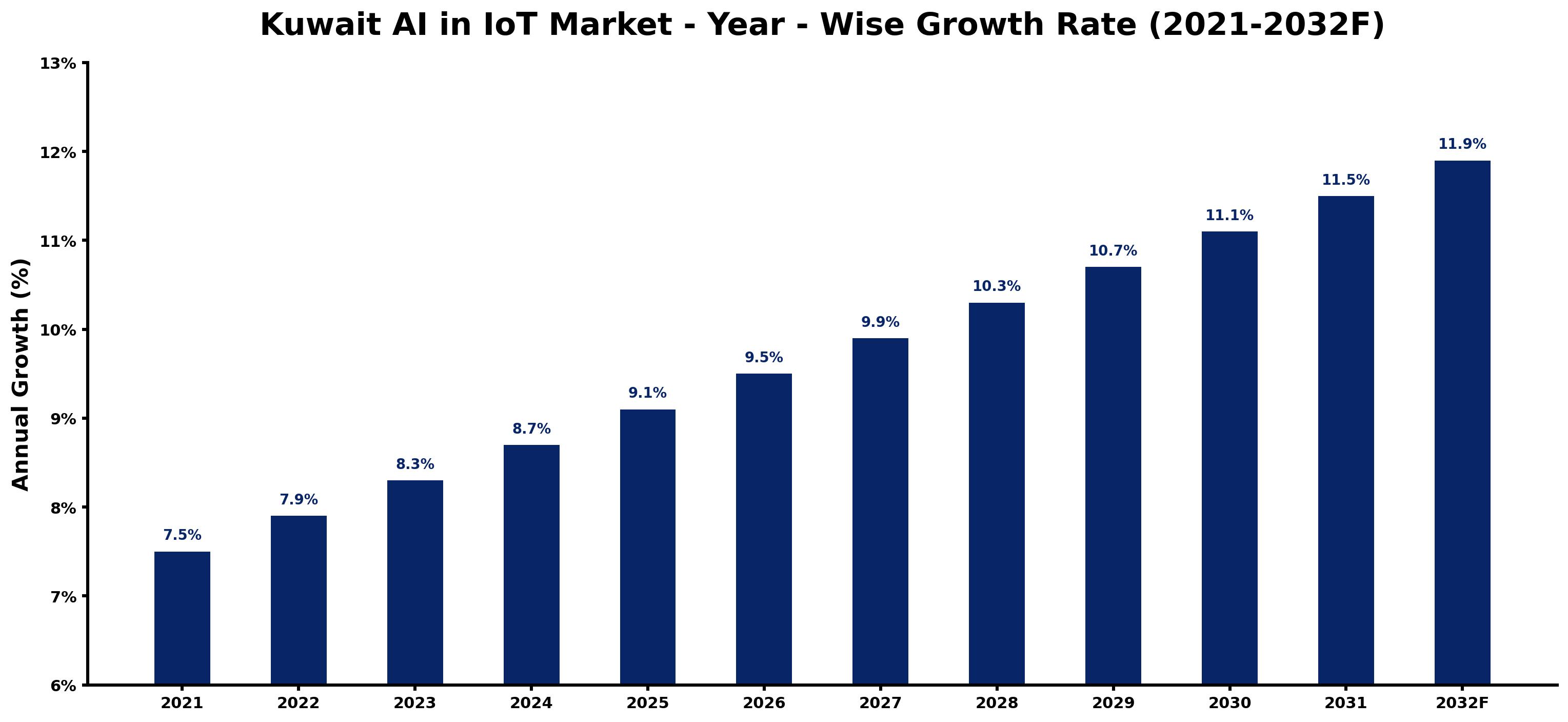
The table below presents the year‑wise growth rates along with the key drivers influencing the market
| Year | Growth Rate | Major Drivers |
| 2021 | 7.5% | Kuwait’s Vision 2035 promotes smart technology adoption. |
| 2022 | 7.9% | Public sector IoT initiatives drive data management efficiencies. |
| 2023 | 8.3% | Increased demand for smart home solutions among citizens. |
| 2024 | 8.7% | Government investment in AI research upgrades infrastructure capabilities. |
| 2025 | 9.1% | Collaboration with private sectors enhances IoT innovation. |
| 2026 | 9.5% | Growing interest in health-tech IoT applications supports adoption. |
| 2027 | 9.9% | Kuwait's tech-savvy youth boosts IoT product demand. |
| 2028 | 10.3% | Economic diversification strategies support tech industry growth. |
| 2029 | 10.7% | Local startups innovating AI solutions attracting global investors. |
| 2030 | 11.1% | Regulatory frameworks encourage AI integration in industries. |
| 2031 | 11.5% | Rise in IoT-enabled agricultural practices throughout Kuwait. |
| 2032 | 11.9% | Smart city projects enhance IoT infrastructure developments. |
Note: Market size estimations and growth projections presented in this report are based on 6Wresearch's proprietary forecasting methodology, utilizing the latest available industry data, government publications, and primary research inputs.
Kuwait AI in IoT Market Key Takeaways
Below are some of the specific key takeaways from the market, including:
- The market is projected to grow from USD 1479 Million in 2025 to USD 2577 Million by 2032.
- Healthcare and manufacturing are leading sectors in adopting AI and IoT technologies.
- Government initiatives are crucial in fostering digital transformation and smart city projects.
- Data security remains a primary concern impacting the adoption of AI in IoT solutions.
- Collaboration between local and international firms is enhancing innovation within the market.
Evaluation of Restraints in Kuwait AI in IoT Market
The growth of the Kuwait AI in IoT market faces notable restraints, particularly in data security. As IoT devices proliferate, the sensitivity of data they handle raises concerns among businesses and consumers alike. on top of that, the lack of standardized regulations can lead to confusion and inconsistency in implementation. Limited awareness and understanding of the technology also hampers widespread adoption, compounded by a shortage of skilled professionals in the field. High initial investment costs deter many potential adopters, as traditional methods often remain entrenched in various industries, further slowing the transition to AI and IoT solutions.
Kuwait AI in IoT Market Trends
Several trends are shaping the future of the Kuwait AI in IoT market. One prominent trend is the integration of AI algorithms with IoT devices, enhancing data processing and analysis capabilities. This integration is driving improved decision-making across sectors. Another trend is the increasing focus on automation, particularly in manufacturing and logistics, where AI-powered IoT solutions are streamlining operations. The push towards smart cities is also notable, as urban planning increasingly relies on data analytics to enhance service delivery and infrastructure management.
Kuwait AI in IoT Market Opportunities
Opportunities abound in the Kuwait AI in IoT market, especially within sectors like healthcare, energy, and transportation. The development of tailored AI-powered IoT solutions can address specific challenges in these industries, such as improving patient care, optimizing energy usage, and enhancing traffic management. on top of that, the government's commitment to digital transformation initiatives opens avenues for public-private partnerships, fostering innovation and investment. As local businesses recognize the benefits of AI integration, demand for customized solutions is expected to rise significantly.
Government Initiatives in the Kuwait AI in IoT Market
The Kuwaiti government is actively shaping the AI and IoT landscape through various strategic initiatives aimed at fostering technological advancement. By emphasizing digital transformation and smart city projects, the government is creating a conducive environment for innovation. Public policy plays a critical role in establishing regulatory frameworks and providing funding for research and development, which are essential for the market's growth.
- A national digital infrastructure upgrade programme launched recently aims to enhance connectivity and data management capabilities.
- Current efforts include an ongoing initiative to establish a regulatory framework for IoT devices, ensuring compliance and security standards.
- Upcoming plans feature a public-private partnership focused on developing AI training programmes to bridge the skills gap in the workforce.
- The National Innovation Strategy, introduced last year, allocates resources for supporting emerging technologies like AI and IoT.
- Collaborative agreements with international tech companies are currently underway to facilitate technology transfer and knowledge sharing.
Future Insights of the Kuwait AI in IoT Market
Looking ahead to 2026-2032, the Kuwait AI in IoT market is expected to thrive as digital transformation continues to gain momentum. Increased adoption of IoT devices across multiple sectors will drive demand for AI solutions capable of analyzing vast data sets. Kuwait's strategic location and emphasis on technological innovation will create fertile ground for vendors looking to expand. With government support and a growing recognition of the benefits of AI and IoT, the market is set for significant developments that will enhance operational efficiencies and service delivery.
Kuwait AI in IoT Market Latest Developments
Recent activity in the Kuwait AI in IoT market indicates a proactive approach by both government and industry stakeholders to enhance technological capabilities. Over the past year, several key developments have emerged, reflecting a commitment to innovation and modernization within the sector.
- A major technology vendor announced the rollout of a new AI-driven IoT platform aimed at streamlining operations in manufacturing, launched in Q2 2025.
- A collaborative project between local universities and tech companies, initiated in early 2025, focuses on developing advanced analytics solutions for healthcare applications.
- A pilot program for smart transportation solutions is currently underway, testing AI integration in traffic management systems, expected to conclude by late 2025.
- Plans for an IoT innovation hub are set to kick off in mid-2026, aiming to foster startups and facilitate collaboration among businesses.
- A newly formed public-private initiative, expected to launch in early 2026, will focus on enhancing cybersecurity measures for IoT devices across sectors.
Kuwait AI in IoT Market - Key Attractiveness of the Report
- 10 Years of Market Numbers
- Historical Data Starting from 2022 to 2025
- Base Year: 2025
- Forecast Data until 2032
- Key Performance Indicators Impacting the Market
- Major Upcoming Developments and Projects
Key Highlights of the Report:
- Kuwait AI in IoT Market Outlook
- Market Size of Kuwait AI in IoT Market, 2025
- Forecast of Kuwait AI in IoT Market, 2032
- Historical Data and Forecast of Kuwait AI in IoT Revenues & Volume for the Period 2022-2032F
- Kuwait AI in IoT Market Trend Evolution
- Kuwait AI in IoT Market Drivers and Challenges
- Kuwait AI in IoT Price Trends
- Kuwait AI in IoT Porter's Five Forces
- Kuwait AI in IoT Industry Life Cycle
- Historical Data and Forecast of Kuwait AI in IoT Market Revenues & Volume By Component for the Period 2022-2032F
- Historical Data and Forecast of Kuwait AI in IoT Market Revenues & Volume By Platforms for the Period 2022-2032F
- Historical Data and Forecast of Kuwait AI in IoT Market Revenues & Volume By Software Solutions for the Period 2022-2032F
- Historical Data and Forecast of Kuwait AI in IoT Market Revenues & Volume By Services for the Period 2022-2032F
- Historical Data and Forecast of Kuwait AI in IoT Market Revenues & Volume By Vertical for the Period 2022-2032F
- Historical Data and Forecast of Kuwait AI in IoT Market Revenues & Volume By Manufacturing for the Period 2022-2032F
- Historical Data and Forecast of Kuwait AI in IoT Market Revenues & Volume By Energy and Utilities for the Period 2022-2032F
- Historical Data and Forecast of Kuwait AI in IoT Market Revenues & Volume By Transportation and Mobility for the Period 2022-2032F
- Historical Data and Forecast of Kuwait AI in IoT Market Revenues & Volume By BFSI for the Period 2022-2032F
- Historical Data and Forecast of Kuwait AI in IoT Market Revenues & Volume By Government and Defense for the Period 2022-2032F
- Historical Data and Forecast of Kuwait AI in IoT Market Revenues & Volume By Retail for the Period 2022-2032F
- Historical Data and Forecast of Kuwait AI in IoT Market Revenues & Volume By Healthcare and Life Sciences for the Period 2022-2032F
- Historical Data and Forecast of Kuwait AI in IoT Market Revenues & Volume By Telecom for the Period 2022-2032F
- Historical Data and Forecast of Kuwait AI in IoT Market Revenues & Volume By Technology for the Period 2022-2032F
- Historical Data and Forecast of Kuwait AI in IoT Market Revenues & Volume By ML and Deep Learning for the Period 2022-2032F
- Historical Data and Forecast of Kuwait AI in IoT Market Revenues & Volume By NLP for the Period 2022-2032F
- Kuwait AI in IoT Import Export Trade Statistics
- Market Opportunity Assessment By Component
- Market Opportunity Assessment By Vertical
- Market Opportunity Assessment By Technology
- Kuwait AI in IoT Top Companies Market Share
- Kuwait AI in IoT Competitive Benchmarking By Technical and Operational Parameters
- Kuwait AI in IoT Company Profiles
- Kuwait AI in IoT Key Strategic Recommendations






































