Kuwait Brandy Market Summary
The kuwait brandy market was estimated at USD 539 Million in 2025 and is projected to reach USD 1019 Million by 2032, growing at a CAGR of 11.0% from 2026 to 2032.
Kuwait Brandy Market Year-wise Growth Rate and Key Drivers
This graph highlights how the Kuwait Brandy Market has steadily grown over the past five years, supported by major growth factors.
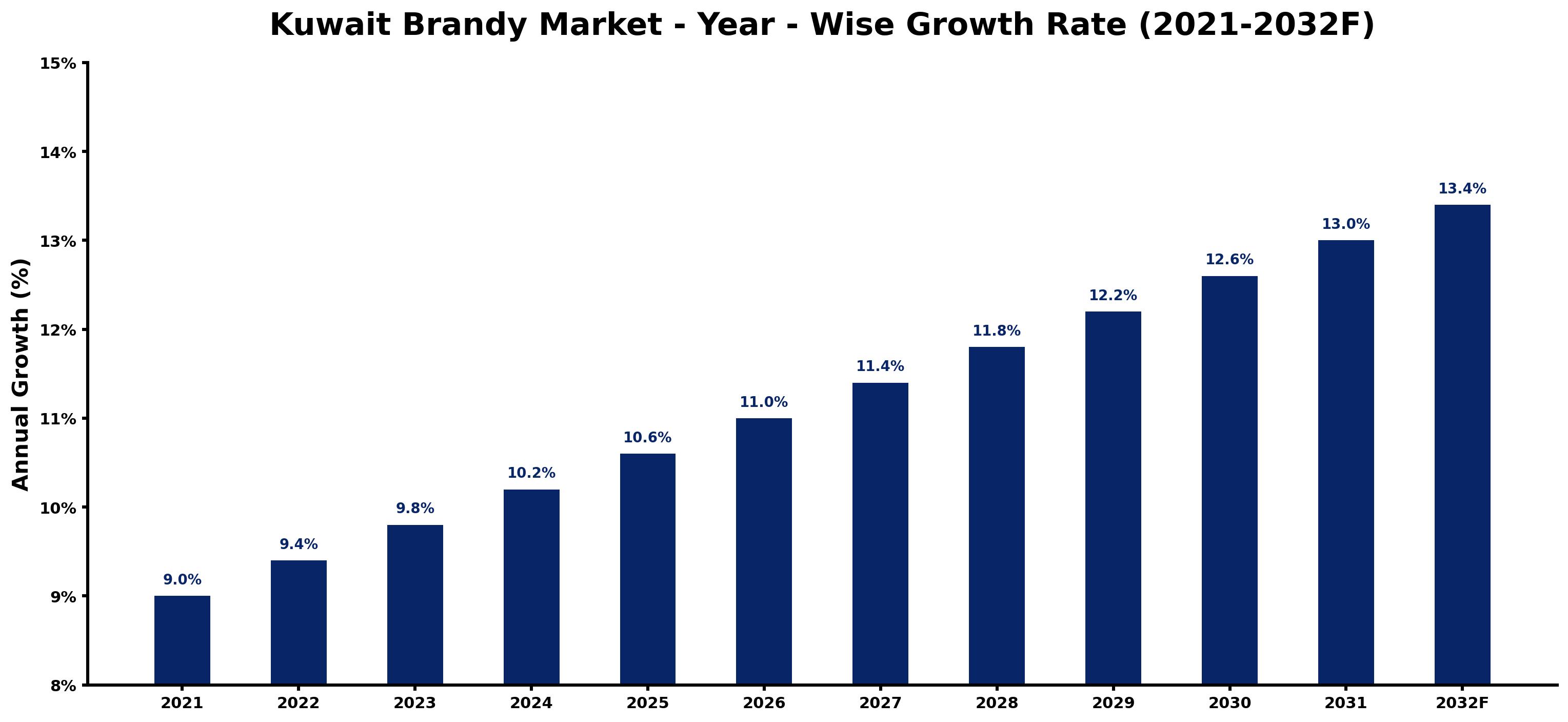
The table below presents the year wise growth rates along with the key drivers influencing the market
| Year | Growth Rate | Major Drivers |
| 2021 | 9.0% | Tourism rebounds slowly, bringing more international brands to local markets. |
| 2022 | 9.4% | Cultural shifts in social gatherings increase brandy consumption at events. |
| 2023 | 9.8% | Local producers focus on premium branding to attract discerning consumers. |
| 2024 | 10.2% | Increased availability in supermarkets enhances accessibility for brandy enthusiasts. |
| 2025 | 10.6% | Young adults influence market preferences, favoring unique flavor profiles. |
| 2026 | 11.0% | Growing interest in mixology prompts more cocktail-focused brandy products. |
| 2027 | 11.4% | Corporate gifting trends highlight brandy as a symbol of sophistication. |
| 2028 | 11.8% | Emerging artisanal distilleries challenge traditional brands with innovative offerings. |
| 2029 | 12.2% | Regional collaborations boost brand visibility across the GCC market. |
| 2030 | 12.6% | Sustainability trends in production resonate with conscious consumer behavior. |
| 2031 | 13.0% | Luxury experiences in bars elevate brandy as a premium choice. |
| 2032 | 13.4% | E-commerce platforms expand, making brandy accessible to a broader audience. |
Note - Market size estimations and growth projections presented in this report are based on 6Wresearch's advanced forecasting approach, validated with industry datasets as of June 2026.
Kuwait Brandy Market Synopsis
The Kuwait Brandy Market is projected to reach 11.0% and witness significant growth during the forecast period (2026-2032). This niche segment of the alcohol industry is characterized by a burgeoning demand for premium branded spirits, propelled by shifts in consumer preferences and increasing levels of disposable income among affluent individuals. Despite the challenges posed by cultural restrictions, the market's evolution reflects a growing inclination toward sophisticated drinking experiences and luxury products.
Kuwait Brandy Market Growth Drivers
Several factors influence the growth trajectory of the Kuwait Brandy Market. Firstly, there is an observable rise in the number of affluent consumers seeking quality brandy options that align with their lifestyle. Secondly, the societal shift towards Western drinking culture creates avenues for expanding brandy consumption among younger demographics. Additionally, the increasing interest in fine dining and upscale social gatherings contributes to a heightened appreciation for premium spirits.
- The emergence of craft and artisanal brandies is attracting discerning consumers who value unique flavor profiles and small-batch production methods.
- A growing trend toward brandy cocktails and mixology is stimulating demand, as consumers seek versatile products suitable for various drinking occasions.
- Strategies integrating local ingredients and traditional production methods resonate well with consumers, adding an authentic touch to brandy offerings.
- Collaborations with high-end bars and restaurants enhance brand visibility and encourage experimentation with brandy-based cocktails.
- Promotional efforts targeting excluded markets, such as expatriates and tourists, are crucial to gaining traction in a highly regulated environment.
Kuwait Brandy Market Trends and Opportunities
The Kuwait Brandy Market is undergoing a notable transformation, with emerging trends that signify opportunities for growth. Consumers are increasingly drawn to aged and limited-edition brandies that offer exclusivity and refinement. This trend amplifies competition among brands striving to introduce unique product offerings tailored to local tastes.
- There is a marked shift towards premium quality and luxurious experiences, reflecting a broader global trend favoring high-end alcoholic beverages.
- Brandy producers are capitalizing on the rising popularity of gourmet cocktails, adapting their products to be seen as essential components in innovative drink recipes.
- The rise in luxury lifestyle branding encourages companies to position their products as part of an aspirational lifestyle, appealing to wealthy consumers.
- Increased focus on sustainability and ethically sourced ingredients may create opportunities for brands that align with these consumer values.
- The digital transformation of marketing presents a unique channel to reach target audiences, leveraging social media platforms to build brand awareness and loyalty.
Kuwait Brandy Market Challenges and Restraints
While there are substantial growth opportunities within the Kuwait Brandy Market, numerous challenges impede its expansion. The primary barrier stems from the stringent regulations surrounding alcohol consumption in Kuwait, deeply rooted in cultural and religious norms.
- The legal restrictions on alcohol sales significantly limit potential consumer outreach, with licensed sales primarily confined to certain establishments catering to expatriates.
- Marketing and advertising limitations hinder brand visibility and growth, particularly for innovative marketing campaigns aimed at local consumers.
- The taboo surrounding alcohol consumption can lead to a social stigma, further impacting brand acceptance and consumer willingness to purchase.
- Logistical challenges related to distribution and supply chain management may restrict the availability of premium brandy products in various locales within Kuwait.
- Increasing competition from alternative luxury beverages, such as high-end wines and spirits, requires brands to differentiate themselves to attract discerning consumers.
Kuwait Brandy Market Government Investment and Initiatives
Government policies play a pivotal role in shaping the dynamics of the Kuwait Brandy Market. The stringent regulations governing alcohol sales and consumption reflect the cultural values that dominate the country. Importation and production of alcoholic products are strictly controlled, with limited licenses granted to certain establishments. This regulation consequently presents barriers to entry for new brands seeking market presence.
- The Kuwaiti government maintains a strict enforcement of laws regarding alcohol consumption, complicating marketing strategies and limiting outreach.
- While the main population adheres to Islamic law prohibiting alcohol, the presence of non-Muslim expatriates creates a niche market that can be targeted effectively.
- Public investments in tourism and hospitality sectors could indirectly boost the brandy market by fostering environments where alcohol consumption is accepted.
- The government's focus on diversifying the economy may lead to future discussions about relaxing regulations related to alcohol, fostering further market exploration.
- Support for rural and small-scale producers of luxury goods, including spirits, could provide new avenues for market penetration and product innovation.
Kuwait Brandy Market Latest Developments (May 2025 - June 2026)
Recent developments in the Kuwait Brandy Market underscore a shift toward diversification and premiumization. Between May 2025 and June 2026, industry stakeholders have increasingly focused on creating brandy products that resonate with the palates of affluent consumers. There has been an uptick in promotional efforts aimed at expatriates and tourists, leveraging social occasions to encourage brandy consumption.
- Branding strategies have evolved to emphasize luxury and exclusivity, with a focus on creating unique marketing campaigns that appeal to upscale dining experiences.
- Industry collaborations with local distributors have improved brand visibility, enabling better market penetration in licensed establishments.
- Emerging trends in mixology have resulted in brands innovating on traditional recipes, making brandy a key ingredient in a new wave of cocktails.
- Efforts to educate consumers about the intricacies of brandy, including its production and flavor profiles, have gained traction among luxury spirits retailers.
- The market is witnessing the launch of new products that incorporate unique flavor infusions, catering to the evolving tastes of discerning consumers.
Kuwait Brandy Market - Key Attractiveness of the Report
- 10 Years of Market Numbers
- Historical Data Starting from 2022 to 2025
- Base Year: 2025
- Forecast Data until 2032
- Key Performance Indicators Impacting the Market
- Major Upcoming Developments and Projects
Key Highlights of the Report:
- Kuwait Brandy Market Outlook
- Market Size of Kuwait Brandy Market, 2025
- Forecast of Kuwait Brandy Market, 2032F
- Historical Data and Forecast of Kuwait Brandy Revenues & Volume for the Period 2022-2032F
- Kuwait Brandy Market Trend Evolution
- Kuwait Brandy Market Drivers and Challenges
- Kuwait Brandy Price Trends
- Kuwait Brandy Porter's Five Forces
- Kuwait Brandy Industry Life Cycle
- Historical Data and Forecast of Kuwait Brandy Market Revenues & Volume By Type for the Period 2022-2032F
- Historical Data and Forecast of Kuwait Brandy Market Revenues & Volume By V.S. ("very special") for the Period 2022-2032F
- Historical Data and Forecast of Kuwait Brandy Market Revenues & Volume By V.S.O.P. ("very superior old pale") for the Period 2022-2032F
- Historical Data and Forecast of Kuwait Brandy Market Revenues & Volume By XO ("extra old") for the Period 2022-2032F
- Historical Data and Forecast of Kuwait Brandy Market Revenues & Volume By Hors d'age ("beyond age") for the Period 2022-2032F
- Historical Data and Forecast of Kuwait Brandy Market Revenues & Volume By Applications for the Period 2022-2032F
- Historical Data and Forecast of Kuwait Brandy Market Revenues & Volume By Shop & Supermarket for the Period 2022-2032F
- Historical Data and Forecast of Kuwait Brandy Market Revenues & Volume By Restaurant & Bar & Club for the Period 2022-2032F
- Historical Data and Forecast of Kuwait Brandy Market Revenues & Volume By Exclusive Store for the Period 2022-2032F
- Historical Data and Forecast of Kuwait Brandy Market Revenues & Volume By Others for the Period 2022-2032F
- Kuwait Brandy Import Export Trade Statistics
- Market Opportunity Assessment By Type
- Market Opportunity Assessment By Applications
- Kuwait Brandy Top Companies Market Share
- Kuwait Brandy Competitive Benchmarking By Technical and Operational Parameters
- Kuwait Brandy Company Profiles
- Kuwait Brandy Key Strategic Recommendations






































