Kuwait Educational Toys Market Size, Share & Growth Rate
The Kuwait Educational Toys Market was estimated at USD 970 Million in 2025 and is projected to reach USD 1653 Million by 2032, growing at a CAGR of 7.9% from 2026 to 2032. This remarkable trajectory is fueled by an escalating awareness among Kuwaiti parents about the significance of early childhood development. Furthermore, the increasing inclination towards STEM education and the demand for interactive, engaging learning experiences are driving the markets expansion.
Kuwait Educational Toys Market Year-wise Growth Rate and Key Drivers
This graph highlights how the Kuwait Educational Toys Market has steadily grown over the years, supported by major growth factors.
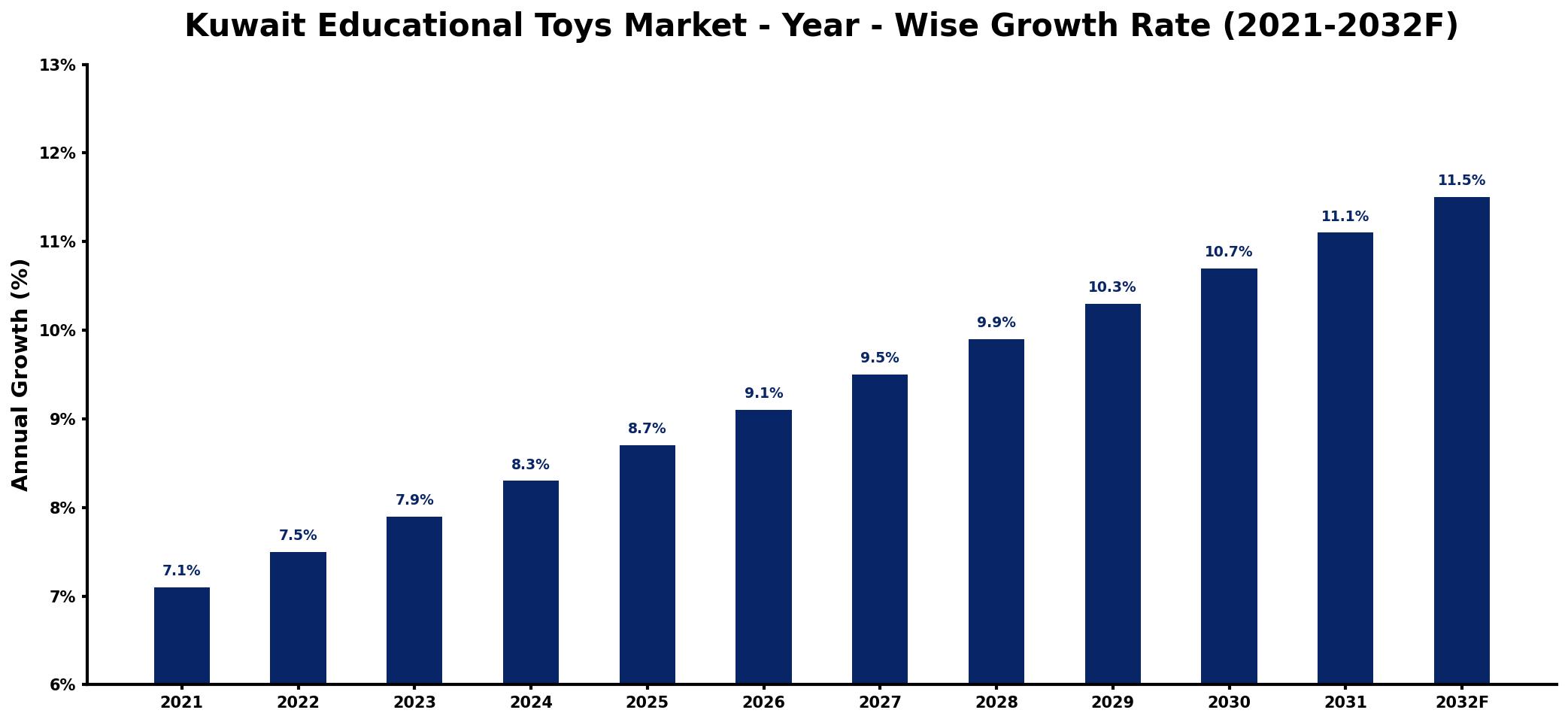
The table below presents the year‑wise growth rates along with the key drivers influencing the market
| Year | Growth Rate | Major Drivers |
| 2021 | 7.1% | Rise in parental spending habits |
| 2022 | 7.5% | Increased awareness of learning |
| 2023 | 7.9% | Growing demand for interactive experiences |
| 2024 | 8.3% | Expansion of online retail platforms |
| 2025 | 8.7% | Emergence of innovative product designs |
| 2026 | 9.1% | Investment in child development programs |
| 2027 | 9.5% | Focus on sustainability and eco-friendliness |
| 2028 | 9.9% | enhanced product quality standards |
| 2029 | 10.3% | Increased collaboration with schools |
| 2030 | 10.7% | Boost in global sourcing strategies |
| 2031 | 11.1% | Enhancement of customer engagement strategies |
| 2032 | 11.5% | increased pharmaceutical industry usage |
Note: Market size estimations and growth projections presented in this report are based on 6Wresearch's proprietary forecasting methodology, utilizing the latest available industry data, government publications, and primary research inputs.
Kuwait Educational Toys Market Synopsis
The strongest force currently shaping the Kuwait Educational Toys Market is the heightened awareness among parents regarding the role of educational toys in fostering developmental skills. As parents prioritize cognitive development, toys that enhance problem-solving, creativity, and analytical thinking have seen a surge in popularity.
In addition to parental awareness, the market is influenced by a growing preference for toys that incorporate elements of cultural and religious education. This trend aims to connect children with their heritage while promoting a comprehensive learning experience that aligns with both modern educational practices and local values.
Kuwait Educational Toys Market Key Takeaways
- The educational toys market in Kuwait is witnessing substantial growth, driven by parental investment in quality education.
- STEM-based toys are increasingly favored as they align with educational trends and foster critical thinking.
- Online platforms are reshaping the distribution landscape, enhancing accessibility for consumers.
- Government initiatives are aimed at bolstering local production and ensuring compliance with safety standards.
- Investors have opportunities to introduce culturally relevant and technologically innovative educational toys.
Evaluation of Restraints in Kuwait Educational Toys Market
Despite the promising growth trajectory, the Kuwait Educational Toys Market faces several constraints. A notable challenge lies in the limited awareness among parents regarding the long-term benefits of educational toys, which can hinder demand. Additionally, the availability of high-quality products tailored to the specific cultural and educational needs of Kuwaiti children remains a significant concern. Import regulations also complicate market dynamics, potentially restricting the variety and innovation of educational toys in the region. As the market navigates these hurdles, effective marketing strategies and partnerships with educational institutions will be essential to fostering growth.
Kuwait Educational Toys Market Trends
The current trends in the Kuwait Educational Toys Market indicate a strong inclination towards products that blend learning with fun. Parents are actively seeking interactive, hands-on toys that nurture creativity and logic. Moreover, there is an emerging interest in educational toys that reflect the cultural values and heritage of Kuwait, creating a unique niche in the market. The shift towards online shopping is also reshaping consumer behavior, enabling parents to access a broader spectrum of educational toys than ever before.
Kuwait Educational Toys Market Opportunities
The Kuwait Educational Toys Market presents numerous avenues for growth and investment. With a burgeoning population of young families coupled with rising disposable incomes, there is a substantial demand for innovative toys that engage children in meaningful learning experiences. Investors can capitalize on this trend by introducing educational toys that are not only aligned with global educational standards but also resonate with local customs and beliefs. Additionally, collaborating with educational institutions could create pathways to enhance product visibility and acceptance among parents.
Government Initiatives in the Kuwait Educational Toys Market
The Kuwaiti government has put forth several initiatives to regulate and promote the educational toys market. Policies are focused on enhancing the quality of educational toys, particularly those that support STEM learning outcomes. Furthermore, there are measures to encourage domestic production and support small businesses within this sector. The government also prioritizes safety regulations to ensure that educational toys meet international standards, ultimately aiming to foster innovation while protecting children's developmental needs.
Future Insights of the Kuwait Educational Toys Market
Looking ahead to 2026-2032, the Kuwait Educational Toys Market is set for continued expansion. This growth will be driven by an ongoing emphasis on early childhood education and the increasing willingness of families to invest in high-quality educational products. As digital shopping platforms gain traction, market players will have the opportunity to diversify their offerings and reach a broader audience. The convergence of technology with traditional learning methods will likely shape new product developments, positioning the market for innovation and increased consumer engagement.
Kuwait Educational Toys Market Latest Developments (2025 - 2026)
Recent developments in the Kuwait Educational Toys Market indicate a shift towards enhanced product offerings, with many brands focusing on integrating technology to create more interactive learning experiences. Additionally, there has been a marked increase in partnerships between toy manufacturers and educational institutions, aimed at ensuring that toys meet curricular requirements. This strategic collaboration is paving the way for the introduction of culturally tailored educational toys that resonate with local values while promoting effective learning methodologies.
Kuwait Educational Toys Market - Key Attractiveness of the Report
- 10 Years of Market Numbers
- Historical Data Starting from 2022 to 2025
- Base Year: 2025
- Forecast Data until 2032
- Key Performance Indicators Impacting the Market
- Major Upcoming Developments and Projects
Key Highlights of the Report:
- Kuwait Educational Toys Market Outlook
- Market Size of Kuwait Educational Toys Market, 2025
- Forecast of Kuwait Educational Toys Market, 2032
- Historical Data and Forecast of Kuwait Educational Toys Revenues & Volume for the Period 2022-2032F
- Kuwait Educational Toys Market Trend Evolution
- Kuwait Educational Toys Market Drivers and Challenges
- Kuwait Educational Toys Price Trends
- Kuwait Educational Toys Porter's Five Forces
- Kuwait Educational Toys Industry Life Cycle
- Historical Data and Forecast of Kuwait Educational Toys Market Revenues & Volume By Product Type for the Period 2022-2032F
- Historical Data and Forecast of Kuwait Educational Toys Market Revenues & Volume By Academic toys for the Period 2022-2032F
- Historical Data and Forecast of Kuwait Educational Toys Market Revenues & Volume By Cognitive toys for the Period 2022-2032F
- Historical Data and Forecast of Kuwait Educational Toys Market Revenues & Volume By Motor skills toys for the Period 2022-2032F
- Historical Data and Forecast of Kuwait Educational Toys Market Revenues & Volume By Others for the Period 2022-2032F
- Historical Data and Forecast of Kuwait Educational Toys Market Revenues & Volume By Age Group for the Period 2022-2032F
- Historical Data and Forecast of Kuwait Educational Toys Market Revenues & Volume By 1 ?? 4 years for the Period 2022-2032F
- Historical Data and Forecast of Kuwait Educational Toys Market Revenues & Volume By 4 ?? 8 years for the Period 2022-2032F
- Historical Data and Forecast of Kuwait Educational Toys Market Revenues & Volume By Above 8 years for the Period 2022-2032F
- Historical Data and Forecast of Kuwait Educational Toys Market Revenues & Volume By Others for the Period 2022-2032F
- Historical Data and Forecast of Kuwait Educational Toys Market Revenues & Volume By End-Users for the Period 2022-2032F
- Historical Data and Forecast of Kuwait Educational Toys Market Revenues & Volume By Residential for the Period 2022-2032F
- Historical Data and Forecast of Kuwait Educational Toys Market Revenues & Volume By Commercial for the Period 2022-2032F
- Kuwait Educational Toys Import Export Trade Statistics
- Market Opportunity Assessment By Product Type
- Market Opportunity Assessment By Age Group
- Market Opportunity Assessment By End-Users
- Kuwait Educational Toys Top Companies Market Share
- Kuwait Educational Toys Competitive Benchmarking By Technical and Operational Parameters
- Kuwait Educational Toys Company Profiles
- Kuwait Educational Toys Key Strategic Recommendations






































