Kuwait IT Services Market Size & Growth Rate (2026-2032)
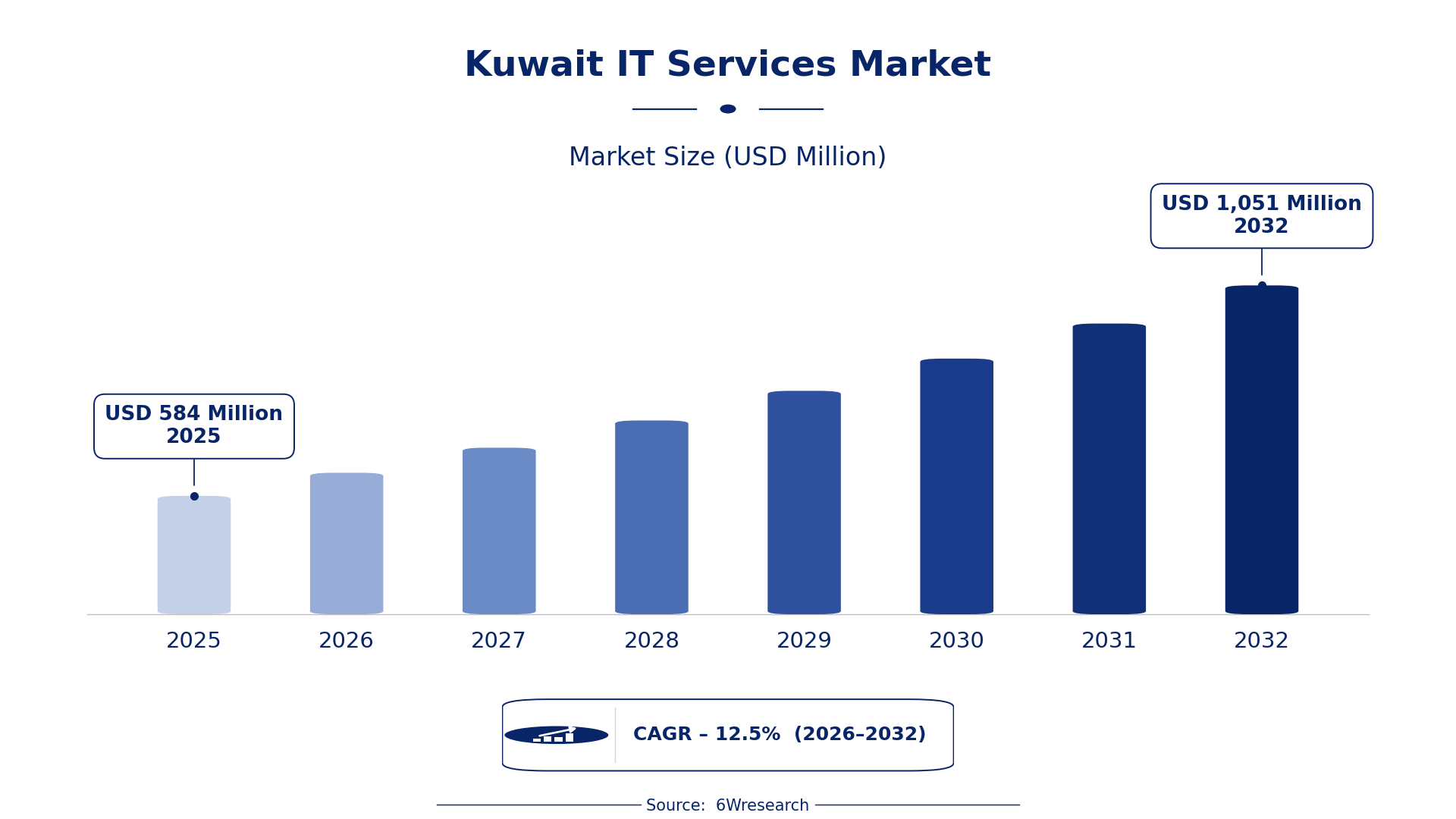
The Kuwait IT Services Market was estimated at USD 584 Million in 2025 and is projected to reach USD 1051 Million by 2032, growing at a CAGR of 12.5% from 2026 to 2032.
Kuwait IT Services Market Synopsis
The recent surge in digital transformation initiatives across various sectors in Kuwait has provided a substantial boost to the IT services market. Organizations are increasingly recognizing the importance of technology in enhancing operational efficiency and achieving competitive advantages.
Looking ahead, the Kuwait IT Services Market is set for accelerated growth, driven by innovations in cloud computing, cybersecurity, and big data analytics. As businesses seek specialized skills and cost-effective solutions, the trend of outsourcing IT services is expected to gain further momentum, shaping the future of this market.
Kuwait IT Services Market Year-wise Growth Rate and Key Drivers
This graph illustrates the annual growth rates of the Kuwait IT Services Market from 2021 to 2032, highlighting a steady upward trajectory and projected expansion over the forecast period.
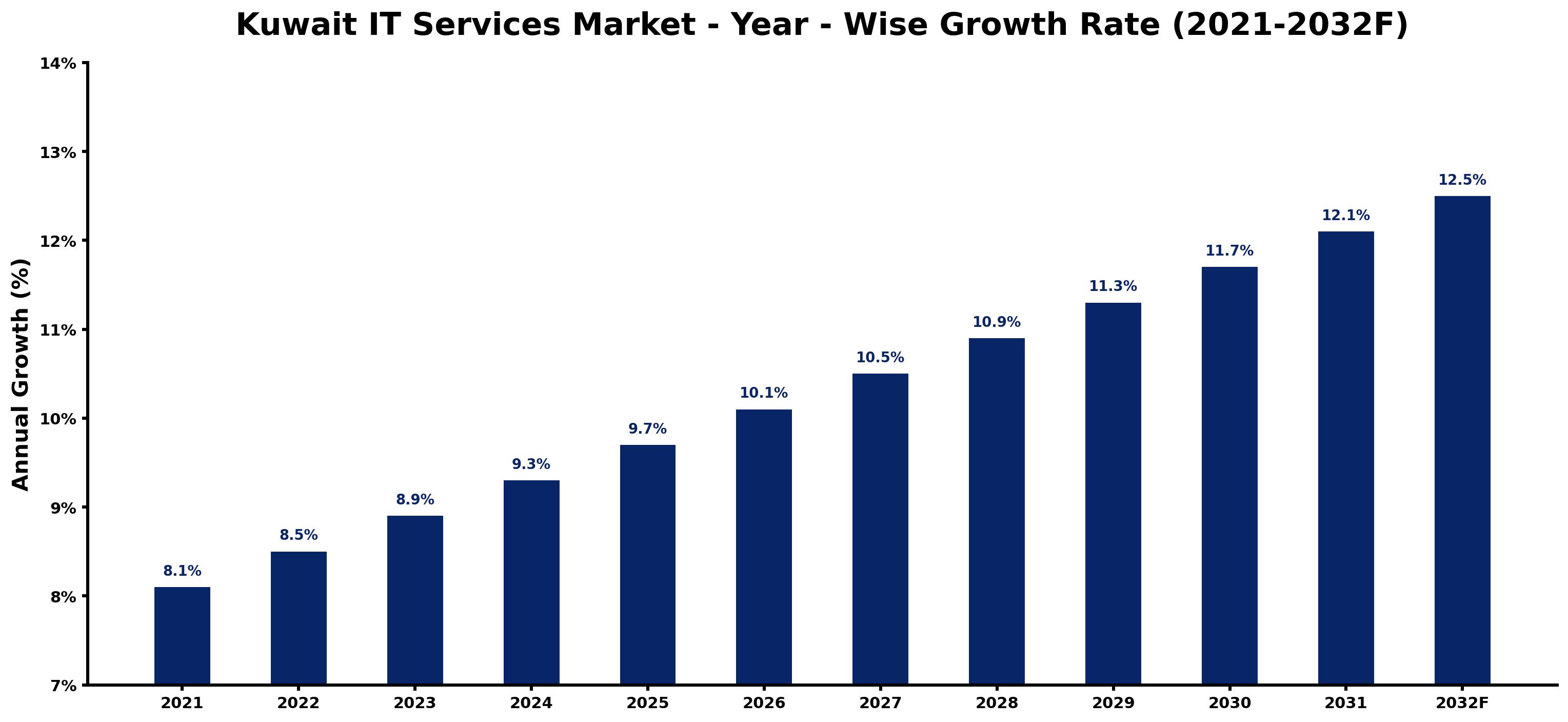
The table below presents the year‑wise growth rates along with the key drivers influencing the market
| Year | Growth Rate | Major Drivers |
| 2021 | 8.1% | Growth in government cyber defense spending boosting IT services. |
| 2022 | 8.5% | Rise in remote working accelerating cloud service adoption. |
| 2023 | 8.9% | Increased investments in digital healthcare technologies. |
| 2024 | 9.3% | Emergence of fintech solutions driving technology integration. |
| 2025 | 9.7% | Higher demand for data analytics among local businesses. |
| 2026 | 10.1% | Regulatory push for digital identity solutions enhancing adoption. |
| 2027 | 10.5% | Local educational initiatives fostering IT skills development. |
| 2028 | 10.9% | Partnerships with international tech firms expanding capabilities. |
| 2029 | 11.3% | Increased mobile payment usage enhancing cybersecurity needs. |
| 2030 | 11.7% | Growing smart logistics sector requiring advanced IT solutions. |
| 2031 | 12.1% | Shift towards e-governance enhancing digital service consumption. |
| 2032 | 12.5% | Support for startups creating innovative IT service solutions. |
Note: Market size estimations and growth projections presented in this report are based on 6Wresearch's proprietary forecasting methodology, utilizing the latest available industry data, government publications, and primary research inputs.
Kuwait IT Services Market Key Takeaways
Below are some of the specific key takeaways from the market, including:
- The increasing reliance on cloud computing solutions is significantly influencing service demand.
- Organizations are prioritizing cybersecurity measures to safeguard their digital assets and data.
- Outsourcing IT services is becoming a strategic move for many companies to enhance efficiency and reduce costs.
- The market is witnessing a growing emphasis on managed services as businesses seek operational support.
- Consulting services are gaining traction, particularly in guiding firms through digital transformation journeys.
Evaluation of Restraints in Kuwait IT Services Market
Despite the promising growth trajectory, the Kuwait IT Services Market faces certain constraints. Increasing competition from both regional and global service providers complicates the landscape for local firms. Additionally, the skills gap in emerging technologies such as artificial intelligence and cloud computing is a pressing issue, as organizations struggle to find qualified talent. The rapid pace of technological change also requires service providers to continually adapt, which can be a challenge for those entrenched in traditional business models.
Kuwait IT Services Market Trends
Several trends are shaping the demand and technology in the Kuwait IT Services Market. A notable shift towards cloud-based services is evident, with businesses increasingly adopting hybrid and multi-cloud strategies. on top of that, big data analytics is becoming integral for decision-making processes, allowing organizations to leverage insights for competitive advantage. In addition, the surge in remote working has elevated the importance of cybersecurity solutions, as firms prioritize the protection of their digital environments.
Kuwait IT Services Market Opportunities
Opportunities abound for growth and investment within the Kuwait IT Services Market. The rising demand for advanced cybersecurity solutions presents a lucrative area for service providers. Additionally, as more businesses embark on digital transformation journeys, the need for consulting and managed services will continue to rise. The ongoing expansion of IoT applications also offers new avenues for innovation, particularly in sectors such as healthcare and logistics.
Government Initiatives in the Kuwait IT Services Market
Government policies are pivotal in shaping the Kuwait IT Services Market, fostering an environment that encourages innovation and technological advancement. Through various initiatives, the government is not only supporting the growth of the IT sector but also enhancing the overall digital capabilities of the economy.
- A national digital infrastructure upgrade programme, recently launched, aims to enhance connectivity across urban and rural areas.
- Currently ongoing is an initiative to incentivize IT investments through tax breaks and grants for technology startups.
- A regulatory framework introduced in 2025 mandates billing transparency for IT service providers, promoting trust and reliability.
- Planned for 2026 is a public-private partnership expected to enhance digital skills training among the workforce.
- The government is also supporting research funding for technology development to accelerate innovation in the sector.
Future Insights of the Kuwait IT Services Market
From 2026 to 2032, the Kuwait IT Services Market is anticipated to witness sustained growth as digital transformation continues to be a priority for organizations. Investment in emerging technologies will be critical, with businesses expected to further adopt cloud solutions, cybersecurity measures, and data analytics. As the market matures, adaptability and innovation will be essential for service providers to meet evolving customer demands and maintain competitive advantages.
Kuwait IT Services Market Latest Developments
In the past year, the Kuwait IT Services Market has seen a flurry of activity, highlighting the sector's dynamic nature. Companies are making strategic moves to enhance their service offerings and respond to increasing demand for digital solutions.
- A major technology vendor announced the rollout of a new cybersecurity platform in Q1 2025 to address growing security concerns.
- A leading regional operator is currently undertaking an initiative to expand cloud service capabilities, with a focus on hybrid solutions, expected to complete by mid-2026.
- In Q4 2025, a prominent consulting firm launched a specialized service aimed at guiding enterprises through digital transformation processes.
- A partnership between several local IT firms is underway, aimed at creating a collaborative hub for innovation in emerging technologies.
- Plans for a comprehensive training programme in advanced IT skills are set to be introduced in early 2026, targeting workforce development.
Kuwait IT Services Market - Key Attractiveness of the Report
- 10 Years of Market Numbers
- Historical Data Starting from 2022 to 2025
- Base Year: 2025
- Forecast Data until 2032
- Key Performance Indicators Impacting the Market
- Major Upcoming Developments and Projects
Key Highlights of the Report:
- Kuwait IT Services Market Outlook
- Market Size of Kuwait IT Services Market, 2025
- Forecast of Kuwait IT Services Market, 2032
- Historical Data and Forecast of Kuwait IT Services Revenues & Volume for the Period 2022-2032F
- Kuwait IT Services Market Trend Evolution
- Kuwait IT Services Market Drivers and Challenges
- Kuwait IT Services Price Trends
- Kuwait IT Services Porter's Five Forces
- Kuwait IT Services Industry Life Cycle
- Historical Data and Forecast of Kuwait IT Services Market Revenues & Volume By Vertical for the Period 2022-2032F
- Historical Data and Forecast of Kuwait IT Services Market Revenues & Volume By Government and defense for the Period 2022-2032F
- Historical Data and Forecast of Kuwait IT Services Market Revenues & Volume By Banking, Financial Services, and Insurance (BFSI) for the Period 2022-2032F
- Historical Data and Forecast of Kuwait IT Services Market Revenues & Volume By Healthcare for the Period 2022-2032F
- Historical Data and Forecast of Kuwait IT Services Market Revenues & Volume By Media and entertainment for the Period 2022-2032F
- Historical Data and Forecast of Kuwait IT Services Market Revenues & Volume By Consumer goods and retail for the Period 2022-2032F
- Historical Data and Forecast of Kuwait IT Services Market Revenues & Volume By IT and telecom for the Period 2022-2032F
- Historical Data and Forecast of Kuwait IT Services Market Revenues & Volume By Business Function for the Period 2022-2032F
- Historical Data and Forecast of Kuwait IT Services Market Revenues & Volume By Human Resources for the Period 2022-2032F
- Historical Data and Forecast of Kuwait IT Services Market Revenues & Volume By Finance and Accounting for the Period 2022-2032F
- Historical Data and Forecast of Kuwait IT Services Market Revenues & Volume By Sales and Marketing for the Period 2022-2032F
- Historical Data and Forecast of Kuwait IT Services Market Revenues & Volume By Supply Chain Management for the Period 2022-2032F
- Historical Data and Forecast of Kuwait IT Services Market Revenues & Volume By Operations and Support for the Period 2022-2032F
- Historical Data and Forecast of Kuwait IT Services Market Revenues & Volume By Manufacturing for the Period 2022-2032F
- Historical Data and Forecast of Kuwait IT Services Market Revenues & Volume By Deployment Mode for the Period 2022-2032F
- Historical Data and Forecast of Kuwait IT Services Market Revenues & Volume By On-premises for the Period 2022-2032F
- Historical Data and Forecast of Kuwait IT Services Market Revenues & Volume By Cloud for the Period 2022-2032F
- Historical Data and Forecast of Kuwait IT Services Market Revenues & Volume By Organization Size for the Period 2022-2032F
- Historical Data and Forecast of Kuwait IT Services Market Revenues & Volume By Large enterprises for the Period 2022-2032F
- Historical Data and Forecast of Kuwait IT Services Market Revenues & Volume By Small and Medium Enterprises (SMEs) for the Period 2022-2032F
- Historical Data and Forecast of Kuwait IT Services Market Revenues & Volume By Service Type for the Period 2022-2032F
- Historical Data and Forecast of Kuwait IT Services Market Revenues & Volume By Professional services for the Period 2022-2032F
- Historical Data and Forecast of Kuwait IT Services Market Revenues & Volume By Managed services for the Period 2022-2032F
- Historical Data and Forecast of Kuwait IT Services Market Revenues & Volume By Telecom services for the Period 2022-2032F
- Kuwait IT Services Import Export Trade Statistics
- Market Opportunity Assessment By Vertical
- Market Opportunity Assessment By Business Function
- Market Opportunity Assessment By Deployment Mode
- Market Opportunity Assessment By Organization Size
- Market Opportunity Assessment By Service Type
- Kuwait IT Services Top Companies Market Share
- Kuwait IT Services Competitive Benchmarking By Technical and Operational Parameters
- Kuwait IT Services Company Profiles
- Kuwait IT Services Key Strategic Recommendations






































