Kuwait Managed Services Market Size & Growth Rate (2026-2032)
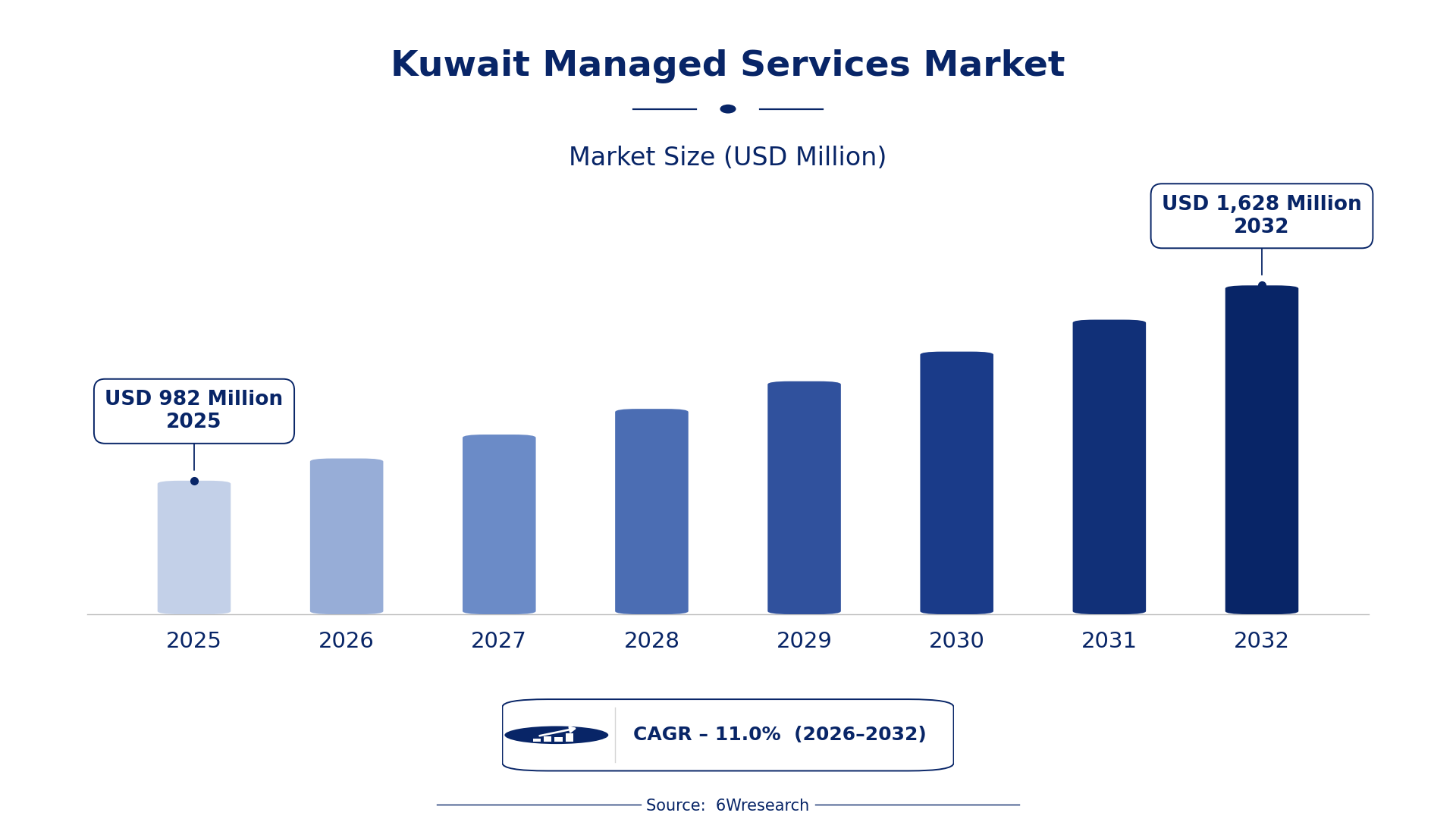
The Kuwait Managed Services Market was estimated at USD 982 Million in 2025 and is projected to reach USD 1628 Million by 2032, growing at a CAGR of 11.0% from 2026 to 2032.
Kuwait Managed Services Market Synopsis
In recent years, the Kuwait Managed Services Market has witnessed a substantial surge, fueled by businesses prioritizing digital transformation. Organizations are increasingly outsourcing their IT needs, from cloud solutions to cybersecurity, to enhance efficiency and mitigate complexities.
This shift is not just a trend; it's a fundamental change in how businesses operate in Kuwait. As enterprises invest in technology, managed service providers are stepping up to offer tailored solutions that address the unique challenges faced by local businesses.
Kuwait Managed Services Market Year-wise Growth Rate and Key Drivers
This graph illustrates the annual growth rates of the Kuwait Managed Services Market from 2021 to 2032, highlighting a steady upward trajectory and projected expansion over the forecast period.
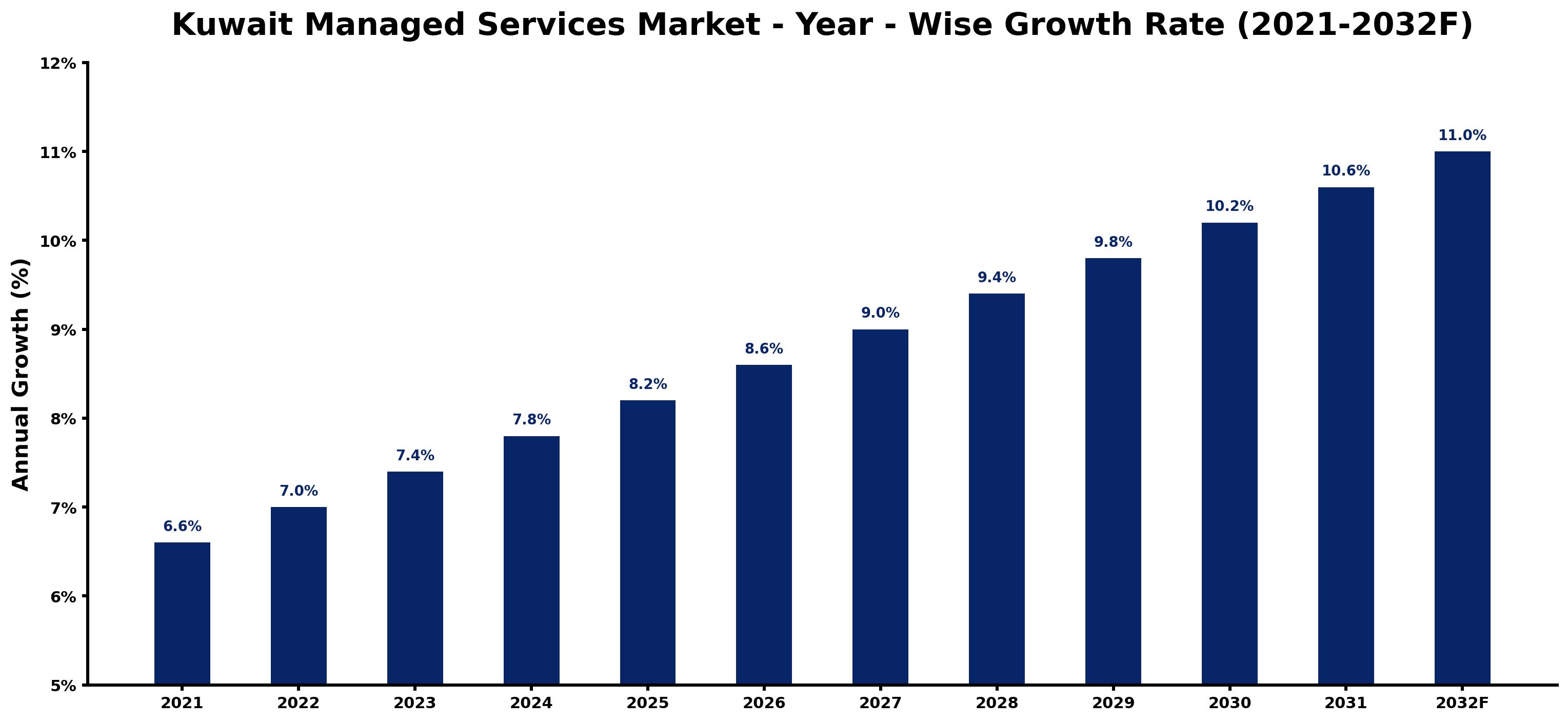
The table below presents the year‑wise growth rates along with the key drivers influencing the market
| Year | Growth Rate | Major Drivers |
| 2021 | 6.6% | Increased cloud adoption among Kuwaiti businesses drives demand. |
| 2022 | 7.0% | Government digitization initiatives boost managed services uptake. |
| 2023 | 7.4% | Local SMEs increasingly outsource IT functions for efficiency. |
| 2024 | 7.8% | Rising digital transformation projects among oil companies create opportunities. |
| 2025 | 8.2% | Kuwait Vision 2035 accelerates managed services market expansion. |
| 2026 | 8.6% | Increased remote work trends elevate managed services reliance. |
| 2027 | 9.0% | Growing cybersecurity regulations push firms towards managed services. |
| 2028 | 9.4% | Adoption of IoT solutions prompts demand for managed services. |
| 2029 | 9.8% | Enhanced telecommunications infrastructure supports managed service innovations. |
| 2030 | 10.2% | Investment in fintech solutions increases demand for IT support. |
| 2031 | 10.6% | Local startups drive growth in managed IT service contracts. |
| 2032 | 11.0% | Collaboration with global tech firms enhances service offerings. |
Note: Market size estimations and growth projections presented in this report are based on 6Wresearch's proprietary forecasting methodology, utilizing the latest available industry data, government publications, and primary research inputs.
Kuwait Managed Services Market Key Takeaways
Below are some of the specific key takeaways from the market, including:
- The market is increasingly driven by the demand for cloud-based solutions and cybersecurity services.
- Businesses are prioritizing outsourcing non-core IT functions to focus on their main competencies.
- There is a noticeable gap in skilled professionals, creating challenges for service providers.
- Government policies are promoting the adoption of managed services across various sectors.
- Emerging technologies like AI and IoT are becoming critical components of service offerings.
Evaluation of Restraints in Kuwait Managed Services Market
Several restraints are impacting the growth of the Kuwait Managed Services Market. A limited understanding of the full benefits of managed services hampers adoption among businesses. Many organizations still rely on traditional IT service models, which can lead to inefficiencies. Additionally, the shortage of skilled professionals exacerbates the challenge, as companies struggle to find qualified personnel to support their IT needs. Concerns about data security and compliance also play a critical role in hesitant investment, as organizations remain cautious about outsourcing sensitive functions. Finally, economic fluctuations in the region can further affect market dynamics, compelling service providers to innovate continuously to remain relevant.
Kuwait Managed Services Market Trends
The Kuwait Managed Services Market is currently marked by a pronounced shift towards cloud solutions and digital transformation. Organizations are increasingly looking for comprehensive managed services that can provide not just IT support but also enhance operational efficiency. The surge in remote work has further accelerated the need for secure and efficient remote access solutions, pushing businesses to adopt managed services more aggressively.
Cybersecurity remains at the forefront of discussions as threats evolve. Companies are demanding managed security services to protect their data and infrastructure. Additionally, the adoption of AI and IoT is reshaping service offerings, creating a demand for innovative solutions that meet the specific needs of Kuwaiti enterprises.
Kuwait Managed Services Market Opportunities
The Kuwait Managed Services Market is ripe with opportunities. Service providers can benefit significantly from partnerships with local businesses to deliver customized solutions that address industry-specific challenges. The increasing focus on specialized expertise means that providers who invest in niche markets can position themselves advantageously. on top of that, with the rise of digital transformation initiatives, there is a growing demand for services that enhance scalability and cost optimization. Investing in emerging technologies like AI and IoT can help providers stay ahead of the curve and meet the evolving demands of the market.
Government Initiatives in the Kuwait Managed Services Market
Government initiatives play a crucial role in shaping the Kuwait Managed Services Market. The public sector is actively promoting the adoption of managed services across various industries, which is essential for fostering a competitive business environment. Regulatory frameworks are being introduced to encourage companies to outsource non-core functions, emphasizing data security and compliance. These policies are designed to attract foreign investment and stimulate local market growth.
- A recently completed initiative focused on providing tax incentives for businesses that adopt managed services to enhance operational efficiency.
- A currently ongoing program aims to establish a regulatory framework that promotes transparency in billing practices for managed services.
- A planned public-private partnership expected to boost IT infrastructure by 2028, enhancing access to managed services for a broader range of businesses.
- Current efforts are underway to streamline regulatory processes, making it easier for foreign managed service providers to enter the Kuwaiti market.
- Upcoming initiatives will focus on enhancing cybersecurity measures across sectors, with a strong emphasis on data protection regulations.
Future Insights of the Kuwait Managed Services Market
Looking ahead to 2026-2032, the Kuwait Managed Services Market is set for steady growth. The ongoing digital transformation across industries will drive demand for cloud services and managed security solutions. Organizations will increasingly focus on core competencies, leading to a greater reliance on managed service providers. This trend will be further supported by the complexities of IT environments, necessitating scalable and cost-effective solutions. As businesses prioritize operational efficiency, the market will likely see innovative service offerings tailored to the specific needs of Kuwaiti enterprises.
Kuwait Managed Services Market Latest Developments
In the last year, the Kuwait Managed Services Market has seen notable developments, reflecting the growing adoption of digital services. Providers are enhancing their offerings to meet the increasing demand for cybersecurity and cloud solutions. This proactive approach is crucial as businesses adapt to new operational challenges and threats.
- A major technology vendor launched an integrated cloud management platform in Q1 2025, aimed at streamlining IT operations for local enterprises.
- A leading regional operator initiated an ongoing project in mid-2025 to expand its cybersecurity services, responding to the rising threat landscape.
- A new partnership was formed in early 2025 between two local firms to develop tailored managed services targeting the healthcare sector.
- An upcoming initiative expected to begin in late 2026 will focus on enhancing training programs for IT professionals to address skill shortages in the market.
- A recent upgrade to an existing managed service platform was completed by a prominent provider in early 2025, enhancing service delivery capabilities.
Kuwait Managed Services Market - Key Attractiveness of the Report
- 10 Years of Market Numbers
- Historical Data Starting from 2022 to 2025
- Base Year: 2025
- Forecast Data until 2032
- Key Performance Indicators Impacting the Market
- Major Upcoming Developments and Projects
Key Highlights of the Report:
- Kuwait Managed Services Market Outlook
- Market Size of Kuwait Managed Services Market, 2025
- Forecast of Kuwait Managed Services Market, 2032
- Historical Data and Forecast of Kuwait Managed Services Revenues & Volume for the Period 2022-2032F
- Kuwait Managed Services Market Trend Evolution
- Kuwait Managed Services Market Drivers and Challenges
- Kuwait Managed Services Price Trends
- Kuwait Managed Services Porter's Five Forces
- Kuwait Managed Services Industry Life Cycle
- Historical Data and Forecast of Kuwait Managed Services Market Revenues & Volume By Service Type for the Period 2022-2032F
- Historical Data and Forecast of Kuwait Managed Services Market Revenues & Volume By Managed Security Services for the Period 2022-2032F
- Historical Data and Forecast of Kuwait Managed Services Market Revenues & Volume By Managed Network Services for the Period 2022-2032F
- Historical Data and Forecast of Kuwait Managed Services Market Revenues & Volume By Managed Data Center and IT Infrastructure Services for the Period 2022-2032F
- Historical Data and Forecast of Kuwait Managed Services Market Revenues & Volume By Managed Communication and Collaboration Services for the Period 2022-2032F
- Historical Data and Forecast of Kuwait Managed Services Market Revenues & Volume By Managed Mobility Services for the Period 2022-2032F
- Historical Data and Forecast of Kuwait Managed Services Market Revenues & Volume By Managed Information Services for the Period 2022-2032F
- Historical Data and Forecast of Kuwait Managed Services Market Revenues & Volume By Deployment Type for the Period 2022-2032F
- Historical Data and Forecast of Kuwait Managed Services Market Revenues & Volume By Cloud for the Period 2022-2032F
- Historical Data and Forecast of Kuwait Managed Services Market Revenues & Volume By On-Premises for the Period 2022-2032F
- Historical Data and Forecast of Kuwait Managed Services Market Revenues & Volume By Organization Size for the Period 2022-2032F
- Historical Data and Forecast of Kuwait Managed Services Market Revenues & Volume By Small and Medium-sized Enterprises (SMEs) for the Period 2022-2032F
- Historical Data and Forecast of Kuwait Managed Services Market Revenues & Volume By Large Enterprises for the Period 2022-2032F
- Historical Data and Forecast of Kuwait Managed Services Market Revenues & Volume By Vertical for the Period 2022-2032F
- Historical Data and Forecast of Kuwait Managed Services Market Revenues & Volume By BFSI for the Period 2022-2032F
- Historical Data and Forecast of Kuwait Managed Services Market Revenues & Volume By IT and Telecom for the Period 2022-2032F
- Historical Data and Forecast of Kuwait Managed Services Market Revenues & Volume By Retail and Consumer Goods for the Period 2022-2032F
- Historical Data and Forecast of Kuwait Managed Services Market Revenues & Volume By Manufacturing for the Period 2022-2032F
- Historical Data and Forecast of Kuwait Managed Services Market Revenues & Volume By Government for the Period 2022-2032F
- Historical Data and Forecast of Kuwait Managed Services Market Revenues & Volume By Healthcare and Life Sciences for the Period 2022-2032F
- Historical Data and Forecast of Kuwait Managed Services Market Revenues & Volume By Energy and Utilities for the Period 2022-2032F
- Historical Data and Forecast of Kuwait Managed Services Market Revenues & Volume By Media and Entertainment for the Period 2022-2032F
- Kuwait Managed Services Import Export Trade Statistics
- Market Opportunity Assessment By Service Type
- Market Opportunity Assessment By Deployment Type
- Market Opportunity Assessment By Organization Size
- Market Opportunity Assessment By Vertical
- Kuwait Managed Services Top Companies Market Share
- Kuwait Managed Services Competitive Benchmarking By Technical and Operational Parameters
- Kuwait Managed Services Company Profiles
- Kuwait Managed Services Key Strategic Recommendations






































