Kuwait Physiotherapy Equipment Market Summary
The kuwait physiotherapy equipment market was estimated at USD 1269 Million in 2025 and is projected to reach USD 2360 Million by 2032, growing at a CAGR of 10.7% from 2026 to 2032.
Kuwait Physiotherapy Equipment Market Year-wise Growth Rate and Key Drivers
This graph highlights how the Kuwait Physiotherapy Equipment Market has steadily grown over the past five years, supported by major growth factors.
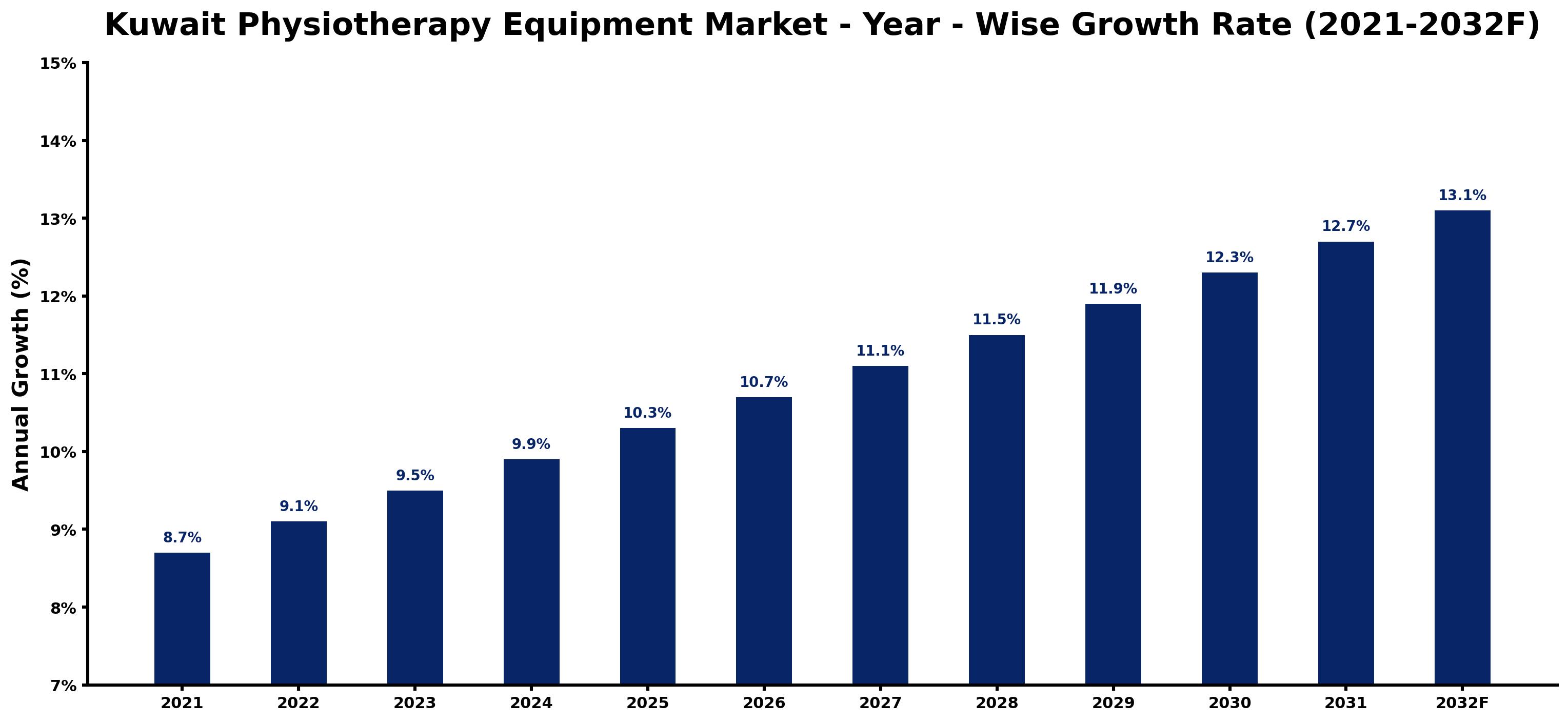
The table below presents the year wise growth rates along with the key drivers influencing the market
| Year | Growth Rate | Major Drivers |
| 2021 | 8.7% | Healthcare facilities invest heavily in upgrading physiotherapy equipment for improved patient care. |
| 2022 | 9.1% | Increasing prevalence of musculoskeletal disorders highlights the need for advanced therapy solutions. |
| 2023 | 9.5% | Establishment of specialized clinics focusing on rehabilitation boosts equipment demand significantly. |
| 2024 | 9.9% | Technological integration enhances therapy effectiveness, attracting more patients to physiotherapy services. |
| 2025 | 10.3% | Local manufacturing initiatives reduce costs, encouraging providers to expand equipment offerings. |
| 2026 | 10.7% | Collaboration between healthcare authorities and private sectors supports physiotherapy market growth. |
| 2027 | 11.1% | Awareness campaigns promote physiotherapy benefits, increasing patient visits to clinics nationwide. |
| 2028 | 11.5% | Advancements in telehealth create new avenues for remote physiotherapy equipment sales. |
| 2029 | 11.9% | An aging population requires tailored solutions, driving innovation in physiotherapy technologies. |
| 2030 | 12.3% | Expansion of fitness and wellness centers further diversifies the physiotherapy equipment market. |
| 2031 | 12.7% | Investment in educational programs enhances skills, leading to higher demand for specialized equipment. |
| 2032 | 13.1% | Emergence of personalized treatment plans shifts focus towards specific physiotherapy modalities. |
Note - Market size estimations and growth projections presented in this report are based on 6Wresearch's advanced forecasting approach, validated with industry datasets as of June 2026.
Kuwait Physiotherapy Equipment Market Synopsis
The Kuwait Physiotherapy Equipment Market is projected to reach 10.7% and witness significant growth during the forecast period (2026-2032). This expansion is largely influenced by an increasing prevalence of chronic diseases, a rising awareness of physical therapy treatments, and notable technological advancements in medical devices. Moreover, the proactive investment strategies adopted by private entities towards research and development in medical device technology are further fostering market growth. Alongside these factors, government initiatives aimed at enhancing healthcare expenditure have positively influenced the industry's trajectory over recent years.
Kuwait Physiotherapy Equipment Market Growth Drivers
The growth of the Kuwait physiotherapy equipment market can be attributed to several key drivers:
- Increasing incidence of life-altering chronic conditions such as diabetes and arthritis which necessitate physiotherapy interventions.
- Expanded recognition of the benefits of physiotherapy among both healthcare professionals and the general population, leading to higher demand for equipment.
- Technological innovations in physiotherapy devices enabling more effective treatments, improving patient outcomes.
- Investment inflows into healthcare technology research and development, bolstering product offerings and performance.
- Government reforms aimed at increasing healthcare access, resulting in greater expenditures in physiotherapeutic services and equipment.
Kuwait Physiotherapy Equipment Market Challenges and Restraints
Despite the positive growth outlook, the Kuwait physiotherapy equipment market faces certain challenges that may impede its progress:
- Strict regulatory frameworks governing the approval of medical devices can complicate and delay new product launches.
- High costs associated with advanced physiotherapy products, particularly robotic equipment, could limit accessibility for smaller health facilities.
- Limited consumer awareness regarding the full scope of physiotherapy treatments could restrict market demand.
- Potential fluctuations in economic conditions may affect healthcare funding and investment in medical technologies.
- Competition from alternative treatment modalities, which may divert patient interest from traditional physiotherapy interventions.
Kuwait Physiotherapy Equipment Market Trends and Opportunities
The Kuwait physiotherapy equipment market is currently characterized by several emerging trends that present new opportunities for growth:
- The integration of telehealth services within physiotherapy practices, facilitating remote patient monitoring and consultations.
- Increased usage of wearable technology to track patient progress, enhancing treatment effectiveness and patient engagement.
- Growing interest in minimally invasive treatment options and home-based exercise regimens, driving demand for portable physiotherapy devices.
- Rising partnerships between healthcare providers and technology companies to innovate and refine physiotherapy equipment.
- Expansion of training programs and educational resources aimed at physiotherapy professionals, improving the overall quality of care.
Kuwait Physiotherapy Equipment Market Government Investment and Initiatives
The government of Kuwait has been instrumental in shaping the physiotherapy equipment market through various investment initiatives:
- Implementation of healthcare policies aimed at elevating the standard of medical services, which include investments in physiotherapy facilities.
- Allocation of budgetary resources to enhance healthcare infrastructure, directly benefiting the physiotherapy sector.
- Establishment of public-private partnerships to encourage innovation in medical technology, thereby enriching the physiotherapy landscape.
- Launch of health awareness campaigns that emphasize the importance of physiotherapy in injury recovery and chronic disease management.
- Funding for research and development programs focused on improving outcomes in physiotherapy treatments, fostering a more advanced equipment market.
Kuwait Physiotherapy Equipment Market Latest Developments (May 2025 - June 2026)
Recent developments in the Kuwait physiotherapy equipment market indicate a strategic shift towards innovative solutions and enhanced patient care:
- The introduction of tele-rehabilitation platforms in response to the increasing demand for remote physiotherapy services.
- Advancements in digital techniques for assessment and treatment, enabling more personalized care for patients.
- Increased investments targeting the enhancement of physiotherapy clinics with the latest equipment to compete on a regional scale.
- Collaborations among healthcare stakeholders aiming to promote the adoption of evidence-based practices in physiotherapy.
- Emergence of local startups focused on developing cost-effective physiotherapy solutions tailored to the needs of the Kuwaiti population.
Kuwait Physiotherapy Equipment Market - Key Attractiveness of the Report
- 10 Years of Market Numbers
- Historical Data Starting from 2022 to 2025
- Base Year: 2025
- Forecast Data until 2032
- Key Performance Indicators Impacting the Market
- Major Upcoming Developments and Projects
Key Highlights of the Report:
- Kuwait Physiotherapy Equipment Market Outlook
- Market Size of Kuwait Physiotherapy Equipment Market, 2025
- Forecast of Kuwait Physiotherapy Equipment Market, 2032F
- Historical Data and Forecast of Kuwait Physiotherapy Equipment Revenues & Volume for the Period 2022-2032F
- Kuwait Physiotherapy Equipment Market Trend Evolution
- Kuwait Physiotherapy Equipment Market Drivers and Challenges
- Kuwait Physiotherapy Equipment Price Trends
- Kuwait Physiotherapy Equipment Porter's Five Forces
- Kuwait Physiotherapy Equipment Industry Life Cycle
- Historical Data and Forecast of Kuwait Physiotherapy Equipment Market Revenues & Volume By Product Types for the Period 2022-2032F
- Historical Data and Forecast of Kuwait Physiotherapy Equipment Market Revenues & Volume By Equipment for the Period 2022-2032F
- Historical Data and Forecast of Kuwait Physiotherapy Equipment Market Revenues & Volume By Accessories for the Period 2022-2032F
- Historical Data and Forecast of Kuwait Physiotherapy Equipment Market Revenues & Volume By Application? for the Period 2022-2032F
- Historical Data and Forecast of Kuwait Physiotherapy Equipment Market Revenues & Volume By Musculoskeletal Applications for the Period 2022-2032F
- Historical Data and Forecast of Kuwait Physiotherapy Equipment Market Revenues & Volume By Neurological Applications for the Period 2022-2032F
- Historical Data and Forecast of Kuwait Physiotherapy Equipment Market Revenues & Volume By Cardiovascular & Pulmonary Applications for the Period 2022-2032F
- Historical Data and Forecast of Kuwait Physiotherapy Equipment Market Revenues & Volume By Pediatric Applications for the Period 2022-2032F
- Historical Data and Forecast of Kuwait Physiotherapy Equipment Market Revenues & Volume By Gynecological Applications for the Period 2022-2032F
- Historical Data and Forecast of Kuwait Physiotherapy Equipment Market Revenues & Volume By Other? for the Period 2022-2032F
- Historical Data and Forecast of Kuwait Physiotherapy Equipment Market Revenues & Volume By End-user for the Period 2022-2032F
- Historical Data and Forecast of Kuwait Physiotherapy Equipment Market Revenues & Volume By Physiotherapy & Rehabilitation Centers for the Period 2022-2032F
- Historical Data and Forecast of Kuwait Physiotherapy Equipment Market Revenues & Volume By Hospitals for the Period 2022-2032F
- Historical Data and Forecast of Kuwait Physiotherapy Equipment Market Revenues & Volume By Home Care Settings for the Period 2022-2032F
- Historical Data and Forecast of Kuwait Physiotherapy Equipment Market Revenues & Volume By Physician Offices for the Period 2022-2032F
- Historical Data and Forecast of Kuwait Physiotherapy Equipment Market Revenues & Volume By Others for the Period 2022-2032F
- Kuwait Physiotherapy Equipment Import Export Trade Statistics
- Market Opportunity Assessment By Product Types
- Market Opportunity Assessment By Application?
- Market Opportunity Assessment By End-user
- Kuwait Physiotherapy Equipment Top Companies Market Share
- Kuwait Physiotherapy Equipment Competitive Benchmarking By Technical and Operational Parameters
- Kuwait Physiotherapy Equipment Company Profiles
- Kuwait Physiotherapy Equipment Key Strategic Recommendations






































