Kuwait Prefabricated Building Market Size Growth Rate
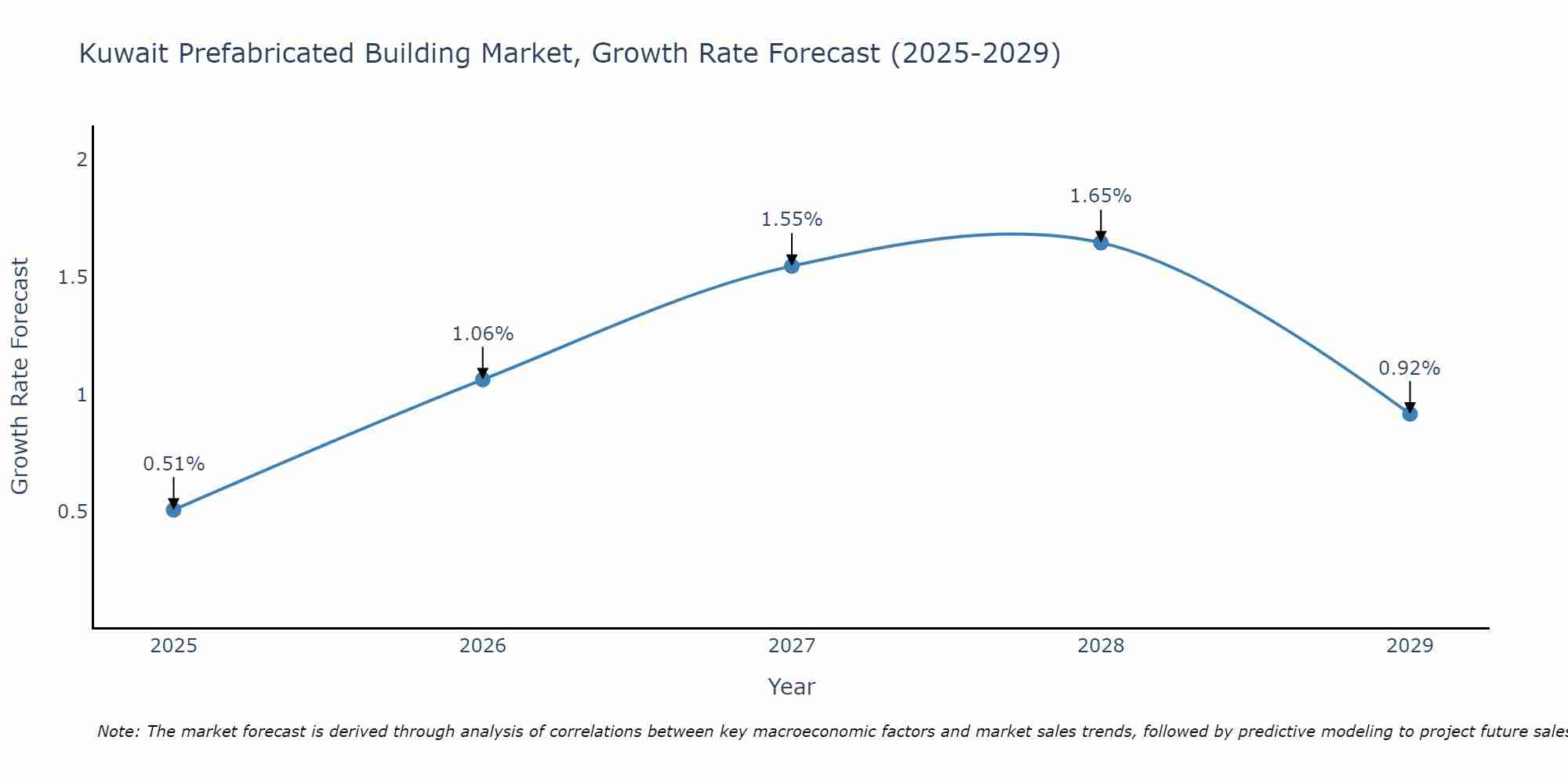
The Kuwait Prefabricated Building Market is projected to witness mixed growth rate patterns during 2025 to 2029. Growth accelerates to 1.65% in 2028, following an initial rate of 0.51%, before easing to 0.92% at the end of the period.
Kuwait Prefabricated Building Market Overview
The Kuwait Prefabricated Building Market is witnessing significant growth due to the country`s increasing focus on sustainable construction practices and the rising demand for cost-effective and efficient building solutions. The market is driven by factors such as rapid urbanization, government initiatives promoting prefabricated construction methods, and the need for quick and efficient housing solutions. Prefabricated buildings offer benefits such as reduced construction time, lower labor costs, and enhanced quality control. Key players in the Kuwait Prefabricated Building Market include local and international companies offering a range of prefabricated solutions for residential, commercial, and industrial applications. With the construction industry in Kuwait poised for growth, the prefabricated building sector is expected to continue expanding in the coming years.
Kuwait Prefabricated Building Market Trends
The Kuwait Prefabricated Building Market is experiencing growth driven by factors such as rapid urbanization, increasing construction activities, and the need for cost-effective and efficient building solutions. There is a rising demand for prefabricated buildings in Kuwait due to their benefits of faster construction times, reduced labor costs, and environmentally friendly construction practices. Additionally, the government`s focus on infrastructure development and initiatives to promote sustainable construction practices are further fueling the adoption of prefabricated buildings in the country. Key trends in the market include the use of advanced technologies in prefabrication processes, customization options to meet specific project requirements, and the integration of sustainable materials and design principles. Overall, the Kuwait Prefabricated Building Market is poised for continued growth and innovation in the coming years.
Kuwait Prefabricated Building Market Challenges
In the Kuwait Prefabricated Building Market, some challenges faced include limited awareness and understanding of prefabricated construction methods among stakeholders, including developers and contractors. Additionally, the traditional construction industry in Kuwait is well-established, leading to resistance to change and adoption of new technologies. Regulatory hurdles and the need for updated building codes that specifically address prefabricated construction also pose challenges in the market. Furthermore, the availability of skilled labor and specialized suppliers for prefabricated building materials may be limited, impacting the scalability and efficiency of prefabricated construction projects in Kuwait. Overall, overcoming these challenges will require education, collaboration among industry players, and government support to drive the growth of the prefabricated building market in Kuwait.
Kuwait Prefabricated Building Market Investment Opportunities
The Kuwait Prefabricated Building Market presents promising investment opportunities due to the country`s focus on infrastructure development and rapid urbanization. With a growing demand for cost-effective and sustainable construction solutions, prefabricated buildings offer efficient and quick construction processes. Investors can explore opportunities in supplying prefabricated components, manufacturing prefabricated buildings, or providing turnkey solutions for residential, commercial, and industrial projects. Additionally, government initiatives to promote affordable housing and smart city developments further drive the demand for prefabricated buildings in Kuwait. Investing in the Kuwait Prefabricated Building Market can provide long-term growth prospects and a competitive edge in the construction sector.
Kuwait Prefabricated Building Market Government Policy
In Kuwait, the government has implemented various policies to support the growth of the prefabricated building market. These policies include initiatives to streamline the permitting process for prefabricated construction projects, financial incentives for developers utilizing prefabricated techniques, and regulations promoting the use of sustainable materials in prefab structures. Additionally, the government has encouraged research and development in the prefabricated building sector to improve efficiency and quality standards. Overall, these policies aim to drive innovation, reduce construction timelines, and enhance the sustainability of the building industry in Kuwait through the widespread adoption of prefabricated construction methods.
Kuwait Prefabricated Building Market Future Outlook
The future outlook for the Kuwait Prefabricated Building Market appears promising, with a projected growth driven by factors such as increasing demand for cost-effective and sustainable construction solutions, rapid urbanization, and the government`s focus on infrastructure development. Prefabricated buildings offer advantages such as faster construction timelines, reduced labor costs, and minimal waste generation, making them an attractive choice for various applications including residential, commercial, and industrial sectors. Additionally, technological advancements in prefabrication techniques, design customization options, and the rising trend towards modular construction are expected to further fuel market growth. As Kuwait continues to invest in construction projects to diversify its economy and improve infrastructure, the prefabricated building market is likely to witness significant expansion in the coming years.
Key Highlights of the Report:
- Kuwait Prefabricated Building Market Outlook
- Market Size of Kuwait Prefabricated Building Market, 2021
- Forecast of Kuwait Prefabricated Building Market, 2031
- Historical Data and Forecast of Kuwait Prefabricated Building Revenues & Volume for the Period 2018 - 2031
- Kuwait Prefabricated Building Market Trend Evolution
- Kuwait Prefabricated Building Market Drivers and Challenges
- Kuwait Prefabricated Building Price Trends
- Kuwait Prefabricated Building Porter's Five Forces
- Kuwait Prefabricated Building Industry Life Cycle
- Historical Data and Forecast of Kuwait Prefabricated Building Market Revenues & Volume By Dimensions for the Period 2018 - 2031
- Historical Data and Forecast of Kuwait Prefabricated Building Market Revenues & Volume By Skeleton System for the Period 2018 - 2031
- Historical Data and Forecast of Kuwait Prefabricated Building Market Revenues & Volume By Panel System for the Period 2018 - 2031
- Historical Data and Forecast of Kuwait Prefabricated Building Market Revenues & Volume By Cellular System for the Period 2018 - 2031
- Historical Data and Forecast of Kuwait Prefabricated Building Market Revenues & Volume By Combined System for the Period 2018 - 2031
- Historical Data and Forecast of Kuwait Prefabricated Building Market Revenues & Volume By Application for the Period 2018 - 2031
- Historical Data and Forecast of Kuwait Prefabricated Building Market Revenues & Volume By Residential for the Period 2018 - 2031
- Historical Data and Forecast of Kuwait Prefabricated Building Market Revenues & Volume By Non-Residential for the Period 2018 - 2031
- Kuwait Prefabricated Building Import Export Trade Statistics
- Market Opportunity Assessment By Dimensions
- Market Opportunity Assessment By Application
- Kuwait Prefabricated Building Top Companies Market Share
- Kuwait Prefabricated Building Competitive Benchmarking By Technical and Operational Parameters
- Kuwait Prefabricated Building Company Profiles
- Kuwait Prefabricated Building Key Strategic Recommendations






































