Kuwait Smart Building Market Size, Share & Growth Rate
The Kuwait Smart Building Market was estimated at USD 354 Million in 2025 and is projected to reach USD 616 Million by 2032, growing at a CAGR of 8.2% from 2026 to 2032. This promising trajectory is fueled by an increasing emphasis on sustainable development and advanced technologies, such as IoT and AI, which are being actively integrated into building management systems. Additionally, government initiatives supporting smart city projects further stimulate demand for innovative solutions that enhance operational efficiency and occupant comfort.
Kuwait Smart Building Market Year-wise Growth Rate and Key Drivers
This graph highlights how the Kuwait Smart Building Market has steadily grown over the years, supported by major growth factors.
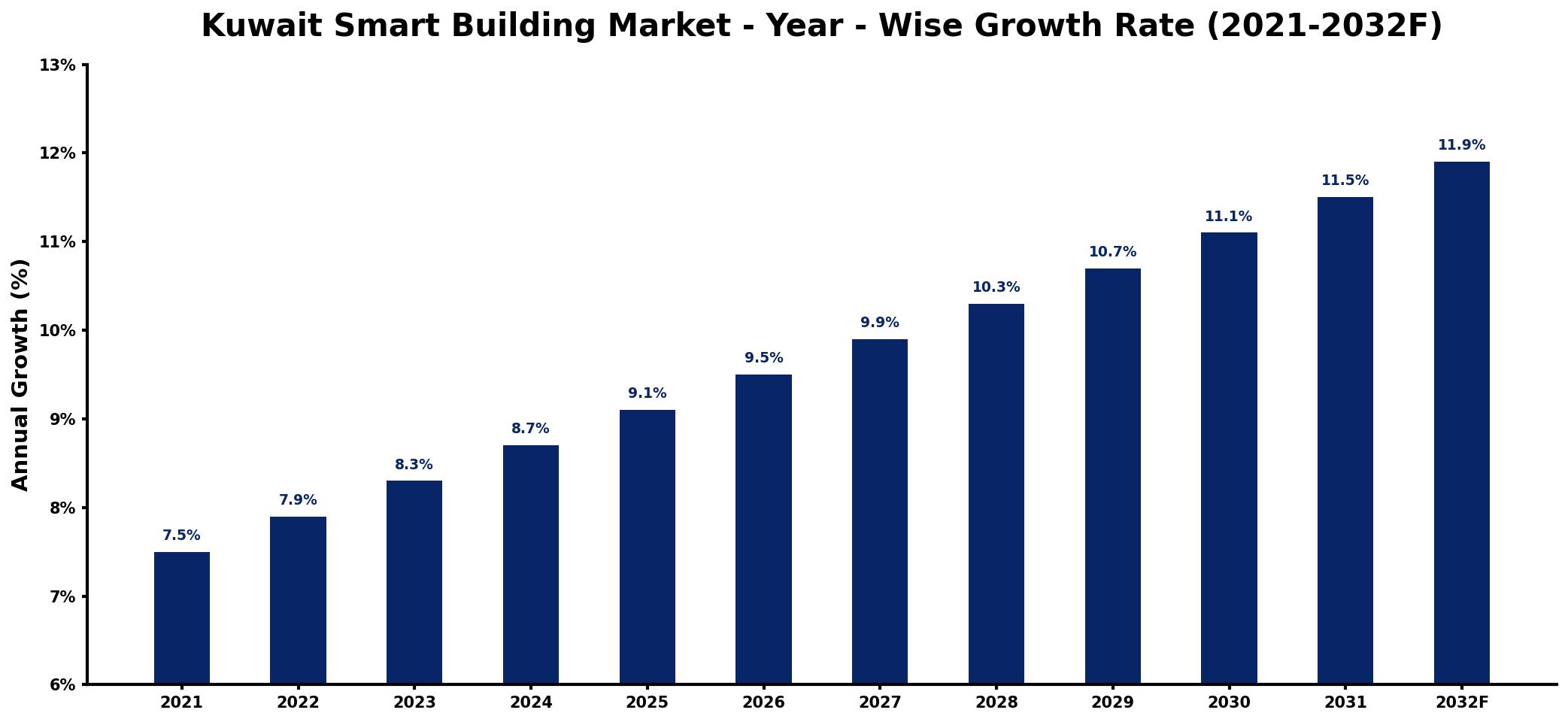
The table below presents the year‑wise growth rates along with the key drivers influencing the market
| Year | Growth Rate | Major Drivers |
| 2021 | 7.5% | Rising demand for energy efficiency |
| 2022 | 7.9% | Increased government infrastructure investments |
| 2023 | 8.3% | Growing adoption of IoT technologies |
| 2024 | 8.7% | Expanding urban population growth |
| 2025 | 9.1% | Enhanced focus on sustainability initiatives |
| 2026 | 9.5% | Technological advancements in automation |
| 2027 | 9.9% | Surge in real estate developments |
| 2028 | 10.3% | Growing interest in remote monitoring |
| 2029 | 10.7% | Increased focus on occupant comfort |
| 2030 | 11.1% | growing emerging market penetration |
| 2031 | 11.5% | Investment in renewable energy sources |
| 2032 | 11.9% | Heightened emphasis on regulatory compliance |
Note: Market size estimations and growth projections presented in this report are based on 6Wresearch's proprietary forecasting methodology, utilizing the latest available industry data, government publications, and primary research inputs.
Kuwait Smart Building Market Synopsis
The Kuwait Smart Building Market is currently witnessing a wave of momentum, propelled by strategic government policies and a growing recognition of the benefits of smart technologies. As organizations seek to modernize their infrastructure, the market is on track to evolve into a more sophisticated landscape over the coming years, characterized by enhanced energy efficiency and occupant experiences.
While the recent growth has laid a solid foundation, the market's future expansion hinges on the successful integration of innovative technologies and the alignment with evolving regulatory standards. The convergence of sustainability goals with cutting-edge building solutions presents a unique opportunity for stakeholders in Kuwait's burgeoning smart building sector.
Kuwait Smart Building Market Key Takeaways
- Significant growth anticipated due to government-led smart city initiatives and sustainability targets.
- Technologies like IoT, AI, and cloud computing are transforming building management systems.
- Market expansion is driven by increasing demand for energy-efficient solutions.
- Challenges such as high initial costs and limited awareness present barriers that need addressing.
- Emerging trends focus on occupant comfort, advanced security systems, and real-time monitoring technologies.
Evaluation of Restraints in Kuwait Smart Building Market
Despite the promising outlook, the Kuwait Smart Building Market faces several restraints that could hinder its growth trajectory. A significant barrier is the high initial investment required to implement smart technologies, which can deter building owners and developers from making the transition. Additionally, there remains a limited understanding among stakeholders regarding the long-term benefits of smart solutions, leading to hesitancy in adoption. The lack of standardized regulations and guidelines further complicates the implementation process, requiring specialized expertise that may not be readily available in the local market. Furthermore, data security and privacy concerns continue to loom as essential issues needing resolution to ensure stakeholder confidence in smart building technologies.
Kuwait Smart Building Market Trends
The Kuwait Smart Building Market is being shaped by several current and emerging trends. The integration of advanced technologies like artificial intelligence and machine learning is enhancing building automation systems, making them more responsive and efficient. Real-time monitoring through smart sensors is gaining traction, allowing for optimized building operations and improved energy management. Additionally, there is a strong focus on sustainable practices, including achieving green building certifications, which align with global sustainability standards. The increasing implementation of touchless access control systems and indoor air quality monitoring solutions reflects a growing commitment to occupant safety and comfort, thereby enhancing the overall appeal of smart buildings.
Kuwait Smart Building Market Opportunities
Investment opportunities within the Kuwait Smart Building Market are abundant, particularly in segments such as building automation systems, energy management, and smart HVAC solutions. With ongoing government support for sustainable development initiatives, technology providers are encouraged to innovate and deliver integrated smart building solutions. Collaborating with local stakeholders or investing in technology startups that focus on smart innovations presents viable avenues for growth. Additionally, retrofitting existing buildings with smart technologies offers significant potential to meet evolving energy efficiency standards, marking a crucial step toward achieving sustainability goals in the built environment.
Government Initiatives in the Kuwait Smart Building Market
The Kuwaiti government is actively encouraging the adoption of smart building technologies through a series of policy initiatives. These initiatives include the establishment of energy efficiency standards for buildings and incentives for developers who incorporate environmentally friendly technologies. Furthermore, programs supporting research and development in smart building sectors, alongside educational campaigns aimed at stakeholders, seek to heighten awareness of the advantages associated with smart buildings. Collectively, these efforts aim to enhance sustainability and upgrade the quality of the country's infrastructure.
Future Insights of the Kuwait Smart Building Market
Looking ahead to the period between 2026 and 2032, the Kuwait Smart Building Market is expected to experience robust growth driven by increasing investments in smart city initiatives and a rising demand for energy-efficient infrastructure. The growing incorporation of advanced technologies, such as IoT and AI, will be pivotal in transforming building management into a more efficient and sustainable practice. As stakeholders become more aware of the operational efficiencies and cost savings associated with smart buildings, the market will likely witness a significant increase in the adoption of smart technologies, paving the way for innovative solutions in the built environment.
Kuwait Smart Building Market Latest Developments (2025 - 2026)
In the recent months leading up to mid-2026, the Kuwait Smart Building Market has seen a flurry of activity, particularly in the realm of technology integration and the development of new building projects. Stakeholders are increasingly focusing on enhancing energy efficiency and occupant experience through advanced automation technologies. Furthermore, collaborative efforts are emerging between technology providers and construction firms to spearhead smart building projects that align with national sustainability goals. Awareness campaigns aimed at educating building owners on the benefits of smart solutions are also gaining traction, signaling a shift towards greater acceptance and implementation of smart building technologies.
Kuwait Smart Building Market - Key Attractiveness of the Report
- 10 Years of Market Numbers
- Historical Data Starting from 2022 to 2025
- Base Year: 2025
- Forecast Data until 2032
- Key Performance Indicators Impacting the Market
- Major Upcoming Developments and Projects
Key Highlights of the Report:
- Kuwait Smart Building Market Outlook
- Market Size of Kuwait Smart Building Market, 2025
- Forecast of Kuwait Smart Building Market, 2032
- Historical Data and Forecast of Kuwait Smart Building Revenues & Volume for the Period 2022-2032F
- Kuwait Smart Building Market Trend Evolution
- Kuwait Smart Building Market Drivers and Challenges
- Kuwait Smart Building Price Trends
- Kuwait Smart Building Porter's Five Forces
- Kuwait Smart Building Industry Life Cycle
- Historical Data and Forecast of Kuwait Smart Building Market Revenues & Volume By Component for the Period 2022-2032F
- Historical Data and Forecast of Kuwait Smart Building Market Revenues & Volume By Solution for the Period 2022-2032F
- Historical Data and Forecast of Kuwait Smart Building Market Revenues & Volume By Services for the Period 2022-2032F
- Historical Data and Forecast of Kuwait Smart Building Market Revenues & Volume By Application for the Period 2022-2032F
- Historical Data and Forecast of Kuwait Smart Building Market Revenues & Volume By Residential for the Period 2022-2032F
- Historical Data and Forecast of Kuwait Smart Building Market Revenues & Volume By Commercial for the Period 2022-2032F
- Kuwait Smart Building Import Export Trade Statistics
- Market Opportunity Assessment By Component
- Market Opportunity Assessment By Application
- Kuwait Smart Building Top Companies Market Share
- Kuwait Smart Building Competitive Benchmarking By Technical and Operational Parameters
- Kuwait Smart Building Company Profiles
- Kuwait Smart Building Key Strategic Recommendations






































