United Kingdom (UK) Smart Building Market Size, Share & Growth Rate
The United Kingdom (UK) Smart Building Market was estimated at USD 408 Million in 2025 and is projected to reach USD 564 Million by 2032, growing at a CAGR of 4.7% from 2026 to 2032. This growth trajectory is largely influenced by increasing governmental support for energy efficiency and sustainability. As organizations seek to reduce operational costs while enhancing occupant comfort, smart technologies are becoming integral to building management systems across the UK.
United Kingdom (UK) Smart Building Market Year-wise Growth Rate and Key Drivers
This graph highlights how the United Kingdom (UK) Smart Building Market has steadily grown over the years, supported by major growth factors.
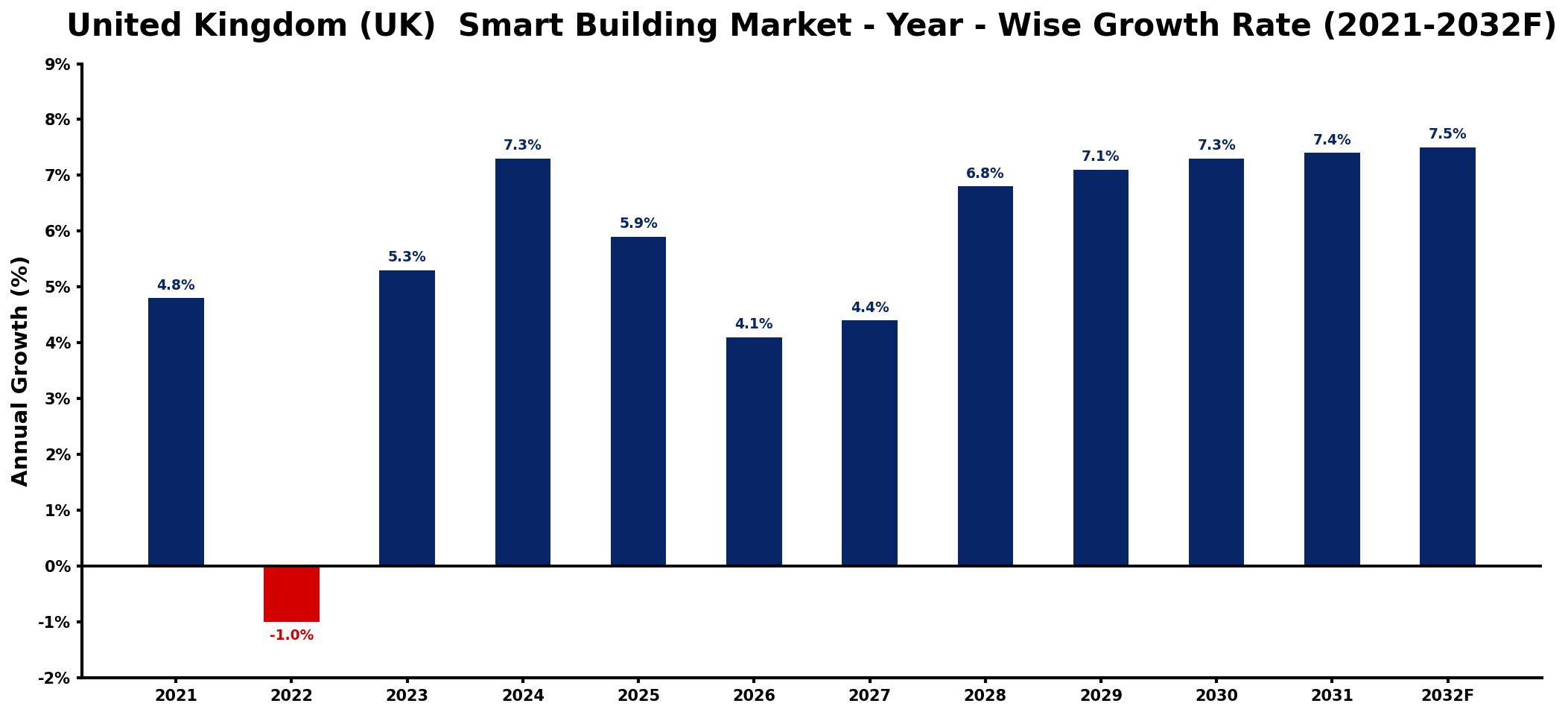
The table below presents the year‑wise growth rates along with the key drivers influencing the market
| Year | Growth Rate | Major Drivers |
| 2021 | 4.8% | increased investments in automation |
| 2022 | -1.0% | reduced funding for technology projects |
| 2023 | 5.3% | growing interest in energy efficiency |
| 2024 | 7.3% | expansion of IoT applications |
| 2025 | 5.9% | rising demand for sustainability solutions |
| 2026 | 4.1% | enhanced focus on workplace safety |
| 2027 | 4.4% | growing integration of AI technologies |
| 2028 | 6.8% | increased adoption of renewable energy |
| 2029 | 7.1% | increased domestic production output |
| 2030 | 7.3% | growing awareness of data security |
| 2031 | 7.4% | increased focus on user experience |
| 2032 | 7.5% | strengthening international trade flows |
Note: Market size estimations and growth projections presented in this report are based on 6Wresearch's proprietary forecasting methodology, utilizing the latest available industry data, government publications, and primary research inputs.
United Kingdom (UK) Smart Building Market Synopsis
The UK Smart Building Market is undergoing a transformative phase, characterized by the rapid integration of advanced technologies such as IoT, artificial intelligence, and data analytics. These innovations not only enhance energy efficiency but also improve the overall experience for occupants, aligning with growing expectations for sustainable and intelligent workspaces.
Government initiatives and heightened awareness regarding climate change are catalyzing this shift. Organizations are prioritizing smart building technologies to comply with stringent regulations and achieve energy efficiency, thereby leading to a marked increase in market demand.
United Kingdom (UK) Smart Building Market Key Takeaways
- The market is experiencing robust growth driven by a focus on sustainability and energy efficiency.
- Technologies such as IoT and AI are increasingly being adopted for building automation and predictive maintenance.
- Occupant comfort and wellness are becoming focal points for smart building technologies.
- Interoperability challenges and high initial costs remain key hurdles for market players.
- Government policies play a significant role in fostering innovation within the smart building sector.
Evaluation of Restraints in United Kingdom (UK) Smart Building Market
While the UK Smart Building Market is poised for growth, several restraints must be addressed. One of the primary barriers is the high initial investment required for smart technologies. Many building owners hesitate to make substantial upfront expenditures, especially when the ROI is not immediately clear. Moreover, the lack of standardized regulations can create confusion among stakeholders, leading to delays in adoption. Interoperability issues among different smart systems further complicate the landscape, as the full potential of smart buildings cannot be realized if various technologies do not communicate effectively. Finally, data privacy and security remain pressing concerns, as safeguarding sensitive information is critical for maintaining trust in smart solutions.
United Kingdom (UK) Smart Building Market Trends
The market is currently witnessing a surge in the adoption of IoT technologies that enhance building automation and energy management. AI and machine learning are being integrated to optimize operations and facilitate predictive maintenance, reducing overall costs. Additionally, there is an increasing emphasis on occupant comfort, with technologies like air quality monitoring and personalized workspace solutions gaining traction. Another notable trend is the incorporation of robust cybersecurity measures to protect sensitive data and ensure secure building operations. These trends reflect a broader shift toward creating smarter, more efficient buildings that focus on both environmental impact and occupant well-being.
United Kingdom (UK) Smart Building Market Opportunities
The United Kingdom's Smart Building Market offers significant investment opportunities across various segments, including energy management, security systems, and automation solutions. As the demand for energy-efficient technologies grows, investors can explore companies specializing in smart sensors, IoT platforms, and integrated building management systems. Additionally, the governments push for green building practices and the development of smart cities serves as a catalyst for innovation, making this sector ripe for long-term investments with the potential for substantial returns.
Government Initiatives in the United Kingdom (UK) Smart Building Market
The UK government has been proactive in fostering the growth of the Smart Building Market through various initiatives. Policies such as the Clean Growth Strategy and the Future Homes Standard emphasize the importance of innovation in building construction and energy efficiency. These initiatives not only set ambitious targets for reducing carbon emissions but also incentivize the adoption of smart technologies in buildings. Furthermore, government funding is being allocated to support research and development in smart building technologies, creating a conducive environment for stakeholders to invest and innovate.
Future Insights of the United Kingdom (UK) Smart Building Market
Looking ahead to 2026-2032, the United Kingdom Smart Building Market is expected to continue its upward trajectory, driven by the ongoing adoption of IoT technologies and a heightened focus on energy efficiency and sustainability. The increasing demand for smart solutions—ranging from building automation systems to advanced energy management—will likely reshape how buildings are designed and operated. Additionally, advancements in AI and data analytics promise to further enhance operational efficiency and occupant comfort. As businesses increasingly prioritize environmental responsibilities, the smart building sector in the UK is set for significant growth and innovation.
United Kingdom (UK) Smart Building Market Latest Developments (2025 - 2026)
Recent developments in the UK Smart Building Market indicate a strong emphasis on integrating more advanced technologies into existing building infrastructures. Companies are increasingly focusing on enhancing interoperability among smart systems to maximize efficiency. Additionally, the conversation around sustainability is becoming more pronounced, leading to collaborative efforts aimed at creating green buildings. Initiatives to foster community engagement in smart city projects are also gaining traction, encouraging innovative solutions tailored to local needs.
United Kingdom (UK) Smart Building Market - Key Attractiveness of the Report
- 10 Years of Market Numbers
- Historical Data Starting from 2022 to 2025
- Base Year: 2025
- Forecast Data until 2032
- Key Performance Indicators Impacting the Market
- Major Upcoming Developments and Projects
Key Highlights of the Report:
- United Kingdom (UK) Smart Building Market Outlook
- Market Size of United Kingdom (UK) Smart Building Market, 2025
- Forecast of United Kingdom (UK) Smart Building Market, 2032
- Historical Data and Forecast of United Kingdom (UK) Smart Building Revenues & Volume for the Period 2022-2032F
- United Kingdom (UK) Smart Building Market Trend Evolution
- United Kingdom (UK) Smart Building Market Drivers and Challenges
- United Kingdom (UK) Smart Building Price Trends
- United Kingdom (UK) Smart Building Porter's Five Forces
- United Kingdom (UK) Smart Building Industry Life Cycle
- Historical Data and Forecast of United Kingdom (UK) Smart Building Market Revenues & Volume By Component for the Period 2022-2032F
- Historical Data and Forecast of United Kingdom (UK) Smart Building Market Revenues & Volume By Solution for the Period 2022-2032F
- Historical Data and Forecast of United Kingdom (UK) Smart Building Market Revenues & Volume By Services for the Period 2022-2032F
- Historical Data and Forecast of United Kingdom (UK) Smart Building Market Revenues & Volume By Application for the Period 2022-2032F
- Historical Data and Forecast of United Kingdom (UK) Smart Building Market Revenues & Volume By Residential for the Period 2022-2032F
- Historical Data and Forecast of United Kingdom (UK) Smart Building Market Revenues & Volume By Commercial for the Period 2022-2032F
- United Kingdom (UK) Smart Building Import Export Trade Statistics
- Market Opportunity Assessment By Component
- Market Opportunity Assessment By Application
- United Kingdom (UK) Smart Building Top Companies Market Share
- United Kingdom (UK) Smart Building Competitive Benchmarking By Technical and Operational Parameters
- United Kingdom (UK) Smart Building Company Profiles
- United Kingdom (UK) Smart Building Key Strategic Recommendations






































