Kuwait Web Content Management Market Size & Growth Rate (2026-2032)
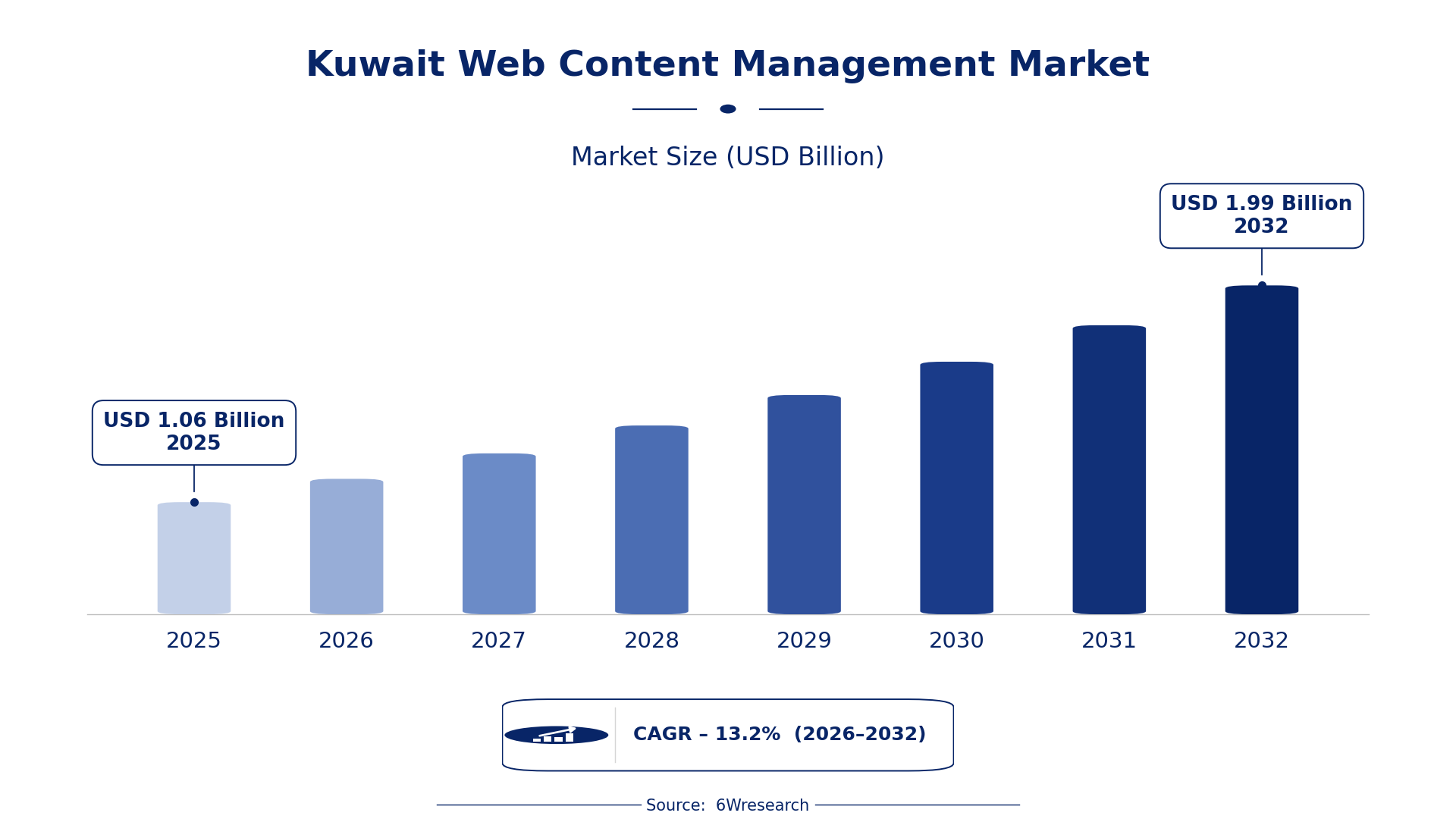
The Kuwait Web Content Management Market was estimated at USD 1063 Million in 2025 and is projected to reach USD 1988 Million by 2032, growing at a CAGR of 13.2% from 2026 to 2032.
Kuwait Web Content Management Market Synopsis
The driving force in the Kuwait Web Content Management Market is the urgent need for organizations to enhance their digital presence. As businesses strive to engage with consumers effectively, the emphasis on streamlined content management systems has never been greater. This demand is fueled by a growing digital economy, where user experience is paramount.
As a result, companies are increasingly turning to advanced WCM solutions that provide not just integration and scalability, but also personalization features. The focus on delivering tailored content is reshaping how businesses approach customer engagement, ensuring that digital strategies align with user expectations.
Kuwait Web Content Management Market Year-wise Growth Rate and Key Drivers
This graph illustrates the annual growth rates of the Kuwait Web Content Management Market from 2021 to 2032, highlighting a steady upward trajectory and projected expansion over the forecast period.
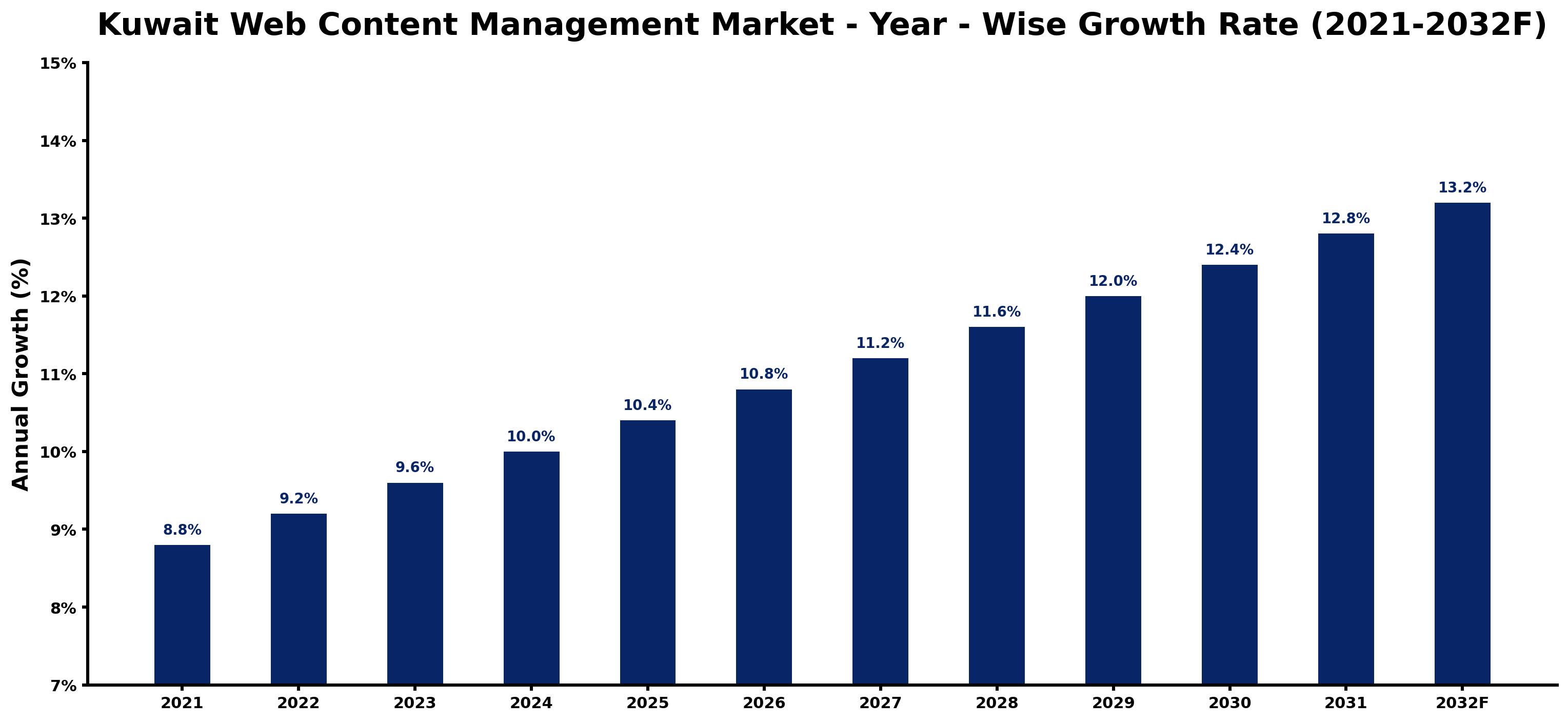
The table below presents the year‑wise growth rates along with the key drivers influencing the market
| Year | Growth Rate | Major Drivers |
| 2021 | 8.8% | Increased demand for digital transformation in enterprises. |
| 2022 | 9.2% | Kuwait's youth population driving online content engagement. |
| 2023 | 9.6% | Government initiatives boosting e-governance and digital services. |
| 2024 | 10.0% | Rising adoption of mobile applications for local businesses. |
| 2025 | 10.4% | Increased internet penetration fostering widespread content creation. |
| 2026 | 10.8% | Growth of small and medium enterprises seeking online presence. |
| 2027 | 11.2% | Enhanced digital literacy programs supporting web content needs. |
| 2028 | 11.6% | Local startups focusing on innovative content management solutions. |
| 2029 | 12.0% | Investment in cybersecurity driving secure content management demand. |
| 2030 | 12.4% | Emerging trends in AI personalization impacting web strategies. |
| 2031 | 12.8% | Growing social media engagement by businesses and brands. |
| 2032 | 13.2% | Government regulations promoting digital accessibility standards. |
Note: Market size estimations and growth projections presented in this report are based on 6Wresearch's proprietary forecasting methodology, utilizing the latest available industry data, government publications, and primary research inputs.
Kuwait Web Content Management Market Key Takeaways
Below are some of the specific key takeaways from the market, including:
- The push for digital transformation is leading to increased investments in web content management systems.
- Personalization and user engagement are critical factors driving the adoption of WCM solutions.
- Challenges around maintaining brand consistency while managing diverse content are prevalent.
- Government policies are actively promoting the digitalization of services across sectors.
- Market growth presents significant opportunities for both established players and new entrants.
Evaluation of Restraints in Kuwait Web Content Management Market
Despite its growth trajectory, the Kuwait Web Content Management Market faces notable constraints. One of the primary hurdles is the challenge of creating content that resonates with a diverse audience. Organizations must strike a balance between personalization and maintaining a cohesive brand identity. on top of that, the rapid pace of technological advancements necessitates constant updates and adaptations, which can overwhelm companies lacking the necessary resources or expertise. These factors create an environment where businesses must invest not only in technology but also in skilled personnel to navigate the complexities of modern content management.
Kuwait Web Content Management Market Trends
The market is witnessing several key trends that are shaping its future. One significant trend is the growing emphasis on mobile-friendly content management solutions, as more users access digital platforms via smartphones. Additionally, there is a marked shift towards AI-driven content personalization, enabling businesses to deliver tailored experiences efficiently. Cloud-based WCM systems are also gaining traction, offering scalability and flexibility that align with evolving business needs. As organizations become more data-driven, the integration of analytics into content strategies is becoming standard practice.
Kuwait Web Content Management Market Opportunities
The Kuwait Web Content Management Market is rife with opportunities for growth and innovation. As companies increasingly prioritize digital transformation, the demand for sophisticated WCM solutions is set to rise. There is substantial potential in developing niche products that cater to specific industries, such as e-commerce and education. on top of that, the shift towards cloud-based solutions opens avenues for service providers to offer scalable and cost-effective options to businesses of all sizes. Investment in training and development of local talent can also enhance service delivery, positioning companies favorably in a competitive landscape.
Government Initiatives in the Kuwait Web Content Management Market
Government policy in Kuwait is actively shaping the Web Content Management Market through initiatives aimed at enhancing digital services across both public and private sectors. The focus on digitalization not only improves service delivery but also aligns with global standards for accessibility and user engagement. These initiatives are crucial for fostering an environment conducive to innovation and growth within the WCM sector.
- A national digital infrastructure upgrade programme that aims to enhance internet accessibility and speed, currently underway and set to be completed by late 2025.
- Recent introduction of a regulatory framework mandating multilingual support for public sector websites to cater to Kuwait's diverse population.
- Ongoing efforts to develop a centralized digital content repository for government entities to streamline content creation and management.
- A planned public-private partnership expected to launch in 2027 to promote the adoption of advanced WCM technologies in SMEs.
Future Insights of the Kuwait Web Content Management Market
Looking ahead to 2026-2032, the Kuwait Web Content Management Market is set for significant evolution. The increasing need for businesses to adapt to rapidly changing consumer behaviors will drive demand for more sophisticated content management solutions. Organizations will likely focus on integrating advanced analytics and AI tools to enhance personalization efforts. Additionally, as government initiatives continue to promote digitalization, more sectors will adopt WCM systems, further expanding the market. This environment will encourage innovation and competition, positioning Kuwait as a regional hub for digital content management solutions.
Kuwait Web Content Management Market Latest Developments
In the last year, the Kuwait Web Content Management Market has seen a surge in activity as businesses strive to enhance their digital capabilities. Key developments include the adoption of new technologies and partnerships aimed at improving content delivery and management. Companies are actively exploring ways to leverage technology to stay competitive in a rapidly evolving digital landscape.
- A major technology vendor launched an innovative WCM solution in early 2025, focusing on enhanced personalization and user engagement features.
- An initiative began in mid-2025, aimed at developing a collaborative platform for local businesses to share best practices in web content management.
- A regional operator is currently upgrading its content management systems to incorporate AI tools, expected to be completed by late 2025.
- A partnership between local businesses and a leading software company is planned for Q1 2026 to develop customized WCM solutions for the healthcare sector.
Kuwait Web Content Management Market - Key Attractiveness of the Report
- 10 Years of Market Numbers
- Historical Data Starting from 2022 to 2025
- Base Year: 2025
- Forecast Data until 2032
- Key Performance Indicators Impacting the Market
- Major Upcoming Developments and Projects
Key Highlights of the Report:
- Kuwait Web Content Management Market Outlook
- Market Size of Kuwait Web Content Management Market, 2025
- Forecast of Kuwait Web Content Management Market, 2032
- Historical Data and Forecast of Kuwait Web Content Management Revenues & Volume for the Period 2022-2032F
- Kuwait Web Content Management Market Trend Evolution
- Kuwait Web Content Management Market Drivers and Challenges
- Kuwait Web Content Management Price Trends
- Kuwait Web Content Management Porter's Five Forces
- Kuwait Web Content Management Industry Life Cycle
- Historical Data and Forecast of Kuwait Web Content Management Market Revenues & Volume By Component for the Period 2022-2032F
- Historical Data and Forecast of Kuwait Web Content Management Market Revenues & Volume By Software for the Period 2022-2032F
- Historical Data and Forecast of Kuwait Web Content Management Market Revenues & Volume By Services for the Period 2022-2032F
- Historical Data and Forecast of Kuwait Web Content Management Market Revenues & Volume By Organization Size for the Period 2022-2032F
- Historical Data and Forecast of Kuwait Web Content Management Market Revenues & Volume By SMEs for the Period 2022-2032F
- Historical Data and Forecast of Kuwait Web Content Management Market Revenues & Volume By Large Enterprises for the Period 2022-2032F
- Historical Data and Forecast of Kuwait Web Content Management Market Revenues & Volume By Application for the Period 2022-2032F
- Historical Data and Forecast of Kuwait Web Content Management Market Revenues & Volume By Website Management for the Period 2022-2032F
- Historical Data and Forecast of Kuwait Web Content Management Market Revenues & Volume By Document Management for the Period 2022-2032F
- Historical Data and Forecast of Kuwait Web Content Management Market Revenues & Volume By Workflow Management for the Period 2022-2032F
- Historical Data and Forecast of Kuwait Web Content Management Market Revenues & Volume By Social Media Management for the Period 2022-2032F
- Historical Data and Forecast of Kuwait Web Content Management Market Revenues & Volume By Content Scheduling/ Deployment for the Period 2022-2032F
- Historical Data and Forecast of Kuwait Web Content Management Market Revenues & Volume By Access Control for the Period 2022-2032F
- Historical Data and Forecast of Kuwait Web Content Management Market Revenues & Volume By Workforce Optimization for the Period 2022-2032F
- Historical Data and Forecast of Kuwait Web Content Management Market Revenues & Volume By Deployment Mode for the Period 2022-2032F
- Historical Data and Forecast of Kuwait Web Content Management Market Revenues & Volume By On-premises for the Period 2022-2032F
- Historical Data and Forecast of Kuwait Web Content Management Market Revenues & Volume By Cloud for the Period 2022-2032F
- Historical Data and Forecast of Kuwait Web Content Management Market Revenues & Volume By Vertical for the Period 2022-2032F
- Historical Data and Forecast of Kuwait Web Content Management Market Revenues & Volume By BFSI for the Period 2022-2032F
- Historical Data and Forecast of Kuwait Web Content Management Market Revenues & Volume By IT and Telecom for the Period 2022-2032F
- Historical Data and Forecast of Kuwait Web Content Management Market Revenues & Volume By Retail and eCommerce for the Period 2022-2032F
- Historical Data and Forecast of Kuwait Web Content Management Market Revenues & Volume By Healthcare and Life Sciences for the Period 2022-2032F
- Historical Data and Forecast of Kuwait Web Content Management Market Revenues & Volume By Government for the Period 2022-2032F
- Historical Data and Forecast of Kuwait Web Content Management Market Revenues & Volume By Travel and Hospitality for the Period 2022-2032F
- Historical Data and Forecast of Kuwait Web Content Management Market Revenues & Volume By Media and Entertainment for the Period 2022-2032F
- Historical Data and Forecast of Kuwait Web Content Management Market Revenues & Volume By Education for the Period 2022-2032F
- Kuwait Web Content Management Import Export Trade Statistics
- Market Opportunity Assessment By Component
- Market Opportunity Assessment By Organization Size
- Market Opportunity Assessment By Application
- Market Opportunity Assessment By Deployment Mode
- Market Opportunity Assessment By Vertical
- Kuwait Web Content Management Top Companies Market Share
- Kuwait Web Content Management Competitive Benchmarking By Technical and Operational Parameters
- Kuwait Web Content Management Company Profiles
- Kuwait Web Content Management Key Strategic Recommendations






































