Lithuania Locomotive Market - Import Trends (2019-2025)
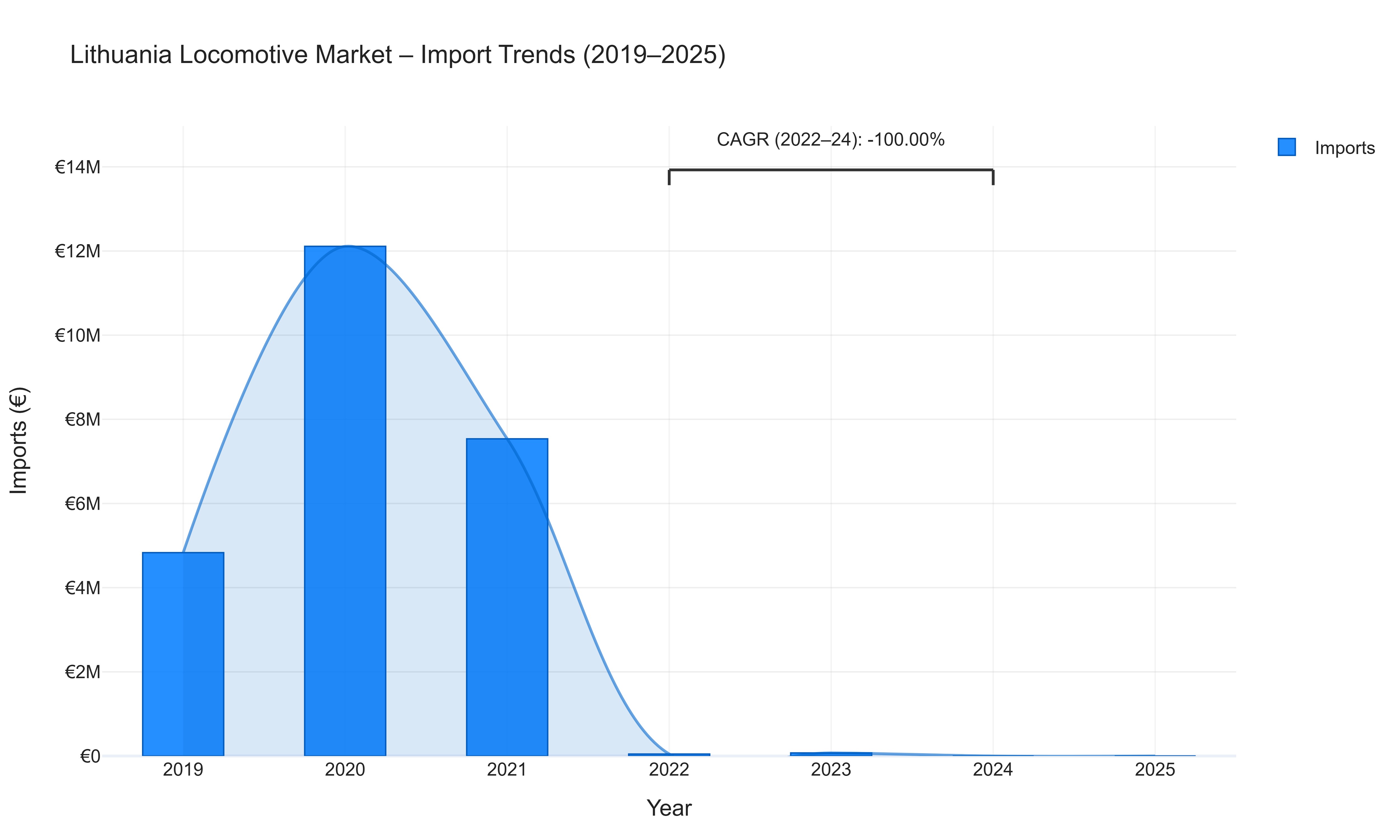
In the Lithuania Locomotive Market, Import Values exhibited significant fluctuations over the past five years. The Import Value surged from €4.83 million in 2019 to €12.11 million in 2020, marking a remarkable growth of 150.61%. However, this growth trend reversed sharply in the following years, with Import Values plummeting to €47.24 thousand in 2022, a decline of 99.37%. The subsequent recovery to €73.24 thousand in 2023 represented a growth of 55.05%. These fluctuations can be attributed to various factors such as supply chain disruptions, changing demand dynamics, and possibly regulatory changes impacting import volumes. The calculated Compound Annual Growth Rate (CAGR) of -100.00% for the period 2022-2024 indicates a complete reversal in the import trend, reflecting a challenging market environment or a potential shift in sourcing strategies within the industry.
Key Highlights of the Report:
- Lithuania Locomotive Market Outlook
- Market Size of Lithuania Locomotive Market, 2024
- Forecast of Lithuania Locomotive Market, 2031
- Historical Data and Forecast of Lithuania Locomotive Revenues & Volume for the Period 2021-2031
- Lithuania Locomotive Market Trend Evolution
- Lithuania Locomotive Market Drivers and Challenges
- Lithuania Locomotive Price Trends
- Lithuania Locomotive Porter`s Five Forces
- Lithuania Locomotive Industry Life Cycle
- Historical Data and Forecast of Lithuania Locomotive Market Revenues & Volume By Technology Type for the Period 2021-2031
- Historical Data and Forecast of Lithuania Locomotive Market Revenues & Volume By IGBT Module for the Period 2021-2031
- Historical Data and Forecast of Lithuania Locomotive Market Revenues & Volume By GTO Thyristor for the Period 2021-2031
- Historical Data and Forecast of Lithuania Locomotive Market Revenues & Volume By SiC Module for the Period 2021-2031
- Historical Data and Forecast of Lithuania Locomotive Market Revenues & Volume By Propulsion Type for the Period 2021-2031
- Historical Data and Forecast of Lithuania Locomotive Market Revenues & Volume By Diesel for the Period 2021-2031
- Historical Data and Forecast of Lithuania Locomotive Market Revenues & Volume By Electric for the Period 2021-2031
- Lithuania Locomotive Import Export Trade Statistics
- Market Opportunity Assessment By Technology Type
- Market Opportunity Assessment By Propulsion Type
- Lithuania Locomotive Top Companies Market Share
- Lithuania Locomotive Competitive Benchmarking By Technical and Operational Parameters
- Lithuania Locomotive Company Profiles
- Lithuania Locomotive Key Strategic Recommendations






































