Luxembourg Atomic Clock Market Size (2020-2030)
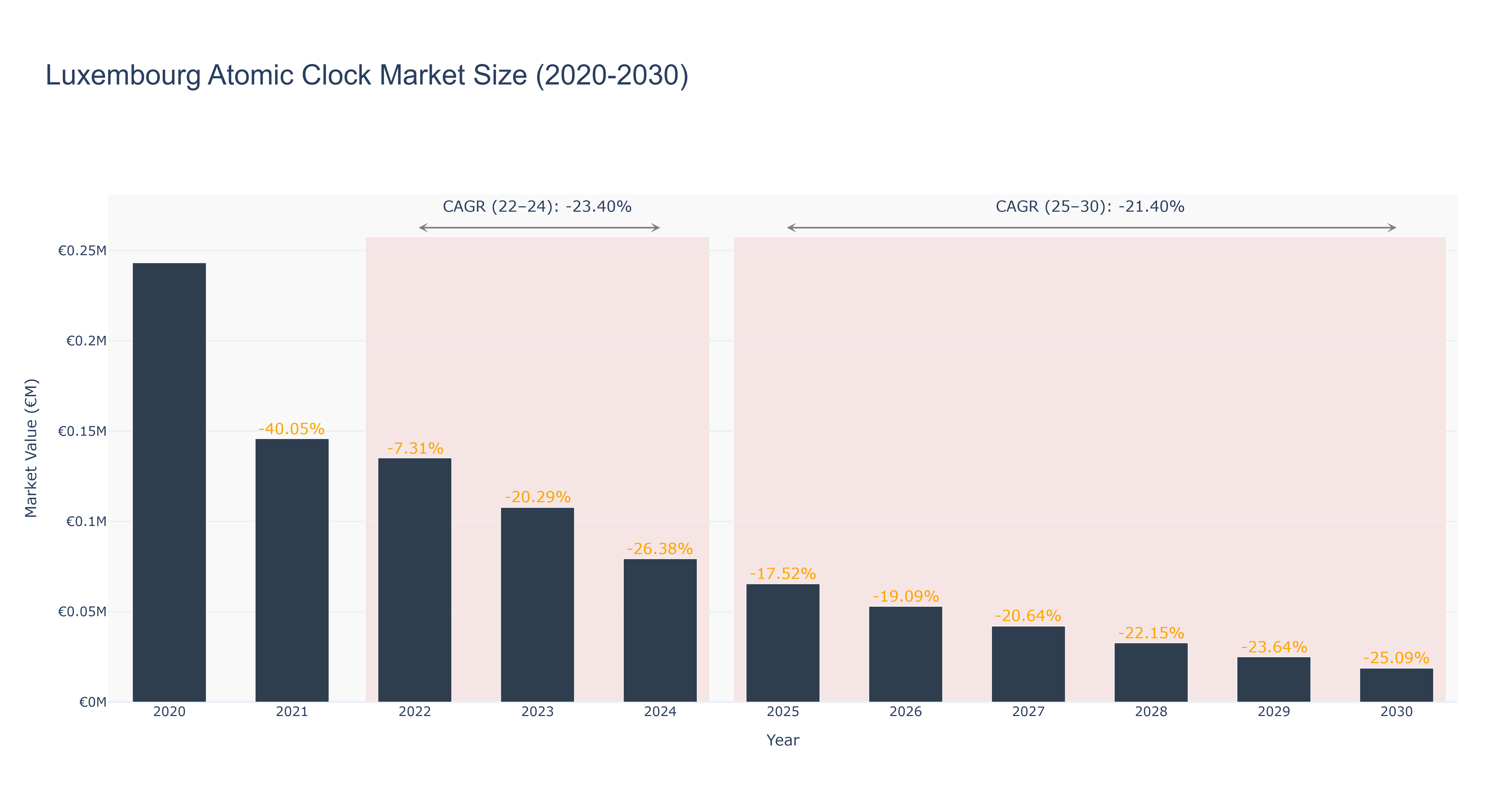
The Luxembourg Atomic Clock Market reached its peak market size of €243.19 thousand in 2020; however, it has since experienced a significant decline, with actual market sizes falling to €135.12 thousand in 2022 and €79.29 thousand in 2024, reflecting a CAGR of -23.40% during this period. The downward trend continues into the forecasted years, with projected market sizes decreasing to €65.40 thousand by 2025 and further to €18.70 thousand by 2030, indicating a CAGR of -21.40%. This decline can be attributed to factors such as reduced investment in precision timing technologies and competition from alternative technologies. Furthermore, the market may face challenges due to limited domestic demand and constrained research funding. While specific upcoming projects are not highlighted, broader macroeconomic trends suggest a pressing need for advancements in telecommunications and satellite systems, which could influence future growth prospects in this niche market.
Luxembourg Atomic Clock Market: Production & Trade Performance (2019-2025)
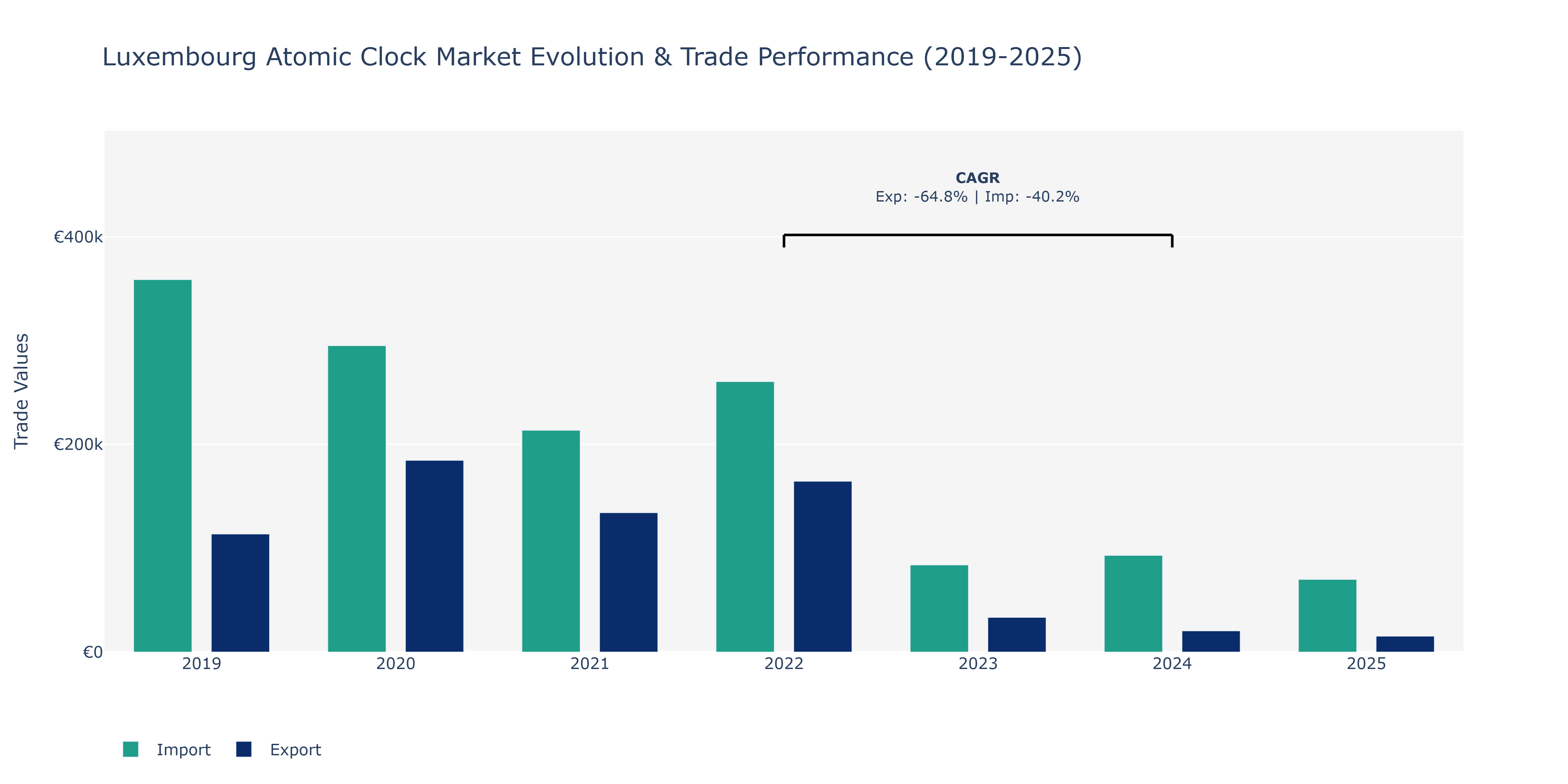
In the Luxembourg Atomic Clock Market, exports and imports exhibited notable fluctuations over the years. In 2019, imports surpassed exports significantly, with imports at €358.81 thousand and exports at €113.67 thousand. However, by 2021, both exports and imports experienced a decline, with exports decreasing to €134.24 thousand and imports to €213.6 thousand. The market saw a substantial peak in exports in 2020, reaching €184.66 thousand, while imports decreased to €295.12 thousand in the same year. Interestingly, there was a sharp decline in exports and imports in 2023, with exports at €33.37 thousand and imports at €83.86 thousand. This decline may be attributed to global economic factors affecting trade patterns within the industry. The subsequent recovery in 2024, where exports slightly increased to €20.36 thousand and imports to €93.06 thousand, could indicate market stabilization or strategic shifts in supply chain dynamics. The decline in export and import values in 2025 to €15.3 thousand and €69.96 thousand, respectively, may suggest ongoing market adjustments or shifts in consumer demand for atomic clock technologies. These fluctuations could be driven by evolving technological advancements, changes in global trade policies, or shifts in consumer preferences for precision timekeeping solutions.
Key Highlights of the Report:
- Luxembourg Atomic Clock Market Outlook
- Market Size of Luxembourg Atomic Clock Market, 2025
- Forecast of Luxembourg Atomic Clock Market, 2032
- Historical Data and Forecast of Luxembourg Atomic Clock Revenues & Volume for the Period 2022-2032F
- Luxembourg Atomic Clock Market Trend Evolution
- Luxembourg Atomic Clock Market Drivers and Challenges
- Luxembourg Atomic Clock Price Trends
- Luxembourg Atomic Clock Porter's Five Forces
- Luxembourg Atomic Clock Industry Life Cycle
- Historical Data and Forecast of Luxembourg Atomic Clock Market Revenues & Volume By Type for the Period 2022-2032F
- Historical Data and Forecast of Luxembourg Atomic Clock Market Revenues & Volume By Cesium Atomic Clock for the Period 2022-2032F
- Historical Data and Forecast of Luxembourg Atomic Clock Market Revenues & Volume By Hydrogen Atomic Clock for the Period 2022-2032F
- Historical Data and Forecast of Luxembourg Atomic Clock Market Revenues & Volume By Rubidium Atomic Clock for the Period 2022-2032F
- Luxembourg Atomic Clock Import Export Trade Statistics
- Market Opportunity Assessment By Type
- Luxembourg Atomic Clock Top Companies Market Share
- Luxembourg Atomic Clock Competitive Benchmarking By Technical and Operational Parameters
- Luxembourg Atomic Clock Company Profiles
- Luxembourg Atomic Clock Key Strategic Recommendations






































