Malaysia Aquaculture Market Size, Share & Growth Rate
The Malaysia Aquaculture Market was estimated at USD 450 Million in 2025 and is projected to reach USD 586 Million by 2032, growing at a CAGR of 3.8% from 2026 to 2032. This growth trajectory is supported by Malaysia's extensive coastline and a burgeoning demand for seafood both domestically and abroad. As the global appetite for sustainable seafood options rises, the countrys innovative aquaculture practices are set to play a pivotal role in meeting this demand.
Malaysia Aquaculture Market Year-wise Growth Rate and Key Drivers
This graph highlights how the Malaysia Aquaculture Market has steadily grown over the years, supported by major growth factors.
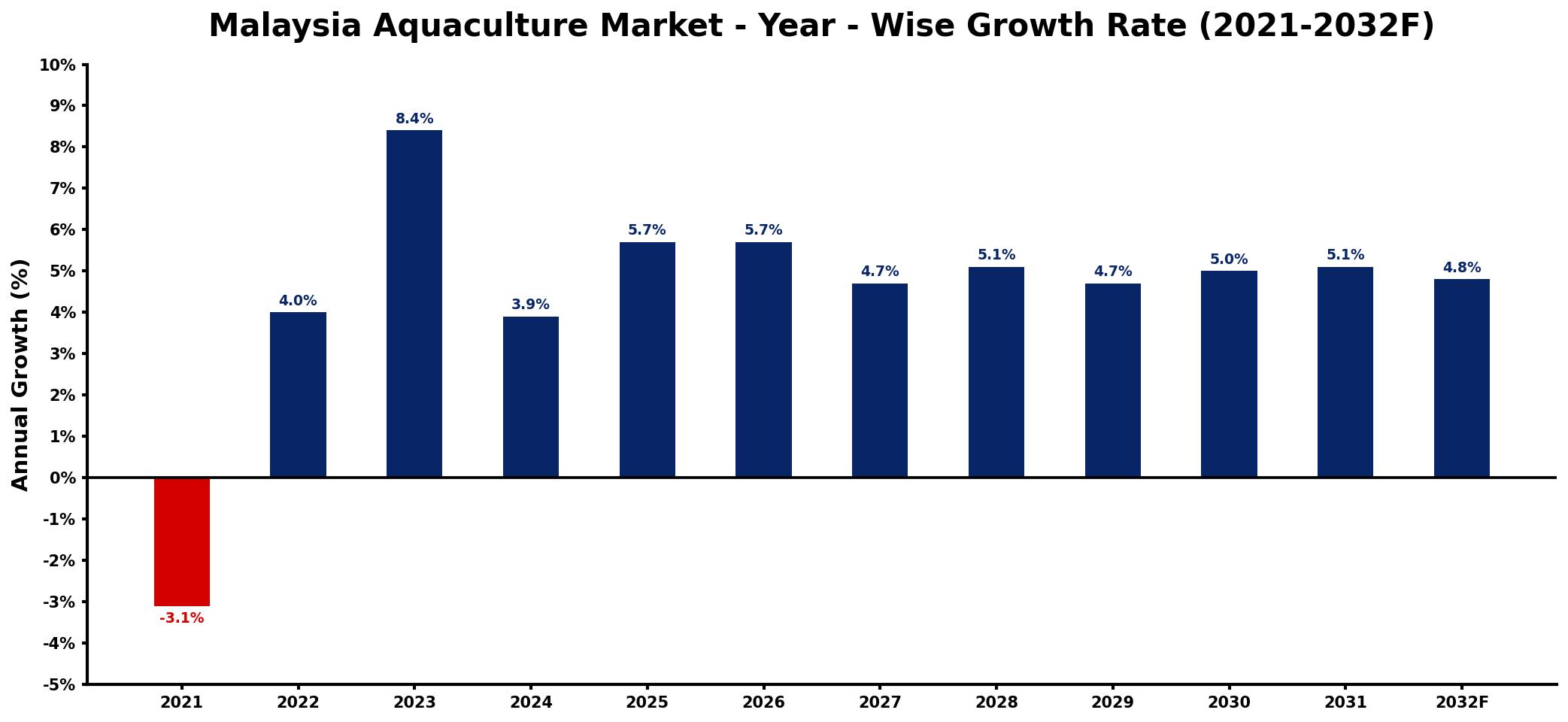
The table below presents the year‑wise growth rates along with the key drivers influencing the market
| Year | Growth Rate | Major Drivers |
| 2021 | -3.1% | Decreased consumer spending on seafood |
| 2022 | 4.0% | Rising health awareness among consumers |
| 2023 | 8.4% | Increased investment in technology |
| 2024 | 3.9% | Growing demand for sustainable practices |
| 2025 | 5.7% | Expansion of export markets globally |
| 2026 | 5.7% | Higher consumer preference for local |
| 2027 | 4.7% | Enhanced supply chain efficiencies emerging |
| 2028 | 5.1% | Strengthening partnerships with retailers |
| 2029 | 4.7% | Adoption of innovative farming techniques |
| 2030 | 5.0% | Diversification into new species |
| 2031 | 5.1% | Increased focus on quality assurance |
| 2032 | 4.8% | Growing popularity of online sales |
Note: Market size estimations and growth projections presented in this report are based on 6Wresearch's proprietary forecasting methodology, utilizing the latest available industry data, government publications, and primary research inputs.
Malaysia Aquaculture Market Synopsis
In Malaysia, aquaculture has become an essential pillar of the food production system, particularly in the context of rising seafood consumption. The cultivation of species like shrimp and various fish types is not just a source of nutrition but also a critical economic driver, providing jobs and supporting rural communities.
Sustainable aquaculture practices are gaining traction in the region, as stakeholders increasingly recognize the importance of environmental stewardship. This shift is complemented by significant investments from both the government and private sectors aimed at enhancing infrastructure and promoting research, ensuring long-term viability for the industry.
Malaysia Aquaculture Market Key Takeaways
- Malaysia is experiencing a steady increase in aquaculture production, bolstered by its extensive coastline.
- Government support and investment in aquaculture infrastructure are pivotal for market growth.
- Rising global demand for sustainable seafood aligns perfectly with Malaysias aquaculture capabilities.
- Technological advancements in aquaculture management enhance operational efficiency and productivity.
- Export opportunities, particularly within the Asia-Pacific region, continue to expand significantly.
Evaluation of Restraints in Malaysia Aquaculture Market
Despite its promising outlook, the Malaysia aquaculture sector faces various challenges that could impede growth. Water quality management remains a critical concern, with pollution and resource management posing significant risks to production. Additionally, disease outbreaks can severely impact fish and shrimp populations, resulting in economic losses. Regulatory compliance is another hurdle; ensuring adherence to local and international standards requires ongoing investments in training and infrastructure. Addressing these limitations through innovative solutions and technologies will be crucial for unlocking the market's full potential.
Malaysia Aquaculture Market Trends
Current trends indicate a strong movement towards the adoption of sustainable aquaculture practices. Consumer preferences are shifting dramatically towards ethically sourced seafood, prompting producers to adapt accordingly. Additionally, advancements in aquaculture technology, such as automated feeding systems and water quality monitoring tools, are gaining traction. These innovations not only improve operational efficiency but also enhance the sustainability of aquaculture practices.
Malaysia Aquaculture Market Opportunities
The genuine growth opportunities in the Malaysia aquaculture market lie within the realm of sustainability and innovation. There is substantial potential for businesses that invest in research and development to enhance aquaculture practices. Expanding into value-added products, such as processed seafood, presents another avenue for growth. Furthermore, partnerships with international markets for seafood export can capitalize on Malaysia's geographical advantages, enhancing its competitive edge.
Government Initiatives in the Malaysia Aquaculture Market
The Malaysian government is actively fostering the growth of the aquaculture sector through various initiatives. These include investments in research and development to advance aquaculture technologies and practices, as well as funding programs aimed at improving infrastructure. Furthermore, policies promoting sustainable aquaculture methods are being implemented to ensure the long-term viability of the industry. Such support is essential for positioning Malaysia as a leading player in the global seafood market.
Future Insights of the Malaysia Aquaculture Market
Looking ahead to 2026-2032, the Malaysia aquaculture market is poised for robust growth, driven by the increasing global seafood consumption trend and a clear focus on sustainability. As producers embrace advanced technologies and respond to changing consumer demands, the market is likely to witness further evolution. The integration of sustainable practices will not only enhance productivity but also strengthen Malaysia's position as a key player in the international seafood trade.
Malaysia Aquaculture Market Latest Developments (2025 - 2026)
Recent developments in the Malaysia aquaculture market highlight a shift towards greater sustainability and innovation. Key industry stakeholders have begun implementing new technology to enhance farm productivity and reduce environmental impact. Additionally, collaborations between government bodies and private enterprises are becoming more common, focusing on research and development to create more resilient aquaculture systems. These trends indicate a robust direction for the industry as it adapts to global demands.
Malaysia Aquaculture Market - Key Attractiveness of the Report
- 10 Years of Market Numbers
- Historical Data Starting from 2022 to 2025
- Base Year: 2025
- Forecast Data until 2032
- Key Performance Indicators Impacting the Market
- Major Upcoming Developments and Projects
Key Highlights of the Report:
- Malaysia Aquaculture Market Outlook
- Market Size of Malaysia Aquaculture Market, 2025
- Forecast of Malaysia Aquaculture Market, 2032
- Historical Data and Forecast of Malaysia Aquaculture Revenues & Volume for the Period 2022-2032F
- Malaysia Aquaculture Market Trend Evolution
- Malaysia Aquaculture Market Drivers and Challenges
- Malaysia Aquaculture Price Trends
- Malaysia Aquaculture Porter's Five Forces
- Malaysia Aquaculture Industry Life Cycle
- Historical Data and Forecast of Malaysia Aquaculture Market Revenues & Volume By Environment for the Period 2022-2032F
- Historical Data and Forecast of Malaysia Aquaculture Market Revenues & Volume By Marine Water for the Period 2022-2032F
- Historical Data and Forecast of Malaysia Aquaculture Market Revenues & Volume By Fresh Water for the Period 2022-2032F
- Historical Data and Forecast of Malaysia Aquaculture Market Revenues & Volume By Brackish Water for the Period 2022-2032F
- Historical Data and Forecast of Malaysia Aquaculture Market Revenues & Volume By Fish Type for the Period 2022-2032F
- Historical Data and Forecast of Malaysia Aquaculture Market Revenues & Volume By Carps for the Period 2022-2032F
- Historical Data and Forecast of Malaysia Aquaculture Market Revenues & Volume By Mollusks for the Period 2022-2032F
- Historical Data and Forecast of Malaysia Aquaculture Market Revenues & Volume By Crustaceans for the Period 2022-2032F
- Historical Data and Forecast of Malaysia Aquaculture Market Revenues & Volume By Mackerel for the Period 2022-2032F
- Historical Data and Forecast of Malaysia Aquaculture Market Revenues & Volume By Sea bream for the Period 2022-2032F
- Historical Data and Forecast of Malaysia Aquaculture Market Revenues & Volume By Others for the Period 2022-2032F
- Malaysia Aquaculture Import Export Trade Statistics
- Market Opportunity Assessment By Environment
- Market Opportunity Assessment By Fish Type
- Malaysia Aquaculture Top Companies Market Share
- Malaysia Aquaculture Competitive Benchmarking By Technical and Operational Parameters
- Malaysia Aquaculture Company Profiles
- Malaysia Aquaculture Key Strategic Recommendations






































