Malaysia Bricks and Blocks Market Summary
The malaysia bricks and blocks market was estimated at USD 373 Million in 2025 and is projected to reach USD 486 Million by 2032, growing at a CAGR of 5.1% from 2026 to 2032.
Malaysia Bricks and Blocks Market Year-wise Growth Rate and Key Drivers
This graph highlights how the Malaysia Bricks and Blocks Market has steadily grown over the past five years, supported by major growth factors.
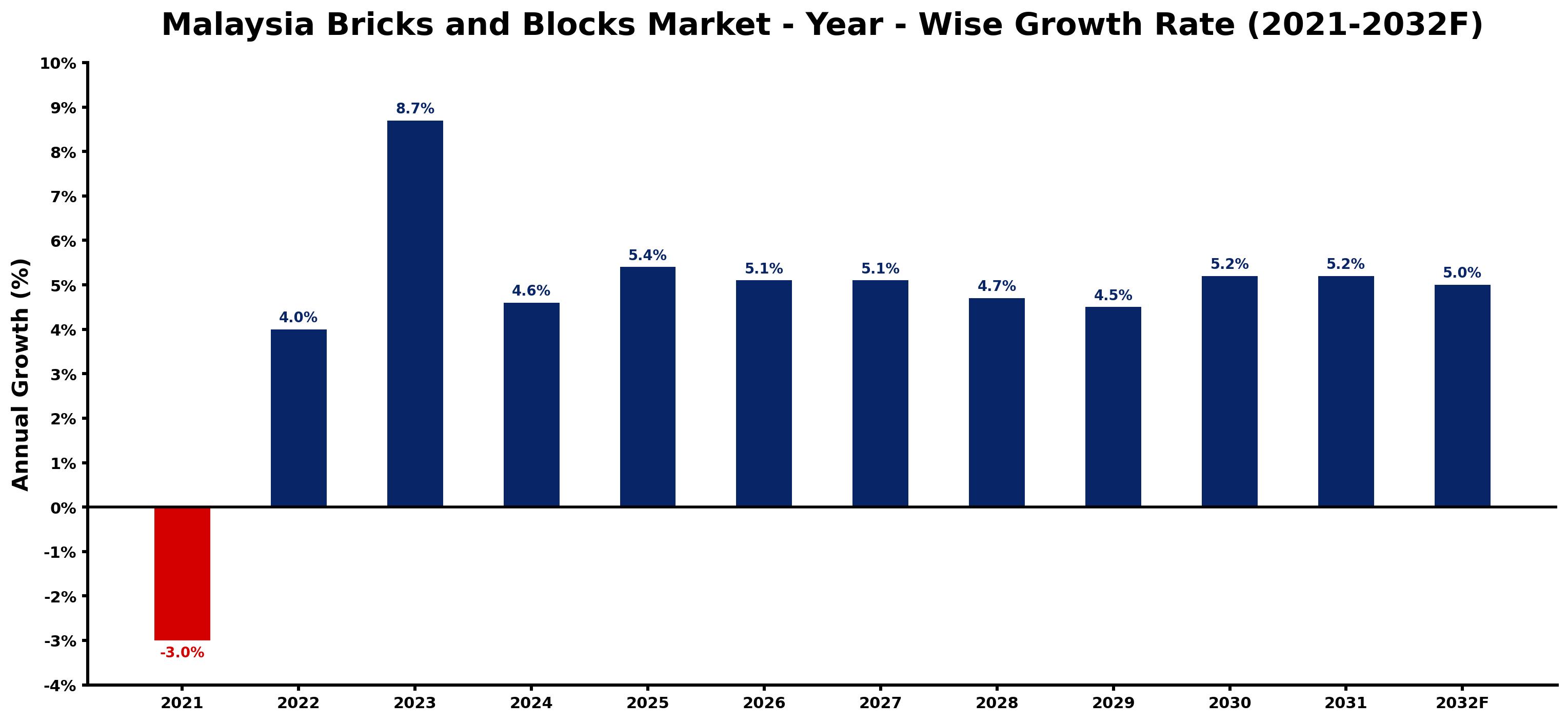
The table below presents the year wise growth rates along with the key drivers influencing the market
| Year | Growth Rate | Major Drivers |
| 2021 | -3.0% | Unforeseen construction delays and project cancellations diminished demand for bricks and blocks in the construction sector. |
| 2022 | 4.0% | Urbanization trends led to increased housing developments in major Malaysian cities. |
| 2023 | 8.7% | Infrastructure investments aimed at improving transportation networks bolstered brick and block usage. |
| 2024 | 4.6% | Local manufacturers expanded capacity to meet rising construction sector needs effectively. |
| 2025 | 5.4% | Shift towards eco-friendly building materials encouraged innovation in block production processes. |
| 2026 | 5.1% | Home improvement projects gained popularity, increasing sales of bricks and blocks. |
| 2027 | 5.1% | Rural development initiatives prompted a spike in demand for affordable housing solutions. |
| 2028 | 4.7% | Technological integration in construction methods improved efficiency in bricklaying practices. |
| 2029 | 4.5% | Strong government support for green building standards influenced material selection in projects. |
| 2030 | 5.2% | Emerging trends in modular construction methods boosted the popularity of pre-cast blocks. |
| 2031 | 5.2% | Increased foreign investment in construction firms enhanced market competitiveness and innovation. |
| 2032 | 5.0% | Sustainable urban living concepts gained traction, driving demand for energy-efficient building materials. |
Note - Market size estimations and growth projections presented in this report are based on 6Wresearch's advanced forecasting approach, validated with industry datasets as of June 2026.
Malaysia Bricks and Blocks Market Synopsis
The Malaysia Bricks and Blocks Market is projected to reach 5.1% and witness significant growth during the forecast period (2026-2032). This growth trajectory is underscored by the increasing urbanization rates and a burgeoning population, both of which are catalyzing demand for durable and cost-effective construction materials. The market has benefitted from a decade of robust expansion in production capacities, positioning it as one of the more mature segments within South East Asia. The escalating demand for bricks and blocks can be attributed to their inherent characteristics such as affordability, availability, and excellent fire resistance, making them favorable for a myriad of construction applications.
Malaysia Bricks and Blocks Market Growth Drivers
Several key factors are driving the growth of the Malaysia Bricks and Blocks Market. Firstly, the rapid pace of urbanization across the nation is leading to an increased need for housing and commercial spaces, thereby fostering the demand for bricks and blocks. Secondly, technological advancements in production processes have significantly improved efficiency and reduced costs, allowing manufacturers to cater to both urban and rural markets.
- The rise in population density in urban areas has amplified the necessity for sustainable building materials, with bricks and blocks fulfilling this requirement efficiently.
- Government initiatives aimed at promoting affordable housing are further driving the construction sector, thus enhancing demand for bricks and blocks.
- As construction standards evolve, the durability and fire resistance properties of bricks and blocks make them a preferred choice among builders and architects.
- Increased awareness regarding energy-efficient and sustainable building practices has led to a preference for bricks and blocks, as they contribute to better thermal insulation compared to alternative materials.
- Market players are increasingly adopting innovative technologies to expand their production capabilities and reduce environmental footprints, further stimulating market growth.
Malaysia Bricks and Blocks Market Challenges and Restraints
Despite the positive growth trajectory, the Malaysia Bricks and Blocks Market faces several challenges that could hinder its long-term potential. A significant constraint is the shortage of skilled labor, which leads to project delays and potentially escalates construction costs. Furthermore, there are stringent environmental regulations that can restrict the adoption of advanced manufacturing technologies, thereby limiting operational efficiencies.
- The limited availability of skilled labor can result in inefficiencies in production and construction, negatively impacting project timelines and costs.
- Environmental regulations aimed at promoting sustainable practices often necessitate investment in cleaner technologies, which may not be feasible for all manufacturers.
- Competition from alternative building materials, which may offer lower initial costs, poses a challenge to the traditional bricks and blocks sector.
- Market volatility in raw material prices can also affect production costs, leading to unpredictability in pricing strategies.
- Additionally, increased consumer preferences for eco-friendly building solutions could compel manufacturers to adapt quickly to changing market demands, which may prove challenging.
Malaysia Bricks and Blocks Market Government Investment and Initiatives
The Malaysian government has been proactive in encouraging development within the construction sector, which greatly influences the Malaysia Bricks and Blocks Market. Various public investments and initiatives are aimed at enhancing infrastructure and promoting affordable housing projects. The government is also actively involved in formulating policies that support sustainable construction practices.
- Investment in public infrastructure projects such as transportation and utilities is expected to propel the need for bricks and blocks in construction.
- Government incentives for green building initiatives encourage the adoption of eco-friendly practices, indirectly benefiting the bricks and blocks industry.
- Public spending on urban development has accelerated, leading to increased demand for construction materials.
- Regulatory frameworks aimed at promoting sustainable materials are facilitating the transition towards more environmentally friendly building practices.
- Government partnerships with private sector players are fostering innovation in manufacturing processes, enhancing overall industry competitiveness.
Malaysia Bricks and Blocks Market Latest Developments (May 2025 - June 2026)
In the period stretching from May 2025 to June 2026, the Malaysia Bricks and Blocks Market has seen several notable developments. Advances in production technologies have further optimized the efficiency of brick manufacturing, catering to the growing construction sector's demands. Industry players are increasingly focusing on sustainability, leading to the adoption of more eco-friendly production methods. Additionally, there has been a noticeable shift in consumer preferences towards materials that meet higher environmental standards.
- Several manufacturers have embarked on upgrading their production facilities to incorporate modern technology, aiming for enhanced efficiency and reduced waste.
- New partnerships have formed within the industry to address challenges associated with skilled labor shortages and production delays.
- Market players are holding workshops and training sessions to develop a more skilled workforce, thereby improving construction timelines and quality.
- The popularity of modular construction techniques is gaining traction, and bricks and blocks are being integrated into these innovative building practices.
- Increased dialogue between the government and industry stakeholders has led to a more favorable regulatory environment for the bricks and blocks market.
Malaysia Bricks and Blocks Market - Key Attractiveness of the Report
- 10 Years of Market Numbers
- Historical Data Starting from 2022 to 2025
- Base Year: 2025
- Forecast Data until 2032
- Key Performance Indicators Impacting the Market
- Major Upcoming Developments and Projects
Key Highlights of the Report:
- Malaysia Bricks and Blocks Market Outlook
- Market Size of Malaysia Bricks and Blocks Market, 2025
- Forecast of Malaysia Bricks and Blocks Market, 2032F
- Historical Data and Forecast of Malaysia Bricks and Blocks Revenues & Volume for the Period 2022-2032F
- Malaysia Bricks and Blocks Market Trend Evolution
- Malaysia Bricks and Blocks Market Drivers and Challenges
- Malaysia Bricks and Blocks Price Trends
- Malaysia Bricks and Blocks Porter's Five Forces
- Malaysia Bricks and Blocks Industry Life Cycle
- Historical Data and Forecast of Malaysia Bricks and Blocks Market Revenues & Volume By Type for the Period 2022-2032F
- Historical Data and Forecast of Malaysia Bricks and Blocks Market Revenues & Volume By Clay Bricks for the Period 2022-2032F
- Historical Data and Forecast of Malaysia Bricks and Blocks Market Revenues & Volume By Concrete Bricks and Blocks for the Period 2022-2032F
- Historical Data and Forecast of Malaysia Bricks and Blocks Market Revenues & Volume By Calcium Silicate Bricks for the Period 2022-2032F
- Historical Data and Forecast of Malaysia Bricks and Blocks Market Revenues & Volume By Autoclaved Aerated Concrete for the Period 2022-2032F
- Historical Data and Forecast of Malaysia Bricks and Blocks Market Revenues & Volume By Others for the Period 2022-2032F
- Historical Data and Forecast of Malaysia Bricks and Blocks Market Revenues & Volume By Applications for the Period 2022-2032F
- Historical Data and Forecast of Malaysia Bricks and Blocks Market Revenues & Volume By Building for the Period 2022-2032F
- Historical Data and Forecast of Malaysia Bricks and Blocks Market Revenues & Volume By Path for the Period 2022-2032F
- Historical Data and Forecast of Malaysia Bricks and Blocks Market Revenues & Volume By Parterre for the Period 2022-2032F
- Historical Data and Forecast of Malaysia Bricks and Blocks Market Revenues & Volume By Other for the Period 2022-2032F
- Malaysia Bricks and Blocks Import Export Trade Statistics
- Market Opportunity Assessment By Type
- Market Opportunity Assessment By Applications
- Malaysia Bricks and Blocks Top Companies Market Share
- Malaysia Bricks and Blocks Competitive Benchmarking By Technical and Operational Parameters
- Malaysia Bricks and Blocks Company Profiles
- Malaysia Bricks and Blocks Key Strategic Recommendations






































