Malaysia Building Energy Management Systems Market | Country-Wise Share and Competition Analysis
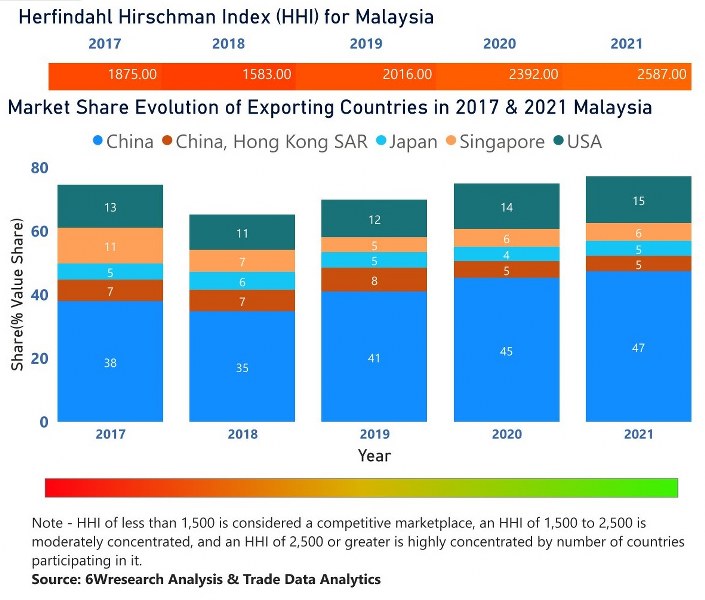
In the year 2021, China was the largest exporter in terms of value, followed by Japan. It has registered a growth of 34.38% over the previous year. While Japan registered a growth of 38.58% as compared to the previous year. In the year 2017, China was the largest exporter followed by Japan. In terms of the Herfindahl Index, which measures the competitiveness of countries exporting, Malaysia has the Herfindahl index of 2015 in 2017 which signifies moderately concentrated also in 2021 it registered a Herfindahl index of 1893 which signifies moderately concentrated in the market.
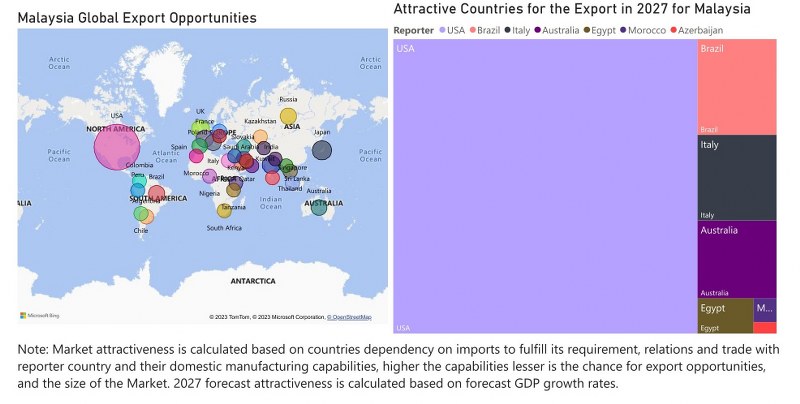
 Malaysia Building Energy Management Systems Market - Export Market Opportunities
Malaysia Building Energy Management System Market Highlights
| Report Name | Malaysia Building Energy Management System Market |
| Forecast period | 2025-2031 |
| CAGR | 7.6% |
| Growing Sector | Industrial Buildings |
Topics Covered in the Malaysia Building Energy Management System Market Report
The Malaysia Building Energy Management System (BEMS) Market report provides a detailed analysis based on components & services, applications, technology, and end-users. It explores key drivers, investment opportunities, and regulatory frameworks to assist stakeholders in strategic decision-making.
Malaysia Building Energy Management System Market Synopsis
The Malaysia BEMS market is expanding due to the increasing focus on energy efficiency, rising electricity costs, and government initiatives promoting sustainable infrastructure. The adoption of smart energy solutions is driven by rapid urbanization and advancements in building automation technologies. However, high initial costs and a lack of technical expertise may slow down market penetration.
According to 6Wresearch, the Malaysia BEMS Market is expected to grow at a CAGR of 7.6% during the forecast period 2025-2031. The demand for energy conservation and sustainability in commercial and industrial buildings is driving market expansion. The integration of IoT, AI, and automation in energy management systems enhances efficiency and reduces operational costs.
Despite strong growth potential, market challenges such as limited awareness of BEMS benefits and inconsistencies in regulatory policies persist. Addressing these concerns through awareness campaigns and incentive programs will be crucial for further market development.
Malaysia Building Energy Management System Market Trends
Key trends influencing the market include:
- IoT and AI Integration: Smart energy monitoring and automated controls are improving efficiency.
- Renewable Energy Integration: BEMS solutions are increasingly designed to support solar and wind power.
- Cloud-Based Energy Management: Remote monitoring capabilities are enhancing flexibility and cost savings.
- Government-Led Sustainability Policies: Incentives and regulatory support are driving energy-efficient building adoption.
Investment Opportunities in the Malaysia BEMS Market
Key investment areas include:
- Smart Energy Solutions for Commercial Spaces: Offices, shopping malls, and hotels are adopting BEMS solutions.
- Technical Training and Workforce Development: Enhancing expertise in BEMS implementation and maintenance.
- Affordable and Scalable BEMS Solutions: Supporting small businesses and residential sectors with cost-effective options.
Leading Players in the Malaysia BEMS Market
Key players include Schneider Electric, Honeywell, Siemens, Johnson Controls, ABB, and Eaton. These companies focus on innovation, strategic partnerships, and expanding their presence in emerging markets.
Government Regulations in the Malaysia BEMS Market
The Malaysian government has introduced energy efficiency regulations, including mandatory energy audits for large buildings and incentives for adopting sustainable technologies. Compliance with Malaysia’s Energy Efficiency and Conservation Act (EECA) supports the adoption of BEMS solutions, promoting a greener and more sustainable energy landscape.
Future Insights of the Malaysia BEMS Market
The future of the Malaysia BEMS market is promising, driven by technological advancements, increasing awareness of energy conservation, and continued government support. The integration of AI, IoT, and machine learning will revolutionize energy management, making BEMS solutions more adaptive and efficient. Additionally, the growing adoption of green buildings and sustainable infrastructure will further propel market demand.
Market Segmentation Analysis
The report provides insights into the following segments:
Software to Dominate the Market – By Component & Service
According to Parth, Senior Research Analyst at 6Wresearch, Software solutions are the leading segment in Malaysia’s BEMS market, enabling real-time energy monitoring, predictive analytics, and automation. Cloud-based platforms are increasing accessibility and affordability.
Wireless to Dominate the Market – By Technology
Wireless technology is gaining traction due to its cost-effectiveness and ease of installation. Wireless BEMS solutions provide seamless communication between devices, enabling efficient energy management.
Commercial to Dominate the Market – By End-Users
The commercial sector, including office buildings, retail centers, and hospitality establishments, is the key driver of BEMS adoption in Malaysia. Businesses are investing in smart energy solutions to optimize costs and comply with sustainability standards.
Lighting to Dominate the Market – By Applications
Smart lighting solutions are a primary application of BEMS in Malaysia. Automated lighting controls and AI-driven energy management are helping commercial and residential sectors reduce energy consumption and costs.
Key Attractiveness of the Report
- 10 Years Market Numbers.
- Historical Data Starting from 2021 to 2024.
- Base Year 2024.
- Forecast Data until 2031.
- Key Performance Indicators Impacting the Market.
- Major Upcoming Developments and Projects.
Key Highlights of the Report:
- Malaysia Building Energy Management System Market Overview
- Malaysia Building Energy Management System Market Outlook
- Malaysia Building Energy Management System Market Forecast
- Historical Data of Malaysia Building Energy Management System Market Revenues for the Period 2021-2031
- Malaysia Building Energy Management System Market Size and Forecast of Revenues, Until 2031
- Historical Data of Malaysia Building Energy Management System Market Revenues, by Components and Services, for the Period 2021-2031
- Market Size & Forecast of Malaysia Building Energy Management System Market Revenues, by Components and Services, until 2031
- Historical Data of Malaysia Building Energy Management System Market Revenues, by Technology, for the Period 2021-2031
- Market Size & Forecast of Malaysia Building Energy Management System Market Revenues, by Technology, until 2031
- Historical Data of Malaysia Building Energy Management System Market Revenues, by End-User, for the Period 2021-2031
- Market Size & Forecast of Malaysia Building Energy Management System Market Revenues, by End-User, until 2031
- Historical Data of Malaysia Building Energy Management System Market Revenues, by Application, for the Period 2021-2031
- Market Size & Forecast of Malaysia Building Energy Management System Market Revenues, by Application, until 2031
- Market Drivers and Restraints
- Malaysia Building Energy Management System Market Trends
- Market Opportunity Assessment
- Malaysia Building Energy Management System Market Share, By Players
- Malaysia Building Energy Management System Market Overview on Competitive Benchmarking
- Company Profiles
- Key Strategic Recommendations
Markets Covered
The Malaysia BEMS Market report provides a detailed analysis of the following market segments:
By Components & Services:
- Hardware
- Sensors
- Controllers
- Actuators
- Others
- Software
- Services
By Technology:
- Wired
- Wireless
By End-Users:
- Residential
- Commercial
- Industrial
By Applications:
- Space Heating
- Computers & Office Equipment
- Lighting
- Air Conditioners
- Others






































