Malaysia Deodorants and Anti-Perspirant Products Market Summary
The malaysia deodorants and anti-perspirant products market was estimated at USD 160 Million in 2025 and is projected to reach USD 207 Million by 2032, growing at a CAGR of 5.3% from 2026 to 2032.
Malaysia Deodorants and Anti-Perspirant Products Market Year-wise Growth Rate and Key Drivers
This graph highlights how the Malaysia Deodorants and Anti-Perspirant Products Market has steadily grown over the past five years, supported by major growth factors.
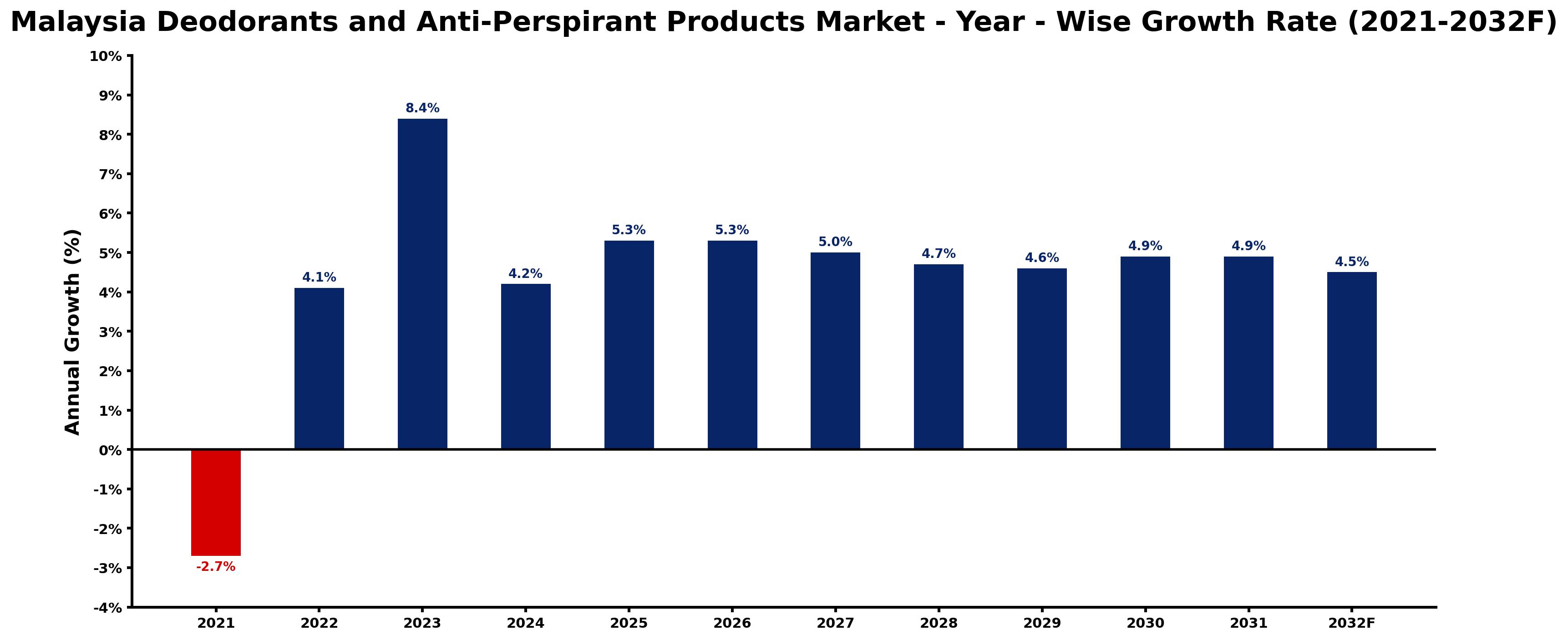
The table below presents the year wise growth rates along with the key drivers influencing the market
| Year | Growth Rate | Major Drivers |
| 2021 | -2.7% | Increased awareness of health concerns linked to certain deodorant ingredients led to declining consumer interest. |
| 2022 | 4.1% | Growing preference for natural and organic deodorants influenced product offerings significantly. |
| 2023 | 8.4% | Increased awareness regarding health benefits of aluminum-free anti-perspirants shaped market dynamics. |
| 2024 | 4.2% | Innovative packaging solutions improved consumer convenience and brand visibility in retail spaces. |
| 2025 | 5.3% | E-commerce platforms expanded accessibility, catering to diverse consumer preferences nationwide. |
| 2026 | 5.3% | Local brands began to capture market share through targeted marketing strategies and community engagement. |
| 2027 | 5.0% | Sustainability trends motivated brands to adopt eco-friendly production practices and materials. |
| 2028 | 4.7% | Rising urbanization encouraged higher purchasing power among consumers in metropolitan areas. |
| 2029 | 4.6% | Health-conscious consumers sought products with skin-soothing properties and hypoallergenic formulations. |
| 2030 | 4.9% | Increased focus on male grooming expanded the market for deodorants targeting male consumers. |
| 2031 | 4.9% | Collaborations between brands and influencers enhanced product reach and consumer trust. |
| 2032 | 4.5% | Integration of technology in product development led to smarter and customized deodorant solutions. |
Note - Market size estimations and growth projections presented in this report are based on 6Wresearch's advanced forecasting approach, validated with industry datasets as of June 2026.
Malaysia Deodorants and Anti-Perspirant Products Market Synopsis
The Malaysia Deodorants and Anti-Perspirant Products Market is projected to reach 5.3% and witness significant growth during the forecast period (2026-2032). This upward trend is primarily driven by the increasing health consciousness among consumers who are becoming more selective about the personal care products they use. Furthermore, rising disposable income allows individuals to invest more in premium and organic products. The demand for natural and organic deodorants is particularly notable, as more consumers prioritize ingredients that are perceived as safer and better for the environment.
Malaysia Deodorants and Anti-Perspirant Products Market Growth Drivers
Several key factors are propelling the growth of the Malaysia deodorants and anti-perspirant products market. Among these drivers is the heightened awareness of personal hygiene and grooming. As more consumers recognize the importance of maintaining body odor control, sales of deodorants and anti-perspirants are expected to increase. Additionally, the influence of social media trends significantly shapes consumer preferences, with influencers often promoting various personal care products.
- The rise in health consciousness has led consumers to prefer products that are chemical-free and cruelty-free.
- Higher disposable incomes in the Malaysian population enable greater spending on personal care and grooming products.
- Social media marketing strategies adopted by brands effectively engage younger demographics seeking innovative products.
- Collaborations between brands and influencers often drive launches of new products designed to appeal to specific consumer segments.
- Increased availability of natural and organic deodorants caters to consumers' desires for eco-friendly and sustainable options.
Malaysia Deodorants and Anti-Perspirant Products Market Trends and Opportunities
The Malaysia deodorants and anti-perspirant products market is witnessing several emerging trends that reflect shifting consumer preferences. The move toward natural and organic formulations is likely to continue as brands adapt to the growing demand for transparency in product ingredients. Additionally, the trend of unisex deodorants is gaining traction, reflecting contemporary views on gender and personal care.
- Innovative product formats, such as spray-on and roll-on, are being embraced for their convenience and ease of use.
- Brands are increasingly adopting sustainable packaging solutions in response to environmental concerns.
- Customized deodorant products tailored to individual needs, including skin types and scent preferences, are on the rise.
- Consumer interest in multi-functional products that provide added benefits, such as skin moisturization or antimicrobial properties, is expanding.
- Active lifestyle-focused deodorants that promise long-lasting performance for fitness enthusiasts are gaining popularity.
Malaysia Deodorants and Anti-Perspirant Products Market Challenges and Restraints
Despite the projections for robust growth, the Malaysia deodorants and anti-perspirant products market faces several challenges. One significant issue is the consumer skepticism surrounding the effectiveness and safety of chemical-based deodorants, leading some to seek alternative solutions. Moreover, price sensitivity among consumers could hinder the adoption of premium products.
- The increasing competition from unregulated local brands may impact the market share of established players.
- Concerns about skin irritation and allergies related to certain deodorant ingredients discourage some consumers.
- Market saturation with numerous product offerings makes it difficult for brands to differentiate themselves.
- Economic fluctuations can influence consumer spending patterns on non-essential personal care products.
- Regulatory challenges may arise as the government scrutinizes product formulations more closely to ensure safety and compliance.
Malaysia Deodorants and Anti-Perspirant Products Market Government Investment and Initiatives
The government is actively promoting initiatives that support the personal care industry, including the Malaysia deodorants and anti-perspirant products market. Policies aimed at fostering innovation and sustainability are becoming increasingly relevant, with incentives provided for companies that adopt environmentally friendly practices. Development plans focus on enhancing the production capabilities of local manufacturers while encouraging investments in research and development for new product formulations. Furthermore, public spending on health awareness campaigns is driving consumer interest in personal hygiene products, including deodorants and anti-perspirants.
Malaysia Deodorants and Anti-Perspirant Products Market Latest Developments (May 2025 - June 2026)
Recent developments in the Malaysia deodorants and anti-perspirant products market indicate a shift towards greater consumer engagement and product innovation. Companies are increasingly focused on launching new product lines that cater to specific consumer needs, such as hypoallergenic options and extended wear formulations. The popularity of e-commerce platforms has also accelerated, allowing brands to reach a wider audience and tailor marketing strategies to individual preferences. Additionally, sustainability initiatives are becoming core to brand messaging, driving several launches of eco-friendly deodorants.
Malaysia Deodorants and Anti-Perspirant Products Market - Key Attractiveness of the Report
- 10 Years of Market Numbers
- Historical Data Starting from 2022 to 2025
- Base Year: 2025
- Forecast Data until 2032
- Key Performance Indicators Impacting the Market
- Major Upcoming Developments and Projects
Key Highlights of the Report:
- Malaysia Deodorants and Anti-Perspirant Products Market Outlook
- Market Size of Malaysia Deodorants and Anti-Perspirant Products Market, 2025
- Forecast of Malaysia Deodorants and Anti-Perspirant Products Market, 2032F
- Historical Data and Forecast of Malaysia Deodorants and Anti-Perspirant Products Revenues & Volume for the Period 2022-2032F
- Malaysia Deodorants and Anti-Perspirant Products Market Trend Evolution
- Malaysia Deodorants and Anti-Perspirant Products Market Drivers and Challenges
- Malaysia Deodorants and Anti-Perspirant Products Price Trends
- Malaysia Deodorants and Anti-Perspirant Products Porter's Five Forces
- Malaysia Deodorants and Anti-Perspirant Products Industry Life Cycle
- Historical Data and Forecast of Malaysia Deodorants and Anti-Perspirant Products Market Revenues & Volume By Function for the Period 2022-2032F
- Historical Data and Forecast of Malaysia Deodorants and Anti-Perspirant Products Market Revenues & Volume By Aerosol Spray for the Period 2022-2032F
- Historical Data and Forecast of Malaysia Deodorants and Anti-Perspirant Products Market Revenues & Volume By Cream for the Period 2022-2032F
- Historical Data and Forecast of Malaysia Deodorants and Anti-Perspirant Products Market Revenues & Volume By Roll-On for the Period 2022-2032F
- Historical Data and Forecast of Malaysia Deodorants and Anti-Perspirant Products Market Revenues & Volume By Gel for the Period 2022-2032F
- Historical Data and Forecast of Malaysia Deodorants and Anti-Perspirant Products Market Revenues & Volume By Ingredient for the Period 2022-2032F
- Historical Data and Forecast of Malaysia Deodorants and Anti-Perspirant Products Market Revenues & Volume By Alcohol for the Period 2022-2032F
- Historical Data and Forecast of Malaysia Deodorants and Anti-Perspirant Products Market Revenues & Volume By Antimicrobials for the Period 2022-2032F
- Historical Data and Forecast of Malaysia Deodorants and Anti-Perspirant Products Market Revenues & Volume By Conditioner and Moisturizer for the Period 2022-2032F
- Historical Data and Forecast of Malaysia Deodorants and Anti-Perspirant Products Market Revenues & Volume By Fragrances for the Period 2022-2032F
- Historical Data and Forecast of Malaysia Deodorants and Anti-Perspirant Products Market Revenues & Volume By Paraben and Propellants for the Period 2022-2032F
- Historical Data and Forecast of Malaysia Deodorants and Anti-Perspirant Products Market Revenues & Volume By Others for the Period 2022-2032F
- Malaysia Deodorants and Anti-Perspirant Products Import Export Trade Statistics
- Market Opportunity Assessment By Function
- Market Opportunity Assessment By Ingredient
- Malaysia Deodorants and Anti-Perspirant Products Top Companies Market Share
- Malaysia Deodorants and Anti-Perspirant Products Competitive Benchmarking By Technical and Operational Parameters
- Malaysia Deodorants and Anti-Perspirant Products Company Profiles
- Malaysia Deodorants and Anti-Perspirant Products Key Strategic Recommendations






































