Malaysia Distilled Water Market Size, Share & Growth Rate
The Malaysia Distilled Water Market was estimated at USD 210 Million in 2025 and is projected to reach USD 272 Million by 2032, growing at a CAGR of 3.8% from 2026 to 2032. This upward trajectory is primarily fueled by a surge in health consciousness among consumers, who are increasingly concerned about the quality of water they consume. As urbanization continues and disposable incomes rise, the preference for pure, distilled water options in both residential and commercial sectors is anticipated to further drive market growth.
Malaysia Distilled Water Market Year-wise Growth Rate and Key Drivers
This graph highlights how the Malaysia Distilled Water Market has steadily grown over the years, supported by major growth factors.
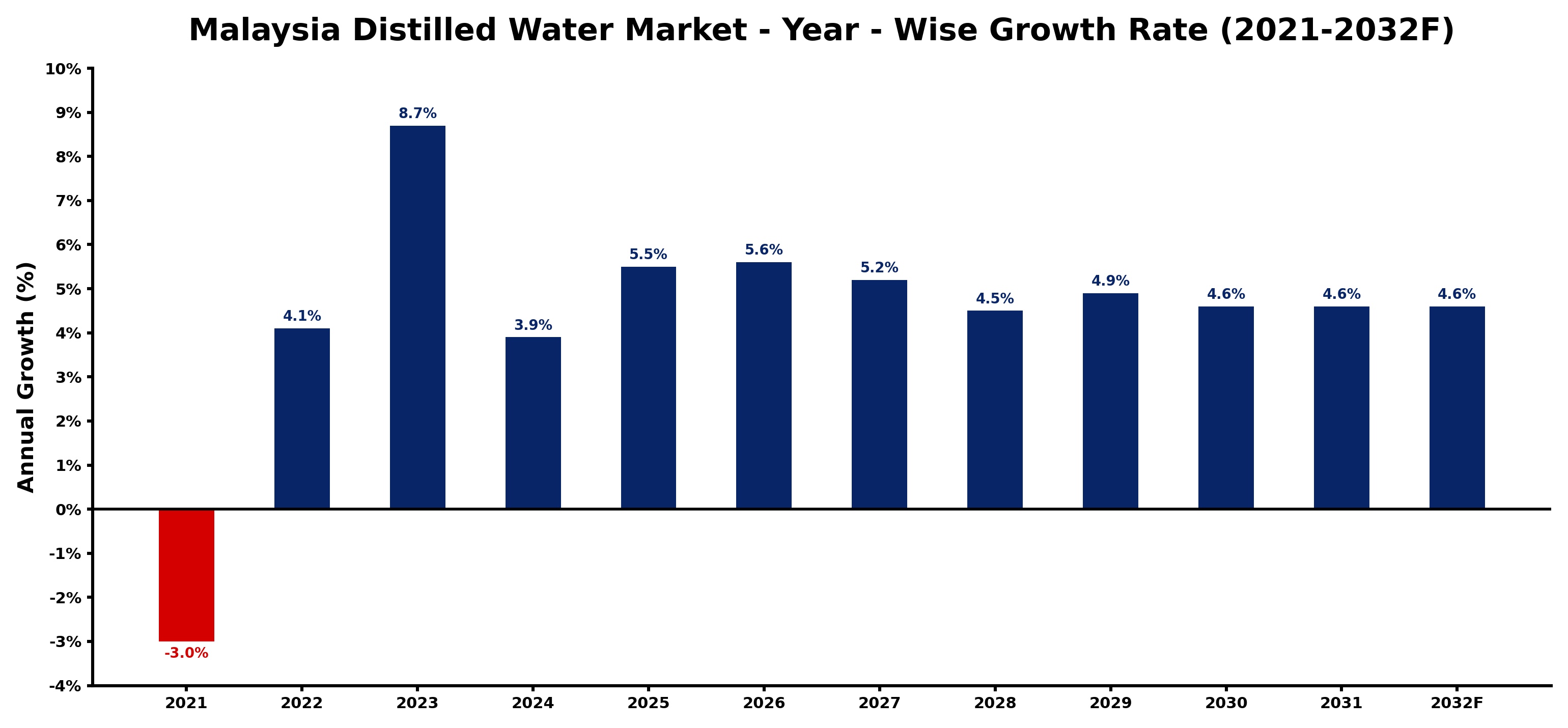
The table below presents the year‑wise growth rates along with the key drivers influencing the market
| Year | Growth Rate | Major Drivers |
| 2021 | -3.0% | Consumer demand for alternatives decreased |
| 2022 | 4.1% | Health awareness drove product demand |
| 2023 | 8.7% | Increased urbanization boosted consumption |
| 2024 | 3.9% | Sustainability trends enhanced market growth |
| 2025 | 5.5% | Technological advancements improved production |
| 2026 | 5.6% | Rising disposable incomes fueled purchases |
| 2027 | 5.2% | Corporate partnerships expanded distribution channels |
| 2028 | 4.5% | E-commerce growth enhanced accessibility |
| 2029 | 4.9% | Product innovation attracted new customers |
| 2030 | 4.6% | Environmental regulations encouraged quality focus |
| 2031 | 4.6% | Brand loyalty strengthened market position |
| 2032 | 4.6% | Consumer education improved product understanding |
Note - Market size estimations and growth projections presented in this report are based on 6Wresearch's advanced forecasting approach, validated with industry datasets as of June 2026.
Malaysia Distilled Water Market Synopsis
In recent years, the demand for distilled water in Malaysia has seen a noteworthy increase, largely propelled by growing awareness of water quality and its effects on health. Consumers are becoming more informed about the potential health risks associated with non-distilled drinking water, prompting a shift towards safer alternatives.
Additionally, the use of distilled water is not limited to everyday consumption; it plays a crucial role in various industrial applications, including healthcare and electronics manufacturing. As these sectors expand, they further elevate the demand for high-purity water, reinforcing the market's growth narrative.
Malaysia Distilled Water Market Key Takeaways
- The market is anticipated to reach USD 272 Million by 2032, driven by rising health awareness.
- Key industries propelling growth include healthcare, laboratories, and electronics manufacturing.
- Urban population growth and increasing disposable income are significant factors enhancing demand.
- High-quality standards and regulatory compliance remain central to production and distribution strategies.
- COVID-19 has shifted demand dynamics, particularly in healthcare, but recovery is expected as industries normalize.
Evaluation of Restraints in Malaysia Distilled Water Market
Despite the promising growth trajectory, the Malaysia Distilled Water Market faces several challenges that could impede its potential. Quality control is paramount, and maintaining the purity of distilled water through consistent production processes is essential. Furthermore, logistical issues related to supply chain management can disrupt availability and pricing. Competition from alternative water sources, including bottled and tap water, complicates market dynamics, compelling distilled water producers to innovate and improve their offerings continually.
Malaysia Distilled Water Market Trends
Several trends are shaping the Malaysia Distilled Water Market. Firstly, an increasing number of consumers are opting for convenience, prompting a rise in the availability of distilled water in retail settings. Additionally, technological advancements in water purification methods are enhancing the efficiency of production processes. Furthermore, as environmental concerns grow, there is a notable push towards sustainable practices in water sourcing and packaging, with an emphasis on reducing plastic waste.
Malaysia Distilled Water Market Opportunities
The Malaysia Distilled Water Market presents numerous opportunities for growth and investment. There is significant potential in expanding distribution channels to reach underserved areas, particularly rural regions where access to clean water remains a challenge. Furthermore, as industries like pharmaceuticals and electronics evolve, the demand for ultra-pure distilled water is likely to increase, offering avenues for specialized product development and high-value offerings.
Government Initiatives in the Malaysia Distilled Water Market
The Malaysian government has implemented various initiatives aimed at improving water quality and access across the country. Policies encouraging investment in water purification technologies and incentives for environmentally friendly practices are part of a broader effort to ensure safe drinking water for all citizens. Public spending on infrastructure improvements, alongside awareness campaigns, aims to highlight the importance of water safety, thereby indirectly supporting the distilled water market.
Future Insights of the Malaysia Distilled Water Market
Looking ahead to the period between 2026 and 2032, the Malaysia Distilled Water Market is poised for steady growth. The convergence of rising health consciousness and advancements in water purification technologies suggests that demand will continue to rise. Moreover, as urban centers expand and disposable incomes increase, the transition towards premium quality water solutions is likely to solidify distilled water's place in the consumer market. The industry's focus on sustainability and quality will further ensure resilience in the face of competition.
Malaysia Distilled Water Market Latest Developments (May 2025 - June 2026)
Recently, the Malaysia Distilled Water Market has seen a shift toward greater innovation in purification technologies, enabling producers to enhance efficiency while maintaining quality. Additionally, several companies are exploring collaborations with healthcare facilities to meet the rising demand for high-purity distilled water in medical applications. The impact of global supply chain challenges continues to influence logistics, with companies adapting strategies to mitigate disruptions.
Malaysia Distilled Water Market - Key Attractiveness of the Report
- 10 Years of Market Numbers
- Historical Data Starting from 2022 to 2025
- Base Year: 2025
- Forecast Data until 2032
- Key Performance Indicators Impacting the Market
- Major Upcoming Developments and Projects
Key Highlights of the Report:
- Malaysia Distilled Water Market Outlook
- Market Size of Malaysia Distilled Water Market, 2025
- Forecast of Malaysia Distilled Water Market, 2032
- Historical Data and Forecast of Malaysia Distilled Water Revenues & Volume for the Period 2022-2032F
- Malaysia Distilled Water Market Trend Evolution
- Malaysia Distilled Water Market Drivers and Challenges
- Malaysia Distilled Water Price Trends
- Malaysia Distilled Water Porter's Five Forces
- Malaysia Distilled Water Industry Life Cycle
- Historical Data and Forecast of Malaysia Distilled Water Market Revenues & Volume By Types for the Period 2022-2032F
- Historical Data and Forecast of Malaysia Distilled Water Market Revenues & Volume By Pharmaceutical Grade for the Period 2022-2032F
- Historical Data and Forecast of Malaysia Distilled Water Market Revenues & Volume By Industrial Grade for the Period 2022-2032F
- Historical Data and Forecast of Malaysia Distilled Water Market Revenues & Volume By Applications for the Period 2022-2032F
- Historical Data and Forecast of Malaysia Distilled Water Market Revenues & Volume By Drinking for the Period 2022-2032F
- Historical Data and Forecast of Malaysia Distilled Water Market Revenues & Volume By Chemical and Biological Laboratories for the Period 2022-2032F
- Historical Data and Forecast of Malaysia Distilled Water Market Revenues & Volume By Automotive Cooling Systems and Batteries for the Period 2022-2032F
- Historical Data and Forecast of Malaysia Distilled Water Market Revenues & Volume By Medical for the Period 2022-2032F
- Historical Data and Forecast of Malaysia Distilled Water Market Revenues & Volume By Others for the Period 2022-2032F
- Malaysia Distilled Water Import Export Trade Statistics
- Market Opportunity Assessment By Types
- Market Opportunity Assessment By Applications
- Malaysia Distilled Water Top Companies Market Share
- Malaysia Distilled Water Competitive Benchmarking By Technical and Operational Parameters
- Malaysia Distilled Water Company Profiles
- Malaysia Distilled Water Key Strategic Recommendations






































