Malaysia Emerging Insulation Materials Market Size, Share & Growth Rate
The Malaysia Emerging Insulation Materials Market was estimated at USD 484 Million in 2025 and is projected to reach USD 632 Million by 2032, growing at a CAGR of 3.9% from 2026 to 2032. This positive trajectory can be attributed primarily to the rising demand for enhanced energy efficiency in residential and commercial buildings, alongside a notable increase in the adoption of green building practices. Additionally, government initiatives aimed at reducing carbon emissions are fostering a conducive environment for market growth, ultimately driving investments in advanced insulation technologies.
Malaysia Emerging Insulation Materials Market Year-wise Growth Rate and Key Drivers
This graph highlights how the Malaysia Emerging Insulation Materials Market has steadily grown over the years, supported by major growth factors.
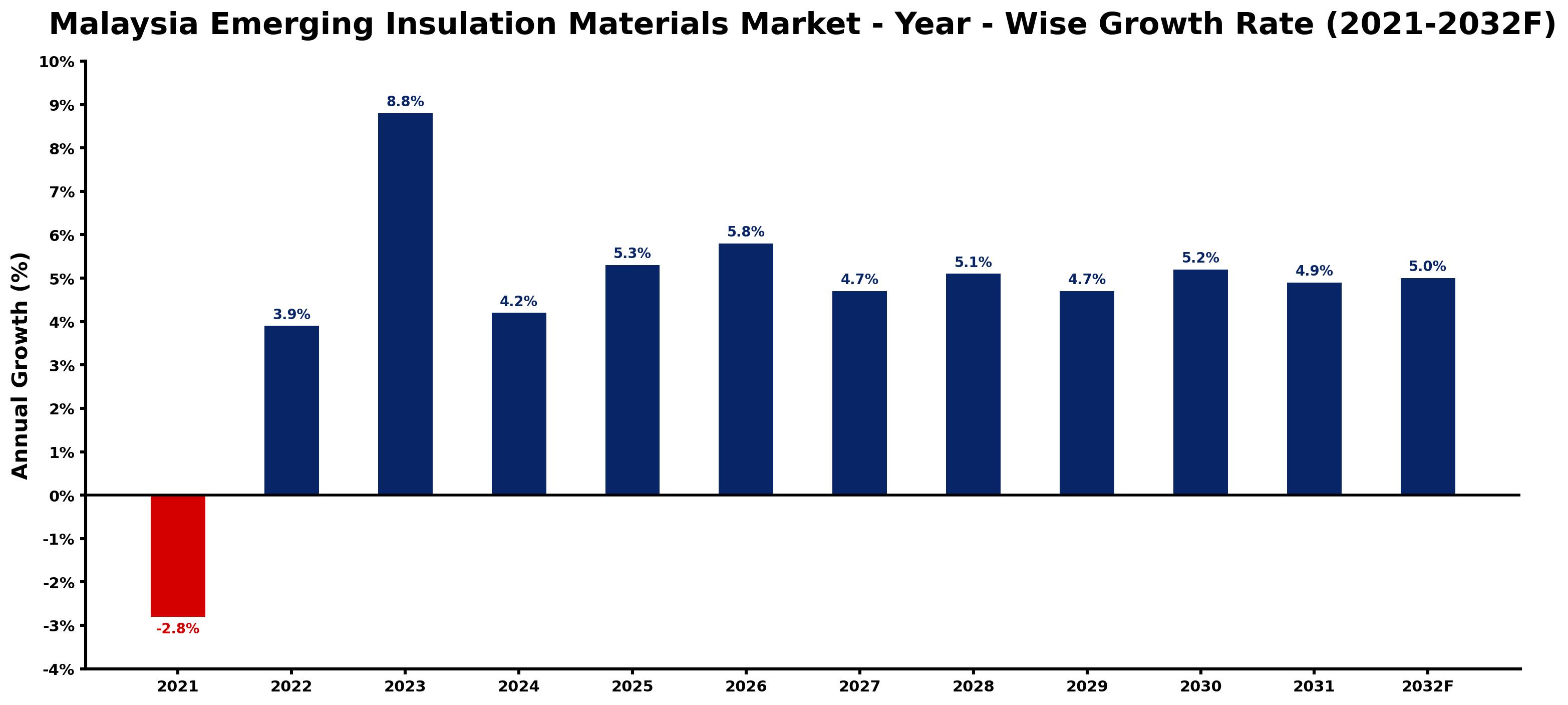
The table below presents the year‑wise growth rates along with the key drivers influencing the market
| Year | Growth Rate | Major Drivers |
| 2021 | -2.8% | Government infrastructure modernization initiatives |
| 2022 | 3.9% | Increasing smart city development projects |
| 2023 | 8.8% | Increasing adoption of advanced technologies |
| 2024 | 4.2% | Expansion of commercial construction activities |
| 2025 | 5.3% | Government infrastructure modernization initiatives |
| 2026 | 5.8% | Increasing industrial automation investments |
| 2027 | 4.7% | Increasing industrial automation investments |
| 2028 | 5.1% | Expansion of commercial construction activities |
| 2029 | 4.7% | Increasing industrial automation investments |
| 2030 | 5.2% | Increasing smart city development projects |
| 2031 | 4.9% | Increasing adoption of advanced technologies |
| 2032 | 5.0% | Expansion of manufacturing activities |
Note - Market size estimations and growth projections presented in this report are based on 6Wresearch’s advanced forecasting approach, validated with industry datasets as of June 2026.
Malaysia Emerging Insulation Materials Market Synopsis
The strongest force currently shaping the Malaysia Emerging Insulation Materials Market is the heightened awareness of energy conservation among consumers. With rising utility costs and stringent energy regulations, Malaysian households and businesses are increasingly seeking high-performance insulation solutions to optimize energy consumption. This shift is not only contributing to demand for insulation materials but is also encouraging manufacturers to innovate and offer cutting-edge products.
Furthermore, government efforts to promote sustainable building practices play a critical role in steering market dynamics. Initiatives aimed at encouraging eco-friendly construction methods and materials have sparked greater adoption of insulation technologies that enhance thermal resistance and durability. This proactive regulatory environment is, therefore, crucial for the continued expansion of the insulation materials sector in Malaysia.
Malaysia Emerging Insulation Materials Market Key Takeaways
- The market is expected to see substantial growth driven by energy efficiency demands and government regulations.
- Technological advancements, including the use of nanotechnology, are enhancing product offerings in the market.
- Consumer awareness regarding energy conservation is significantly influencing purchasing decisions.
- Government incentives are fostering innovation and adoption of insulation materials.
- The residential building sector is poised to be a major consumer of emerging insulation materials.
Evaluation of Restraints in Malaysia Emerging Insulation Materials Market
Despite the positive outlook, the Malaysia Emerging Insulation Materials Market faces notable restraints. Cost factors related to advanced insulation solutions can be a barrier for small-scale builders and consumers who are price-sensitive. Additionally, fluctuating raw material prices may impact production costs and, in turn, market prices. The awareness of insulation materials is still growing, which means that some segments of the market may not fully appreciate the benefits of modern insulation options, hampering broader adoption.
Malaysia Emerging Insulation Materials Market Trends
Current trends indicate a shift towards sustainable insulation materials, emphasizing environmental impact and recyclability. There is a growing preference for eco-friendly products that align with international sustainability standards. Manufacturers are also exploring innovative materials that combine functionality with aesthetic appeal, catering to consumer preferences in both residential and commercial projects. Additionally, advancements in digital technologies are enabling better design and insulation performance, further shaping market demands.
Malaysia Emerging Insulation Materials Market Opportunities
The market presents significant opportunities for growth and investment, particularly in the residential sector, which continues to expand. Demand for energy-efficient buildings and green technologies is fostering a ripe landscape for manufacturers to introduce innovative insulation materials. Furthermore, the rising trend of retrofitting existing structures with advanced insulation solutions offers a lucrative avenue for market players. Companies that can effectively capitalize on sustainability trends while providing cost-effective solutions will likely succeed in capturing market share.
Government Initiatives in the Malaysia Emerging Insulation Materials Market
The Malaysian government has implemented several initiatives aimed at promoting the adoption of energy-efficient materials, including insulation solutions. Policies focused on reducing carbon footprints and incentivizing green building practices are pivotal in steering investments towards sustainable construction. Programs that support research and development in insulation technologies further enhance market conditions, while public spending on infrastructure projects typically integrates energy-efficient design standards that encourage insulation adoption.
Future Insights of the Malaysia Emerging Insulation Materials Market
Looking ahead, the Malaysia Emerging Insulation Materials Market is poised for steady growth from 2026 to 2032. With escalating energy costs and growing consumer focus on sustainability, demand for innovative insulation solutions will likely expand. Manufacturers who adapt to evolving regulatory environments and technological advances will find themselves well-positioned to capitalize on emerging opportunities. As market awareness grows, collaborations between industry stakeholders may also foster enhanced product development and consumer outreach.
Malaysia Emerging Insulation Materials Market Latest Developments (May 2025 - June 2026)
Recent developments in the Malaysia Emerging Insulation Materials Market have highlighted a trend towards increased collaboration between manufacturers and research institutions. These partnerships are focusing on developing new insulation technologies that align with environmental standards. Additionally, several industry events have been centered around sustainability and innovation, showcasing the latest advancements in insulation materials. This heightened engagement is signaling a collective push towards a more energy-efficient future in Malaysia.
Malaysia Emerging Insulation Materials Market - Key Attractiveness of the Report
- 10 Years of Market Numbers
- Historical Data Starting from 2022 to 2025
- Base Year: 2025
- Forecast Data until 2032
- Key Performance Indicators Impacting the Market
- Major Upcoming Developments and Projects
Key Highlights of the Report:
- Malaysia Emerging Insulation Materials Market Outlook
- Market Size of Malaysia Emerging Insulation Materials Market, 2025
- Forecast of Malaysia Emerging Insulation Materials Market, 2032F
- Historical Data and Forecast of Malaysia Emerging Insulation Materials Revenues & Volume for the Period 2022-2032F
- Malaysia Emerging Insulation Materials Market Trend Evolution
- Malaysia Emerging Insulation Materials Market Drivers and Challenges
- Malaysia Emerging Insulation Materials Price Trends
- Malaysia Emerging Insulation Materials Porter's Five Forces
- Malaysia Emerging Insulation Materials Industry Life Cycle
- Historical Data and Forecast of Malaysia Emerging Insulation Materials Market Revenues & Volume By Types for the Period 2022-2032F
- Historical Data and Forecast of Malaysia Emerging Insulation Materials Market Revenues & Volume By Fibrous for the Period 2022-2032F
- Historical Data and Forecast of Malaysia Emerging Insulation Materials Market Revenues & Volume By Granular for the Period 2022-2032F
- Historical Data and Forecast of Malaysia Emerging Insulation Materials Market Revenues & Volume By Gas for the Period 2022-2032F
- Historical Data and Forecast of Malaysia Emerging Insulation Materials Market Revenues & Volume By Cellular for the Period 2022-2032F
- Historical Data and Forecast of Malaysia Emerging Insulation Materials Market Revenues & Volume By Enabling High-performance Reflective Insulation for the Period 2022-2032F
- Historical Data and Forecast of Malaysia Emerging Insulation Materials Market Revenues & Volume By Applications for the Period 2022-2032F
- Historical Data and Forecast of Malaysia Emerging Insulation Materials Market Revenues & Volume By Infrastructure for the Period 2022-2032F
- Historical Data and Forecast of Malaysia Emerging Insulation Materials Market Revenues & Volume By Industrial for the Period 2022-2032F
- Historical Data and Forecast of Malaysia Emerging Insulation Materials Market Revenues & Volume By HVAC & OEM for the Period 2022-2032F
- Historical Data and Forecast of Malaysia Emerging Insulation Materials Market Revenues & Volume By Transportation for the Period 2022-2032F
- Historical Data and Forecast of Malaysia Emerging Insulation Materials Market Revenues & Volume By Appliances for the Period 2022-2032F
- Historical Data and Forecast of Malaysia Emerging Insulation Materials Market Revenues & Volume By Furniture for the Period 2022-2032F
- Historical Data and Forecast of Malaysia Emerging Insulation Materials Market Revenues & Volume By Packaging for the Period 2022-2032F
- Malaysia Emerging Insulation Materials Import Export Trade Statistics
- Market Opportunity Assessment By Types
- Market Opportunity Assessment By Applications
- Malaysia Emerging Insulation Materials Top Companies Market Share
- Malaysia Emerging Insulation Materials Competitive Benchmarking By Technical and Operational Parameters
- Malaysia Emerging Insulation Materials Company Profiles
- Malaysia Emerging Insulation Materials Key Strategic Recommendations






































