Malaysia Ice maker Market Size Growth Rate
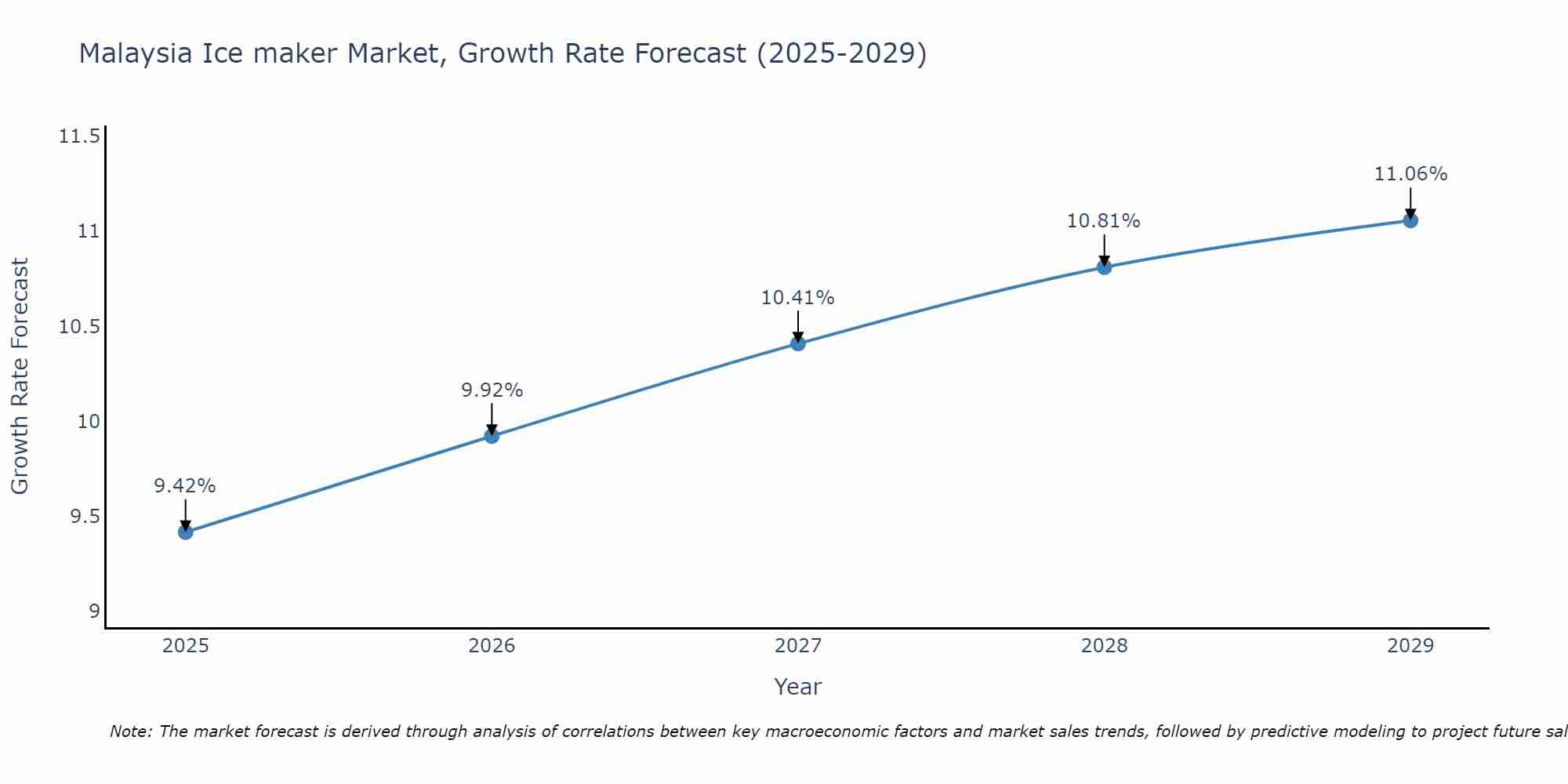
The Malaysia Ice maker Market is likely to experience consistent growth rate gains over the period 2025 to 2029. The growth rate starts at 9.42% in 2025 and reaches 11.06% by 2029.
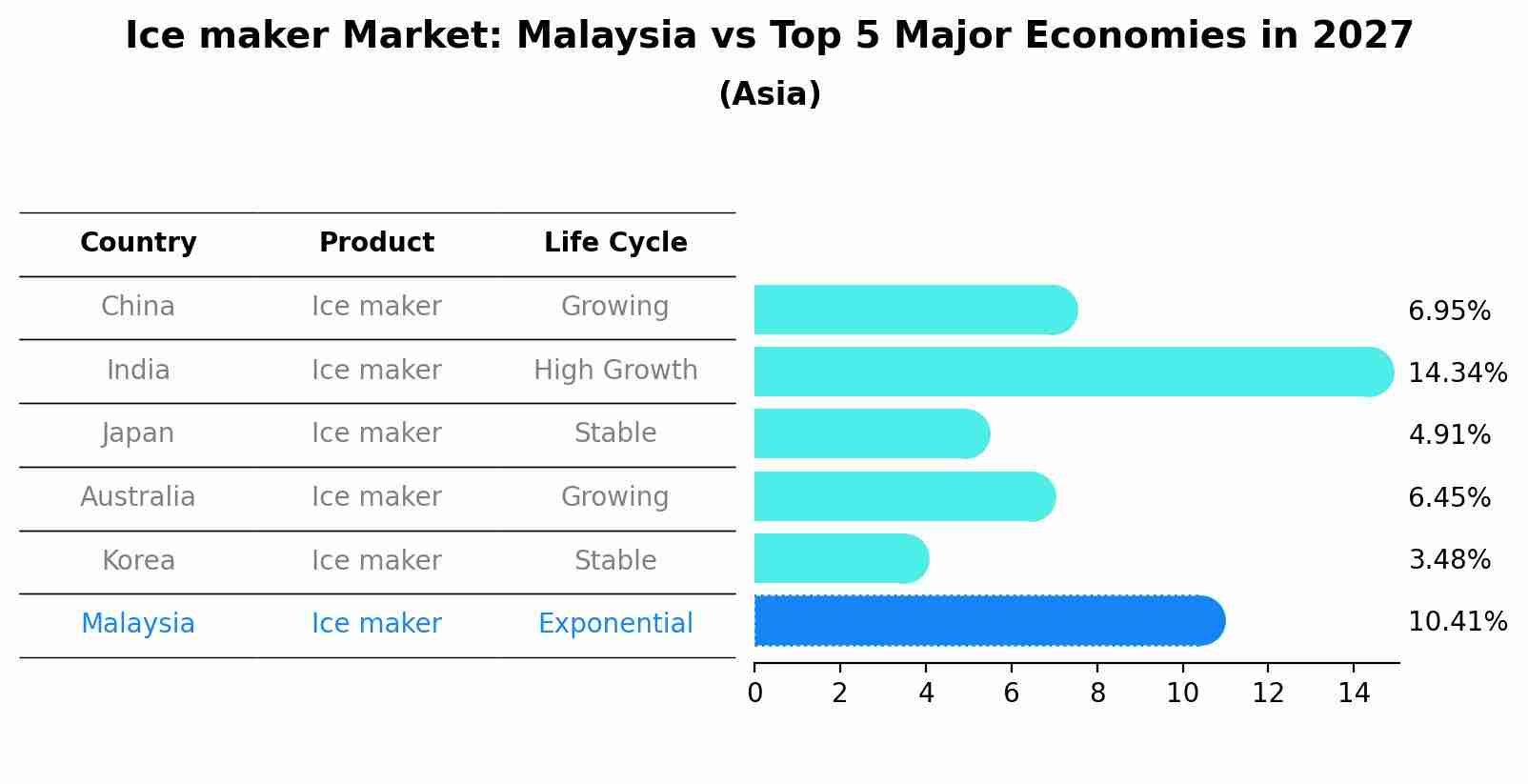
Ice maker Market: Malaysia vs Top 5 Major Economies in 2027 (Asia)
By 2027, the Ice maker market in Malaysia is anticipated to reach a growth rate of 10.41%, as part of an increasingly competitive Asia region, where China remains at the forefront, supported by India, Japan, Australia and South Korea, driving innovations and market adoption across sectors.
Malaysia Ice Maker Market Synopsis
The ice maker market in Malaysia was valued at USD 120 million in 2025, and is projected to reach USD 156 million by 2031 with a CAGR of 5.4%. Demand for ice makers has been growing due to increased convenience offered by these products as well as environmental-friendly features such as low electricity consumption compared to traditional methods of ice making like refrigerators or freezers. Furthermore , technological advancements are driving product innovation leading to greater accessibility across all segments.
Market Drivers of the market
The Malaysia ice maker market is anticipated to experience steady growth due to the increasing demand from the hospitality, foodservice, and healthcare sectors. Ice makers are essential for maintaining a constant supply of ice for various applications, including food preservation, beverages, and medical uses. The growth of the tourism industry in Malaysia and the rising number of restaurants and cafes are expected to drive the demand for ice makers. Additionally, the healthcare sector`s requirement for ice in medical facilities may further support market growth.
Challenges of the market
The ice maker market in Malaysia faces challenges related to the increasing competition and the need for energy-efficient and environmentally friendly ice-making solutions. Additionally, ensuring after-sales service and maintenance support can be crucial for customer satisfaction and loyalty in this market.
Covid-19 Impact on the market
The ice maker market faced challenges during the pandemic due to the closure of hospitality and foodservice businesses. The decline in tourism also impacted the demand for ice makers. However, as the hospitality sector rebounds, the market is expected to recover.
Key Players of the market
Key players in the Malaysia ice maker market include Manitowoc Ice Malaysia, Hoshizaki Electric Malaysia, and Cornelius Malaysia. These companies are leading manufacturers and suppliers of ice-making machines used in the hospitality, foodservice, and healthcare industries.
Key Highlights of the Report:
- Malaysia Ice maker Market Outlook
- Market Size of Malaysia Ice maker Market, 2024
- Forecast of Malaysia Ice maker Market, 2031
- Historical Data and Forecast of Malaysia Ice maker Revenues & Volume for the Period 2021-2031
- Malaysia Ice maker Market Trend Evolution
- Malaysia Ice maker Market Drivers and Challenges
- Malaysia Ice maker Price Trends
- Malaysia Ice maker Porter's Five Forces
- Malaysia Ice maker Industry Life Cycle
- Historical Data and Forecast of Malaysia Ice maker Market Revenues & Volume By Product type for the Period 2021-2031
- Historical Data and Forecast of Malaysia Ice maker Market Revenues & Volume By Ice Cube Maker for the Period 2021-2031
- Historical Data and Forecast of Malaysia Ice maker Market Revenues & Volume By Ice Flake Maker for the Period 2021-2031
- Historical Data and Forecast of Malaysia Ice maker Market Revenues & Volume By Ice Nugget Maker for the Period 2021-2031
- Historical Data and Forecast of Malaysia Ice maker Market Revenues & Volume By Others for the Period 2021-2031
- Historical Data and Forecast of Malaysia Ice maker Market Revenues & Volume By Component for the Period 2021-2031
- Historical Data and Forecast of Malaysia Ice maker Market Revenues & Volume By Condenser for the Period 2021-2031
- Historical Data and Forecast of Malaysia Ice maker Market Revenues & Volume By Evaporator for the Period 2021-2031
- Historical Data and Forecast of Malaysia Ice maker Market Revenues & Volume By Throttle Valve for the Period 2021-2031
- Historical Data and Forecast of Malaysia Ice maker Market Revenues & Volume By Compressor for the Period 2021-2031
- Historical Data and Forecast of Malaysia Ice maker Market Revenues & Volume By Motors for the Period 2021-2031
- Historical Data and Forecast of Malaysia Ice maker Market Revenues & Volume By Heating Elements for the Period 2021-2031
- Historical Data and Forecast of Malaysia Ice maker Market Revenues & Volume By Application for the Period 2021-2031
- Historical Data and Forecast of Malaysia Ice maker Market Revenues & Volume By Residential for the Period 2021-2031
- Historical Data and Forecast of Malaysia Ice maker Market Revenues & Volume By Commercial for the Period 2021-2031
- Malaysia Ice maker Import Export Trade Statistics
- Market Opportunity Assessment By Product type
- Market Opportunity Assessment By Component
- Market Opportunity Assessment By Application
- Malaysia Ice maker Top Companies Market Share
- Malaysia Ice maker Competitive Benchmarking By Technical and Operational Parameters
- Malaysia Ice maker Company Profiles
- Malaysia Ice maker Key Strategic Recommendations






































