Malaysia IT Services Market Size & Growth Rate (2026-2032)
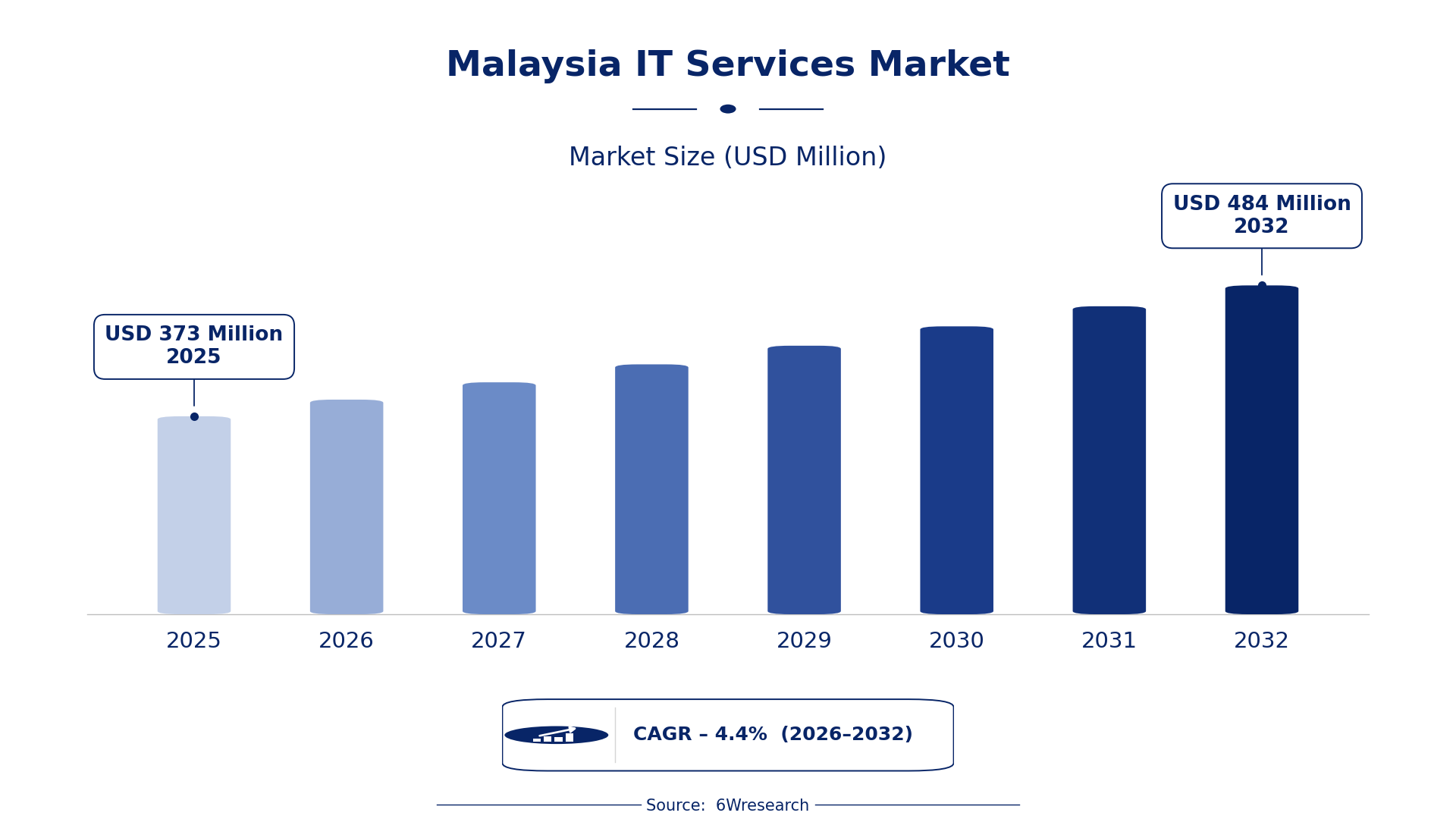
The Malaysia IT Services Market was estimated at USD 373 Million in 2025 and is projected to reach USD 484 Million by 2032, growing at a CAGR of 4.4% from 2026 to 2032.
Malaysia IT Services Market Synopsis
The Malaysia IT Services market is characterized by a blend of traditional and emerging technologies, serving a diverse array of sectors from finance to healthcare. As organizations increasingly prioritize digital transformation, the demand for tailored IT solutions has surged, reflecting the urgency to enhance operational efficiencies and customer engagement.
The sector is witnessing a proactive push towards the integration of Industry 4.0 technologies, driven by both local enterprises and multinational corporations. This trend is further amplified by government initiatives aimed at establishing Malaysia as a regional digital hub, positioning the IT services market for sustained growth in the coming years.
Malaysia IT Services Market Year-wise Growth Rate and Key Drivers
This graph illustrates the annual growth rates of the Malaysia IT Services Market from 2021 to 2032, highlighting a steady upward trajectory and projected expansion over the forecast period.
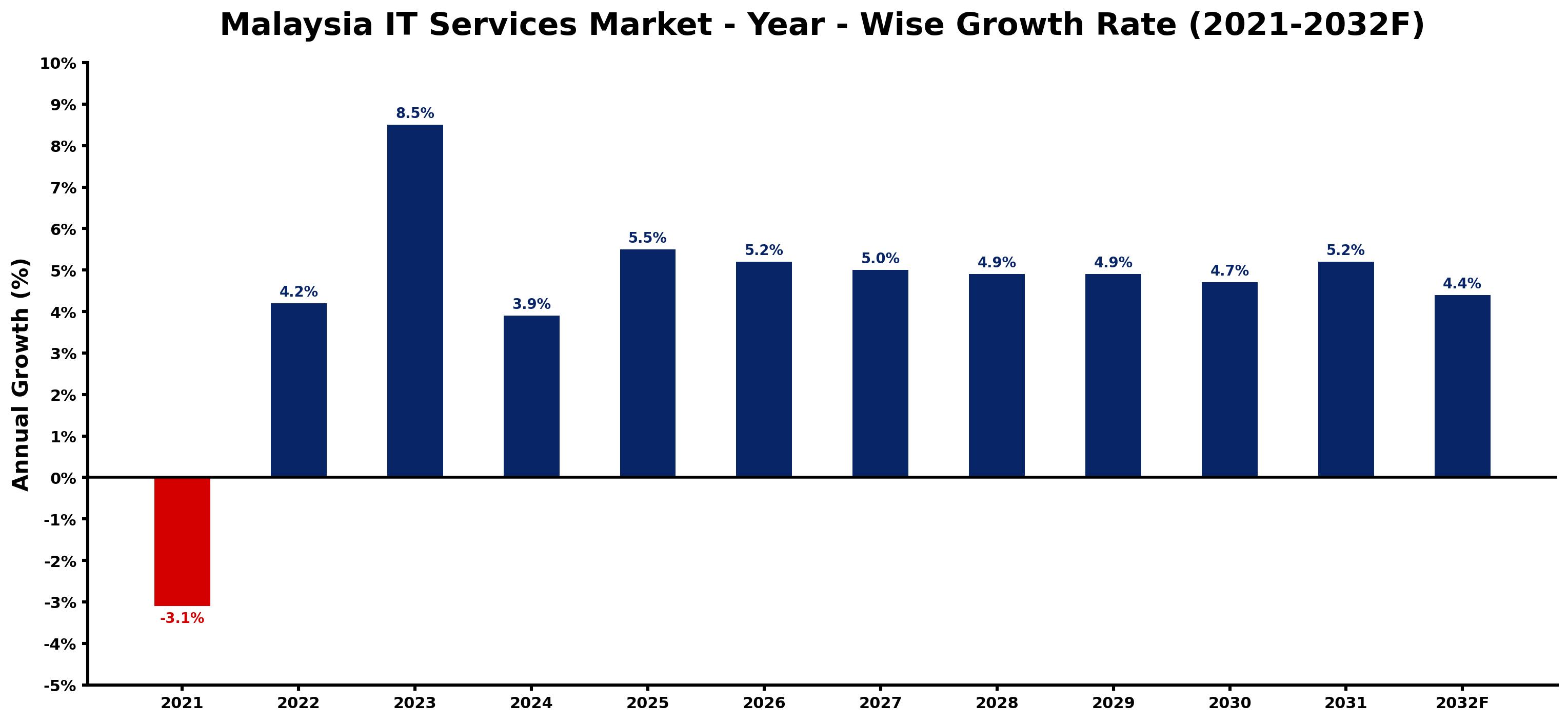
The table below presents the year‑wise growth rates along with the key drivers influencing the market
| Year | Growth Rate | Major Drivers |
| 2021 | -3.1% | Delayed digital transformation initiatives post-COVID-19 lockdowns. |
| 2022 | 4.2% | Launch of MyDIGITAL national digital economy blueprint. |
| 2023 | 8.5% | Increased foreign investment in Malaysia's digital services. |
| 2024 | 3.9% | Demand for e-commerce solutions surge post-pandemic. |
| 2025 | 5.5% | Growth of mobile payment platforms in urban areas. |
| 2026 | 5.2% | Adoption of AI technology by local SMEs accelerates. |
| 2027 | 5.0% | Government incentives for digital literacy programs expand. |
| 2028 | 4.9% | Rise in remote work driving IT service demands. |
| 2029 | 4.9% | Boost in smart city projects in Kuala Lumpur. |
| 2030 | 4.7% | Implementation of digital ID systems enhances service uptake. |
| 2031 | 5.2% | Growing popularity of FinTech solutions among young adults. |
| 2032 | 4.4% | Healthcare digitalization initiatives spur IT service usage. |
Note: Market size estimations and growth projections presented in this report are based on 6Wresearch's proprietary forecasting methodology, utilizing the latest available industry data, government publications, and primary research inputs.
Malaysia IT Services Market Key Takeaways
Below are some of the specific key takeaways from the market, including:
- Rapid digitization across industries is a primary driver of IT services demand.
- Government initiatives are actively fostering a conducive environment for digital adoption.
- Cybersecurity concerns are heightening the need for advanced IT infrastructure solutions.
- The rise of remote work has accelerated investments in IT support services.
- Malaysia's startup ecosystem is catalyzing innovation in IT services delivery.
Evaluation of Restraints in Malaysia IT Services Market
Despite the promising growth trajectory, the Malaysia IT Services market faces significant hurdles. Cybersecurity threats are increasingly sophisticated, compelling businesses to invest heavily in protective measures. Many organizations struggle to keep pace with evolving security standards, which can deter potential investments. Additionally, a talent shortage in critical IT domains hampers the ability to deliver comprehensive solutions, limiting growth potential for service providers.
Malaysia IT Services Market Trends
A notable trend shaping the Malaysia IT Services market is the escalating focus on cloud computing solutions. Businesses are migrating to the cloud to improve scalability and reduce operational costs. Alongside this, there is a growing emphasis on data analytics, as companies seek to harness insights for better decision-making. The adoption of artificial intelligence and machine learning technologies is also gaining momentum, enabling organizations to automate processes and enhance service delivery.
Malaysia IT Services Market Opportunities
Opportunities abound in the Malaysia IT Services market, particularly in sectors such as e-commerce, fintech, and healthcare. As businesses pivot towards digital channels, there is an increasing demand for IT consulting services to guide strategic transformations. on top of that, investments in cybersecurity services present a lucrative avenue, given the heightened awareness of data protection. The government’s commitment to fostering a digital economy indicates a supportive policy environment for IT service providers.
Government Initiatives in the Malaysia IT Services Market
The Malaysian government plays a crucial role in shaping the IT Services market through strategic initiatives aimed at promoting digital transformation. With a focus on enhancing the nation’s technological capabilities, these initiatives are geared towards fostering innovation and improving the overall business ecosystem. Such policies are vital, as they not only encourage local enterprises to adopt advanced IT solutions but also attract foreign investments.
- A national digital infrastructure upgrade programme launched in 2023 to enhance connectivity across urban and rural areas.
- Currently ongoing initiatives to support the development of cybersecurity frameworks, aimed at increasing the resilience of businesses against cyber threats.
- A planned public-private partnership expected to expand access to high-speed internet services by 2026, facilitating better IT services delivery.
- Recent policies encouraging the establishment of tech incubators, aiming to support startups in developing innovative IT solutions.
Future Insights of the Malaysia IT Services Market
Looking towards 2026-2032, the Malaysia IT Services market is set to evolve significantly. The continued push for digital transformation across various sectors will drive demand for integrated IT solutions. As companies increasingly embrace remote and hybrid work models, investments in IT infrastructure will remain a priority. on top of that, the convergence of technologies like AI, IoT, and big data analytics will create new avenues for service innovation, enhancing competitive advantages for early adopters.
Malaysia IT Services Market Latest Developments
In the past year, the Malaysia IT Services market has seen a flurry of activity, indicative of its dynamic nature. Key players are accelerating their service offerings in response to evolving client needs, particularly in areas related to cybersecurity and cloud services. The emphasis on innovation is prompting businesses to invest in partnerships and collaborations to enhance their technology stacks.
- A major technology vendor launched a comprehensive cybersecurity training programme in early 2023 to address workforce skill gaps.
- A regional operator is currently underway with the deployment of a new cloud computing platform, aimed at improving service delivery for SMEs.
- In mid-2023, a tech startup announced an innovative IT service solution designed to streamline supply chain management, marking a significant addition to the market.
- A leading local firm is planning to roll out a new suite of AI-driven analytics tools by late 2024, targeting industries such as retail and finance.
Malaysia IT Services Market - Key Attractiveness of the Report
- 10 Years of Market Numbers
- Historical Data Starting from 2022 to 2025
- Base Year: 2025
- Forecast Data until 2032
- Key Performance Indicators Impacting the Market
- Major Upcoming Developments and Projects
Key Highlights of the Report:
- Malaysia IT Services Market Outlook
- Market Size of Malaysia IT Services Market, 2025
- Forecast of Malaysia IT Services Market, 2032
- Historical Data and Forecast of Malaysia IT Services Revenues & Volume for the Period 2022-2032F
- Malaysia IT Services Market Trend Evolution
- Malaysia IT Services Market Drivers and Challenges
- Malaysia IT Services Price Trends
- Malaysia IT Services Porter's Five Forces
- Malaysia IT Services Industry Life Cycle
- Historical Data and Forecast of Malaysia IT Services Market Revenues & Volume By Vertical for the Period 2022-2032F
- Historical Data and Forecast of Malaysia IT Services Market Revenues & Volume By Government and defense for the Period 2022-2032F
- Historical Data and Forecast of Malaysia IT Services Market Revenues & Volume By Banking, Financial Services, and Insurance (BFSI) for the Period 2022-2032F
- Historical Data and Forecast of Malaysia IT Services Market Revenues & Volume By Healthcare for the Period 2022-2032F
- Historical Data and Forecast of Malaysia IT Services Market Revenues & Volume By Media and entertainment for the Period 2022-2032F
- Historical Data and Forecast of Malaysia IT Services Market Revenues & Volume By Consumer goods and retail for the Period 2022-2032F
- Historical Data and Forecast of Malaysia IT Services Market Revenues & Volume By IT and telecom for the Period 2022-2032F
- Historical Data and Forecast of Malaysia IT Services Market Revenues & Volume By Business Function for the Period 2022-2032F
- Historical Data and Forecast of Malaysia IT Services Market Revenues & Volume By Human Resources for the Period 2022-2032F
- Historical Data and Forecast of Malaysia IT Services Market Revenues & Volume By Finance and Accounting for the Period 2022-2032F
- Historical Data and Forecast of Malaysia IT Services Market Revenues & Volume By Sales and Marketing for the Period 2022-2032F
- Historical Data and Forecast of Malaysia IT Services Market Revenues & Volume By Supply Chain Management for the Period 2022-2032F
- Historical Data and Forecast of Malaysia IT Services Market Revenues & Volume By Operations and Support for the Period 2022-2032F
- Historical Data and Forecast of Malaysia IT Services Market Revenues & Volume By Manufacturing for the Period 2022-2032F
- Historical Data and Forecast of Malaysia IT Services Market Revenues & Volume By Deployment Mode for the Period 2022-2032F
- Historical Data and Forecast of Malaysia IT Services Market Revenues & Volume By On-premises for the Period 2022-2032F
- Historical Data and Forecast of Malaysia IT Services Market Revenues & Volume By Cloud for the Period 2022-2032F
- Historical Data and Forecast of Malaysia IT Services Market Revenues & Volume By Organization Size for the Period 2022-2032F
- Historical Data and Forecast of Malaysia IT Services Market Revenues & Volume By Large enterprises for the Period 2022-2032F
- Historical Data and Forecast of Malaysia IT Services Market Revenues & Volume By Small and Medium Enterprises (SMEs) for the Period 2022-2032F
- Historical Data and Forecast of Malaysia IT Services Market Revenues & Volume By Service Type for the Period 2022-2032F
- Historical Data and Forecast of Malaysia IT Services Market Revenues & Volume By Professional services for the Period 2022-2032F
- Historical Data and Forecast of Malaysia IT Services Market Revenues & Volume By Managed services for the Period 2022-2032F
- Historical Data and Forecast of Malaysia IT Services Market Revenues & Volume By Telecom services for the Period 2022-2032F
- Malaysia IT Services Import Export Trade Statistics
- Market Opportunity Assessment By Vertical
- Market Opportunity Assessment By Business Function
- Market Opportunity Assessment By Deployment Mode
- Market Opportunity Assessment By Organization Size
- Market Opportunity Assessment By Service Type
- Malaysia IT Services Top Companies Market Share
- Malaysia IT Services Competitive Benchmarking By Technical and Operational Parameters
- Malaysia IT Services Company Profiles
- Malaysia IT Services Key Strategic Recommendations






































