Malaysia Motors and Generators Market Summary
The malaysia motors and generators market was estimated at USD 250 Million in 2025 and is projected to reach USD 326 Million by 2032, growing at a CAGR of 5.4% from 2026 to 2032.
Malaysia Motors and Generators Market Year-wise Growth Rate and Key Drivers
This graph highlights how the Malaysia Motors and Generators Market has steadily grown over the past five years, supported by major growth factors.
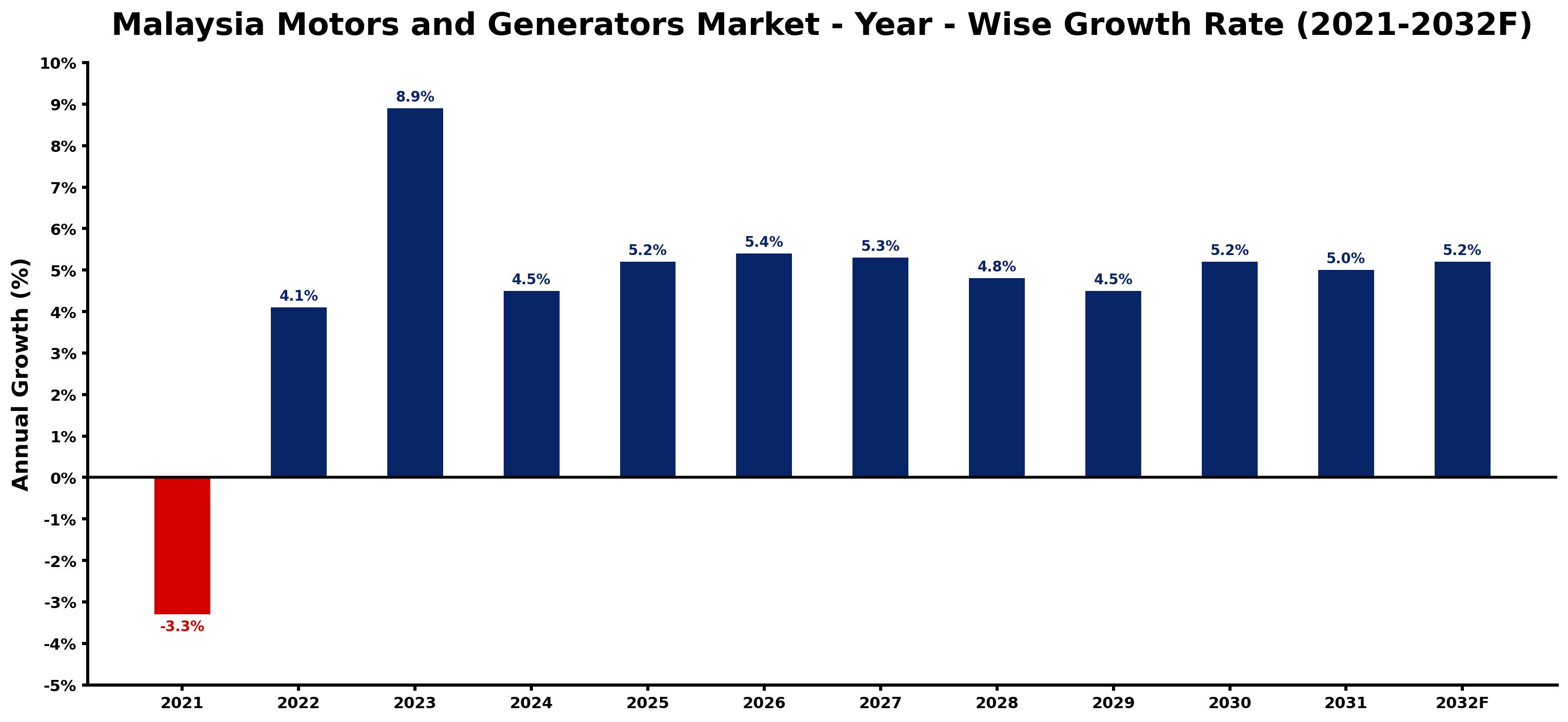
The table below presents the year wise growth rates along with the key drivers influencing the market
| Year | Growth Rate | Major Drivers |
| 2021 | -3.3% | Supply chain disruptions significantly hindered manufacturing capabilities, leading to increased lead times and limited product availability. |
| 2022 | 4.1% | Emerging technologies attracted new players, enhancing competition and innovation in machinery. |
| 2023 | 8.9% | Local assembly initiatives supported by tax incentives boosted domestic manufacturing capabilities. |
| 2024 | 4.5% | Urbanization trends triggered heightened demand for reliable energy solutions in cities. |
| 2025 | 5.2% | Renewable energy integration prompted growth in hybrid motors and generator technologies. |
| 2026 | 5.4% | Rural electrification programs expanded access, driving generator sales across underserved regions. |
| 2027 | 5.3% | Technological collaborations among firms facilitated development of smart energy management systems. |
| 2028 | 4.8% | Increased awareness of energy efficiency spurred consumer interest in high-performance generators. |
| 2029 | 4.5% | Global supply chain shifts redirected foreign investments towards Malaysia's manufacturing sector. |
| 2030 | 5.2% | Maintenance and repair services for motors became a significant revenue stream for enterprises. |
| 2031 | 5.0% | Digital transformation efforts led to advanced predictive maintenance solutions for industrial uses. |
| 2032 | 5.2% | Sustainability trends encouraged manufacturers to innovate with eco-friendly, energy-efficient products. |
Note - Market size estimations and growth projections presented in this report are based on 6Wresearch's advanced forecasting approach, validated with industry datasets as of June 2026.
Malaysia Motors and Generators Market Synopsis
The Malaysia Motors and Generators Market is projected to reach 5.4% and witness significant growth during the forecast period (2026-2032). Driven by a surge in industrialization and burgeoning construction activities, this market is poised for a compound annual growth rate (CAGR) of approximately 6.7%. The escalating demand for reliable standby power solutions in critical sectors, such as healthcare, fire safety, and security, is anticipated to further propel the adoption of motors and generators across Malaysia. In addition, governmental infrastructure initiatives designed to enhance transportation networks—including expressways, airports, and railroads—are set to create substantial demand for electric motors starting in 2025. Furthermore, a growing focus on renewable energy projects and substantial investments in smart grid technology are expected to favorably influence the electric motor industry throughout the forecast period.
Malaysia Motors and Generators Market Growth Drivers
Several dynamics are driving growth in the Malaysia Motors and Generators Market. The following key factors highlight these growth drivers:
- The ongoing industrialization in Malaysia is a primary catalyst for increased demand for motors and generators. As factories and manufacturing units expand, the need for efficient power solutions becomes paramount.
- Government efforts to modernize infrastructure, including the construction of highways, bridges, and public transport systems, necessitate a significant increase in electric motor utilization at construction sites and within the completed structures.
- The heightened requirement for standby power systems in essential facilities, particularly in healthcare and safety applications, supports market expansion. Reliable power supply is critical in emergencies, further boosting demand for generators.
- Investments in renewable energy projects have begun to reshape the market landscape, fostering opportunities for electric motors designed for green technologies such as solar and wind power.
- Technological advancements, particularly in smart grid technology, are enhancing the efficiency of power distribution, which directly correlates to the demand for modern electrical machinery, including motors and generators.
Malaysia Motors and Generators Market Challenges and Restraints
While the market is exhibiting robust growth potential, certain challenges may impede momentum. These include:
- The high initial costs associated with advanced motors and generators can deter adoption, especially among small and medium-sized enterprises with limited budgets.
- Supply chain disruptions, exacerbated by global events, can lead to delays in product availability, affecting project timelines and end-user satisfaction.
- Market players face increasing pressure to comply with stringent environmental regulations, which can elevate operational costs and necessitate significant investment in R&D to create compliant products.
- Rapid technological changes mean that companies must continuously innovate, or risk obsolescence, leading to potential financial strain and resource allocation challenges.
- Competition from alternative energy solutions may divert investments from traditional motors and generators, posing a risk to market share.
Malaysia Motors and Generators Market Government Investment and Initiatives
The Malaysian government has laid the groundwork for significant advancements in the motors and generators sector through various initiatives and public spending plans. Key political and financial commitments include:
- Allocation of funds for large infrastructure projects, such as new highways, metro lines, and airports, which inherently require an extensive array of electrical equipment, including motors and generators.
- Increased investment in renewable energy policies, aimed at boosting the share of green energy in national production, thereby driving demand for energy-efficient motors and related technologies.
- Strategic partnerships with private sectors to foster development in smart grid initiatives, anticipating enhanced efficiency and energy savings, which in turn support motor applications.
- Incentives for businesses adopting advanced technologies, focusing on the integration of modern electrical machinery into operational frameworks to enhance productivity and efficiency.
- Support for research and development initiatives aimed at improving the performance and sustainability of electric motors, thereby driving innovation and market growth.
Malaysia Motors and Generators Market Latest Developments (May 2025 - June 2026)
Recent developments within the Malaysia Motors and Generators Market from May 2025 to June 2026 have indicated a shift towards modernization and sustainability. There has been a marked increase in collaborative projects aimed at harnessing renewable energy sources, with companies exploring innovative motor technologies suited for these applications. Additionally, advancements in smart grid technology have prompted initiatives that improve efficiency in electrical generation and distribution. These trends reveal a growing emphasis on the necessity of integrating cutting-edge solutions within the industry. Furthermore, government initiatives have focused on expediting infrastructure projects, resulting in an uptick in demand for electric motors in various sectors, including construction and transport.
Malaysia Motors and Generators Market - Key Attractiveness of the Report
- 10 Years of Market Numbers
- Historical Data Starting from 2022 to 2025
- Base Year: 2025
- Forecast Data until 2032
- Key Performance Indicators Impacting the Market
- Major Upcoming Developments and Projects
Key Highlights of the Report:
- Malaysia Motors and Generators Market Outlook
- Market Size of Malaysia Motors and Generators Market, 2025
- Forecast of Malaysia Motors and Generators Market, 2032
- Historical Data and Forecast of Malaysia Motors and Generators Revenues & Volume for the Period 2022-2032F
- Malaysia Motors and Generators Market Trend Evolution
- Malaysia Motors and Generators Market Drivers and Challenges
- Malaysia Motors and Generators Price Trends
- Malaysia Motors and Generators Porter's Five Forces
- Malaysia Motors and Generators Industry Life Cycle
- Historical Data and Forecast of Malaysia Motors and Generators Market Revenues & Volume By Type for the Period 2022-2032F
- Historical Data and Forecast of Malaysia Motors and Generators Market Revenues & Volume By Motor Manufacturing for the Period 2022-2032F
- Historical Data and Forecast of Malaysia Motors and Generators Market Revenues & Volume By Generator Manufacturing for the Period 2022-2032F
- Historical Data and Forecast of Malaysia Motors and Generators Market Revenues & Volume By End-User for the Period 2022-2032F
- Historical Data and Forecast of Malaysia Motors and Generators Market Revenues & Volume By Industrial for the Period 2022-2032F
- Historical Data and Forecast of Malaysia Motors and Generators Market Revenues & Volume By Commercial for the Period 2022-2032F
- Historical Data and Forecast of Malaysia Motors and Generators Market Revenues & Volume By Residential for the Period 2022-2032F
- Malaysia Motors and Generators Import Export Trade Statistics
- Market Opportunity Assessment By Type
- Market Opportunity Assessment By End-User
- Malaysia Motors and Generators Top Companies Market Share
- Malaysia Motors and Generators Competitive Benchmarking By Technical and Operational Parameters
- Malaysia Motors and Generators Company Profiles
- Malaysia Motors and Generators Key Strategic Recommendations






































