Malaysia Warehousing and Storage Market Size, Share & Growth Rate
The Malaysia Warehousing and Storage Market was estimated at USD 421 Million in 2025 and is projected to reach USD 547 Million by 2032, growing at a CAGR of 3.8% from 2026 to 2032. This growth trajectory reflects a strategic response to the booming e-commerce sector, which has significantly increased the demand for efficient storage and distribution solutions. Furthermore, the integration of advanced technologies in logistics and the expansion of cold storage facilities are pivotal factors propelling this market forward.
Malaysia Warehousing and Storage Market Year-wise Growth Rate and Key Drivers
This graph highlights how the Malaysia Warehousing and Storage Market has steadily grown over the years, supported by major growth factors.
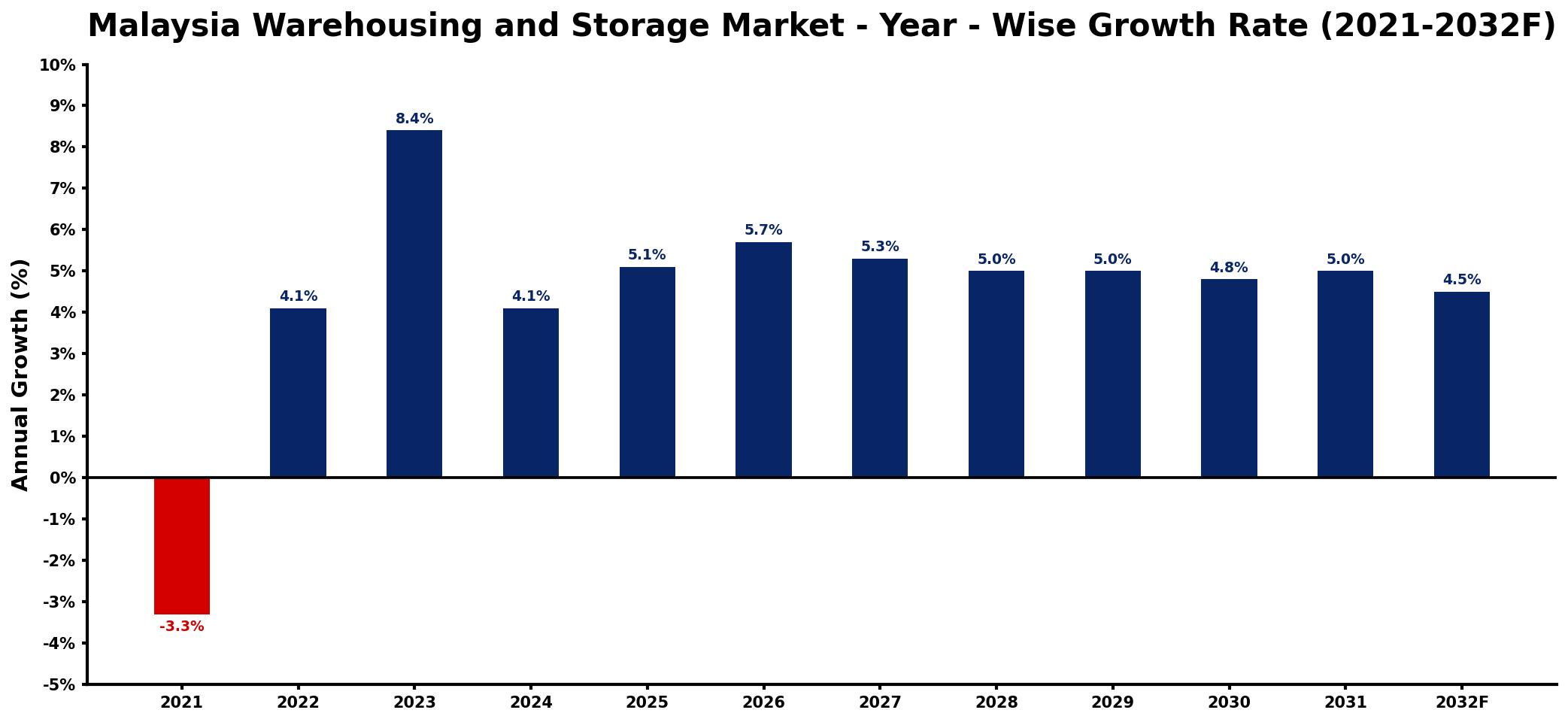
The table below presents the year‑wise growth rates along with the key drivers influencing the market
| Year | Growth Rate | Major Drivers |
| 2021 | -3.3% | decrease in industrial activity |
| 2022 | 4.1% | rise in e-commerce demand |
| 2023 | 8.4% | increase in logistics investments |
| 2024 | 4.1% | growth in retail sector |
| 2025 | 5.1% | expansion of food distribution |
| 2026 | 5.7% | surge in online shopping |
| 2027 | 5.3% | development of cold chain |
| 2028 | 5.0% | enhanced supply chain efficiency |
| 2029 | 5.0% | growing automotive sector requirements |
| 2030 | 4.8% | demand for sustainable practices |
| 2031 | 5.0% | expanding manufacturing base activity |
| 2032 | 4.5% | strengthening underlying market demand |
Note: Market size estimations and growth projections presented in this report are based on 6Wresearch's proprietary forecasting methodology, utilizing the latest available industry data, government publications, and primary research inputs.
Malaysia Warehousing and Storage Market Synopsis
In recent years, the Malaysian warehousing and storage market has gained considerable momentum, largely spurred by the rapid growth of e-commerce and logistics services. As businesses adapt to changing consumer demands, the need for modern and efficient warehousing solutions has become more pronounced.
Looking ahead, the market is poised for robust expansion, driven by a sustained increase in goods movement and the necessity for advanced storage solutions. The shift towards automation and technology in warehousing practices underscores a transformative phase that promises both challenges and opportunities for stakeholders.
Malaysia Warehousing and Storage Market Key Takeaways
- The market is anticipated to reach USD 547 Million by 2032, driven by e-commerce growth.
- Modern warehousing facilities incorporating technology are essential for competitive advantage.
- Cold storage solutions are becoming increasingly vital due to the rise of perishable goods.
- Market players face pressures to innovate amidst growing competition.
- Government policies are likely to foster a more robust logistics ecosystem.
Evaluation of Restraints in Malaysia Warehousing and Storage Market
Despite the promising outlook for the warehousing and storage market in Malaysia, several restraints may hinder growth. The intense competition among existing players necessitates a focus on innovation and efficiency, often requiring substantial investments in technology and infrastructure. Additionally, limited availability of prime locations for warehousing facilities in key urban areas can restrict expansion capabilities. Companies must navigate these challenges while striving to meet the increasing demands of a dynamic market landscape.
Malaysia Warehousing and Storage Market Trends
Several trends are currently shaping the landscape of the Malaysia warehousing and storage market. First, the adoption of automation and warehouse management systems is transforming traditional operations, enhancing efficiency and accuracy. Moreover, there is a notable shift towards sustainable practices, with an emphasis on energy-efficient facilities and eco-friendly logistics solutions. The rise of omnichannel retailing is also influencing warehousing strategies, as businesses seek to meet diverse consumer preferences seamlessly.
Malaysia Warehousing and Storage Market Opportunities
Opportunities within the Malaysia warehousing and storage market are abundant, particularly in leveraging technology to optimize operations. The growth of the e-commerce sector presents avenues for businesses to invest in modern facilities equipped with the latest logistics solutions. Furthermore, the demand for cold storage facilities, driven by the increasing volume of perishable goods, offers significant investment potential. Companies can also explore partnerships with tech firms to enhance automation capabilities, thereby positioning themselves advantageously in a competitive market.
Government Initiatives in the Malaysia Warehousing and Storage Market
The Malaysian government is actively promoting the logistics sector through various initiatives aimed at enhancing infrastructure and fostering innovation. Public spending on transportation and logistics infrastructure is expected to bolster warehousing capabilities across the nation. Additionally, government programs focusing on digitalization and sustainability in logistics are likely to provide support for businesses transitioning towards more efficient storage solutions. These initiatives create a conducive environment for investment and growth in the warehousing sector.
Future Insights of the Malaysia Warehousing and Storage Market
From 2026 to 2032, the Malaysian warehousing and storage market is set to evolve significantly, driven by continuous advancements in technology and increasing consumer expectations. The integration of Internet of Things (IoT) and Artificial Intelligence (AI) into warehousing practices will redefine operational efficiencies. Furthermore, as the e-commerce sector remains a dominant force, logistics and warehousing strategies will need to adapt, ensuring swift and reliable delivery systems. This dynamic will shape a future marked by innovation, efficiency, and sustainable practices.
Malaysia Warehousing and Storage Market Latest Developments (2025 - 2026)
Recent developments in the Malaysian warehousing and storage market indicate a continued focus on technological advancements and automation. Businesses are increasingly investing in smart warehousing solutions to improve inventory management and logistics efficiency. Additionally, partnerships are emerging between warehousing providers and tech firms, aiming to integrate cutting-edge technologies into traditional operations. The importance of cold storage is highlighted by new facilities being developed to cater to the growing needs of the perishable goods sector.
Malaysia Warehousing and Storage Market - Key Attractiveness of the Report
- 10 Years of Market Numbers
- Historical Data Starting from 2022 to 2025
- Base Year: 2025
- Forecast Data until 2032
- Key Performance Indicators Impacting the Market
- Major Upcoming Developments and Projects
Key Highlights of the Report:
- Malaysia Warehousing and Storage Market Outlook
- Market Size of Malaysia Warehousing and Storage Market, 2025
- Forecast of Malaysia Warehousing and Storage Market, 2032
- Historical Data and Forecast of Malaysia Warehousing and Storage Revenues & Volume for the Period 2022-2032F
- Malaysia Warehousing and Storage Market Trend Evolution
- Malaysia Warehousing and Storage Market Drivers and Challenges
- Malaysia Warehousing and Storage Price Trends
- Malaysia Warehousing and Storage Porter's Five Forces
- Malaysia Warehousing and Storage Industry Life Cycle
- Historical Data and Forecast of Malaysia Warehousing and Storage Market Revenues & Volume By Type for the Period 2022-2032F
- Historical Data and Forecast of Malaysia Warehousing and Storage Market Revenues & Volume By General Warehousing and Storage for the Period 2022-2032F
- Historical Data and Forecast of Malaysia Warehousing and Storage Market Revenues & Volume By Refrigerated Warehousing and Storage for the Period 2022-2032F
- Historical Data and Forecast of Malaysia Warehousing and Storage Market Revenues & Volume By Farm Product Warehousing and Storage for the Period 2022-2032F
- Historical Data and Forecast of Malaysia Warehousing and Storage Market Revenues & Volume By Ownership for the Period 2022-2032F
- Historical Data and Forecast of Malaysia Warehousing and Storage Market Revenues & Volume By Private Warehouses for the Period 2022-2032F
- Historical Data and Forecast of Malaysia Warehousing and Storage Market Revenues & Volume By Public Warehouses for the Period 2022-2032F
- Historical Data and Forecast of Malaysia Warehousing and Storage Market Revenues & Volume By Bonded Warehouses for the Period 2022-2032F
- Historical Data and Forecast of Malaysia Warehousing and Storage Market Revenues & Volume By End-Use for the Period 2022-2032F
- Historical Data and Forecast of Malaysia Warehousing and Storage Market Revenues & Volume By Manufacturing for the Period 2022-2032F
- Historical Data and Forecast of Malaysia Warehousing and Storage Market Revenues & Volume By Consumer Goods for the Period 2022-2032F
- Historical Data and Forecast of Malaysia Warehousing and Storage Market Revenues & Volume By Retail for the Period 2022-2032F
- Historical Data and Forecast of Malaysia Warehousing and Storage Market Revenues & Volume By Food and Beverage for the Period 2022-2032F
- Historical Data and Forecast of Malaysia Warehousing and Storage Market Revenues & Volume By IT Hardware for the Period 2022-2032F
- Historical Data and Forecast of Malaysia Warehousing and Storage Market Revenues & Volume By Healthcare for the Period 2022-2032F
- Historical Data and Forecast of Malaysia Warehousing and Storage Market Revenues & Volume By Chemicals for the Period 2022-2032F
- Historical Data and Forecast of Malaysia Warehousing and Storage Market Revenues & Volume By Others for the Period 2022-2032F
- Malaysia Warehousing and Storage Import Export Trade Statistics
- Market Opportunity Assessment By Type
- Market Opportunity Assessment By Ownership
- Market Opportunity Assessment By End-Use
- Malaysia Warehousing and Storage Top Companies Market Share
- Malaysia Warehousing and Storage Competitive Benchmarking By Technical and Operational Parameters
- Malaysia Warehousing and Storage Company Profiles
- Malaysia Warehousing and Storage Key Strategic Recommendations






































