Malaysia Windows Market Summary
The malaysia windows market was estimated at USD 255 Million in 2025 and is projected to reach USD 332 Million by 2032, growing at a CAGR of 5.2% from 2026 to 2032.
Malaysia Windows Market Year-wise Growth Rate and Key Drivers
This graph highlights how the Malaysia Windows Market has steadily grown over the past five years, supported by major growth factors.
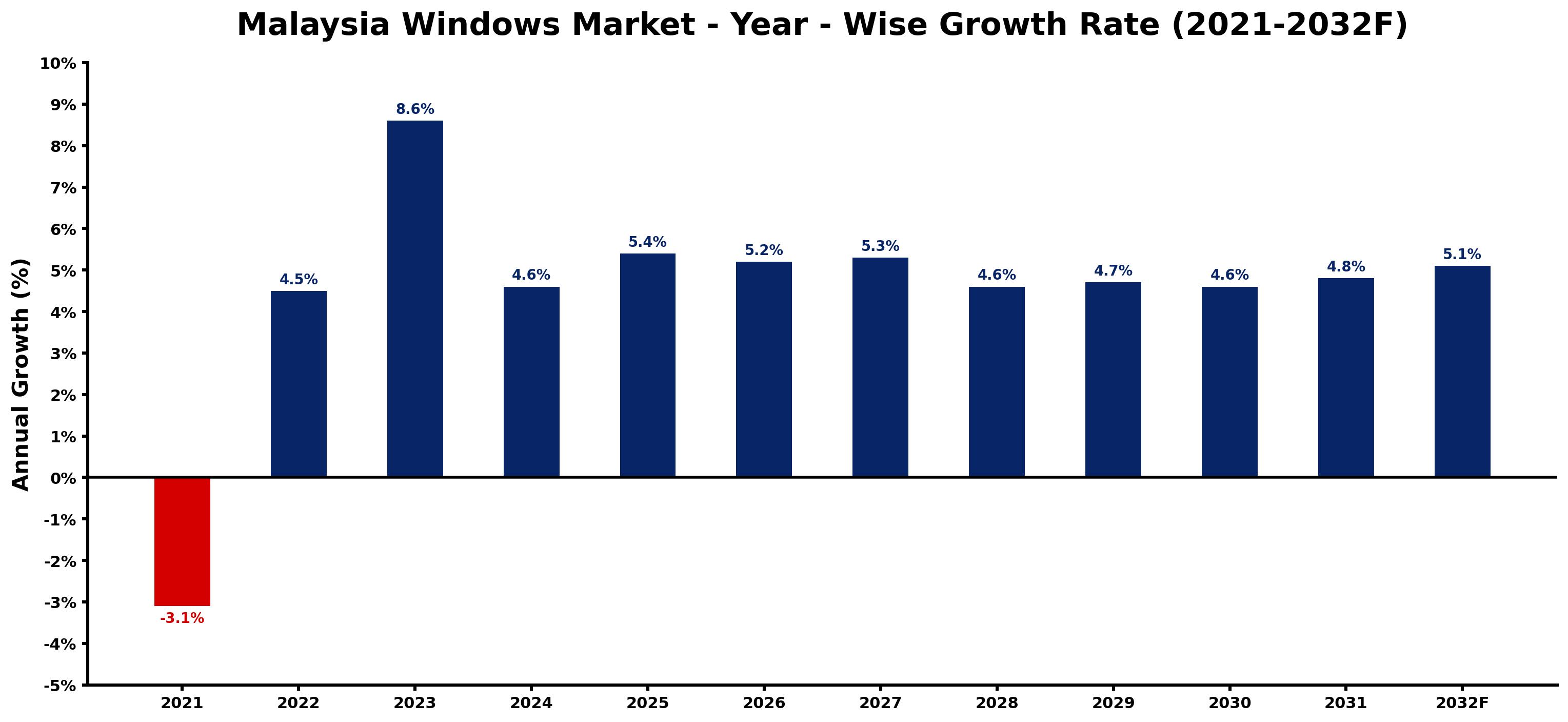
The table below presents the year wise growth rates along with the key drivers influencing the market
| Year | Growth Rate | Major Drivers |
| 2021 | -3.1% | Supply chain disruptions significantly delayed construction projects, leading to decreased demand for window installations. |
| 2022 | 4.5% | Emerging residential developments in urban areas highlighted the need for modern window solutions. |
| 2023 | 8.6% | Construction material prices fluctuated, affecting affordability and choices in window types. |
| 2024 | 4.6% | Innovative designs gained traction as homeowners sought to enhance energy efficiency and aesthetics. |
| 2025 | 5.4% | The influx of expatriates led to increased property investments, boosting window market demand. |
| 2026 | 5.2% | Evolving consumer preferences shifted towards smart windows with integrated energy-saving features. |
| 2027 | 5.3% | Sustainable building practices gained momentum, influencing the materials used in window manufacturing. |
| 2028 | 4.6% | Technological advancements made window monitoring systems more accessible to a wider audience. |
| 2029 | 4.7% | Competitive pricing among manufacturers created diverse options for consumers seeking quality windows. |
| 2030 | 4.6% | Urbanization continued to drive the need for high-performance windows in city housing projects. |
| 2031 | 4.8% | Enhanced focus on climate resilience prompted innovations in window durability and weather resistance. |
| 2032 | 5.1% | Integration of augmented reality tools in retail transformed consumer experiences during window selection. |
Note - Market size estimations and growth projections presented in this report are based on 6Wresearch's advanced forecasting approach, validated with industry datasets as of June 2026.
Malaysia Windows Market Synopsis
The Malaysia Windows Market is projected to reach 5.2% and witness significant growth during the forecast period (2026-2032). The anticipated Compound Annual Growth Rate (CAGR) of 4.8% is primarily driven by the flourishing construction sector and a growing preference for energy-efficient windows in residential buildings. As urbanization accelerates, the demand for modern infrastructure is expected to increase significantly, positioning the Malaysia windows market for notable expansion.
Malaysia Windows Market Growth Drivers
The growth trajectory of the Malaysia windows market is influenced by several key factors:
- The robust construction sector in Malaysia serves as a pivotal driver, fueled by urban development and population growth. As more residential and commercial properties are constructed, the demand for high-quality windows is expected to rise.
- Energy efficiency is becoming a critical consideration for homeowners and builders alike, prompted by rising energy costs and environmental awareness. Energy-efficient windows, which can reduce heating and cooling costs, are increasingly favored in new buildings.
- Technological advancements in window manufacturing processes are enhancing product performance and aesthetics, contributing to consumer interest and adoption in both the residential and commercial sectors.
- Government policies favoring sustainable building practices are creating an enabling environment for energy-efficient products. Incentives for green building initiatives are likely to encourage the adoption of advanced window technologies.
- Foreign investment in the Malaysian windows market is growing, bringing in capital and expertise that will spur innovation and competitiveness within the industry. This influx of investment is anticipated to create new opportunities for businesses operating in this sector.
Malaysia Windows Market Trends and Opportunities
Several trends are emerging within the Malaysia windows market, offering unique opportunities for growth:
- Sustainability is increasingly shaping market preferences, with consumers gravitating towards products that comply with environmental standards. The trend towards green building materials is likely to accelerate market growth as awareness of sustainability increases.
- Smart windows, equipped with technologies such as electrochromic glass that can change tint based on light conditions, are gaining traction. The integration of technology in windows is becoming a desirable feature for modern construction.
- The focus on aesthetic appeal in residential properties is leading to an increasing demand for customizable window designs that match consumer preferences and home architecture.
- The shift towards prefabricated construction methods is expected to boost the demand for pre-manufactured windows that streamline the building process and reduce labor costs.
- Regional disparities in development efforts within Malaysia will lead to varied opportunities across states, with urban areas likely seeing faster adoption of innovative window solutions compared to rural regions.
Malaysia Windows Market Government Investment and Initiatives
The Malaysian government has been proactive in promoting initiatives aimed at enhancing the construction industry, which significantly impacts the windows market:
- Policies encouraging the use of energy-efficient materials in construction are being implemented, with specific programs aimed at reducing carbon footprints across urban areas.
- Public investment in infrastructure projects creates numerous opportunities for window manufacturers, as new buildings and renovations require modern window solutions.
- Incentives for builders adopting green technologies are becoming more prevalent. Tax rebates and funding for eco-friendly construction initiatives further stimulate demand for energy-efficient windows.
- The Malaysian government is facilitating collaborations between public and private sectors, allowing for shared resources and knowledge to improve industry standards and practices.
- Through various housing programs, the government is enhancing home ownership, which in turn boosts the demand for residential window installations.
Malaysia Windows Market Latest Developments (May 2025 - June 2026)
Recent developments in the Malaysia windows market indicate a positive trajectory towards innovation and sustainability:
- The introduction of new regulations mandating energy-efficient building practices has prompted manufacturers to innovate their product lines to meet these standards.
- There has been a noticeable increase in partnerships between local manufacturers and technology firms, focusing on enhancing the functionality and efficiency of window products.
- Consumer awareness campaigns regarding the benefits of energy-efficient windows have gained momentum, resulting in higher market demand.
- Exhibitions and trade fairs hosted in Malaysia have showcased advancements in window technologies, drawing interest from international stakeholders.
- The market is witnessing a rise in the adoption of smart window solutions, reflecting a broader trend towards automation and smart homes.
Malaysia Windows Market - Key Attractiveness of the Report
- 10 Years of Market Numbers
- Historical Data Starting from 2022 to 2025
- Base Year: 2025
- Forecast Data until 2032
- Key Performance Indicators Impacting the Market
- Major Upcoming Developments and Projects
Key Highlights of the Report:
- Malaysia Windows Market Outlook
- Market Size of Malaysia Windows Market, 2025
- Forecast of Malaysia Windows Market, 2032F
- Historical Data and Forecast of Malaysia Windows Revenues & Volume for the Period 2022-2032F
- Malaysia Windows Market Trend Evolution
- Malaysia Windows Market Drivers and Challenges
- Malaysia Windows Price Trends
- Malaysia Windows Porter's Five Forces
- Malaysia Windows Industry Life Cycle
- Historical Data and Forecast of Malaysia Windows Market Revenues & Volume By Material for the Period 2022-2032F
- Historical Data and Forecast of Malaysia Windows Market Revenues & Volume By uPVC for the Period 2022-2032F
- Historical Data and Forecast of Malaysia Windows Market Revenues & Volume By Wood for the Period 2022-2032F
- Historical Data and Forecast of Malaysia Windows Market Revenues & Volume By Metal for the Period 2022-2032F
- Historical Data and Forecast of Malaysia Windows Market Revenues & Volume By Others for the Period 2022-2032F
- Historical Data and Forecast of Malaysia Windows Market Revenues & Volume By Application for the Period 2022-2032F
- Historical Data and Forecast of Malaysia Windows Market Revenues & Volume By Residential for the Period 2022-2032F
- Historical Data and Forecast of Malaysia Windows Market Revenues & Volume By Commercial for the Period 2022-2032F
- Malaysia Windows Import Export Trade Statistics
- Market Opportunity Assessment By Material
- Market Opportunity Assessment By Application
- Malaysia Windows Top Companies Market Share
- Malaysia Windows Competitive Benchmarking By Technical and Operational Parameters
- Malaysia Windows Company Profiles
- Malaysia Windows Key Strategic Recommendations






































