Mexico 3D Animation Market Size & Growth Rate (2026-2032)
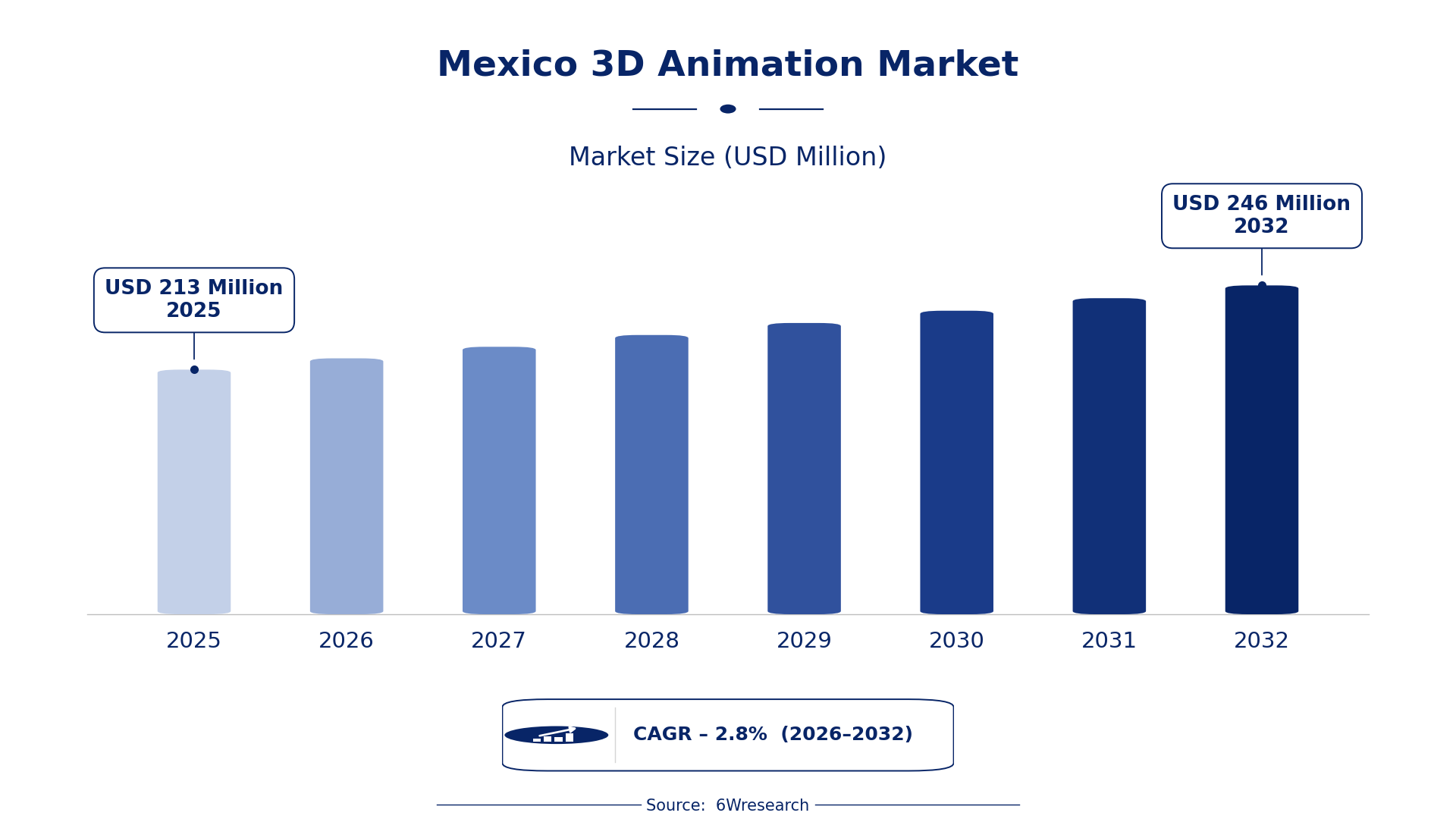
The Mexico 3D Animation Market was estimated at USD 213 Million in 2025 and is projected to reach USD 246 Million by 2032, growing at a CAGR of 2.8% from 2026 to 2032.
Mexico 3D Animation Market Synopsis
The demand for high-quality animated content in Mexico is surging, particularly in the entertainment and advertising sectors. This growth is fueled by the increasing consumption of digital media and the rising popularity of streaming platforms, which require visually engaging and immersive animation experiences.
The local animation studios are responding to this demand by investing in advanced technology and talent development. Collaborations with international companies are also becoming more common, allowing Mexican studios to enhance their production quality and global reach, positioning the country as a competitive player in the animation market.
Mexico 3D Animation Market Year-wise Growth Rate and Key Drivers
This graph illustrates the annual growth rates of the Mexico 3D Animation Market from 2021 to 2032, highlighting a steady upward trajectory and projected expansion over the forecast period.
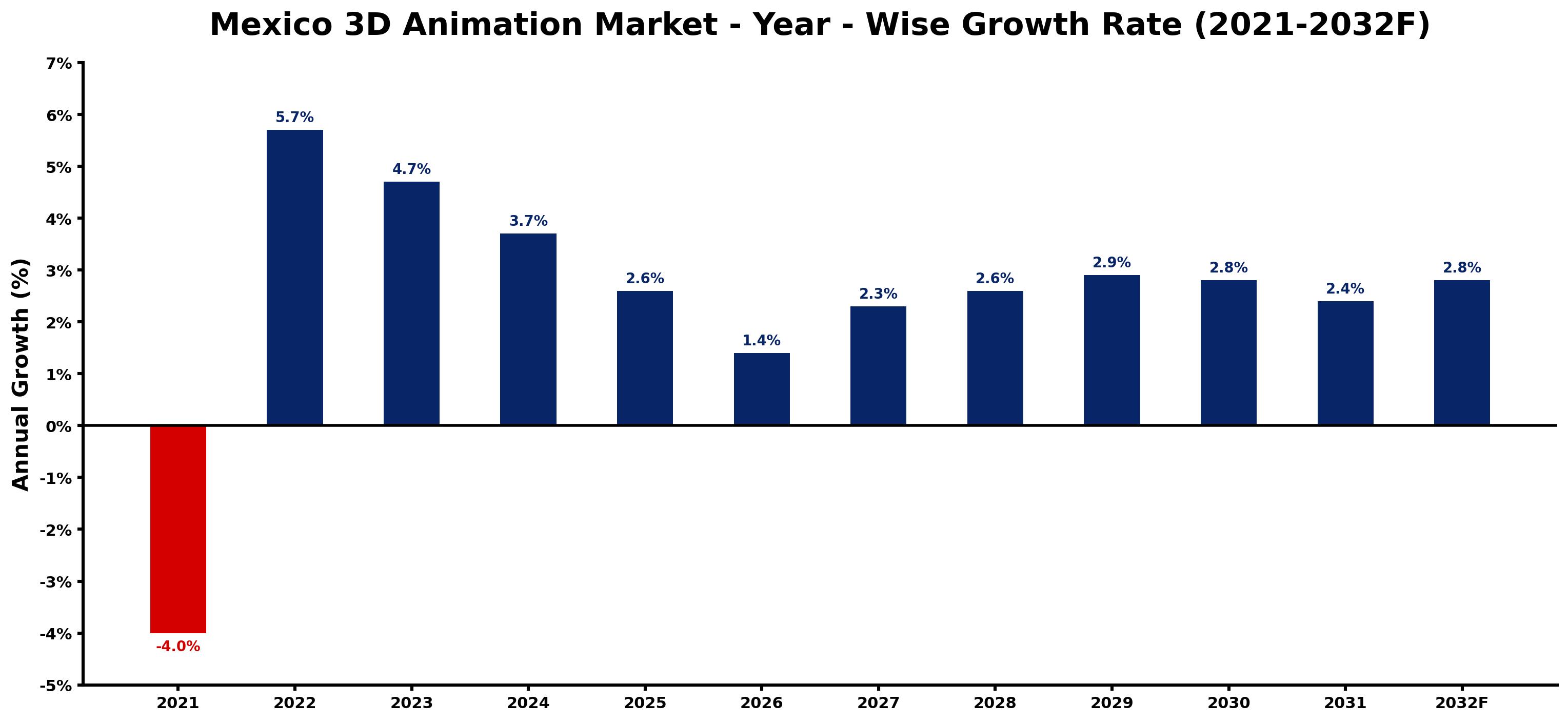
The table below presents the year‑wise growth rates along with the key drivers influencing the market
| Year | Growth Rate | Major Drivers |
| 2021 | -4.0% | COVID-19 restrictions limited production capabilities in studios |
| 2022 | 5.7% | Increased investment in Mexican film and gaming industries. |
| 2023 | 4.7% | Growth of local animation studios attracting international projects. |
| 2024 | 3.7% | Government support for digital creative industries initiatives. |
| 2025 | 2.6% | Popularity of animated series on streaming platforms increases. |
| 2026 | 1.4% | Rising enrollment in animation and digital arts programs. |
| 2027 | 2.3% | Collaborations with U.S. studios enhance market capabilities. |
| 2028 | 2.6% | Emergence of augmented reality applications in marketing. |
| 2029 | 2.9% | Local companies adopting 3D technology for product visualization. |
| 2030 | 2.8% | Increased mobile gaming driving demand for animation services. |
| 2031 | 2.4% | Growth in e-learning utilizing animated content for engagement. |
| 2032 | 2.8% | Emergence of 3D content in virtual events and trade shows. |
Note: Market size estimations and growth projections presented in this report are based on 6Wresearch's proprietary forecasting methodology, utilizing the latest available industry data, government publications, and primary research inputs.
Mexico 3D Animation Market Key Takeaways
Below are some of the specific key takeaways from the market, including:
- The Mexican animation industry is rapidly expanding, driven by diverse applications in entertainment, advertising, and education.
- Investment in new technologies such as virtual and augmented reality is gaining traction among local studios.
- Government incentives are playing a crucial role in supporting the growth of the animation sector.
- Collaboration between local and international animation firms is enhancing production quality and market competitiveness.
- The increasing demand for animated content is set to sustain market growth through 2032.
Evaluation of Restraints in Mexico 3D Animation Market
Despite the promising growth trajectory, the Mexico 3D animation market faces several challenges. Intense competition from established international animation studios puts pressure on local firms to innovate continuously. Additionally, the industry grapples with a shortage of skilled talent, which limits the capacity for high-quality production. Access to advanced technology remains limited for some studios, affecting their ability to compete effectively. Economic fluctuations and currency exchange rate volatility can further complicate production budgets, necessitating strategic planning and partnerships to overcome these hurdles.
Mexico 3D Animation Market Trends
Key trends shaping the Mexico 3D animation market include the increasing use of advanced technologies, such as virtual reality (VR) and augmented reality (AR), which are opening new avenues for creative storytelling. The rise of streaming platforms is also driving demand for innovative and engaging animation, compelling studios to elevate their production quality. on top of that, there’s a noticeable shift towards collaboration, with local studios partnering with international players to share expertise and resources, creating a more vibrant animation ecosystem.
Mexico 3D Animation Market Opportunities
Investment opportunities abound in the Mexico 3D animation market as demand for high-quality content continues to grow. Local studios are increasingly gaining recognition for their creativity and talent, making them attractive partners for co-productions and technology investments. The proximity to the North American market offers strategic advantages, allowing investors to tap into a larger audience. As the market matures, opportunities in training programs and technology development will also emerge, providing avenues for sustainable growth.
Government Initiatives in the Mexico 3D Animation Market
The Mexican government is actively fostering the growth of the 3D animation market through various supportive policies. Initiatives aimed at providing financial incentives for animation production and promoting international collaborations are critical to enhancing the industry’s competitiveness. With an emphasis on developing local talent and improving production capabilities, these policies are crucial for the sector's ongoing success.
- A recently launched Film and Audiovisual Incentives Law provides tax rebates to companies producing animation content, aiming to stimulate local industry growth.
- Currently underway is a program by IMCINE (Mexican Institute of Cinematography) offering funding and resources to local animation studios to enhance their capabilities.
- Planned initiatives include a national talent development program expected to roll out by 2026, focusing on training skilled animators and technicians.
- Efforts to establish international partnerships are being promoted through government-sponsored events designed to connect local studios with global players.
Future Insights of the Mexico 3D Animation Market
Looking ahead to 2026-2032, the Mexico 3D animation market is likely to experience significant advancements driven by technology and creative talent. As studios adopt more sophisticated animation techniques, the quality and range of animated content will improve, appealing to both local and international audiences. The growth of digital platforms will continue to provide new opportunities for distribution, while collaborations with international firms will further enhance production values. The market is positioned for ongoing innovation and growth, supported by governmental policies and a vibrant creative community.
Mexico 3D Animation Market Latest Developments
In the past year, the Mexico 3D animation market has seen a flurry of activity, reflecting a growing commitment to enhancing production quality and expanding market reach. Local studios are increasingly investing in new technologies to stay competitive, while collaborations are becoming more common as companies seek to leverage shared expertise.
- An initiative launched in early 2025 aims to upgrade digital infrastructure for animation studios across Mexico, enhancing production capabilities.
- A partnership formed in mid-2025 between a local studio and an international distributor is currently underway, focusing on co-producing animated series for streaming platforms.
- By late 2026, a new animation talent showcase is planned to highlight local talent and connect animators with potential investors and collaborators.
- A technology rollout aimed at integrating VR into existing animation workflows began in Q1 2025 and remains ongoing, promising to revolutionize content creation.
Mexico 3D Animation Market - Key Attractiveness of the Report
- 10 Years of Market Numbers
- Historical Data Starting from 2022 to 2025
- Base Year: 2025
- Forecast Data until 2032
- Key Performance Indicators Impacting the Market
- Major Upcoming Developments and Projects
Key Highlights of the Report:
- Mexico 3D Animation Market Outlook
- Market Size of Mexico 3D Animation Market, 2025
- Forecast of Mexico 3D Animation Market, 2032
- Historical Data and Forecast of Mexico 3D Animation Revenues & Volume for the Period 2022-2032F
- Mexico 3D Animation Market Trend Evolution
- Mexico 3D Animation Market Drivers and Challenges
- Mexico 3D Animation Price Trends
- Mexico 3D Animation Porter's Five Forces
- Mexico 3D Animation Industry Life Cycle
- Historical Data and Forecast of Mexico 3D Animation Market Revenues & Volume By Technology for the Period 2022-2032F
- Historical Data and Forecast of Mexico 3D Animation Market Revenues & Volume By 3D Modeling for the Period 2022-2032F
- Historical Data and Forecast of Mexico 3D Animation Market Revenues & Volume By Motion Graphics for the Period 2022-2032F
- Historical Data and Forecast of Mexico 3D Animation Market Revenues & Volume By 3D Rendering for the Period 2022-2032F
- Historical Data and Forecast of Mexico 3D Animation Market Revenues & Volume By Visual Effects for the Period 2022-2032F
- Historical Data and Forecast of Mexico 3D Animation Market Revenues & Volume By Service for the Period 2022-2032F
- Historical Data and Forecast of Mexico 3D Animation Market Revenues & Volume By Consulting for the Period 2022-2032F
- Historical Data and Forecast of Mexico 3D Animation Market Revenues & Volume By Support and Maintenance for the Period 2022-2032F
- Historical Data and Forecast of Mexico 3D Animation Market Revenues & Volume By Integration and Deployment for the Period 2022-2032F
- Historical Data and Forecast of Mexico 3D Animation Market Revenues & Volume By Education and Training for the Period 2022-2032F
- Historical Data and Forecast of Mexico 3D Animation Market Revenues & Volume By Vertical for the Period 2022-2032F
- Historical Data and Forecast of Mexico 3D Animation Market Revenues & Volume By Media and Entertainment for the Period 2022-2032F
- Historical Data and Forecast of Mexico 3D Animation Market Revenues & Volume By Construction and Architecture for the Period 2022-2032F
- Historical Data and Forecast of Mexico 3D Animation Market Revenues & Volume By Healthcare and Lifesciences for the Period 2022-2032F
- Historical Data and Forecast of Mexico 3D Animation Market Revenues & Volume By Manufacturing for the Period 2022-2032F
- Historical Data and Forecast of Mexico 3D Animation Market Revenues & Volume By Education and Academia for the Period 2022-2032F
- Historical Data and Forecast of Mexico 3D Animation Market Revenues & Volume By Others for the Period 2022-2032F
- Historical Data and Forecast of Mexico 3D Animation Market Revenues & Volume By Deployment for the Period 2022-2032F
- Historical Data and Forecast of Mexico 3D Animation Market Revenues & Volume By On-Premises for the Period 2022-2032F
- Historical Data and Forecast of Mexico 3D Animation Market Revenues & Volume By On-Demand for the Period 2022-2032F
- Mexico 3D Animation Import Export Trade Statistics
- Market Opportunity Assessment By Technology
- Market Opportunity Assessment By Service
- Market Opportunity Assessment By Vertical
- Market Opportunity Assessment By Deployment
- Mexico 3D Animation Top Companies Market Share
- Mexico 3D Animation Competitive Benchmarking By Technical and Operational Parameters
- Mexico 3D Animation Company Profiles
- Mexico 3D Animation Key Strategic Recommendations






































