Mexico Cloud Managed Services Market Size & Growth Rate (2026-2032)
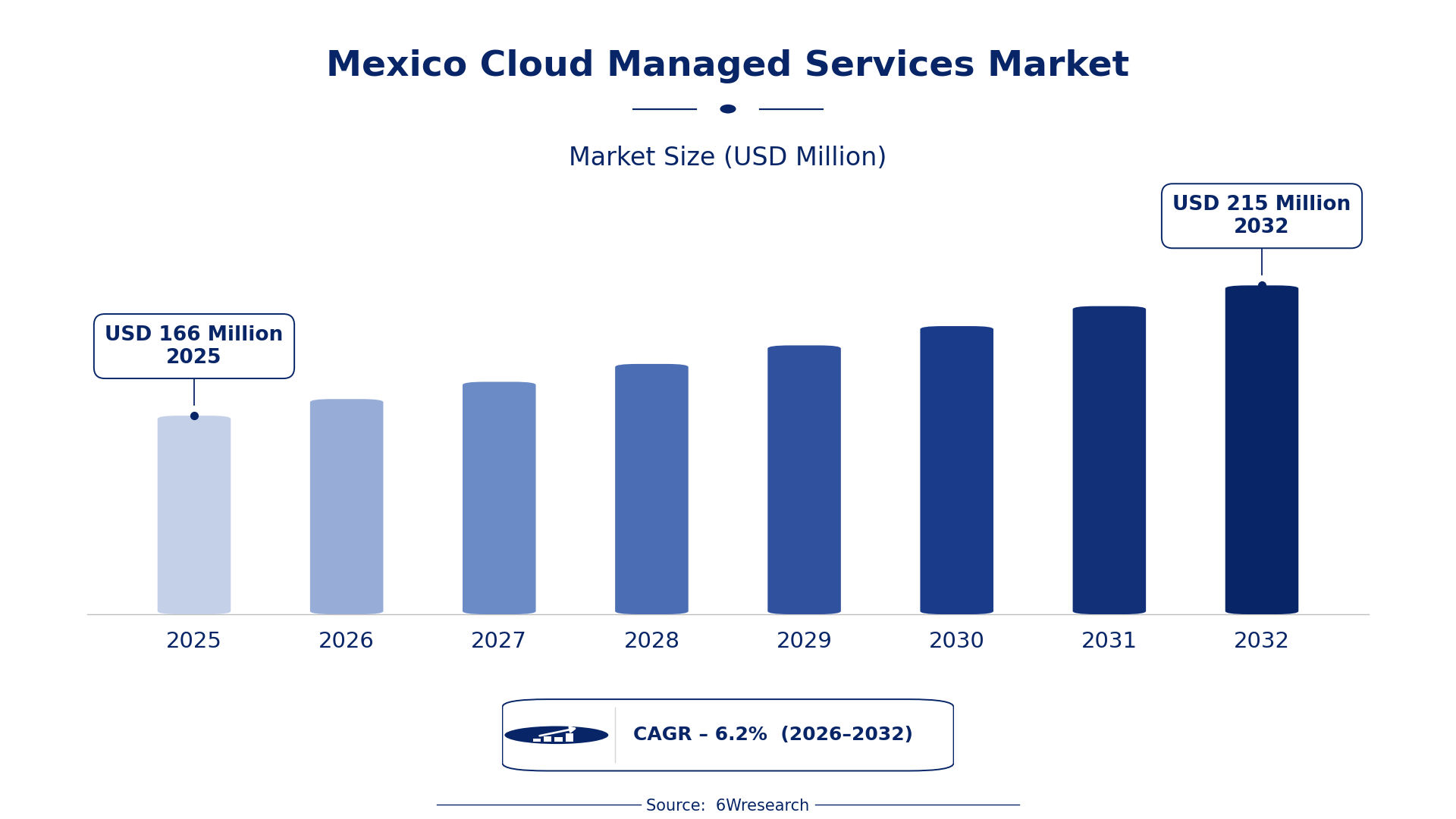
The Mexico Cloud Managed Services Market was estimated at USD 166 Million in 2025 and is projected to reach USD 215 Million by 2032, growing at a CAGR of 6.2% from 2026 to 2032.
Mexico Cloud Managed Services Market Synopsis
The increasing complexity of IT environments is pushing Mexican businesses toward cloud managed services. Companies are keen to outsource their IT management, focusing on their core competencies while relying on specialized providers for cloud infrastructure and applications.
This shift is not merely a trend; it reflects a strategic decision to optimize operations. As firms navigate the challenges of digital transformation, cloud managed services are becoming indispensable, offering both efficiency and expert guidance.
Mexico Cloud Managed Services Market Year-wise Growth Rate and Key Drivers
This graph illustrates the annual growth rates of the Mexico Cloud Managed Services Market from 2021 to 2032, highlighting a steady upward trajectory and projected expansion over the forecast period.
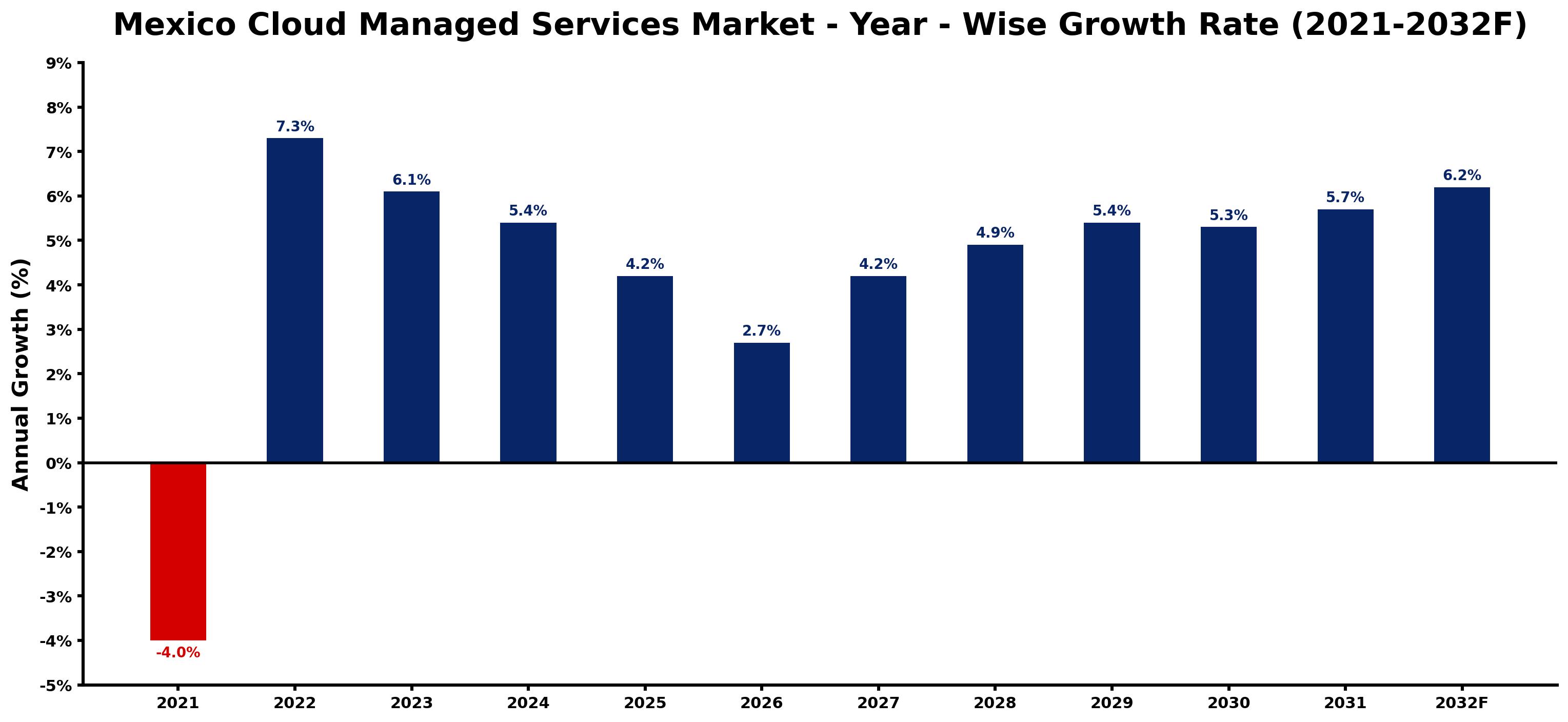
The table below presents the year‑wise growth rates along with the key drivers influencing the market
| Year | Growth Rate | Major Drivers |
| 2021 | -4.0% | COVID-19 budget cuts by Mexican SMEs affected spending |
| 2022 | 7.3% | Increased digital transformation spending by Mexican enterprises. |
| 2023 | 6.1% | Government incentives for SMEs adopting cloud solutions. |
| 2024 | 5.4% | Growing emphasis on data security regulations by COFEMER. |
| 2025 | 4.2% | Rising adoption of IoT devices driving cloud usage. |
| 2026 | 2.7% | Strong growth in tech startups seeking managed services. |
| 2027 | 4.2% | Large enterprises migrating to multi-cloud environments. |
| 2028 | 4.9% | Regional data privacy laws boosting cloud service demand. |
| 2029 | 5.4% | Collaboration with local universities enhancing cloud talent pool. |
| 2030 | 5.3% | Increased foreign investment in Mexico's tech sector. |
| 2031 | 5.7% | Emergence of e-commerce platforms driving cloud resource needs. |
| 2032 | 6.2% | Adoption of AI-driven solutions requiring robust cloud infrastructure. |
Note: Market size estimations and growth projections presented in this report are based on 6Wresearch's proprietary forecasting methodology, utilizing the latest available industry data, government publications, and primary research inputs.
Mexico Cloud Managed Services Market Key Takeaways
Below are some of the specific key takeaways from the market, including:
- Rising demand for outsourcing IT management is fueling market growth.
- Customization and vendor management challenges are critical issues for service providers.
- Government support through favorable policies enhances market viability.
- Enterprises are increasingly adopting multi-cloud strategies, impacting service offerings.
- Cost control remains a major concern, necessitating effective financial management practices.
Evaluation of Restraints in Mexico Cloud Managed Services Market
Despite promising growth, the Mexico Cloud Managed Services Market faces notable restraints. One major challenge is the demand for service customization. Organizations expect tailored solutions that align closely with their operational workflows, complicating the ability of providers to deliver standardized services. This customization not only increases the complexity of service delivery but also heightens the risk of misalignment between client expectations and provider capabilities.
on top of that, managing relationships with multiple vendors in a multi-cloud environment can lead to interoperability issues and varying service level agreements (SLAs). Clients need clarity and transparency in costs to avoid unanticipated expenditures, which requires both advanced cost management tools and effective communication with service providers. Addressing these restraints is essential for maintaining customer trust and ensuring satisfaction.
Mexico Cloud Managed Services Market Trends
The drive toward digital transformation continues to shape the Mexico Cloud Managed Services Market. Many companies are adopting hybrid cloud strategies that combine public and private cloud solutions, aiming for flexibility and enhanced security. As organizations increasingly prioritize data analytics, service providers are also focusing on integrating AI and machine learning capabilities into their offerings, enhancing decision-making processes.
Sustainability is another emerging trend; businesses are looking for eco-friendly solutions in their cloud infrastructure. This demand is prompting managed service providers to explore green technologies and energy-efficient practices, responding to both regulatory pressures and consumer expectations.
Mexico Cloud Managed Services Market Opportunities
The opportunities within the Mexico Cloud Managed Services Market are substantial. As companies increasingly recognize the benefits of cloud solutions, there is a growing demand for specialized services that cater to niche markets. Industries such as healthcare and finance are prime candidates for tailored managed services due to their unique compliance requirements and data sensitivity.
on top of that, the rise of small and medium-sized enterprises (SMEs) is creating a fertile ground for cloud managed services. These businesses are often resource-constrained and are eager to adopt cloud solutions that allow them to scale efficiently without heavy upfront investments. Service providers that can offer flexible, cost-effective solutions stand to gain significant market share.
Government Initiatives in the Mexico Cloud Managed Services Market
Government policy plays a crucial role in shaping the Mexico Cloud Managed Services Market. The Mexican government is actively promoting the outsourcing of IT operations, aiming to reduce costs and enhance business agility. Regulatory frameworks are being established to ensure compliance and security in cloud services, which helps to build trust in the market.
- A regulatory framework introduced in 2025 mandating data protection measures for cloud service providers.
- Currently ongoing guidelines for managed service providers to enhance service quality and accountability.
- A national digital infrastructure upgrade program now in its rollout phase, improving connectivity and access to cloud services.
- Upcoming initiatives aimed at providing tax incentives for companies adopting cloud solutions to encourage innovation.
Future Insights of the Mexico Cloud Managed Services Market
Looking ahead to 2026-2032, the Mexico Cloud Managed Services Market is set to evolve significantly. The integration of advanced technologies, such as AI and automation, will reshape service offerings, making them more efficient and responsive to client needs. As businesses continue to prioritize digital transformation, the reliance on managed services is expected to deepen.
The focus on security and compliance will drive the demand for specialized services, particularly in regulated industries. Companies that can navigate the complexities of multi-cloud environments while ensuring cost control will emerge as leaders in this space. Thus, the future holds promise for those ready to adapt and innovate.
Mexico Cloud Managed Services Market Latest Developments
Recent activity in the Mexico Cloud Managed Services Market indicates a robust shift towards innovative solutions. Over the past year, several service providers have begun enhancing their offerings to meet rising demand and address client concerns regarding customization and cost transparency.
- A major technology vendor launched a new suite of cloud management tools in early 2025, aimed at streamlining operations for SMEs.
- An initiative that began in mid-2025 is currently underway, focusing on establishing partnerships with local firms to expand service delivery capabilities.
- A planned service upgrade expected to commence in late 2025 will incorporate advanced AI-driven analytics to improve performance monitoring.
- A regional operator is in the process of integrating green technologies into its cloud infrastructure, with a rollout expected by Q1 2026.
Mexico Cloud Managed Services Market - Key Attractiveness of the Report
- 10 Years of Market Numbers
- Historical Data Starting from 2022 to 2025
- Base Year: 2025
- Forecast Data until 2032
- Key Performance Indicators Impacting the Market
- Major Upcoming Developments and Projects
Key Highlights of the Report:
- Mexico Cloud Managed Services Market Outlook
- Market Size of Mexico Cloud Managed Services Market, 2025
- Forecast of Mexico Cloud Managed Services Market, 2032
- Historical Data and Forecast of Mexico Cloud Managed Services Revenues & Volume for the Period 2022-2032F
- Mexico Cloud Managed Services Market Trend Evolution
- Mexico Cloud Managed Services Market Drivers and Challenges
- Mexico Cloud Managed Services Price Trends
- Mexico Cloud Managed Services Porter's Five Forces
- Mexico Cloud Managed Services Industry Life Cycle
- Historical Data and Forecast of Mexico Cloud Managed Services Market Revenues & Volume By Service Type for the Period 2022-2032F
- Historical Data and Forecast of Mexico Cloud Managed Services Market Revenues & Volume By Managed Security Services for the Period 2022-2032F
- Historical Data and Forecast of Mexico Cloud Managed Services Market Revenues & Volume By Managed Network Services for the Period 2022-2032F
- Historical Data and Forecast of Mexico Cloud Managed Services Market Revenues & Volume By Managed Infrastructure Services for the Period 2022-2032F
- Historical Data and Forecast of Mexico Cloud Managed Services Market Revenues & Volume By Managed Communication & Collaboration Services for the Period 2022-2032F
- Historical Data and Forecast of Mexico Cloud Managed Services Market Revenues & Volume By Managed Mobility Services for the Period 2022-2032F
- Historical Data and Forecast of Mexico Cloud Managed Services Market Revenues & Volume By Managed Business Services for the Period 2022-2032F
- Historical Data and Forecast of Mexico Cloud Managed Services Market Revenues & Volume By Security Services for the Period 2022-2032F
- Historical Data and Forecast of Mexico Cloud Managed Services Market Revenues & Volume By Managed Identity & Access Management for the Period 2022-2032F
- Historical Data and Forecast of Mexico Cloud Managed Services Market Revenues & Volume By Managed Antivirus/Anti-Malware for the Period 2022-2032F
- Historical Data and Forecast of Mexico Cloud Managed Services Market Revenues & Volume By Managed Firewall for the Period 2022-2032F
- Historical Data and Forecast of Mexico Cloud Managed Services Market Revenues & Volume By Managed Risk & Compliance Management for the Period 2022-2032F
- Historical Data and Forecast of Mexico Cloud Managed Services Market Revenues & Volume By Managed Vulnerability Management for the Period 2022-2032F
- Historical Data and Forecast of Mexico Cloud Managed Services Market Revenues & Volume By Managed Security Information & Event Management for the Period 2022-2032F
- Historical Data and Forecast of Mexico Cloud Managed Services Market Revenues & Volume By Managed Intrusion Detection System/Intrusion Prevention System for the Period 2022-2032F
- Historical Data and Forecast of Mexico Cloud Managed Services Market Revenues & Volume By Managed Data Loss Prevention for the Period 2022-2032F
- Historical Data and Forecast of Mexico Cloud Managed Services Market Revenues & Volume By Network Services for the Period 2022-2032F
- Historical Data and Forecast of Mexico Cloud Managed Services Market Revenues & Volume By Managed Network Provisioning for the Period 2022-2032F
- Historical Data and Forecast of Mexico Cloud Managed Services Market Revenues & Volume By Managed Network Monitoring & Management for the Period 2022-2032F
- Historical Data and Forecast of Mexico Cloud Managed Services Market Revenues & Volume By Infrastructure Services for the Period 2022-2032F
- Historical Data and Forecast of Mexico Cloud Managed Services Market Revenues & Volume By Storage Management for the Period 2022-2032F
- Historical Data and Forecast of Mexico Cloud Managed Services Market Revenues & Volume By Server Management for the Period 2022-2032F
- Historical Data and Forecast of Mexico Cloud Managed Services Market Revenues & Volume By Managed Print Services for the Period 2022-2032F
- Historical Data and Forecast of Mexico Cloud Managed Services Market Revenues & Volume By Managed Communication & Collaboration Services for the Period 2022-2032F
- Historical Data and Forecast of Mexico Cloud Managed Services Market Revenues & Volume By Managed Voice Over Internet Protocol for the Period 2022-2032F
- Historical Data and Forecast of Mexico Cloud Managed Services Market Revenues & Volume By Managed Unified Communication as a Service for the Period 2022-2032F
- Historical Data and Forecast of Mexico Cloud Managed Services Market Revenues & Volume By Managed Mobility Services for the Period 2022-2032F
- Historical Data and Forecast of Mexico Cloud Managed Services Market Revenues & Volume By Device Management Services for the Period 2022-2032F
- Historical Data and Forecast of Mexico Cloud Managed Services Market Revenues & Volume By Application Management Services for the Period 2022-2032F
- Historical Data and Forecast of Mexico Cloud Managed Services Market Revenues & Volume By Managed Business Services for the Period 2022-2032F
- Historical Data and Forecast of Mexico Cloud Managed Services Market Revenues & Volume By Business Process Services for the Period 2022-2032F
- Historical Data and Forecast of Mexico Cloud Managed Services Market Revenues & Volume By Continuity & Disaster Recovery Services for the Period 2022-2032F
- Historical Data and Forecast of Mexico Cloud Managed Services Market Revenues & Volume By Other Managed Business Services for the Period 2022-2032F
- Historical Data and Forecast of Mexico Cloud Managed Services Market Revenues & Volume By Organization Size for the Period 2022-2032F
- Historical Data and Forecast of Mexico Cloud Managed Services Market Revenues & Volume By SMEs for the Period 2022-2032F
- Historical Data and Forecast of Mexico Cloud Managed Services Market Revenues & Volume By Large Enterprises for the Period 2022-2032F
- Mexico Cloud Managed Services Import Export Trade Statistics
- Market Opportunity Assessment By Service Type
- Market Opportunity Assessment By Security Services
- Market Opportunity Assessment By Network Services
- Market Opportunity Assessment By Infrastructure Services
- Market Opportunity Assessment By Managed Communication & Collaboration Services
- Market Opportunity Assessment By Managed Mobility Services
- Market Opportunity Assessment By Managed Business Services
- Market Opportunity Assessment By Organization Size
- Mexico Cloud Managed Services Top Companies Market Share
- Mexico Cloud Managed Services Competitive Benchmarking By Technical and Operational Parameters
- Mexico Cloud Managed Services Company Profiles
- Mexico Cloud Managed Services Key Strategic Recommendations






































