Mexico Data Center Market Growth Rate
According to 6Wresearch internal databases and industry insights, the Mexico Data Center Market is projected to grow at a robust compound annual growth rate (CAGR) of 19.32% during the forecast period 2026–2032.
Mexico Data Center Market Year-wise Growth Rate and Key Drivers (2022-2032)
This graph illustrates the annual growth rates of the Mexico Data Center Market from 2022 to 2032, highlighting a steady upward trajectory and projected market expansion over the forecast period.
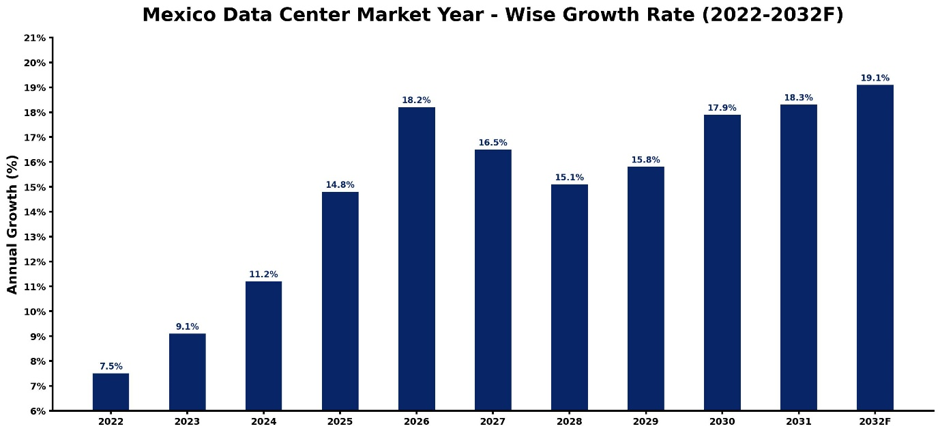
The following table summarizes the historical and forecasted growth rates of the Mexico Data Center Market, along with the rationale behind each year’s performance.
| Year | Estimated Growth (%) | Market Rationale |
| 2022 | 7.5% | Recovery from pandemic-era supply chain constraints. |
| 2023 | 9.1% | Initial surge in enterprise cloud migration. |
| 2024 | 11.2% | Increased demand for nearshoring and digital transformation. |
| 2025 | 14.8% | Massive influx of hyperscale facility investments. |
| 2026 | 18.2% | Expansion of AI-optimized data center infrastructure. |
| 2027 | 16.5% | High demand for low-latency edge deployments. |
| 2028 | 15.1% | Scaling of nationwide 5G connectivity networks. |
| 2029 | 15.8% | Maturation of regional high-performance computing hubs. |
| 2030 | 17.9% | Broad-scale renewable energy integration for cooling. |
| 2031 | 18.3% | Widespread adoption of sovereign cloud solutions. |
| 2032 | 19.1% | Full-scale integration of modular AI data architectures. |
Topics Covered in Mexico Data Center Market Report
The Mexico Data Center industry report covers the market by component, by vertical and Competitive Landscape. The report provides a detailed analysis of ongoing market trends, opportunities/high-growth areas, and market drivers that will help stakeholders align strategies based on current and future market dynamics.
Mexico Data Center Market Highlights
| Report Name | Mexico Data Center Market |
| Forecast period | 2026–2032 |
| CAGR | 19.32% |
| Growing Sector | IT & Telecommunications |
Mexico Data Center Market Synopsis
The Mexico Data Center Market is undergoing a significant transformation, shifting from traditional legacy infrastructure toward highly flexible, software-defined, and next-generation digital environments. As Mexico continues to strengthen its role as a strategic digital hub connecting North and South America, demand for advanced IT infrastructure, power systems, and efficient cooling technologies is rapidly increasing.
The market is being shaped by the deployment of high-density, AI-ready data center racks, along with the development of sustainable Green Data Centres that integrate advanced liquid cooling solutions, renewable energy sourcing, and energy-efficient designs. These advancements are enabling greater scalability, improved operational efficiency, and enhanced support for the growing demands of cloud computing, artificial intelligence, and digital services across the region.
Evaluation of Growth Drivers in Mexico Data Center Market (2026–2032)
Below are some major drivers and their influence on the market dynamics:
| Drivers | Primary Segment Affected | Why It Matters |
| Hyperscale Cloud Expansion | IT Infrastructure | Major tech giants are establishing domestic cloud regions to meet local low-latency requirements. |
| AI/ML Workload Demand | Servers/Compute | AI training necessitates 4x to 8x higher energy density compared to traditional enterprise workloads. |
| Nearshoring Trends | Networking | Economic shifts are driving global firms to relocate supply chains to Mexico, which increases local data demand. |
| 5G Network Proliferation | Edge Infrastructure | The innovation of 5G requires micro-data centres near users, that will minimize latency for applications. |
| Digital Economy Growth | Hospitals/Fintech | Rapid adoption of digital banking and e-commerce requires resilient data facilities. |
The Mexico Data Center Market is projected to grow at a CAGR of 19.32% during the forecast period 2026-2032. This growth is attributed to the hyperscale expansion, AI-driven workloads, and a growing dependence of enterprises for cloud-based infrastructure. This growth is result of a structural shift towards distributed computing ecosystems, where edge nodes and regional colocation centres are critical to reduce latency and ensure regulatory compliance.
Evaluation of Restraints in Mexico Data Center Market
Below are some major restraints and their influence on the market dynamics:
| Restraints | Primary Segment Affected | What This Means |
| Grid Reliability Issues | Power Infrastructure | Frequent blackouts in industrial zones disrupt operations and inflate backup energy costs. |
| Permitting Timelines | Construction Services | Lengthy municipal land-zoning and environmental permits delay project go-live dates. |
| Skilled Labour Shortage | Managed Services | A lack of specialized spatial talent forces firms to rely on external and expensive professional services. |
| High Capital Expenditure | Enterprises | Expensive AI-ready hardware creates a barrier for mid-sized domestic firms. |
| Energy Scarcity | Government/Utility | A swift demand growth beats current grid capacity in major facilities. |
Mexico Data Center Market Challenges
The primary challenge that the Mexico Data Centre Market growth is facing, is the energy-demand gap. While data centres are built at a record pace, the energy infrastructure, specifically transmission capacity, has struggled to follow along. The necessity of achieving net-zero emissions, while also managing large AI-driven heat loads requires costly upgrades for the existing mechanical systems. Another key challenge is the shortage of Tier III and Tier IV compliant infrastructure outside major hubs, which restricts rapid geographical expansion.
Mexico Data Center Market Trends
Emerging trends shaping the Mexico Data Center Market include the following:
- Modular Deployment: Expansion of prefabricated and modular data centres allow for rapid capacity scaling, which meets unpredictable traffic.
- Sustainable Cooling: Shift from conventional air cooling towards immersion cooling and closed-loop systems to reduce high energy usage.
- Edge Proliferation: Increasing investment in small-scale, edge facilities, that are located in major metropolitan hubs, serves the rising gaming and OTT sectors.
- Energy Arbitrage: Data center operators are highly investing in private renewable energy projects, which avoids unstable grid constraints.
Investment Opportunities in Mexico Data Center Market
Attractive investment opportunities within the Mexico Data Center Market include the following:
- Renewable Energy Power Plants: Investing in solar and wind farms to supply steadfast energy to major data center parks.
- DCIM Software: High chances for the innovation of Infrastructure Management software, which uses AI algorithms for energy breakdowns and to optimize power consumption.
- Green Retrofits: Potential exists to upgrade older tier I/II centres into tier III/IV centres.
- GPU-Enhanced Colocation: Introducing innovative GPU tenancy solutions to capitalize high margins, that are generated from AI model training.
Top Players in the Mexico Data Center Market
Below is a curated list of leading companies in the Mexico Data Center Market:
1. Equinix
| Company Name | Equinix |
|---|---|
| Established Year | 1998 |
| Headquarters | Redwood City, USA |
| Official Website | Click Here |
Equinix operates highly connected, carrier-neutral facilities in Mexico, providing direct access to global cloud, network, and IT ecosystems.
2. KIO Data Centres
| Company Name | KIO Data Centres |
|---|---|
| Established Year | 2002 |
| Headquarters | Mexico City, Mexico |
| Official Website | Click Here |
A dominant regional provider focusing on high-availability mission-critical services, cloud computing, and managed cybersecurity tailored to the Latin American market.
3. Scala Data Centres
| Company Name | Scala Data Centres |
|---|---|
| Established Year | 2020 |
| Headquarters | Barueri, Brazil (with major Mexico operations) |
| Official Website | Click Here |
Focuses on hyper-scale sustainable data centres designed to meet the extreme energy efficiency requirements of modern cloud and AI hyperscale’s.
4. HostDime
| Company Name | HostDime |
|---|---|
| Established Year | 2001 |
| Headquarters | Orlando, USA |
| Official Website | Click Here |
Provides enterprise-grade colocation and managed cloud services, maintaining robust localized infrastructure to support the growing enterprise sectors.
5. Ascenty (Digital Realty)
| Company Name | Ascenty (Digital Realty) |
|---|---|
| Established Year | 2010 |
| Headquarters | São Paulo, Brazil |
| Official Website | Click Here |
Leverages extensive international backing to deploy massive connectivity-rich campuses, supporting the large-scale capacity requirements of global corporations.
Government Initiatives in Mexico Data Center Market
The Mexican government, along with the Ministry of Energy, has launched open calls for private investment in renewable energy, to address the rising power demands of the data center industry. Additionally, regional governments have actively partnered with international tech giants to establish high-performance computing (HPC) and AI centres, providing tax incentives for long-term investments in high-tech infrastructure. Furthermore, several other schemes have been implemented by the government, such as the National Digital Strategy Programs, which encourages cloud adoption across public sector institutions, the Digital Mexico Initiative, that is expanding broadband and data infrastructure in rural regions, and many others which are contributing towards the data centre market of Mexico.
Future Insights of the Mexico Data Center Market
The future of Mexico Data Center Market follows the combination of AI with sustainable energy. By 2032, the industry is likely to be dominated by self-sustaining and smart campuses, that manage their own power generation through the help of private microgrids. As data sovereignty continues to be a legal priority, more international providers are transitioning from simple colocation, and offering regionalized and local-cloud platforms.
Market Segmentation Analysis
This report presents a detailed analysis of the market segments along with their leading categories:
By Vertical: IT & Telecom Dominates the Market
According to Ravi Bhandari, Research Head, 6Wresearch, the IT & Telecom sector have the largest market share of 48.02% in 2025, driven by the demand for massive data throughput and 5G network hosting. On the other hand, the BFSI (Banking, Financial Services, and Insurance) sector is also expanding rapidly, on account of strict regulatory requirements for 2N fault tolerance, and the digitalization of fintech platforms.
Note: Market size estimations and growth projections presented in this report are based on 6Wresearch's proprietary forecasting methodology, utilizing the latest available industry data, government publications, and primary research inputs.
Key Attractiveness of the Report:
- 10 Years of Market Numbers
- Historical Data Starting from 2022 to 2025
- Base Year: 2025
- Forecast Data until 2032
- Key Performance Indicators Impacting the Market
- Major Upcoming Developments and Projects
Key Highlights of the Report:
- Mexico Data Center Market Outlook
- Market Size of Mexico Data Center Market, 2025
- Forecast of Mexico Data Center Market, 2032
- Historical Data and Forecast of Mexico Data Center Revenues & Volume for the Period 2022-2032
- Mexico Data Center Market Trend Evolution
- Mexico Data Center Market Drivers and Challenges
- Mexico Data Center Price Trends
- Mexico Data Center Porter's Five Forces
- Mexico Data Center Industry Life Cycle
- Historical Data and Forecast of Mexico Data Center Market Revenues & Volume By Component for the Period 2022-2032
- Historical Data and Forecast of Mexico Data Center Market Revenues & Volume By Electrical for the Period 2022-2032
- Historical Data and Forecast of Mexico Data Center Market Revenues & Volume By Mechanical for the Period 2022-2032
- Historical Data and Forecast of Mexico Data Center Market Revenues & Volume By Networking for the Period 2022-2032
- Historical Data and Forecast of Mexico Data Center Market Revenues & Volume By Racks for the Period 2022-2032
- Historical Data and Forecast of Mexico Data Center Market Revenues & Volume By Security Systems for the Period 2022-2032
- Historical Data and Forecast of Mexico Data Center Market Revenues & Volume By Fire Systems for the Period 2022-2032
- Historical Data and Forecast of Mexico Data Center Market Revenues & Volume By Vertical for the Period 2022-2032
- Historical Data and Forecast of Mexico Data Center Market Revenues & Volume By Banking Financial Services & Insurance (BFSI) for the Period 2022-2032
- Historical Data and Forecast of Mexico Data Center Market Revenues & Volume By Government for the Period 2022-2032
- Historical Data and Forecast of Mexico Data Center Market Revenues & Volume By IT & Telecom for the Period 2022-2032
- Historical Data and Forecast of Mexico Data Center Market Revenues & Volume By Media for the Period 2022-2032
- Historical Data and Forecast of Mexico Data Center Market Revenues & Volume By Retail for the Period 2022-2032
- Historical Data and Forecast of Mexico Data Center Market Revenues & Volume By Manufacturing for the Period 2022-2032
- Historical Data and Forecast of Mexico Data Center Market Revenues & Volume By Others for the Period 2022-2032
- Mexico Data Center Import Export Trade Statistics
- Market Opportunity Assessment By Component
- Market Opportunity Assessment By Vertical
- Mexico Data Center Top Companies Market Share
- Mexico Data Center Competitive Benchmarking By Technical and Operational Parameters
- Mexico Data Center Company Profiles
- Mexico Data Center Key Strategic Recommendations
Market Covered
The report offers an extensive study of the following market segments:
By Component
- Electrical
- Mechanical
- Networking
- Racks
- Security Systems
- Fire Systems
By Vertical
- Banking Financial Services & Insurance (BFSI)
- Government
- IT & Telecom
- Media
- Retail
- Manufacturing
- Others






































