Mexico High Strength Steel Market Size, Share & Growth Rate
The Mexico High Strength Steel Market was estimated at USD 80 Million in 2025 and is projected to reach USD 92 Million by 2032, growing at a CAGR of 2.0% from 2026 to 2032. This growth trajectory is primarily fueled by the increasing demand for high strength steel in the automotive and construction sectors. As these industries continue to evolve, the need for materials that provide a superior strength-to-weight ratio and enhanced durability is pushing manufacturers toward adopting high strength steel.
Mexico High Strength Steel Market Year-wise Growth Rate and Key Drivers
This graph highlights how the Mexico High Strength Steel Market has steadily grown over the years, supported by major growth factors.
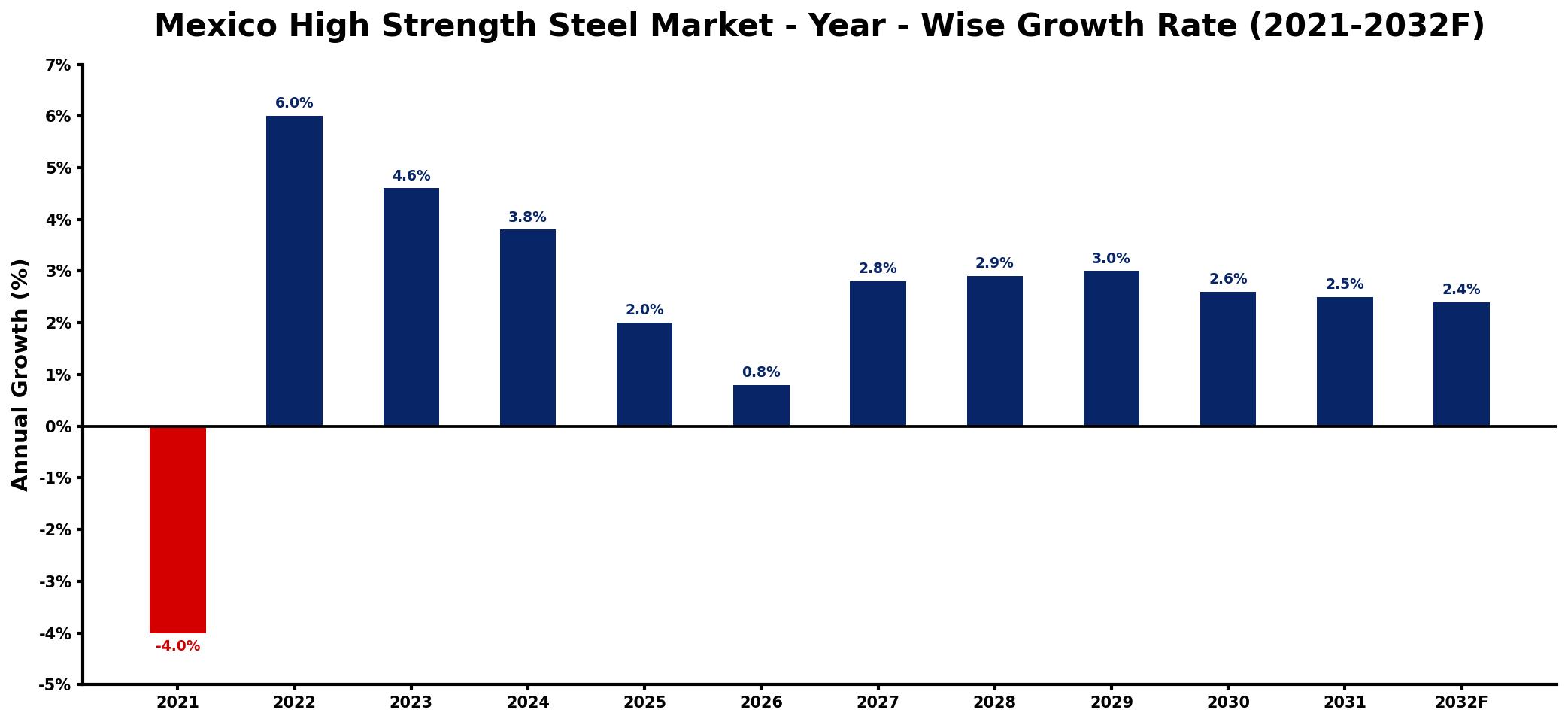
The table below presents the year‑wise growth rates along with the key drivers influencing the market
| Year | Growth Rate | Major Drivers |
| 2021 | -4.0% | decreased infrastructure spending initiatives |
| 2022 | 6.0% | rising construction project investments |
| 2023 | 4.6% | increased automotive manufacturing output |
| 2024 | 3.8% | growing renewable energy sector demands |
| 2025 | 2.0% | expansion in transportation infrastructure projects |
| 2026 | 0.8% | surge in appliance manufacturing needs |
| 2027 | 2.8% | boost in industrial machinery production |
| 2028 | 2.9% | development of urban housing projects |
| 2029 | 3.0% | enhanced mining sector activities |
| 2030 | 2.6% | growth in defense sector contracts |
| 2031 | 2.5% | increased commercial construction investments |
| 2032 | 2.4% | rising demand for agricultural equipment |
Note: Market size estimations and growth projections presented in this report are based on 6Wresearch's proprietary forecasting methodology, utilizing the latest available industry data, government publications, and primary research inputs.
Mexico High Strength Steel Market Synopsis
The high strength steel market in Mexico is witnessing a significant transformation, driven largely by innovations in material science and engineering. With a growing focus on sustainability and efficiency, high strength steel is becoming the material of choice for applications that prioritize strength without compromising weight.
A notable trend is the automotive sector's shift toward lighter and more fuel-efficient vehicles, which necessitates the use of advanced materials. Simultaneously, the construction industry is increasingly relying on high strength steel to enhance structural integrity while reducing overall material use, creating a synergistic effect across both sectors.
Mexico High Strength Steel Market Key Takeaways
- Increasing adoption of high strength steel in automotive and construction sectors drives market growth.
- Government policies supporting local production and use of high strength steel are enhancing market potential.
- High strength steel's superior mechanical properties position it as a preferred choice in various applications.
- Fluctuating raw material prices and R&D investment needs present challenges for market participants.
- Innovative manufacturing processes are poised to improve product quality and reduce costs in the coming years.
Evaluation of Restraints in Mexico High Strength Steel Market
Despite the promising outlook for the Mexico high strength steel market, several limitations exist that can hinder growth. Volatile steel prices are a primary concern, affecting profitability and pricing strategies for manufacturers. Additionally, intense competition among domestic and international producers puts pressure on market players to continuously innovate. The necessity for significant capital investments in research and development to develop new steel grades can deter smaller companies from entering the market, thereby limiting the diversity of options available for end-users.
Mexico High Strength Steel Market Trends
Several key trends are shaping the Mexico high strength steel market, particularly regarding sustainability and efficiency. As industries adopt more stringent environmental standards, the demand for high strength steel, which enables lower emissions and improved energy efficiency, is expected to rise. Furthermore, advancements in manufacturing technologies, such as automation and smart manufacturing, are enhancing the production capabilities of high strength steel, allowing for more precise and customized applications.
Mexico High Strength Steel Market Opportunities
Opportunities for growth in the Mexico high strength steel market are abundant, particularly within the automotive and construction industries. As automakers seek to meet regulatory demands for fuel efficiency and reduced emissions, high strength steel becomes an integral part of vehicle design. The ongoing construction boom in Mexico also presents an avenue for increasing high strength steel adoption in infrastructure projects, residential buildings, and commercial facilities, thereby driving further market expansion.
Government Initiatives in the Mexico High Strength Steel Market
The Mexican government is actively promoting the use of high strength steel through various initiatives aimed at enhancing local production capabilities. These initiatives include subsidies for manufacturers who invest in the production of high strength steel, tax incentives for companies that utilize these materials, and trade agreements that facilitate the export of Mexican steel. Regulatory frameworks are also established to ensure that high strength steel products meet quality and safety standards, fostering a more competitive market environment.
Future Insights of the Mexico High Strength Steel Market
Looking ahead to the period from 2026 to 2032, the Mexico high strength steel market is expected to evolve significantly. The convergence of technological advancements, increased governmental support, and a heightened focus on sustainability will propel the market forward. As the automotive and construction industries adapt to changing consumer demands and regulatory landscapes, the adoption of high strength steel will likely deepen, positioning it as a cornerstone material for future developments.
Mexico High Strength Steel Market Latest Developments (2025 - 2026)
Recent developments in the Mexico high strength steel market have focused on enhancing production techniques and optimizing material properties. Manufacturers are increasingly exploring innovative alloy compositions and treatments to improve strength and corrosion resistance. Collaborations between industry and academia are fostering research initiatives aimed at developing next-generation high strength steel grades, further positioning Mexico as a competitive player in the global market.
Mexico High Strength Steel Market - Key Attractiveness of the Report
- 10 Years of Market Numbers
- Historical Data Starting from 2022 to 2025
- Base Year: 2025
- Forecast Data until 2032
- Key Performance Indicators Impacting the Market
- Major Upcoming Developments and Projects
Key Highlights of the Report:
- Mexico High Strength Steel Market Outlook
- Market Size of Mexico High Strength Steel Market, 2025
- Forecast of Mexico High Strength Steel Market, 2032
- Historical Data and Forecast of Mexico High Strength Steel Revenues & Volume for the Period 2022-2032F
- Mexico High Strength Steel Market Trend Evolution
- Mexico High Strength Steel Market Drivers and Challenges
- Mexico High Strength Steel Price Trends
- Mexico High Strength Steel Porter's Five Forces
- Mexico High Strength Steel Industry Life Cycle
- Historical Data and Forecast of Mexico High Strength Steel Market Revenues & Volume By Product Type for the Period 2022-2032F
- Historical Data and Forecast of Mexico High Strength Steel Market Revenues & Volume By Dual Phase Steel for the Period 2022-2032F
- Historical Data and Forecast of Mexico High Strength Steel Market Revenues & Volume By Bake Hardenable Steel for the Period 2022-2032F
- Historical Data and Forecast of Mexico High Strength Steel Market Revenues & Volume By Carbon Manganese Steel for the Period 2022-2032F
- Historical Data and Forecast of Mexico High Strength Steel Market Revenues & Volume By Other Product Types for the Period 2022-2032F
- Historical Data and Forecast of Mexico High Strength Steel Market Revenues & Volume By Application for the Period 2022-2032F
- Historical Data and Forecast of Mexico High Strength Steel Market Revenues & Volume By Automotive for the Period 2022-2032F
- Historical Data and Forecast of Mexico High Strength Steel Market Revenues & Volume By Construction for the Period 2022-2032F
- Historical Data and Forecast of Mexico High Strength Steel Market Revenues & Volume By Yellow Goods and Mining Equipment for the Period 2022-2032F
- Historical Data and Forecast of Mexico High Strength Steel Market Revenues & Volume By Aviation and Marine for the Period 2022-2032F
- Historical Data and Forecast of Mexico High Strength Steel Market Revenues & Volume By Other Applications for the Period 2022-2032F
- Mexico High Strength Steel Import Export Trade Statistics
- Market Opportunity Assessment By Product Type
- Market Opportunity Assessment By Application
- Mexico High Strength Steel Top Companies Market Share
- Mexico High Strength Steel Competitive Benchmarking By Technical and Operational Parameters
- Mexico High Strength Steel Company Profiles
- Mexico High Strength Steel Key Strategic Recommendations






































