Brazil High Strength Steel Market Size, Share & Growth Rate
The Brazil High Strength Steel Market was estimated at USD 113 Million in 2025 and is projected to reach USD 134 Million by 2032, growing at a CAGR of 2.5% from 2026 to 2032. This trajectory reflects a robust demand for lightweight, yet durable materials, particularly within the automotive sector, which is focusing heavily on fuel efficiency and performance. The push towards sustainability in production processes and the adoption of advanced manufacturing technologies are also key elements driving this market forward.
Brazil High Strength Steel Market Year-wise Growth Rate and Key Drivers
This graph highlights how the Brazil High Strength Steel Market has steadily grown over the years, supported by major growth factors.
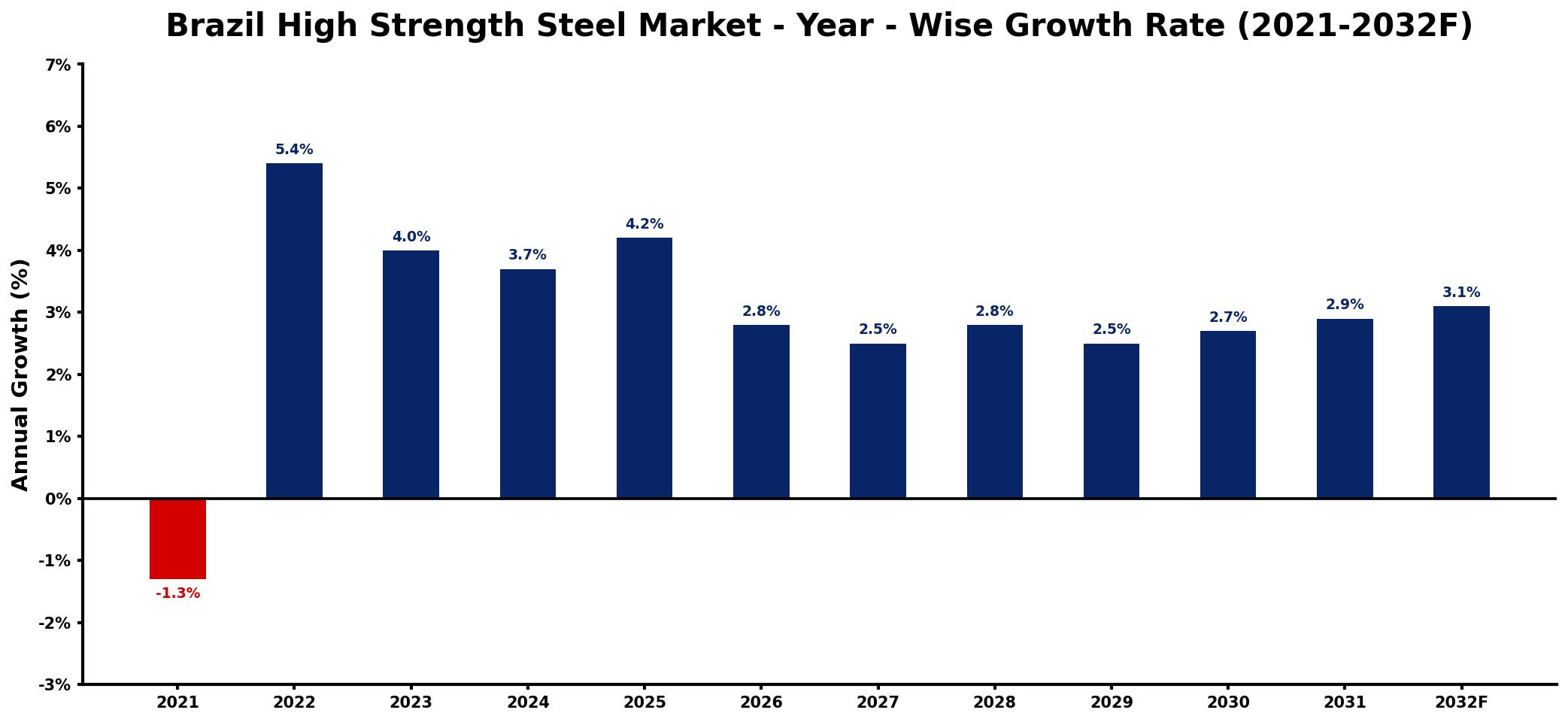
The table below presents the year‑wise growth rates along with the key drivers influencing the market
| Year | Growth Rate | Major Drivers |
| 2021 | -1.3% | Construction activity slowed down significantly |
| 2022 | 5.4% | Infrastructure projects increased demand substantially |
| 2023 | 4.0% | Automotive manufacturing expanded production capacity |
| 2024 | 3.7% | Renewable energy investments surged rapidly |
| 2025 | 4.2% | Export opportunities in international markets |
| 2026 | 2.8% | Technological advancements enhanced production efficiency |
| 2027 | 2.5% | Urbanization trends drove construction growth |
| 2028 | 2.8% | Government initiatives promoted industrial development |
| 2029 | 2.5% | expanding manufacturing base activity |
| 2030 | 2.7% | Sustainability practices boosted manufacturing investments |
| 2031 | 2.9% | Increased foreign investments in infrastructure |
| 2032 | 3.1% | Emerging markets presented new opportunities |
Note: Market size estimations and growth projections presented in this report are based on 6Wresearch's proprietary forecasting methodology, utilizing the latest available industry data, government publications, and primary research inputs.
Brazil High Strength Steel Market Synopsis
The demand for high strength steel in Brazil is increasingly influenced by the automotive industry's shift towards lighter vehicles. This material is favored for its ability to enhance vehicle efficiency, safety, and overall performance without compromising structural integrity. As car manufacturers respond to stringent regulations on emissions, high strength steel is emerging as a critical material in vehicle design and production.
Additionally, structural engineering applications are evolving, with high strength steel becoming vital for modern infrastructure projects. The need for stronger, lighter materials in bridge and building constructions is evident as Brazil continues to modernize its infrastructure to support economic growth. These trends underline the crucial role high strength steel plays across various sectors.
Brazil High Strength Steel Market Key Takeaways
- The market is driven by increased demand in the automotive sector for lightweight, efficient materials.
- Technological innovations in steel production are enhancing performance and expanding application areas.
- Government initiatives are focused on bolstering R&D and skills training to improve competitiveness.
- There is a growing need for sustainable production practices in high strength steel manufacturing.
- Industry partnerships are vital for advancing technology adoption and fostering innovation.
Evaluation of Restraints in Brazil High Strength Steel Market
Despite its growth potential, the Brazil High Strength Steel Market grapples with significant challenges. One of the primary restraints lies in the complexity of developing high-performance steel alloys that meet rigorous industry standards while maintaining efficient production processes. This complexity often leads to increased production costs and longer lead times, hindering market players' ability to meet the rapidly evolving demands of various industries.
Moreover, the variability in raw material prices can affect profitability and investment capacity. The need for skilled labor and advanced manufacturing technology further complicates the landscape, requiring market participants to continuously invest in workforce development and innovation to stay competitive.
Brazil High Strength Steel Market Trends
A notable trend shaping the Brazil High Strength Steel Market is the increasing integration of smart technologies in manufacturing. Automation and data analytics are being harnessed to enhance production efficiency, reduce waste, and improve product quality. Additionally, the trend towards green steel production is gaining momentum, with more companies exploring eco-friendly methods that minimize carbon footprints, aligning with global sustainability goals.
The automotive industry's shift towards electric vehicles is another trend impacting demand. High strength steel is being recognized for its potential to support the unique structural needs of electric and hybrid vehicles, thus expanding its application range. As environmental regulations tighten, the transition towards greener alternatives further propels innovation in high strength steel applications.
Brazil High Strength Steel Market Opportunities
Emerging opportunities in the Brazil High Strength Steel Market largely stem from the country's commitment to infrastructure development. As Brazil invests in modernizing its transportation networks and urban infrastructure, the demand for high strength steel in construction projects will rise significantly. Additionally, the ongoing evolution in the automotive sector towards more efficient, electric vehicles creates a niche for specialized high strength steel products designed to meet specific performance criteria.
Furthermore, collaborations between industry stakeholders and academic institutions can pave the way for innovative material developments and production techniques. The governments push for research and development in this area also represents a ripe opportunity for businesses looking to capitalize on advances in steel technology.
Government Initiatives in the Brazil High Strength Steel Market
The Brazilian government is playing an integral role in the advancement of the high strength steel market through various initiatives aimed at fostering innovation and competitiveness. Policies are focused on enhancing research and development capabilities, promoting the adoption of cutting-edge technologies, and ensuring that workers are equipped with the necessary skills for modern manufacturing environments. These measures help create a more favorable environment for investment and collaboration within the sector, encouraging growth and market penetration.
Future Insights of the Brazil High Strength Steel Market
Looking towards the future, the Brazil High Strength Steel Market is poised for notable advancements as it navigates through 2026 to 2032. Innovations in material science are expected to lead to the introduction of more efficient and high-performing steel grades tailored for diverse applications. Additionally, as sustainability becomes a priority, we anticipate a stronger emphasis on eco-friendly production methods. The convergence of technological advancements and stringent regulatory frameworks will likely position high strength steel as a cornerstone of modern manufacturing and construction in Brazil.
Brazil High Strength Steel Market Latest Developments (2025 - 2026)
Recent developments in the Brazil High Strength Steel Market indicate a strong industry pivot towards integrating advanced manufacturing technologies. Companies are increasingly investing in automation and digitalization to improve production efficiency and meet evolving consumer demands. Collaborative efforts among various stakeholders have also intensified, focusing on developing innovative solutions and enhancing product offerings to better cater to the automotive and construction sectors. Moreover, the emphasis on sustainability is leading to more initiatives aimed at reducing the environmental impact of steel production.
Brazil High Strength Steel Market - Key Attractiveness of the Report
- 10 Years of Market Numbers
- Historical Data Starting from 2022 to 2025
- Base Year: 2025
- Forecast Data until 2032
- Key Performance Indicators Impacting the Market
- Major Upcoming Developments and Projects
Key Highlights of the Report:
- Brazil High Strength Steel Market Outlook
- Market Size of Brazil High Strength Steel Market, 2025
- Forecast of Brazil High Strength Steel Market, 2032
- Historical Data and Forecast of Brazil High Strength Steel Revenues & Volume for the Period 2022-2032F
- Brazil High Strength Steel Market Trend Evolution
- Brazil High Strength Steel Market Drivers and Challenges
- Brazil High Strength Steel Price Trends
- Brazil High Strength Steel Porter's Five Forces
- Brazil High Strength Steel Industry Life Cycle
- Historical Data and Forecast of Brazil High Strength Steel Market Revenues & Volume By Product Type for the Period 2022-2032F
- Historical Data and Forecast of Brazil High Strength Steel Market Revenues & Volume By Dual Phase Steel for the Period 2022-2032F
- Historical Data and Forecast of Brazil High Strength Steel Market Revenues & Volume By Bake Hardenable Steel for the Period 2022-2032F
- Historical Data and Forecast of Brazil High Strength Steel Market Revenues & Volume By Carbon Manganese Steel for the Period 2022-2032F
- Historical Data and Forecast of Brazil High Strength Steel Market Revenues & Volume By Other Product Types for the Period 2022-2032F
- Historical Data and Forecast of Brazil High Strength Steel Market Revenues & Volume By Application for the Period 2022-2032F
- Historical Data and Forecast of Brazil High Strength Steel Market Revenues & Volume By Automotive for the Period 2022-2032F
- Historical Data and Forecast of Brazil High Strength Steel Market Revenues & Volume By Construction for the Period 2022-2032F
- Historical Data and Forecast of Brazil High Strength Steel Market Revenues & Volume By Yellow Goods and Mining Equipment for the Period 2022-2032F
- Historical Data and Forecast of Brazil High Strength Steel Market Revenues & Volume By Aviation and Marine for the Period 2022-2032F
- Historical Data and Forecast of Brazil High Strength Steel Market Revenues & Volume By Other Applications for the Period 2022-2032F
- Brazil High Strength Steel Import Export Trade Statistics
- Market Opportunity Assessment By Product Type
- Market Opportunity Assessment By Application
- Brazil High Strength Steel Top Companies Market Share
- Brazil High Strength Steel Competitive Benchmarking By Technical and Operational Parameters
- Brazil High Strength Steel Company Profiles
- Brazil High Strength Steel Key Strategic Recommendations






































