Morocco Business Intelligence and Analytics Software Market Size & Growth Rate (2026-2032)
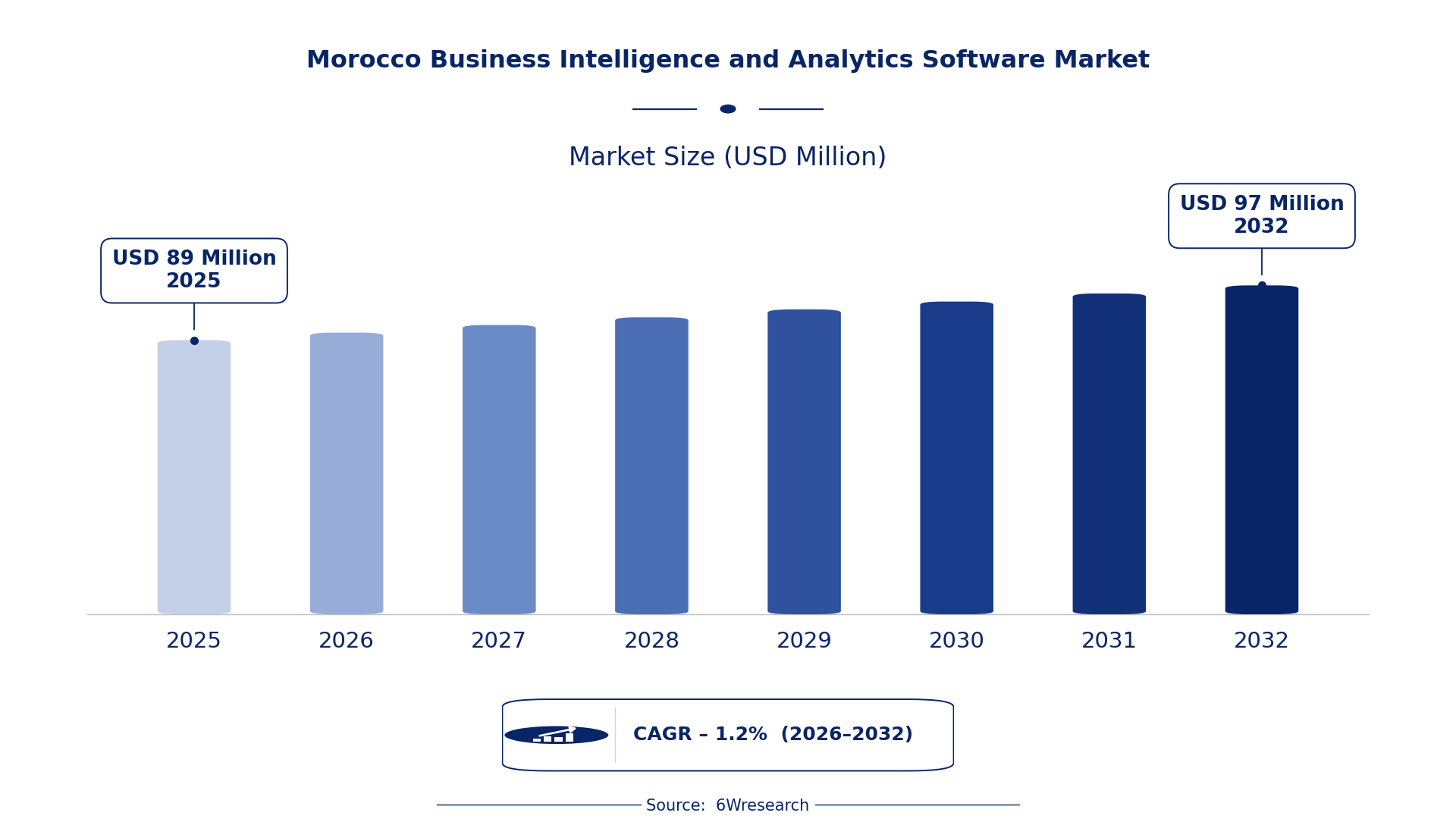
The Morocco Business Intelligence and Analytics Software Market was estimated at USD 89 Million in 2025 and is projected to reach USD 97 Million by 2032, growing at a CAGR of 1.2% from 2026 to 2032.
Morocco Business Intelligence and Analytics Software Market Synopsis
The demand for business intelligence and analytics software in Morocco is surging, particularly as enterprises recognize the necessity of data-driven decision-making. This shift is evident across various sectors, with businesses striving to unlock insights from expansive datasets, which in turn drives operational efficiencies.
Key industries such as banking, telecommunications, and manufacturing are leading the charge in adopting advanced analytics tools. As these sectors embrace digital transformation, the integration of AI and machine learning technologies becomes critical for maintaining a competitive edge and fostering innovation.
Morocco Business Intelligence and Analytics Software Market Year-wise Growth Rate and Key Drivers
This graph illustrates the annual growth rates of the Morocco Business Intelligence and Analytics Software Market from 2021 to 2032, highlighting a steady upward trajectory and projected expansion over the forecast period.
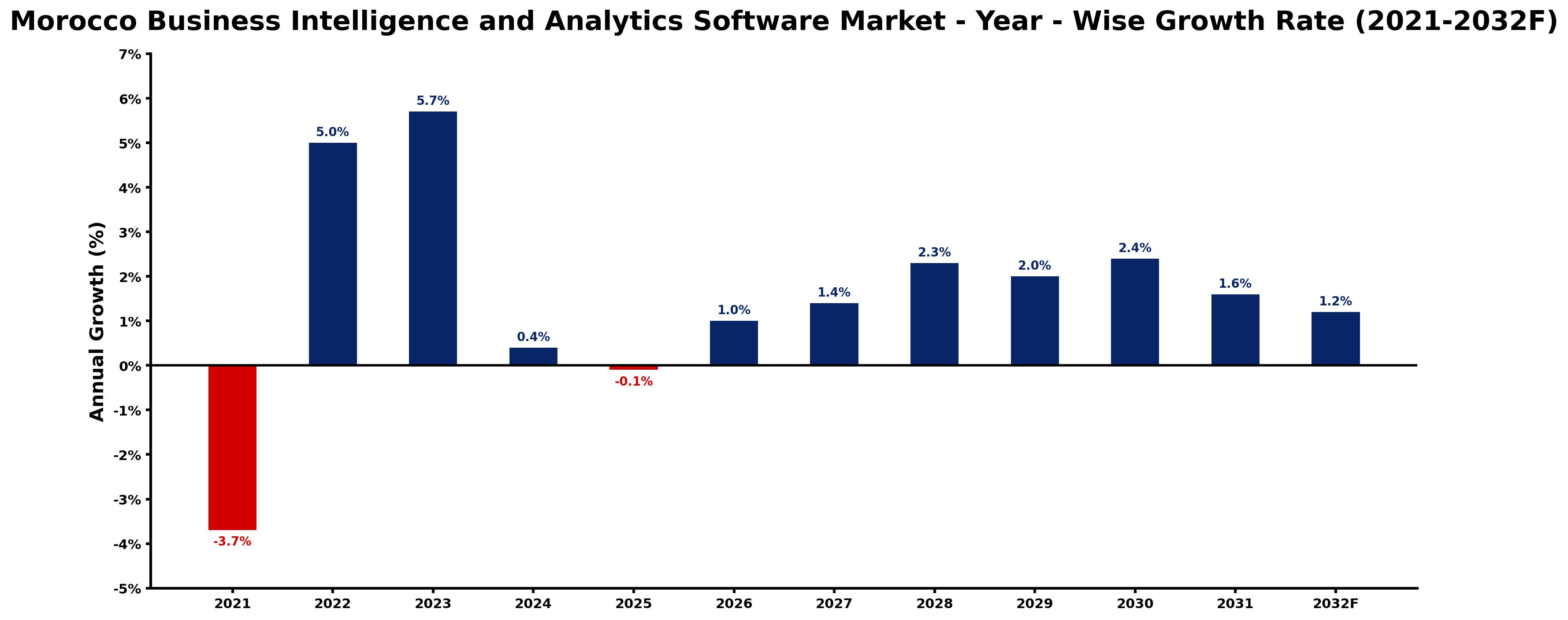
The table below presents the year‑wise growth rates along with the key drivers influencing the market
| Year | Growth Rate | Major Drivers |
| 2021 | -3.7% | Limited digital infrastructure in rural Moroccan areas. |
| 2022 | 5.0% | Government initiative to digitize public sector operations |
| 2023 | 5.7% | Increased demand for data-driven decision-making in SMEs |
| 2024 | 0.4% | Growth in online retail analytics applications |
| 2025 | -0.1% | Decline in public sector IT spending post-reform. |
| 2026 | 1.0% | Investment in AI technologies by local startups |
| 2027 | 1.4% | Emergence of data literacy programs in universities |
| 2028 | 2.3% | Business adaptation to remote work analytics needs |
| 2029 | 2.0% | Rising focus on marketing analytics for local brands |
| 2030 | 2.4% | Strengthened regulations on data management practices |
| 2031 | 1.6% | Collaboration between local firms and tech incubators |
| 2032 | 1.2% | Adoption of cloud solutions among Moroccan enterprises |
Note: Market size estimations and growth projections presented in this report are based on 6Wresearch's proprietary forecasting methodology, utilizing the latest available industry data, government publications, and primary research inputs.
Morocco Business Intelligence and Analytics Software Market Key Takeaways
Below are some of the specific key takeaways from the market, including:
- The market is witnessing increasing investment in analytics solutions across key sectors.
- Real-time data analysis is a primary driver of software adoption among Moroccan businesses.
- Small and medium-sized enterprises face challenges in understanding the potential benefits of these tools.
- Data privacy regulations are shaping how businesses implement analytics solutions.
- Government initiatives are supporting the digital transformation agenda within the market.
Evaluation of Restraints in Morocco Business Intelligence and Analytics Software Market
Despite the growth potential, several restraints hinder market progress. A significant challenge lies in the integration of analytics solutions with existing systems, which often complicates their effective utilization. Additionally, many small and medium-sized enterprises lack a comprehensive understanding of how to harness the power of these software solutions, limiting their engagement. Concerns regarding data privacy and compliance with evolving regulations further complicate the landscape, creating hesitation among potential adopters.
Morocco Business Intelligence and Analytics Software Market Trends
A few key trends are shaping the Morocco Business Intelligence and Analytics Software Market. The shift towards real-time data processing is becoming more pronounced, as companies seek immediate insights for agile decision-making. Additionally, the incorporation of AI technologies is not just a buzzword; it's becoming a necessity for businesses looking to enhance predictive analytics capabilities. The emphasis on user-friendly interfaces is also gaining traction, ensuring that decision-makers at all levels can engage with data effectively.
Morocco Business Intelligence and Analytics Software Market Opportunities
Opportunities in the Moroccan market are extensive, particularly for vendors who can simplify the integration of business intelligence tools with existing infrastructures. There is a growing demand for training programs aimed at enhancing data literacy among small and medium-sized enterprises. on top of that, as regulatory frameworks around data privacy evolve, compliance-oriented solutions will likely see increased interest from organizations looking to align with new standards.
Government Initiatives in the Morocco Business Intelligence and Analytics Software Market
Government initiatives are playing a crucial role in shaping the trajectory of the Morocco Business Intelligence and Analytics Software Market. The focus on digital transformation is evident in various policies aimed at enhancing data utilization across sectors. Such initiatives not only support businesses in adopting analytics tools but also ensure that the necessary regulatory frameworks for data security are in place.
- A national digital infrastructure upgrade programme was recently completed, enhancing connectivity and access to data analytics solutions.
- Current initiatives include digital literacy campaigns aimed at equipping SMEs with the skills needed to leverage business intelligence tools effectively.
- The government is in the process of establishing a regulatory framework to address data privacy concerns, expected to roll out in mid-2026.
- Planned public-private partnerships are set to promote innovation in analytics, focusing on collaborative projects between government entities and tech firms.
Future Insights of the Morocco Business Intelligence and Analytics Software Market
Looking ahead to 2026-2032, the Morocco Business Intelligence and Analytics Software Market is expected to evolve significantly. As businesses increasingly recognize the strategic value of data, investment in analytics tools will likely accelerate. The integration of advanced technologies, such as machine learning and natural language processing, will drive further innovation. Companies that can effectively address data integration and user adoption challenges will be well-positioned to capitalize on emerging opportunities.
Morocco Business Intelligence and Analytics Software Market Latest Developments
Recent developments in the Morocco Business Intelligence and Analytics Software Market indicate a dynamic environment where innovation is at the forefront. Over the past year, organizations have shown increased engagement with analytics solutions as they adapt to the changing market demands.
- A major technology vendor launched a new analytics platform in Q1 2025, focusing on user-friendly data visualization tools.
- An ongoing initiative to enhance public sector data analytics capabilities began in early 2025 and continues to evolve.
- A partnership between regional firms to develop a cloud-based analytics solution is expected to be finalized by late 2026.
- Research efforts aimed at understanding user behavior with analytics tools were initiated in Q3 2025, with findings expected to guide future product development.
Morocco Business Intelligence and Analytics Software Market - Key Attractiveness of the Report
- 10 Years of Market Numbers
- Historical Data Starting from 2022 to 2025
- Base Year: 2025
- Forecast Data until 2032
- Key Performance Indicators Impacting the Market
- Major Upcoming Developments and Projects
Key Highlights of the Report:
- Morocco Business Intelligence and Analytics Software Market Outlook
- Market Size of Morocco Business Intelligence and Analytics Software Market, 2025
- Forecast of Morocco Business Intelligence and Analytics Software Market, 2032
- Historical Data and Forecast of Morocco Business Intelligence and Analytics Software Revenues & Volume for the Period 2022-2032F
- Morocco Business Intelligence and Analytics Software Market Trend Evolution
- Morocco Business Intelligence and Analytics Software Market Drivers and Challenges
- Morocco Business Intelligence and Analytics Software Price Trends
- Morocco Business Intelligence and Analytics Software Porter's Five Forces
- Morocco Business Intelligence and Analytics Software Industry Life Cycle
- Historical Data and Forecast of Morocco Business Intelligence and Analytics Software Market Revenues & Volume By Segment for the Period 2022-2032F
- Historical Data and Forecast of Morocco Business Intelligence and Analytics Software Market Revenues & Volume By Business Intelligence (BI) Platforms for the Period 2022-2032F
- Historical Data and Forecast of Morocco Business Intelligence and Analytics Software Market Revenues & Volume By Corporate Performance Management (CPM) Suite for the Period 2022-2032F
- Historical Data and Forecast of Morocco Business Intelligence and Analytics Software Market Revenues & Volume By Advanced and Predictive Analytics for the Period 2022-2032F
- Historical Data and Forecast of Morocco Business Intelligence and Analytics Software Market Revenues & Volume By Content Analytics for the Period 2022-2032F
- Historical Data and Forecast of Morocco Business Intelligence and Analytics Software Market Revenues & Volume By Analytics Application for the Period 2022-2032F
- Historical Data and Forecast of Morocco Business Intelligence and Analytics Software Market Revenues & Volume By Deployment Modes for the Period 2022-2032F
- Historical Data and Forecast of Morocco Business Intelligence and Analytics Software Market Revenues & Volume By On-premise for the Period 2022-2032F
- Historical Data and Forecast of Morocco Business Intelligence and Analytics Software Market Revenues & Volume By Cloud for the Period 2022-2032F
- Historical Data and Forecast of Morocco Business Intelligence and Analytics Software Market Revenues & Volume By Organization Size for the Period 2022-2032F
- Historical Data and Forecast of Morocco Business Intelligence and Analytics Software Market Revenues & Volume By Small Medium Business (SMB??s) for the Period 2022-2032F
- Historical Data and Forecast of Morocco Business Intelligence and Analytics Software Market Revenues & Volume By Large enterprises for the Period 2022-2032F
- Historical Data and Forecast of Morocco Business Intelligence and Analytics Software Market Revenues & Volume By Deployment Mode for the Period 2022-2032F
- Historical Data and Forecast of Morocco Business Intelligence and Analytics Software Market Revenues & Volume By On-premise for the Period 2022-2032F
- Historical Data and Forecast of Morocco Business Intelligence and Analytics Software Market Revenues & Volume By Cloud for the Period 2022-2032F
- Historical Data and Forecast of Morocco Business Intelligence and Analytics Software Market Revenues & Volume By Verticals for the Period 2022-2032F
- Historical Data and Forecast of Morocco Business Intelligence and Analytics Software Market Revenues & Volume By Banking, Financial Services, and Insurance (BFSI) for the Period 2022-2032F
- Historical Data and Forecast of Morocco Business Intelligence and Analytics Software Market Revenues & Volume By Healthcare for the Period 2022-2032F
- Historical Data and Forecast of Morocco Business Intelligence and Analytics Software Market Revenues & Volume By IT & Telecom for the Period 2022-2032F
- Historical Data and Forecast of Morocco Business Intelligence and Analytics Software Market Revenues & Volume By Retail for the Period 2022-2032F
- Historical Data and Forecast of Morocco Business Intelligence and Analytics Software Market Revenues & Volume By Manufacturing for the Period 2022-2032F
- Historical Data and Forecast of Morocco Business Intelligence and Analytics Software Market Revenues & Volume By Education for the Period 2022-2032F
- Historical Data and Forecast of Morocco Business Intelligence and Analytics Software Market Revenues & Volume By Government for the Period 2022-2032F
- Historical Data and Forecast of Morocco Business Intelligence and Analytics Software Market Revenues & Volume By Energy and Power for the Period 2022-2032F
- Morocco Business Intelligence and Analytics Software Import Export Trade Statistics
- Market Opportunity Assessment By Segment
- Market Opportunity Assessment By Deployment Modes
- Market Opportunity Assessment By Organization Size
- Market Opportunity Assessment By Deployment Mode
- Market Opportunity Assessment By Verticals
- Morocco Business Intelligence and Analytics Software Top Companies Market Share
- Morocco Business Intelligence and Analytics Software Competitive Benchmarking By Technical and Operational Parameters
- Morocco Business Intelligence and Analytics Software Company Profiles
- Morocco Business Intelligence and Analytics Software Key Strategic Recommendations






































