Morocco Paving Blocks Market Summary
The morocco paving blocks market was estimated at USD 477 Million in 2025 and is projected to reach USD 656 Million by 2032, growing at a CAGR of 5.6% from 2026 to 2032.
Morocco Paving Blocks Market Year-wise Growth Rate and Key Drivers
This graph highlights how the Morocco Paving Blocks Market has steadily grown over the past five years, supported by major growth factors.
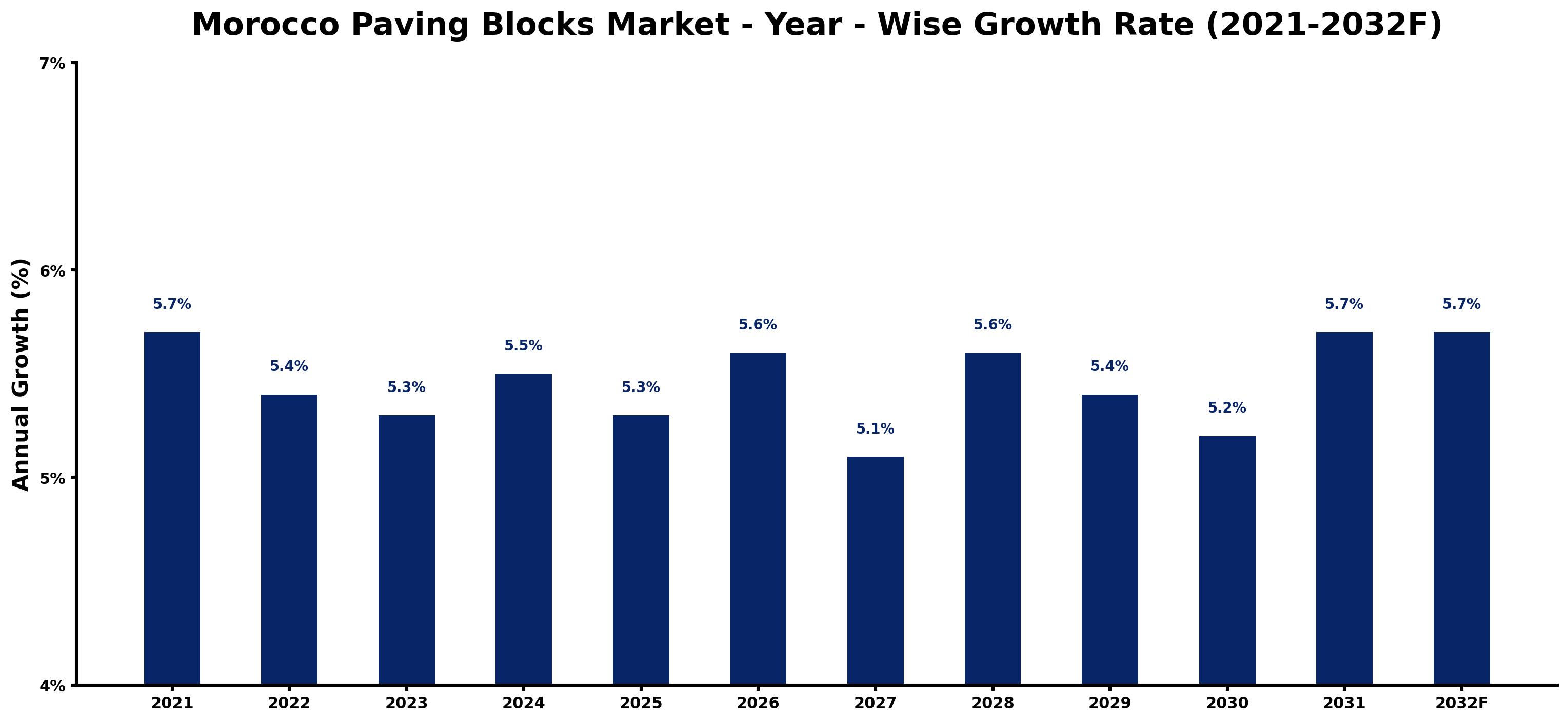
The table below presents the year wise growth rates along with the key drivers influencing the market
| Year | Growth Rate | Major Drivers |
| 2021 | 5.7% | Infrastructure projects in Morocco are gaining momentum after pandemic-related delays. |
| 2022 | 5.4% | Increased urbanization leads to greater investment in residential and commercial spaces. |
| 2023 | 5.3% | Paving blocks become essential for sustainable city planning and environmental solutions. |
| 2024 | 5.5% | Developers prioritize durability and aesthetics, influencing paving block design innovations. |
| 2025 | 5.3% | Emerging construction technologies enhance efficiency in paving block manufacturing processes. |
| 2026 | 5.6% | Market players emphasize cost-effective materials, appealing to budget-conscious projects. |
| 2027 | 5.1% | The tourism sector's growth drives demand for attractive public spaces and walkways. |
| 2028 | 5.6% | E-commerce trends enhance logistics infrastructure, boosting paving block market needs. |
| 2029 | 5.4% | Collaboration among local manufacturers encourages competition, leading to improved product quality. |
| 2030 | 5.2% | Sustainable practices in construction gain traction, influencing paving block material choices. |
| 2031 | 5.7% | Investment in urban mobility projects highlights the necessity for durable paving solutions. |
| 2032 | 5.7% | Consumer preferences shift towards eco-friendly options, reshaping market dynamics and offerings. |
Note - Market size estimations and growth projections presented in this report are based on 6Wresearch's advanced forecasting approach, validated with industry datasets as of June 2026.
Morocco Paving Blocks Market Synopsis
The Morocco Paving Blocks Market is projected to reach 5.6% and witness significant growth during the forecast period (2026-2032). This growth is expected to be driven by a variety of factors, including an uptick in construction activities across residential and commercial sectors, alongside increasing investments in infrastructure development across the nation. Additionally, the ongoing advancements in technology serve to enhance the aesthetic appeal of paving stones, making them more versatile and desirable for various applications.
Morocco Paving Blocks Market Growth Drivers
Several key drivers are propelling the expansion of the Morocco Paving Blocks Market. Firstly, the rising demand for paving stones in residential and commercial construction projects highlights a growing aesthetic appreciation for outdoor spaces, which is influencing purchasing decisions. Secondly, the increasing government focus on infrastructure development provides a conducive environment for market growth, as municipalities invest in better roadways, public plazas, and recreational facilities.
- The resurgence of the construction sector is significantly contributing to the rising demand for paving blocks, particularly as urbanization efforts accelerate in Morocco.
- Increased discretionary spending on public infrastructure such as parks and pedestrian walkways is further supporting market demand for high-quality paving products.
- Technological advancements in paving block production, including improved durability and customized designs, are attracting both consumers and businesses, thereby expanding market opportunities.
- The tourism sector's growing emphasis on well-maintained public spaces is leading to enhanced demand for premium paving solutions, further driving market growth.
- Shifts towards sustainable construction practices are encouraging the adoption of eco-friendly paving blocks, which are gaining traction among environmentally conscious consumers and businesses.
Morocco Paving Blocks Market Trends and Opportunities
The evolving dynamics of the Morocco Paving Blocks Market reveal various trends and opportunities that stakeholders can leverage. A notable trend is the increased preference for decorative paving solutions, which is reshaping the market landscape as consumers seek unique designs and finishes.
- The trend towards the use of permeable paving blocks is gaining momentum due to their environmental benefits, including reducing runoff and improving groundwater recharge.
- Innovation in colors and textures is driving product differentiation, encouraging manufacturers to explore new creative avenues to appeal to a broader customer base.
- As the Moroccan economy continues to grow, there is a significant opportunity for international players to enter the market and collaborate on large-scale urban projects.
- Rising urban population density is necessitating the development of multi-functional spaces, thereby increasing demand for flexible paving solutions that can accommodate various uses.
- Local artisans and SMEs are playing a substantial role in offering customized paving solutions, presenting opportunities for partnerships and diversification.
Morocco Paving Blocks Market Challenges and Restraints
Despite the positive outlook for the Morocco Paving Blocks Market, several challenges may hinder growth. One of the primary issues is the volatility of raw material prices, which can impact production costs and profit margins for manufacturers.
- The increasing competition from alternative materials, such as asphalt and concrete, poses a threat to market share and may require strategic marketing efforts to maintain consumer interest.
- Economic fluctuations and potential political instability in the region could lead to uncertainties in investment and project execution timelines, affecting market growth.
- A lack of awareness regarding the benefits of high-quality paving options among certain consumer segments may impede market adoption, necessitating educational campaigns.
- Supply chain disruptions, particularly those affecting the availability of raw materials and transportation costs, can pose significant challenges to consistent product availability.
- Environmental regulations are becoming increasingly stringent, which could add compliance costs for manufacturers that need to adhere to sustainability standards.
Morocco Paving Blocks Market Government Investment and Initiatives
The Moroccan government has recognized the importance of infrastructure improvement to support economic development, which has led to increased investment in paving block applications. Public spending initiatives focus on enhancing urban spaces to improve quality of life and attract both domestic and international tourism.
- Government policies that emphasize sustainable urban development are encouraging the use of paving blocks that meet modern environmental standards.
- Infrastructure projects aimed at expanding road networks and public transport systems are generating significant demand for high-quality paving solutions.
- Public-private partnerships and collaborations are becoming increasingly common as the government seeks out effective ways to fund and execute large-scale paving projects.
- Incentives for eco-friendly construction practices are becoming more prevalent, stimulating interest in the production and use of sustainable paving materials.
- Regional development plans often include comprehensive guidelines for urban landscaping, which directly ties into the demand for aesthetically pleasing and functional paving options.
Morocco Paving Blocks Market Latest Developments (May 2025 - June 2026)
Recent developments in the Morocco Paving Blocks Market reflect an adaptive industry responding to emerging trends and consumer preferences. Manufacturers are increasingly investing in technology to enhance production methods, focusing on efficiency and sustainability. Moreover, the introduction of innovative designs and color options has generated excitement among consumers, further fuelling sales.
- Collaborative efforts among local manufacturers are fostering knowledge exchanges and best practices, helping to enhance product quality and market offerings.
- Increased participation of local governments in promoting paving solutions for urban transformation projects is gaining traction, leading to a surge in demand.
- Continuing commitments to lasting infrastructure improvements are resulting in the publication of various tenders focused on paving applications.
- The growing popularity of green spaces in urban environments is resulting in increased demand for sustainable paving solutions that make efficient use of available land.
- Efforts to transition towards a circular economy are prompting manufacturers to explore recycling options for paving materials, driving innovation within the sector.
Morocco Paving Blocks Market - Key Attractiveness of the Report
- 10 Years of Market Numbers
- Historical Data Starting from 2022 to 2025
- Base Year: 2025
- Forecast Data until 2032
- Key Performance Indicators Impacting the Market
- Major Upcoming Developments and Projects
Key Highlights of the Report:
- Morocco Paving Blocks Market Outlook
- Market Size of Morocco Paving Blocks Market, 2025
- Forecast of Morocco Paving Blocks Market, 2032F
- Historical Data and Forecast of Morocco Paving Blocks Revenues & Volume for the Period 2022-2032F
- Morocco Paving Blocks Market Trend Evolution
- Morocco Paving Blocks Market Drivers and Challenges
- Morocco Paving Blocks Price Trends
- Morocco Paving Blocks Porter's Five Forces
- Morocco Paving Blocks Industry Life Cycle
- Historical Data and Forecast of Morocco Paving Blocks Market Revenues & Volume By Product for the Period 2022-2032F
- Historical Data and Forecast of Morocco Paving Blocks Market Revenues & Volume By Pavers for the Period 2022-2032F
- Historical Data and Forecast of Morocco Paving Blocks Market Revenues & Volume By Glazed Clay Bricks for the Period 2022-2032F
- Historical Data and Forecast of Morocco Paving Blocks Market Revenues & Volume By Wall Block for the Period 2022-2032F
- Historical Data and Forecast of Morocco Paving Blocks Market Revenues & Volume By Material for the Period 2022-2032F
- Historical Data and Forecast of Morocco Paving Blocks Market Revenues & Volume By Clay for the Period 2022-2032F
- Historical Data and Forecast of Morocco Paving Blocks Market Revenues & Volume By Building Bricks for the Period 2022-2032F
- Historical Data and Forecast of Morocco Paving Blocks Market Revenues & Volume By Concrete for the Period 2022-2032F
- Historical Data and Forecast of Morocco Paving Blocks Market Revenues & Volume By End-users for the Period 2022-2032F
- Historical Data and Forecast of Morocco Paving Blocks Market Revenues & Volume By General for the Period 2022-2032F
- Historical Data and Forecast of Morocco Paving Blocks Market Revenues & Volume By Structural for the Period 2022-2032F
- Historical Data and Forecast of Morocco Paving Blocks Market Revenues & Volume By Hardscaping for the Period 2022-2032F
- Historical Data and Forecast of Morocco Paving Blocks Market Revenues & Volume By Siding for the Period 2022-2032F
- Historical Data and Forecast of Morocco Paving Blocks Market Revenues & Volume By Fireplace for the Period 2022-2032F
- Historical Data and Forecast of Morocco Paving Blocks Market Revenues & Volume By Other for the Period 2022-2032F
- Morocco Paving Blocks Import Export Trade Statistics
- Market Opportunity Assessment By Product
- Market Opportunity Assessment By Material
- Market Opportunity Assessment By End-users
- Morocco Paving Blocks Top Companies Market Share
- Morocco Paving Blocks Competitive Benchmarking By Technical and Operational Parameters
- Morocco Paving Blocks Company Profiles
- Morocco Paving Blocks Key Strategic Recommendations






































