Coal Market: Mozambique vs Top 5 Major Economies in 2027 (Africa)
The Coal market in Mozambique is projected to grow at a high growth rate of 12.20% by 2027, within the Africa region led by Egypt, along with other countries like South Africa, Ethiopia, Algeria and Nigeria, collectively shaping a dynamic and evolving market environment driven by innovation and increasing adoption of emerging technologies.
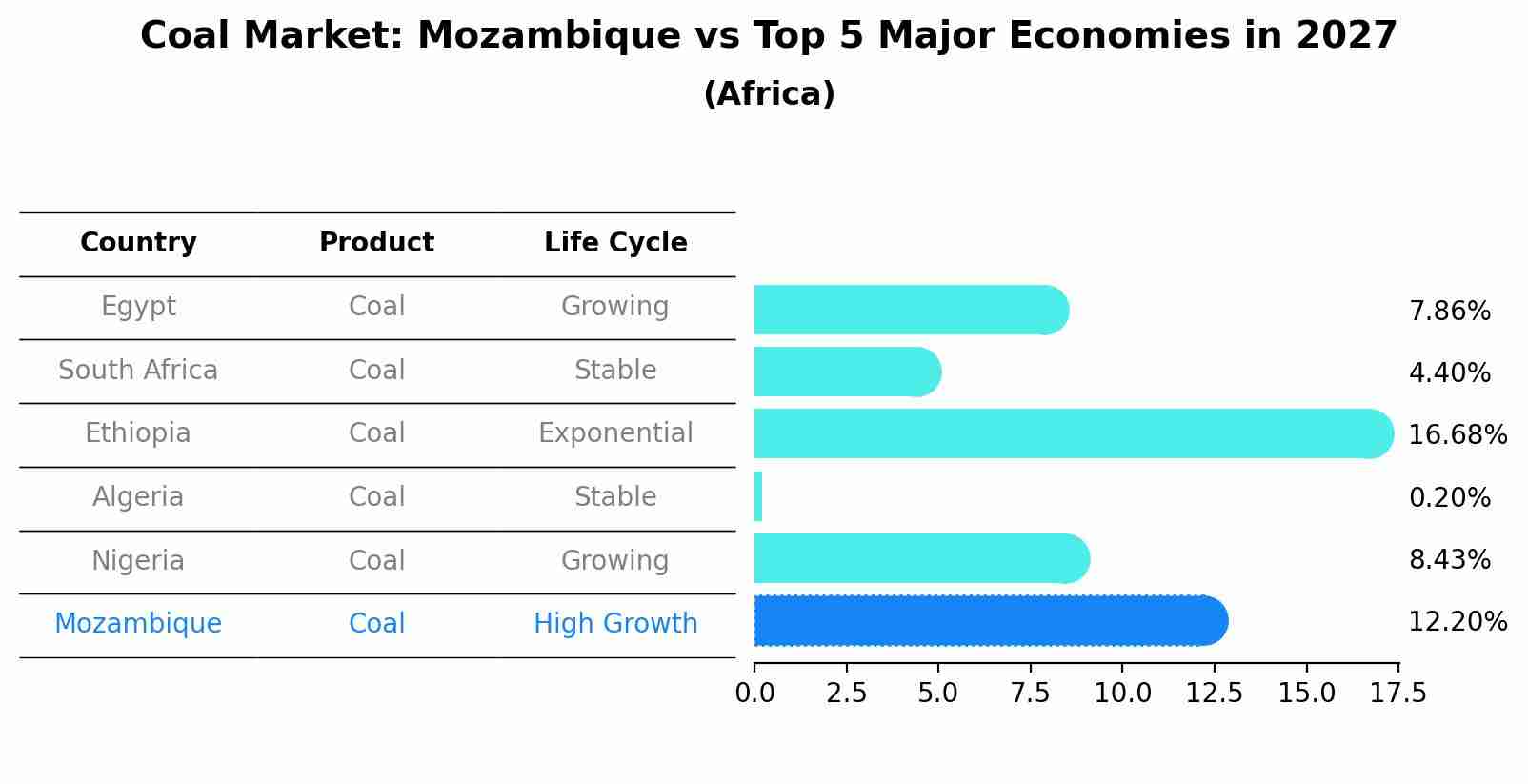
Mozambique Coal Market Growth Rate
According to 6Wresearch internal database and industry insights, the Mozambique Coal Market is projected to grow at a compound annual growth rate (CAGR) of 5.8% during the forecast period (2026-2032).
Topics Covered in the Mozambique Coal Market Report
The Mozambique Coal Market report thoroughly covers the market by types and end-users. The market report provides an unbiased and detailed analysis of ongoing market trends, opportunities/high growth areas, and market drivers, which help stakeholders devise and align their market strategies according to the current and future market dynamics.
Mozambique Coal Market Highlights
| Report Name |
Mozambique Coal Market |
| Forecast period | 2026-2032 |
| CAGR | 5.8% |
| Growing Sector | Steel |
Mozambique Coal Market Synopsis
Mozambique Coal Market is anticipated to record notable growth due to growing international demand for thermal and metallurgical coal as well as greater investments in mining facilities. The nation has rich deposits of coal, especially in the Tete region, which appeals to foreign mining corporations. Improved transport facilities, such as railroads and ports, are making exports more efficient. Additionally, efforts by the government to attract foreign direct investment and improve mining policies are fostering market development. The rising application of coal in power plants and steel production is also driving market growth.
Evaluation of Growth Drivers in the Mozambique Coal Market
Below mentioned are some prominent drivers and their influence on the market dynamics:
| Drivers | Primary Segments Affected | Why it Matters (Evidence) |
| Rising Global Coal Demand | Bituminous; Steel | Increasing steel production boosts demand for metallurgical coal. |
| Infrastructure Development | All Types; Electricity | Rail and port expansions improve coal export capacity. |
| Foreign Direct Investment | All Types; Others | International mining companies enhance production capabilities. |
| Growth in Power Generation | Sub-Bituminous; Electricity | Coal remains a key energy source for electricity generation. |
| Government Mining Policies | All Types; All End-Users | Favorable policies attract investments and streamline operations. |
Mozambique Coal Market is expected to grow at the CAGR of 5.8% during the forecast period of 2026-2032. Growth is being fueled by the rising global demand for coal that is emanating from sectors such as steel production and power plants. Improvement in production capacity as well as export ability is resulting from heavy investments in mining projects and infrastructure developments. The industry is receiving substantial backing from the government in terms of favorable mining policies and foreign investments. Transportation of coal has been facilitated by railway and port expansions. Growth in industrialization in developing nations has equally contributed to steady demand.
Evaluation of Restraints in the Mozambique Coal Market
Below mentioned are some major restraints and their influence on the market dynamics:
| Restraints | Primary Segments Affected | What This Means (Evidence) |
| Environmental Concerns | All Types; Electricity | Global pressure reduces coal consumption in energy sectors. |
| Infrastructure Bottlenecks | All Types; Steel | Limited transport capacity delays exports and supply. |
| Price Volatility | Bituminous; Others | Fluctuating global prices impact profitability. |
| Regulatory Challenges | All Types; All End-Users | Policy changes can slow mining approvals and investments. |
| Dependence on Exports | All Types; Others | Market heavily relies on international demand fluctuations. |
Mozambique Coal Industry Challenges
Despite of massive growth and development, the Mozambique Coal Industry faces several challenges such as infrastructure constraints, environmental concerns, and dependency on export markets. Inadequate rail and port infrastructure may result in delays in the delivery of coal due to inefficiencies in the supply chain. In addition, there is a worldwide pressure on reducing carbon dioxide levels, thus posing questions regarding future demand for coal. Unpredictable prices of coal in the international markets also pose threats to mining firms. Inadequacy in regulations and difficulties in operating mines in remote locations have posed problems with scaling up production.
Mozambique Coal Market Trends
Key developments in the Mozambique Coal Market Growth include:
- Move towards Metallurgical Coal: There is an increasing trend amongst mining firms to produce metallurgical coal which is much needed in the production of steel due to the high demand. This move is assisting in increasing profits for the mining firms and will enable them to match international trends.
- Railway Line Construction Projects and Port Investments: There is huge investment going into railway line construction projects as well as building ports in order to ease coal exportations.
- Advanced Mining Technologies: Firms are embracing advanced technologies that help in boosting productivity.
Investment Opportunities in the Mozambique Coal Market
Major areas presenting investment potential in the Mozambique Coal Market Share include:
- Infrastructure Development in Mining – Investments in rail and port infrastructure can greatly improve coal-exporting efficiency. It would result in less downtime and greater profits.
- Metallurgical Coal Projects Expansion – Concentrating efforts on metallurgical coal mining will result in high profitability. The industry will remain profitable due to consistent demand worldwide.
- Innovations in Mining Technology – Automation and investment in advanced mining machinery will increase productivity. Moreover, it will lead to better safety conditions in the mining sector.
- Mining Sustainability – Sustainable mining practices will ensure compliance with regulatory policies. It will increase profitability and attract more investors in the future.
Top 5 Leading Players in the Mozambique Coal Market
Some leading players operating in the Mozambique Coal Market include:
1. Vale S.A.
| Company Name | Vale S.A. |
|---|---|
| Established Year | 1942 |
| Headquarters | Rio de Janeiro, Brazil |
| Official Website | Click Here |
Vale is a major player in Mozambique’s coal sector, operating large-scale mining projects in the Tete region. The company focuses on high-quality coal production and efficient export operations supported by strong logistics infrastructure.
2. Jindal Africa
| Company Name | Jindal Africa |
|---|---|
| Established Year | 2009 |
| Headquarters | Maputo, Mozambique |
| Official Website | Click Here |
Jindal Africa is actively involved in coal mining and energy projects in Mozambique. The company emphasizes integrated operations, including mining and power generation, to strengthen its market position.
3. Rio Tinto Group
| Company Name | Rio Tinto Group |
|---|---|
| Established Year | 1873 |
| Headquarters | London, United Kingdom |
| Official Website | Click Here |
Rio Tinto has participated in Mozambique’s coal industry through investments in mining projects. The company leverages global expertise and advanced technologies to enhance production efficiency and operational performance.
4. Vulcan International
| Company Name | Vulcan International |
|---|---|
| Established Year | 2021 |
| Headquarters | India |
| Official Website | Click Here |
Vulcan International is a growing player managing coal mining assets in Mozambique. The company focuses on increasing production capacity and improving export logistics to meet global demand effectively.
5. Beacon Hill Resources
| Company Name | Beacon Hill Resources |
|---|---|
| Established Year | 2006 |
| Headquarters | United Kingdom |
| Official Website | - |
Beacon Hill Resources has been involved in developing coal mining projects in Mozambique. The company aims to optimize resource extraction and enhance infrastructure for efficient coal transportation and export.
Government Regulations Introduced in the Mozambique Coal Market
According to Mozambique’s Government Data, Various measures have been put in place to boost the coal mining industry and increase its impact on the economy. These include policy changes aimed at improving the process of obtaining licenses and promoting foreign investment in coal mining. Moreover, there have been developments to improve the transport infrastructure, including the upgrading of the Nacala Corridor railway line and port to improve the transportation of coal exports. In addition, stricter environmental policies have been enforced to ensure sustainability and minimize ecological effects.
Future Insights of the Mozambique Coal Market
The Mozambique Coal Market is expected to witness steady growth over the forecast period, supported by increasing global demand for coal and ongoing infrastructure development. Increased investments in mining projects and logistical structures will result in increased production capability and efficiency in exporting products from the market. The emphasis in the mining of metallurgical coal used for steel production is another factor that may boost demand. Innovations in mining procedures and improvement in regulation will ensure further success for the market. Nonetheless, reconciling environmental issues with development will be a key priority in the market.
Market Segmentation Analysis
The report offers a comprehensive study of the subsequent market segments and their leading categories.
Bituminous Coal to Dominate the Market – By Types
According to Mohit, Senior Research Analyst, 6Wresearch, the Bituminous Coal segment dominates the Mozambique Coal Market due to its extensive use in steel production and electricity generation. As it is composed of high amounts of carbon and is also more efficient, bituminous coal is considered ideal for industrial applications. This market segment will be propelled by high exports, especially those coming from emerging nations. Furthermore, the existence of mining projects and technology development activities will lead to increased production rates. With the rising demand for steel across the world, bituminous coal will continue to dominate the market.
Steel to Dominate the Market – By End-Users
The steel segment accounts for a large share of the Mozambique Coal Market since it uses metallurgical coal in manufacturing. The growing demand for steel leads to an increased consumption of coal.
Electricity Sector to Witness Growth – By End-Users
Growth in this market segment is fueled by the constant utilization of coal in power plants. Growing energy demand in emerging nations propels the electricity market segment.
Key Attractiveness of the Report
- 10 Years of Market Numbers.
- Historical Data Starting from 2022 to 2025.
- Base Year: 2025.
- Forecast Data until 2032.
- Key Performance Indicators Impacting the Market.
- Major Upcoming Developments and Projects.
Key Highlights of the Report:
- Mozambique Coal Market Outlook
- Market Size of Mozambique Coal Market, 2025
- Forecast of Mozambique Coal Market, 2032
- Historical Data and Forecast of Mozambique Coal Revenues & Volume for the Period 2022-2032
- Mozambique Coal Market Trend Evolution
- Mozambique Coal Market Drivers and Challenges
- Mozambique Coal Price Trends
- Mozambique Coal Porter`s Five Forces
- Mozambique Coal Industry Life Cycle
- Historical Data and Forecast of Mozambique Coal Market Revenues & Volume By Types for the Period 2022-2032
- Historical Data and Forecast of Mozambique Coal Market Revenues & Volume By Bituminous Coal for the Period 2022-2032
- Historical Data and Forecast of Mozambique Coal Market Revenues & Volume By Sub-Bituminous Coal for the Period 2022-2032
- Historical Data and Forecast of Mozambique Coal Market Revenues & Volume By Anthracite for the Period 2022-2032
- Historical Data and Forecast of Mozambique Coal Market Revenues & Volume By Lignite for the Period 2022-2032
- Historical Data and Forecast of Mozambique Coal Market Revenues & Volume By End-Users for the Period 2022-2032
- Historical Data and Forecast of Mozambique Coal Market Revenues & Volume By Electricity for the Period 2022-2032
- Historical Data and Forecast of Mozambique Coal Market Revenues & Volume By Steel for the Period 2022-2032
- Historical Data and Forecast of Mozambique Coal Market Revenues & Volume By Cement for the Period 2022-2032
- Historical Data and Forecast of Mozambique Coal Market Revenues & Volume By Others for the Period 2022-2032
- Mozambique Coal Import Export Trade Statistics
- Market Opportunity Assessment By Types
- Market Opportunity Assessment By End-Users
- Mozambique Coal Top Companies Market Share
- Mozambique Coal Competitive Benchmarking By Technical and Operational Parameters
- Mozambique Coal Company Profiles
- Mozambique Coal Key Strategic Recommendations
Market Covered
The report offers a comprehensive study of the subsequent market segments:
By Types
- Bituminous Coal
- Sub-Bituminous Coal
- Anthracite
- Lignite
By End-Users
- Electricity
- Steel
- Cement
- Others






































