Myanmar Digital Forensics Market Size & Growth Rate (2026-2032)
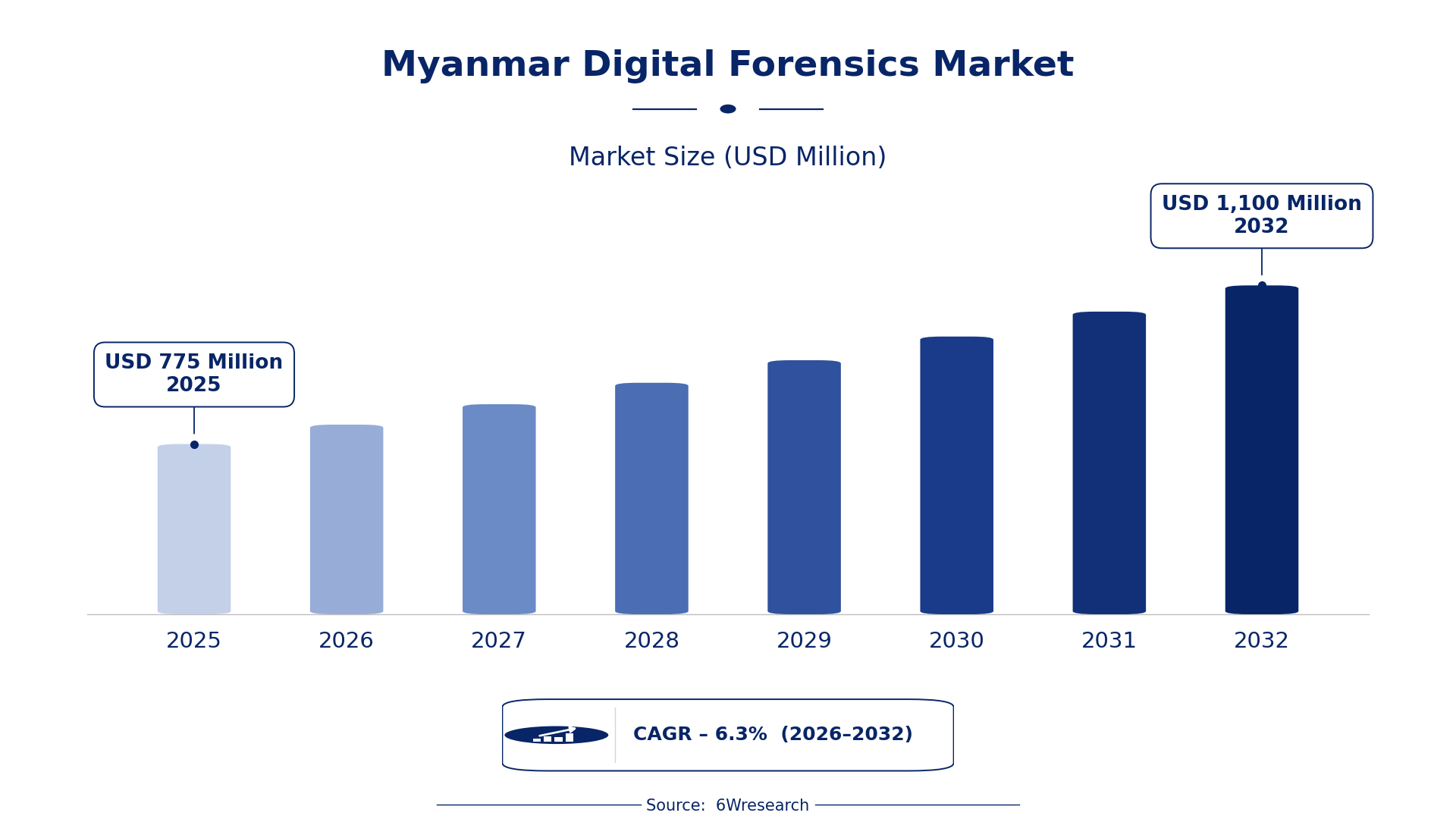
The Myanmar Digital Forensics Market was estimated at USD 775 Million in 2025 and is projected to reach USD 1100 Million by 2032, growing at a CAGR of 6.3% from 2026 to 2032.
Myanmar Digital Forensics Market Synopsis
The Myanmar Digital Forensics Market is currently navigating a significant phase of growth, fueled by an increase in cybercrime and data breach incidents. As organizations grapple with the challenges posed by these threats, demand for digital forensic services is rising sharply, establishing a vital resource for law enforcement and cybersecurity efforts in the country.
Looking ahead, the market's trajectory suggests a continued upward trend as technology advances and regulatory measures tighten. The expansion of digital forensic tools and services is expected to meet escalating needs, particularly as the reliance on digital technology deepens across sectors.
Myanmar Digital Forensics Market Year-wise Growth Rate and Key Drivers
This graph illustrates the annual growth rates of the Myanmar Digital Forensics Market from 2021 to 2032, highlighting a steady upward trajectory and projected expansion over the forecast period.
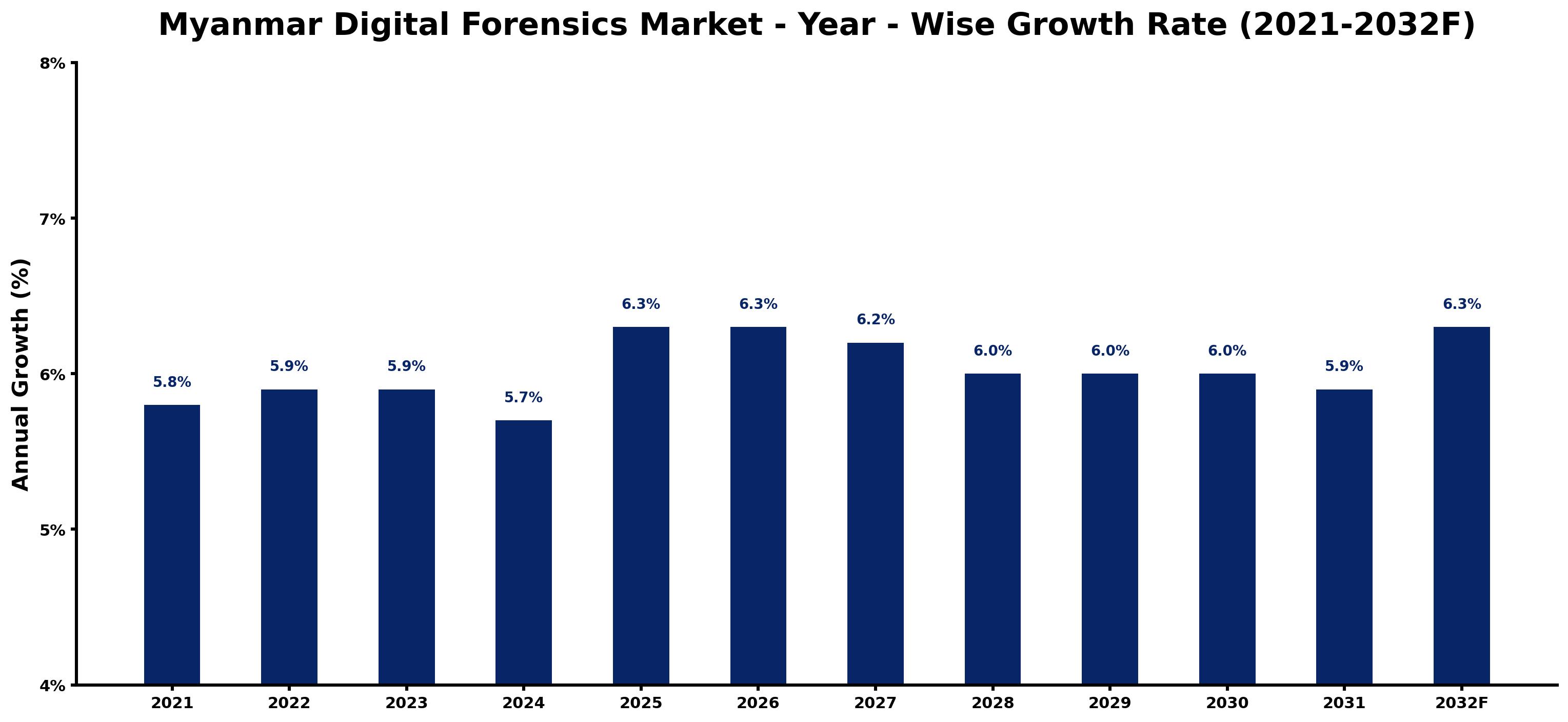
The table below presents the year‑wise growth rates along with the key drivers influencing the market
| Year | Growth Rate | Major Drivers |
| 2021 | 5.8% | Launch of Myanmar's National Cybersecurity Strategy. |
| 2022 | 5.9% | Increased investments in law enforcement digital capabilities. |
| 2023 | 5.9% | Growing adoption of e-commerce driving digital crime prevention. |
| 2024 | 5.7% | Implementation of stricter data protection laws by government. |
| 2025 | 6.3% | Emergence of local tech firms specializing in digital forensics. |
| 2026 | 6.3% | Partnerships with international forensic experts for knowledge transfer. |
| 2027 | 6.2% | Rise in mobile device ownership necessitating forensic analysis. |
| 2028 | 6.0% | Government funding for enhancing digital evidence collection methods. |
| 2029 | 6.0% | Public awareness campaigns on online fraud prevention initiatives. |
| 2030 | 6.0% | Adoption of blockchain technology boosting forensic investigation tools. |
| 2031 | 5.9% | Increased demand for digital evidence in judicial processes. |
| 2032 | 6.3% | Growing startup ecosystem focusing on cybersecurity innovations. |
Note: Market size estimations and growth projections presented in this report are based on 6Wresearch's proprietary forecasting methodology, utilizing the latest available industry data, government publications, and primary research inputs.
Myanmar Digital Forensics Market Key Takeaways
Below are some of the specific key takeaways from the market, including:
- The increasing complexity and prevalence of cybercrime is a primary driver for the digital forensics market in Myanmar.
- Government initiatives to bolster digital forensic capabilities are critical to enhancing investigative success.
- A growing reliance on digital evidence for legal proceedings emphasizes the necessity for skilled forensic professionals.
- Collaborative efforts between law enforcement and private sectors are enhancing investigative frameworks.
- Investment in training and infrastructure remains essential to overcoming current market limitations.
Evaluation of Restraints in Myanmar Digital Forensics Market
Challenges persist in the Myanmar Digital Forensics Market, primarily due to a shortage of specialized expertise and resources. The lack of trained personnel hampers effective cybercrime investigations, while insufficient forensic tools and laboratories restrict operational capabilities. on top of that, as technology evolves rapidly, investigators face increasing difficulties in accessing and analyzing encrypted data. Maintaining legal and ethical standards during investigations is crucial to uphold the credibility of outcomes, making these issues significant hurdles for progress.
Myanmar Digital Forensics Market Trends
A marked trend within the Myanmar Digital Forensics Market is the rising integration of advanced technologies, such as artificial intelligence and machine learning, to streamline forensic analysis. Increased collaboration among law enforcement, academic institutions, and cybersecurity firms is paving the way for enhanced capabilities. Additionally, a growing emphasis on regulatory compliance is pushing organizations to invest in digital forensic services, as adherence to legal standards becomes increasingly critical.
Myanmar Digital Forensics Market Opportunities
The landscape for growth within the Myanmar Digital Forensics Market is ripe with opportunity. As cyber threats become more sophisticated, demand for innovative forensic tools and training programs is set to surge. The potential for public-private partnerships aimed at strengthening digital security infrastructure presents a compelling avenue for investment. Additionally, the ongoing evolution of legal frameworks concerning digital evidence will create a more favorable environment for the expansion of digital forensic services.
Government Initiatives in the Myanmar Digital Forensics Market
The Myanmar government is taking significant steps to address the challenges posed by cybercrime and to bolster the capabilities of the digital forensics market. Public policy is increasingly focused on establishing a regulatory environment that not only supports forensic investigations but also fosters collaboration among various stakeholders in the cybersecurity ecosystem.
- A recently completed initiative established dedicated cybercrime investigation units within law enforcement agencies to enhance their operational capacity.
- Currently underway is a program aimed at upgrading forensic laboratories, ensuring they are equipped with the latest technology for evidence analysis.
- Upcoming policies include a national strategy to improve digital evidence collection frameworks, expected to roll out by 2026.
- Ongoing collaboration with academic institutions to develop specialized training programs for forensic professionals is enhancing local expertise.
- Legislative measures to clarify the admissibility of digital evidence in court are also anticipated in the near future, aiming to strengthen the legal framework for digital forensics.
Future Insights of the Myanmar Digital Forensics Market
As we look to the future, the Myanmar Digital Forensics Market is set to evolve alongside technological advancements and emerging threats. The increasing sophistication of cybercrime will necessitate ongoing investments in both tools and training. By 2032, we anticipate that the market will be characterized by greater collaboration among agencies, enhanced public-private partnerships, and a solidified legal framework that supports forensic activities. This will not only improve investigative outcomes but also foster a culture of cybersecurity awareness across all sectors.
Myanmar Digital Forensics Market Latest Developments
In the last 12-14 months, the Myanmar Digital Forensics Market has witnessed notable activity, with multiple initiatives focusing on enhancing digital investigative capabilities. The industry is responding proactively to rising cyber threats, indicating a burgeoning commitment to strengthening digital security infrastructures.
- A major technology vendor launched an innovative forensic analysis tool in early 2025, aiming to simplify data extraction processes for investigators.
- An initiative that began in mid-2025 and remains underway is the establishment of a network for sharing best practices among cybersecurity professionals across government and private sectors.
- A planned public awareness campaign regarding digital fraud and security measures is expected to commence in late 2026, targeting educational institutions and businesses.
- Ongoing enhancements to digital forensic training programs at local universities are aligning academic offerings with industry needs, improving the skill set of new graduates.
- A regulatory body is currently reviewing existing laws on digital evidence admissibility, with changes anticipated to support the legal framework for digital forensics by 2026.
Myanmar Digital Forensics Market - Key Attractiveness of the Report
- 10 Years of Market Numbers
- Historical Data Starting from 2022 to 2025
- Base Year: 2025
- Forecast Data until 2032
- Key Performance Indicators Impacting the Market
- Major Upcoming Developments and Projects
Key Highlights of the Report:
- Myanmar Digital Forensics Market Outlook
- Market Size of Myanmar Digital Forensics Market, 2025
- Forecast of Myanmar Digital Forensics Market, 2032
- Historical Data and Forecast of Myanmar Digital Forensics Revenues & Volume for the Period 2022-2032F
- Myanmar Digital Forensics Market Trend Evolution
- Myanmar Digital Forensics Market Drivers and Challenges
- Myanmar Digital Forensics Price Trends
- Myanmar Digital Forensics Porter's Five Forces
- Myanmar Digital Forensics Industry Life Cycle
- Historical Data and Forecast of Myanmar Digital Forensics Market Revenues & Volume By Component for the Period 2022-2032F
- Historical Data and Forecast of Myanmar Digital Forensics Market Revenues & Volume By Hardware for the Period 2022-2032F
- Historical Data and Forecast of Myanmar Digital Forensics Market Revenues & Volume By Software for the Period 2022-2032F
- Historical Data and Forecast of Myanmar Digital Forensics Market Revenues & Volume By Services for the Period 2022-2032F
- Historical Data and Forecast of Myanmar Digital Forensics Market Revenues & Volume By Type for the Period 2022-2032F
- Historical Data and Forecast of Myanmar Digital Forensics Market Revenues & Volume By Computer Forensics for the Period 2022-2032F
- Historical Data and Forecast of Myanmar Digital Forensics Market Revenues & Volume By Network Forensics for the Period 2022-2032F
- Historical Data and Forecast of Myanmar Digital Forensics Market Revenues & Volume By Mobile Device Forensics for the Period 2022-2032F
- Historical Data and Forecast of Myanmar Digital Forensics Market Revenues & Volume By Cloud Forensics for the Period 2022-2032F
- Historical Data and Forecast of Myanmar Digital Forensics Market Revenues & Volume By Tool for the Period 2022-2032F
- Historical Data and Forecast of Myanmar Digital Forensics Market Revenues & Volume By Vertical for the Period 2022-2032F
- Myanmar Digital Forensics Import Export Trade Statistics
- Market Opportunity Assessment By Component
- Market Opportunity Assessment By Type
- Market Opportunity Assessment By Tool
- Market Opportunity Assessment By Vertical
- Myanmar Digital Forensics Top Companies Market Share
- Myanmar Digital Forensics Competitive Benchmarking By Technical and Operational Parameters
- Myanmar Digital Forensics Company Profiles
- Myanmar Digital Forensics Key Strategic Recommendations






































