Myanmar Washable Markers Market Size, Share & Growth Rate
The Myanmar Washable Markers Market was estimated at USD 769 Million in 2025 and is projected to reach USD 1116 Million by 2032, growing at a CAGR of 5.5% from 2026 to 2032. This trajectory is propelled by the escalating interest in creative educational tools among schools and households, along with increasing awareness of non-toxic products that promote safe art activities for children. As the market evolves, manufacturers are adapting to these consumer preferences, leading to a proliferation of innovative and eco-friendly offerings.
Myanmar Washable Markers Market Year-wise Growth Rate and Key Drivers
This graph highlights how the Myanmar Washable Markers Market has steadily grown over the years, supported by major growth factors.
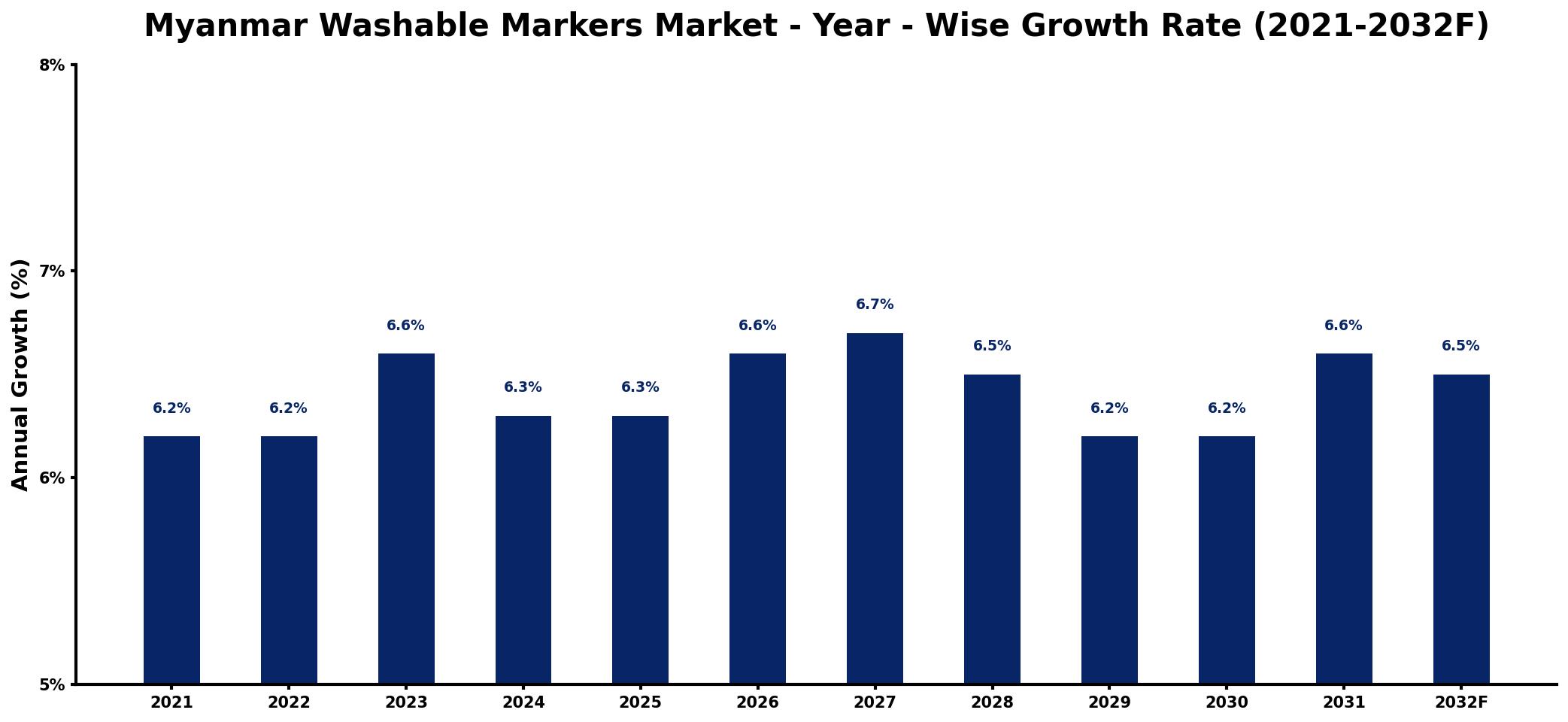
The table below presents the year‑wise growth rates along with the key drivers influencing the market
| Year | Growth Rate | Major Drivers |
| 2021 | 6.2% | Increased educational spending initiatives |
| 2022 | 6.2% | Rise in creative arts programs |
| 2023 | 6.6% | Growing popularity of DIY crafts |
| 2024 | 6.3% | Expansion of art supply retailers |
| 2025 | 6.3% | Surge in online art tutorials |
| 2026 | 6.6% | Increased demand from schools |
| 2027 | 6.7% | Growth in children's art classes |
| 2028 | 6.5% | Boost in community art projects |
| 2029 | 6.2% | Rising trend of eco-friendly supplies |
| 2030 | 6.2% | Investment in educational resources |
| 2031 | 6.6% | Emergence of new art trends |
| 2032 | 6.5% | growing commercial sector adoption |
Note: Market size estimations and growth projections presented in this report are based on 6Wresearch's proprietary forecasting methodology, utilizing the latest available industry data, government publications, and primary research inputs.
Myanmar Washable Markers Market Synopsis
In recent years, the Myanmar Washable Markers Market has gained momentum, driven by heightened demand for art supplies in educational settings and homes. As we look to the future, the market is poised for sustained growth, buoyed by an expanding middle class that values quality educational products and eco-friendly options.
While the momentum is promising, the market faces challenges, including limited awareness of washable markers compared to traditional options. Nevertheless, the increasing focus on sustainability and safety is anticipated to foster greater adoption and diversification within this sector.
Myanmar Washable Markers Market Key Takeaways
- The market is witnessing a notable shift towards eco-friendly and non-toxic washable markers, aligning with global consumer trends.
- Product innovation is key, with manufacturers developing markers that feature vibrant colors and dual tips for versatile applications.
- Awareness-building initiatives are crucial to overcoming consumer misconceptions regarding washable versus traditional markers.
- Growing educational investments are fostering demand for quality art supplies, paving the way for market expansion.
- Distribution challenges remain, particularly in rural areas, necessitating robust logistics solutions to reach underserved markets.
Evaluation of Restraints in Myanmar Washable Markers Market
The Myanmar Washable Markers Market is grappling with several constraints that could impede its growth trajectory. A significant hurdle is the limited consumer awareness regarding the advantages of washable markers, which often leads to hesitance in adoption. Furthermore, economic factors contributing to price sensitivity among consumers can complicate competitive pricing strategies for businesses. In addition, the existing distribution infrastructure presents challenges, particularly when it comes to reaching more remote areas, thereby limiting market penetration. Lastly, the varying regulatory landscape concerning product safety and quality standards could pose further challenges for manufacturers.
Myanmar Washable Markers Market Trends
Current trends in the Myanmar Washable Markers Market indicate a growing consumer preference for environmentally friendly products. Markers that utilize non-toxic, washable ink are becoming increasingly popular, especially among parents concerned about their children's safety. Additionally, theres an emerging interest in dual-tip markers, catering to both fine detail work and broader applications. Manufacturers are also investing in vibrant color palettes and durable designs, aiming to enhance user experience while meeting varied artistic needs.
Myanmar Washable Markers Market Opportunities
The market presents a range of promising investment opportunities, particularly in the realm of educational supplies. With a strong push towards enhancing creativity in educational environments, businesses can focus on producing high-quality, non-toxic washable markers that appeal to schools, parents, and artists alike. Strategic partnerships with local educational institutions can amplify reach and impact. Moreover, investments in marketing initiatives aimed at showcasing the benefits of washable markers can further differentiate products in a competitive landscape.
Government Initiatives in the Myanmar Washable Markers Market
Government policies aimed at safeguarding consumer interests are shaping the landscape of the Myanmar washable markers market. Regulations concerning product quality and safety standards are critical to maintaining consumer trust and ensuring product efficacy. Import and export regulations may influence the availability of materials necessary for production. Furthermore, environmental guidelines are pushing manufacturers toward sustainable production practices. Understanding these governmental frameworks is essential for businesses aiming to thrive in the market.
Future Insights of the Myanmar Washable Markers Market
Looking ahead to 2026-2032, the Myanmar Washable Markers Market is expected to flourish, largely due to an ongoing emphasis on education and creative expression among youth. The rise of the retail sector is likely to increase accessibility to a variety of innovative products. However, firms will need to navigate price sensitivities and competitive pressures from other writing instruments. Future growth will hinge on strategic marketing efforts, quality assurance, and the ability to cater to evolving consumer preferences.
Myanmar Washable Markers Market Latest Developments (2025 - 2026)
Recent developments in the Myanmar washable markers market suggest a strategic pivot towards sustainable product offerings. Manufacturers are beginning to adopt eco-friendly materials in their production processes, aligning with consumer expectations for greener products. Additionally, various marketing campaigns aimed at educating consumers about the benefits of washable markers are gaining traction. As distribution networks expand, particularly in urban areas, the availability of these products is set to improve significantly.
Myanmar Washable Markers Market - Key Attractiveness of the Report
- 10 Years of Market Numbers
- Historical Data Starting from 2022 to 2025
- Base Year: 2025
- Forecast Data until 2032
- Key Performance Indicators Impacting the Market
- Major Upcoming Developments and Projects
Key Highlights of the Report:
- Myanmar Washable Markers Market Outlook
- Market Size of Myanmar Washable Markers Market, 2025
- Forecast of Myanmar Washable Markers Market, 2032
- Historical Data and Forecast of Myanmar Washable Markers Revenues & Volume for the Period 2022-2032F
- Myanmar Washable Markers Market Trend Evolution
- Myanmar Washable Markers Market Drivers and Challenges
- Myanmar Washable Markers Price Trends
- Myanmar Washable Markers Porter's Five Forces
- Myanmar Washable Markers Industry Life Cycle
- Historical Data and Forecast of Myanmar Washable Markers Market Revenues & Volume By Washability for the Period 2022-2032F
- Historical Data and Forecast of Myanmar Washable Markers Market Revenues & Volume By Basic- Washable for the Period 2022-2032F
- Historical Data and Forecast of Myanmar Washable Markers Market Revenues & Volume By Super-washable for the Period 2022-2032F
- Historical Data and Forecast of Myanmar Washable Markers Market Revenues & Volume By End User for the Period 2022-2032F
- Historical Data and Forecast of Myanmar Washable Markers Market Revenues & Volume By Children for the Period 2022-2032F
- Historical Data and Forecast of Myanmar Washable Markers Market Revenues & Volume By Professionals for the Period 2022-2032F
- Myanmar Washable Markers Import Export Trade Statistics
- Market Opportunity Assessment By Washability
- Market Opportunity Assessment By End User
- Myanmar Washable Markers Top Companies Market Share
- Myanmar Washable Markers Competitive Benchmarking By Technical and Operational Parameters
- Myanmar Washable Markers Company Profiles
- Myanmar Washable Markers Key Strategic Recommendations






































