Nepal Railway Maintenance Machinery Market Size, Share & Growth Rate
The Nepal Railway Maintenance Machinery Market was estimated at USD 1385 Million in 2025 and is projected to reach USD 2618 Million by 2032, growing at a CAGR of 9.5% from 2026 to 2032. This robust growth trajectory is fueled by significant government investments in railway infrastructure and a concerted push towards modernization and automation in railway maintenance processes. As the country expands its railway networks and enhances operational efficiency, the demand for advanced maintenance machinery is set to rise considerably.
Nepal Railway Maintenance Machinery Market Year-wise Growth Rate and Key Drivers
This graph highlights how the Nepal Railway Maintenance Machinery Market has steadily grown over the years, supported by major growth factors.
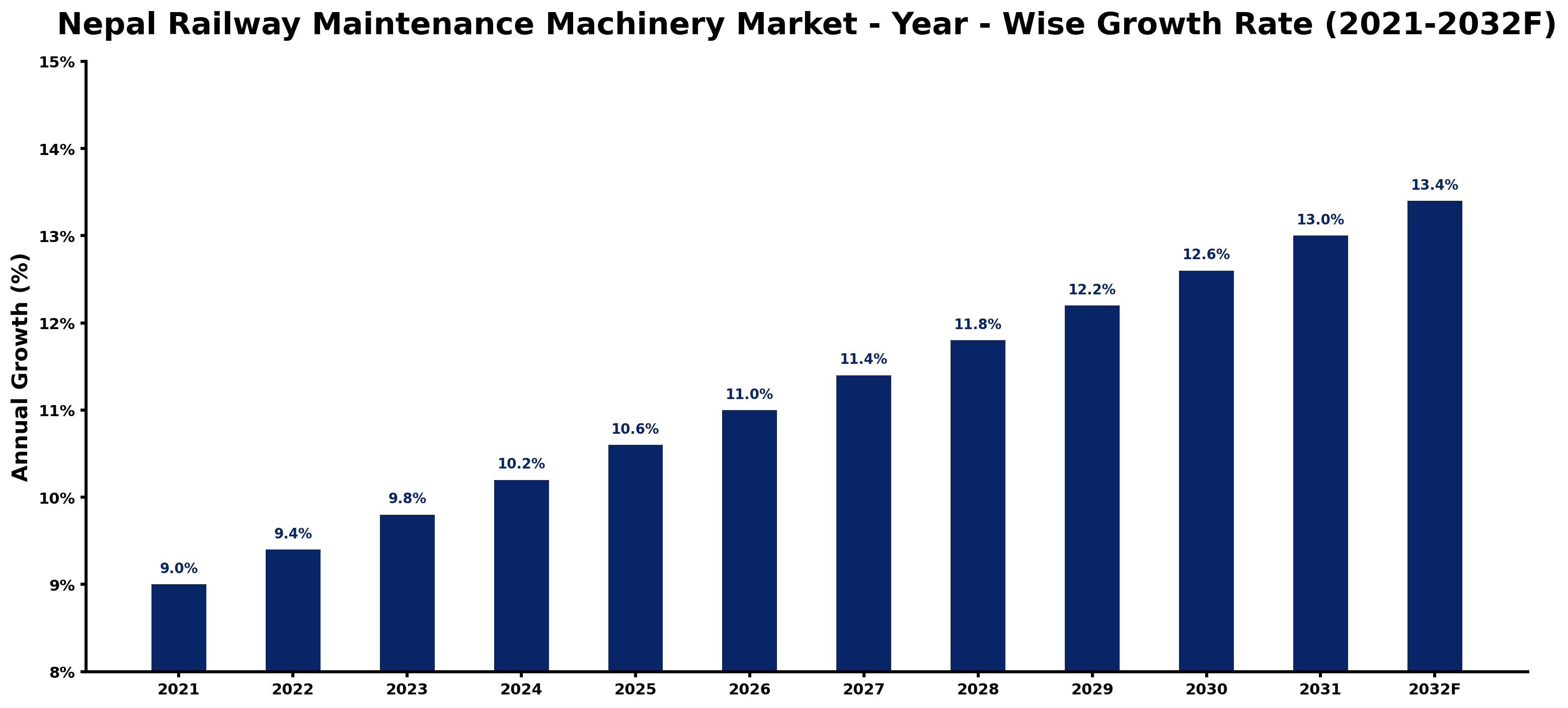
The table below presents the year‑wise growth rates along with the key drivers influencing the market
| Year | Growth Rate | Major Drivers |
| 2021 | 9.0% | Increasing adoption of advanced technologies |
| 2022 | 9.4% | Expansion of commercial construction activities |
| 2023 | 9.8% | Increasing smart city development projects |
| 2024 | 10.2% | Increasing smart city development projects |
| 2025 | 10.6% | Increasing smart city development projects |
| 2026 | 11.0% | Rapid growth in telecom and data center sectors |
| 2027 | 11.4% | Expansion of commercial construction activities |
| 2028 | 11.8% | Rapid growth in telecom and data center sectors |
| 2029 | 12.2% | Expansion of commercial construction activities |
| 2030 | 12.6% | Increasing adoption of advanced technologies |
| 2031 | 13.0% | Increasing industrial infrastructure investments |
| 2032 | 13.4% | Increasing industrial automation investments |
Note - Market size estimations and growth projections presented in this report are based on 6Wresearch's advanced forecasting approach, validated with industry datasets as of June 2026.
Nepal Railway Maintenance Machinery Market Synopsis
While recent momentum in the Nepal Railway Maintenance Machinery Market has been characterized by steady growth, the future presents a dynamic shift as demand surges alongside infrastructure development. The landscape is transforming with an increasing focus on high-tech solutions and sustainable practices, reflecting broader global trends in railway maintenance.
As Nepal moves forward with various railway projects, stakeholders are keenly aware of the necessity for efficient machinery that enhances safety and operational effectiveness. The potential for innovation in this sector not only indicates healthy market growth but also the opportunity for localized advancements tailored to Nepal's unique railway challenges.
Nepal Railway Maintenance Machinery Market Key Takeaways
- Steady growth is expected, with projected market size reaching USD 2618 Million by 2032.
- The government's commitment to infrastructure modernization is a primary growth driver.
- Technological advancements like predictive maintenance and automation are gaining traction.
- Investment opportunities are abundant, particularly in specialized maintenance machinery.
- Emphasis on sustainable practices aligns with global railway maintenance trends.
Evaluation of Restraints in Nepal Railway Maintenance Machinery Market
Despite the promising outlook, the Nepal Railway Maintenance Machinery Market faces notable constraints that could limit growth. Budget allocations for railway infrastructure remain insufficient, often delaying the implementation of necessary upgrades. The adoption of advanced technologies is hampered by both financial barriers and the absence of skilled personnel capable of operating sophisticated machinery. Furthermore, the geographical challenges posed by Nepal's mountainous terrain complicate logistics, making maintenance operations more difficult. These factors collectively hinder the market's efficiency and growth potential, necessitating focused strategies to address them.
Nepal Railway Maintenance Machinery Market Trends
The current trends within the Nepal Railway Maintenance Machinery Market are reflective of a broader shift towards incorporating advanced technologies. There is a marked increase in the adoption of automated track inspection systems and ultrasonic testing equipment, aimed at improving safety and reducing downtime. The market is also witnessing a push towards environmentally friendly maintenance practices, such as electric-powered machinery and sustainable materials. Alongside these trends, investment in research and development is crucial, as local players strive to introduce innovative solutions specifically designed for Nepal's unique rail network requirements.
Nepal Railway Maintenance Machinery Market Opportunities
Investment opportunities within the Nepal Railway Maintenance Machinery Market are vast, particularly as ongoing and future railway projects highlight the need for advanced maintenance solutions. The growing emphasis on predictive maintenance and automation not only presents an avenue for technological advancements but also for partnerships with international firms, allowing access to state-of-the-art equipment. As the government prioritizes enhancing railway efficiency, those willing to invest in high-quality maintenance machinery will find substantial returns in this evolving market landscape.
Government Initiatives in the Nepal Railway Maintenance Machinery Market
The Nepalese government has been actively promoting policies designed to boost the development and maintenance of railway machinery. These initiatives include fostering partnerships with international manufacturers to enhance the technological capabilities of local operations. By encouraging investments in equipment upgrades and personnel training programs, the government aims to elevate the efficiency and safety standards of railway maintenance across the country. Such measures are crucial in supporting the market's growth and ensuring sustainable operations moving forward.
Future Insights of the Nepal Railway Maintenance Machinery Market
Looking ahead to 2026-2032, the Nepal Railway Maintenance Machinery Market is poised for significant expansion. With continuous investments in railway infrastructure and a commitment to modernization, the demand for efficient and advanced maintenance machinery will likely escalate. The integration of technologies such as predictive maintenance systems and digital tools promises to enhance operational effectiveness and minimize downtime. As the government continues to support railway growth initiatives, industry players have a favorable environment to capitalize on emerging opportunities in this promising market.
Nepal Railway Maintenance Machinery Market Latest Developments (May 2025 - June 2026)
Recent developments in the Nepal Railway Maintenance Machinery Market indicate a clear direction towards modernization and technological integration. Industry stakeholders are increasingly focusing on sustainable machinery solutions while engaging in collaborations with international partners to access advanced technologies. Furthermore, training programs aimed at skill enhancement for the workforce are being prioritized, reinforcing the market's commitment to operational excellence and safety standards.
Nepal Railway Maintenance Machinery Market - Key Attractiveness of the Report
- 10 Years of Market Numbers
- Historical Data Starting from 2022 to 2025
- Base Year: 2025
- Forecast Data until 2032
- Key Performance Indicators Impacting the Market
- Major Upcoming Developments and Projects
Key Highlights of the Report:
- Nepal Railway Maintenance Machinery Market Outlook
- Market Size of Nepal Railway Maintenance Machinery Market, 2025
- Forecast of Nepal Railway Maintenance Machinery Market, 2032
- Historical Data and Forecast of Nepal Railway Maintenance Machinery Revenues & Volume for the Period 2022-2032F
- Nepal Railway Maintenance Machinery Market Trend Evolution
- Nepal Railway Maintenance Machinery Market Drivers and Challenges
- Nepal Railway Maintenance Machinery Price Trends
- Nepal Railway Maintenance Machinery Porter's Five Forces
- Nepal Railway Maintenance Machinery Industry Life Cycle
- Historical Data and Forecast of Nepal Railway Maintenance Machinery Market Revenues & Volume By Type for the Period 2022-2032F
- Historical Data and Forecast of Nepal Railway Maintenance Machinery Market Revenues & Volume By Tamping Machine for the Period 2022-2032F
- Historical Data and Forecast of Nepal Railway Maintenance Machinery Market Revenues & Volume By Stabilizing Machinery for the Period 2022-2032F
- Historical Data and Forecast of Nepal Railway Maintenance Machinery Market Revenues & Volume By Rail Handling Machinery for the Period 2022-2032F
- Historical Data and Forecast of Nepal Railway Maintenance Machinery Market Revenues & Volume By Ballast Cleaning Machine for the Period 2022-2032F
- Historical Data and Forecast of Nepal Railway Maintenance Machinery Market Revenues & Volume By Other for the Period 2022-2032F
- Historical Data and Forecast of Nepal Railway Maintenance Machinery Market Revenues & Volume By Applications for the Period 2022-2032F
- Historical Data and Forecast of Nepal Railway Maintenance Machinery Market Revenues & Volume By Ballast Track for the Period 2022-2032F
- Historical Data and Forecast of Nepal Railway Maintenance Machinery Market Revenues & Volume By Ballastless Track for the Period 2022-2032F
- Nepal Railway Maintenance Machinery Import Export Trade Statistics
- Market Opportunity Assessment By Type
- Market Opportunity Assessment By Applications
- Nepal Railway Maintenance Machinery Top Companies Market Share
- Nepal Railway Maintenance Machinery Competitive Benchmarking By Technical and Operational Parameters
- Nepal Railway Maintenance Machinery Company Profiles
- Nepal Railway Maintenance Machinery Key Strategic Recommendations






































