Nepal Yeast Market Size, Share & Growth Rate
The Nepal Yeast Market was estimated at USD 197 Million in 2025 and is projected to reach USD 258 Million by 2032, growing at a CAGR of 3.9% from 2026 to 2032. This growth trajectory is primarily fueled by an expanding consumer base for baked goods and the increasing popularity of craft brewing, both of which are pivotal in driving demand for yeast. Furthermore, the rise in disposable income and changing food preferences towards convenience options are likely to further contribute to market expansion.
Nepal Yeast Market Year-wise Growth Rate and Key Drivers
This graph highlights how the Nepal Yeast Market has steadily grown over the years, supported by major growth factors.
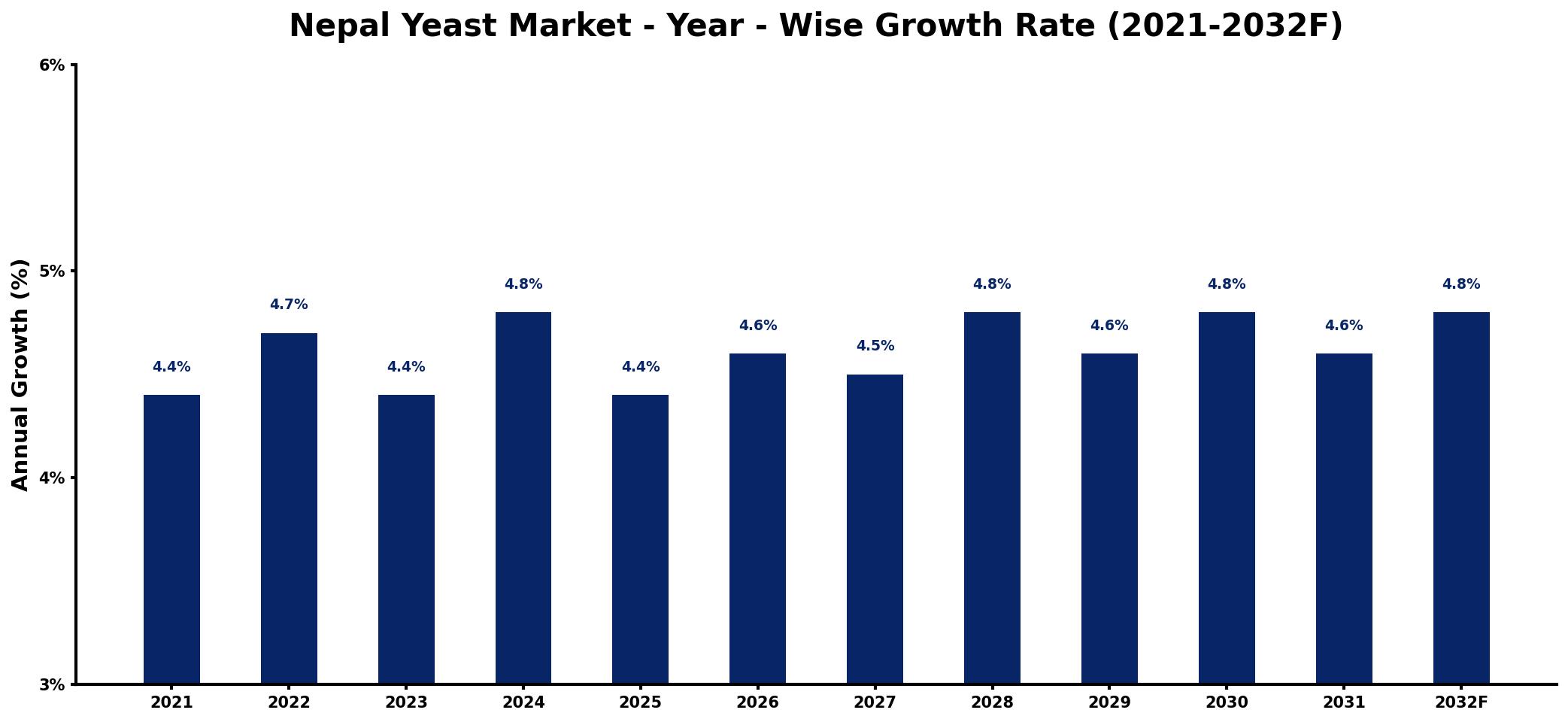
The table below presents the year‑wise growth rates along with the key drivers influencing the market
| Year | Growth Rate | Major Drivers |
| 2021 | 4.4% | Rising consumer health awareness |
| 2022 | 4.7% | Growth in bakery industry demand |
| 2023 | 4.4% | Increased investment in production |
| 2024 | 4.8% | Expansion of food processing sector |
| 2025 | 4.4% | Emergence of new applications |
| 2026 | 4.6% | Rising popularity of fermentation |
| 2027 | 4.5% | Growing demand for organic products |
| 2028 | 4.8% | Increase in export opportunities |
| 2029 | 4.6% | Technological advancements in production |
| 2030 | 4.8% | increased capital investment inflows |
| 2031 | 4.6% | growing commercial sector adoption |
| 2032 | 4.8% | Rising demand for convenience foods |
Note: Market size estimations and growth projections presented in this report are based on 6Wresearch's proprietary forecasting methodology, utilizing the latest available industry data, government publications, and primary research inputs.
Nepal Yeast Market Synopsis
The most significant force shaping the Nepal yeast market currently is the surge in home baking activities. More consumers are embracing the joys of baking, leading to heightened demand for various yeast products, particularly active dry and instant yeast. Alongside this trend, the burgeoning food service industry in urban areas is intensifying the competitive landscape, further propelling the growth of the market.
An increasing number of bakeries, cafes, and restaurants are not only catering to traditional tastes but are also exploring artisanal and specialty offerings, which necessitate high-quality yeast products. This evolving market dynamic is shifting consumer preferences towards natural and organic yeast, as health-conscious individuals seek out better quality ingredients.
Nepal Yeast Market Key Takeaways
- The rising trend of home baking is significantly boosting yeast demand among consumers.
- Urbanization is enhancing the growth of the food service industry, fostering greater yeast utilization.
- Health-conscious consumers are increasingly favoring natural and organic yeast products.
- Investment opportunities exist in production facilities and distribution networks to meet rising demand.
- Challenges related to consumer awareness and distribution efficiency are vital to address for sustained growth.
Evaluation of Restraints in Nepal Yeast Market
Despite the positive outlook, the Nepal yeast market faces several restraints that could impede growth. A significant limitation is the widespread lack of awareness regarding the benefits of yeast among both consumers and businesses. This knowledge gap restricts the overall market demand for yeast products. Additionally, access to high-quality yeast strains at competitive prices can be limited, especially in rural areas. Infrastructure challenges, such as inadequate cold storage facilities, further undermine product quality and longevity, compounding the difficulties faced by manufacturers and distributors alike. Moreover, competition from alternative baking and fermentation ingredients can threaten the market's growth potential, underscoring the need for targeted educational initiatives and robust marketing strategies.
Nepal Yeast Market Trends
Several current and emerging trends are shaping the demand for yeast in Nepal. The revival of traditional baking practices, coupled with the increasing proliferation of artisanal bakeries, is driving sales of premium yeast products. There's also a noteworthy shift toward sustainable practices; consumers are inclined to choose natural and organic yeast options as they become more aware of health implications. Moreover, the craft brewing sector is thriving, fueling demand for specialized yeast strains used in brewing. Manufacturers are responding to these trends by innovating and developing products that align with changing consumer preferences, providing a competitive edge in a dynamic marketplace.
Nepal Yeast Market Opportunities
The Nepal yeast market offers considerable investment opportunities, particularly in the realms of production and distribution. The increasing demand for bakery items serves as a catalyst for growth, presenting a lucrative avenue for establishing yeast production facilities. Furthermore, the rising interest in craft brewing and home fermentation techniques is prompting investments in specialized yeast strains and brewing products. Expanding into neighboring South Asian markets can provide additional avenues for growth, tapping into regional consumer trends that align with Nepals evolving yeast landscape.
Government Initiatives in the Nepal Yeast Market
While specific policies directly targeting the yeast market are lacking, Nepal's government has implemented various regulations that impact food safety and quality standards for yeast products. The Department of Food Technology and Quality Control plays a critical role in ensuring that yeast sold in the market meets safety standards, ultimately supporting consumer confidence. Trade regulations and policies related to imports also influence market dynamics, affecting the availability and pricing of yeast in the country, which can be pivotal for local manufacturers and retailers.
Future Insights of the Nepal Yeast Market
Looking ahead to the period from 2026 to 2032, the Nepal Yeast Market is positioned for robust growth. The increasing interest in baking and brewing, coupled with a shift towards healthier, natural ingredients, is expected to sustain demand for yeast products. As more artisanal bakeries and craft breweries emerge, there will be further opportunities for product innovation and expansion. However, managing challenges related to raw material pricing and competition from substitutes will be critical for companies looking to capture this growing market.
Nepal Yeast Market Latest Developments (2025 - 2026)
In recent months, the Nepal yeast market has seen a noticeable uptick in product innovation, particularly focusing on organic and health-oriented yeast products. Various local producers are beginning to collaborate with international experts to enhance product quality and expand their offerings. Furthermore, the food service sector is actively adapting to consumer preferences, with many establishments integrating artisanal and locally-sourced ingredients, thereby increasing the demand for premium yeast products. The market is also witnessing enhanced distribution networks, aimed at improving access to high-quality yeast in remote areas.
Nepal Yeast Market - Key Attractiveness of the Report
- 10 Years of Market Numbers
- Historical Data Starting from 2022 to 2025
- Base Year: 2025
- Forecast Data until 2032
- Key Performance Indicators Impacting the Market
- Major Upcoming Developments and Projects
Key Highlights of the Report:
- Nepal Yeast Market Outlook
- Market Size of Nepal Yeast Market, 2025
- Forecast of Nepal Yeast Market, 2032
- Historical Data and Forecast of Nepal Yeast Revenues & Volume for the Period 2022-2032F
- Nepal Yeast Market Trend Evolution
- Nepal Yeast Market Drivers and Challenges
- Nepal Yeast Price Trends
- Nepal Yeast Porter's Five Forces
- Nepal Yeast Industry Life Cycle
- Historical Data and Forecast of Nepal Yeast Market Revenues & Volume By Target Audience for the Period 2022-2032F
- Historical Data and Forecast of Nepal Yeast Market Revenues & Volume By Raw material manufacturers and suppliers for the Period 2022-2032F
- Historical Data and Forecast of Nepal Yeast Market Revenues & Volume By Research institutions for the Period 2022-2032F
- Historical Data and Forecast of Nepal Yeast Market Revenues & Volume By Government bodies for the Period 2022-2032F
- Historical Data and Forecast of Nepal Yeast Market Revenues & Volume By Distributors for the Period 2022-2032F
- Historical Data and Forecast of Nepal Yeast Market Revenues & Volume By End-users (food, feed, and the beverage industry) for the Period 2022-2032F
- Historical Data and Forecast of Nepal Yeast Market Revenues & Volume By Type for the Period 2022-2032F
- Historical Data and Forecast of Nepal Yeast Market Revenues & Volume By Baker??s yeast for the Period 2022-2032F
- Historical Data and Forecast of Nepal Yeast Market Revenues & Volume By Brewer??s yeast for the Period 2022-2032F
- Historical Data and Forecast of Nepal Yeast Market Revenues & Volume By Probiotics yeast for the Period 2022-2032F
- Historical Data and Forecast of Nepal Yeast Market Revenues & Volume By Wine yeast for the Period 2022-2032F
- Historical Data and Forecast of Nepal Yeast Market Revenues & Volume By Other types for the Period 2022-2032F
- Historical Data and Forecast of Nepal Yeast Market Revenues & Volume By Genus for the Period 2022-2032F
- Historical Data and Forecast of Nepal Yeast Market Revenues & Volume By Saccharomyces for the Period 2022-2032F
- Historical Data and Forecast of Nepal Yeast Market Revenues & Volume By Kluyveromyces for the Period 2022-2032F
- Historical Data and Forecast of Nepal Yeast Market Revenues & Volume By Other genera for the Period 2022-2032F
- Historical Data and Forecast of Nepal Yeast Market Revenues & Volume By Form for the Period 2022-2032F
- Historical Data and Forecast of Nepal Yeast Market Revenues & Volume By Active for the Period 2022-2032F
- Historical Data and Forecast of Nepal Yeast Market Revenues & Volume By Instant for the Period 2022-2032F
- Historical Data and Forecast of Nepal Yeast Market Revenues & Volume By Fresh for the Period 2022-2032F
- Historical Data and Forecast of Nepal Yeast Market Revenues & Volume By Application for the Period 2022-2032F
- Historical Data and Forecast of Nepal Yeast Market Revenues & Volume By Food for the Period 2022-2032F
- Historical Data and Forecast of Nepal Yeast Market Revenues & Volume By Feed for the Period 2022-2032F
- Nepal Yeast Import Export Trade Statistics
- Market Opportunity Assessment By Target Audience
- Market Opportunity Assessment By Type
- Market Opportunity Assessment By Genus
- Market Opportunity Assessment By Form
- Market Opportunity Assessment By Application
- Nepal Yeast Top Companies Market Share
- Nepal Yeast Competitive Benchmarking By Technical and Operational Parameters
- Nepal Yeast Company Profiles
- Nepal Yeast Key Strategic Recommendations






































