New Zealand Automotive Wiper Market Top 5 Importing Countries and Market Competition (HHI) Analysis
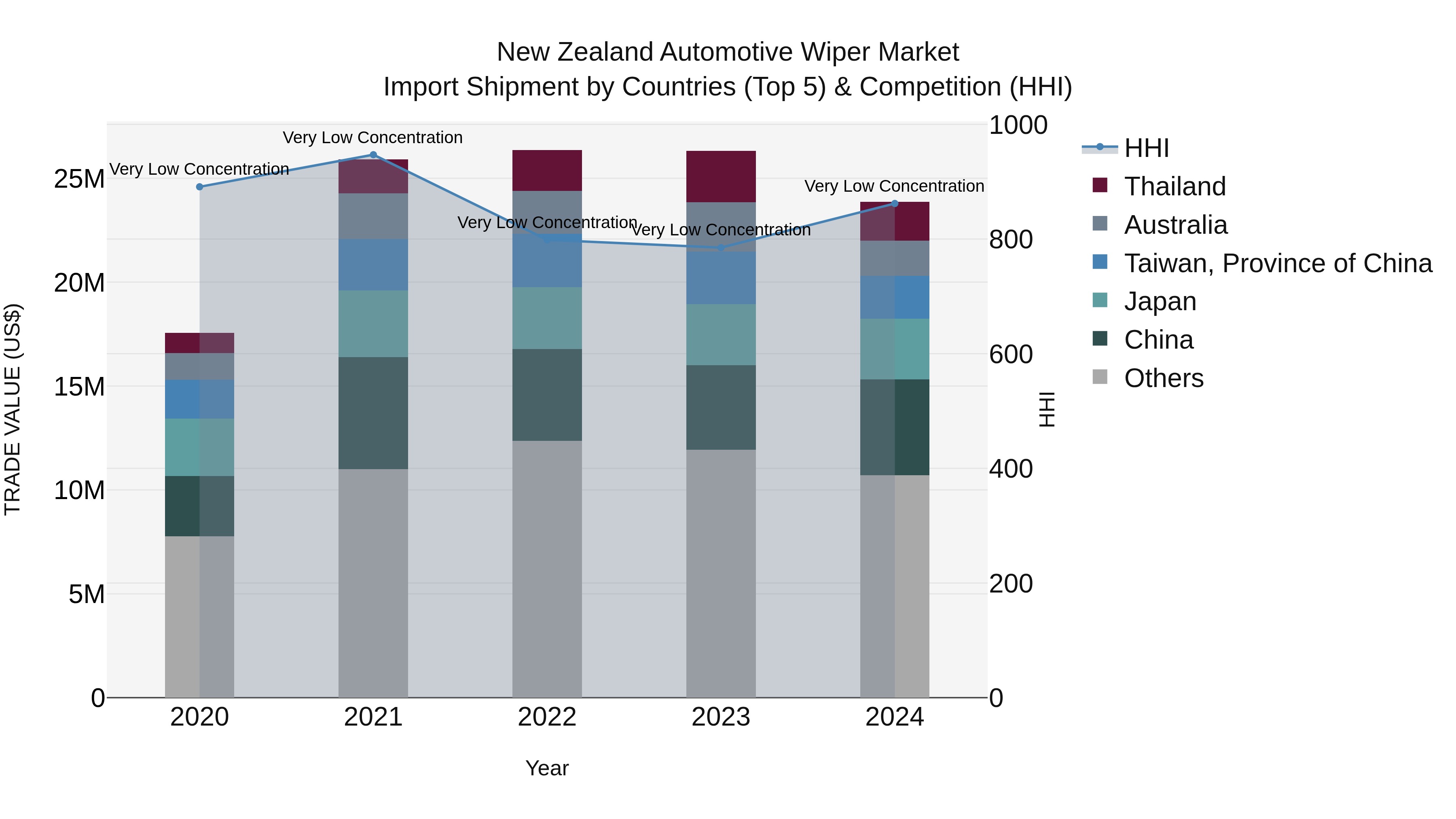
Despite a slight decrease in growth rate in 2024, the New Zealand automotive wiper import market continues to expand steadily with a notable 7.99% CAGR from 2020 to 2024. The top exporting countries to New Zealand include China, Japan, Taiwan, Thailand, and Australia. With a low Herfindahl-Hirschman Index (HHI) indicating low market concentration, the market remains competitive and diverse. The future outlook for automotive wiper imports in New Zealand appears positive, driven by the strong presence of key exporting nations.
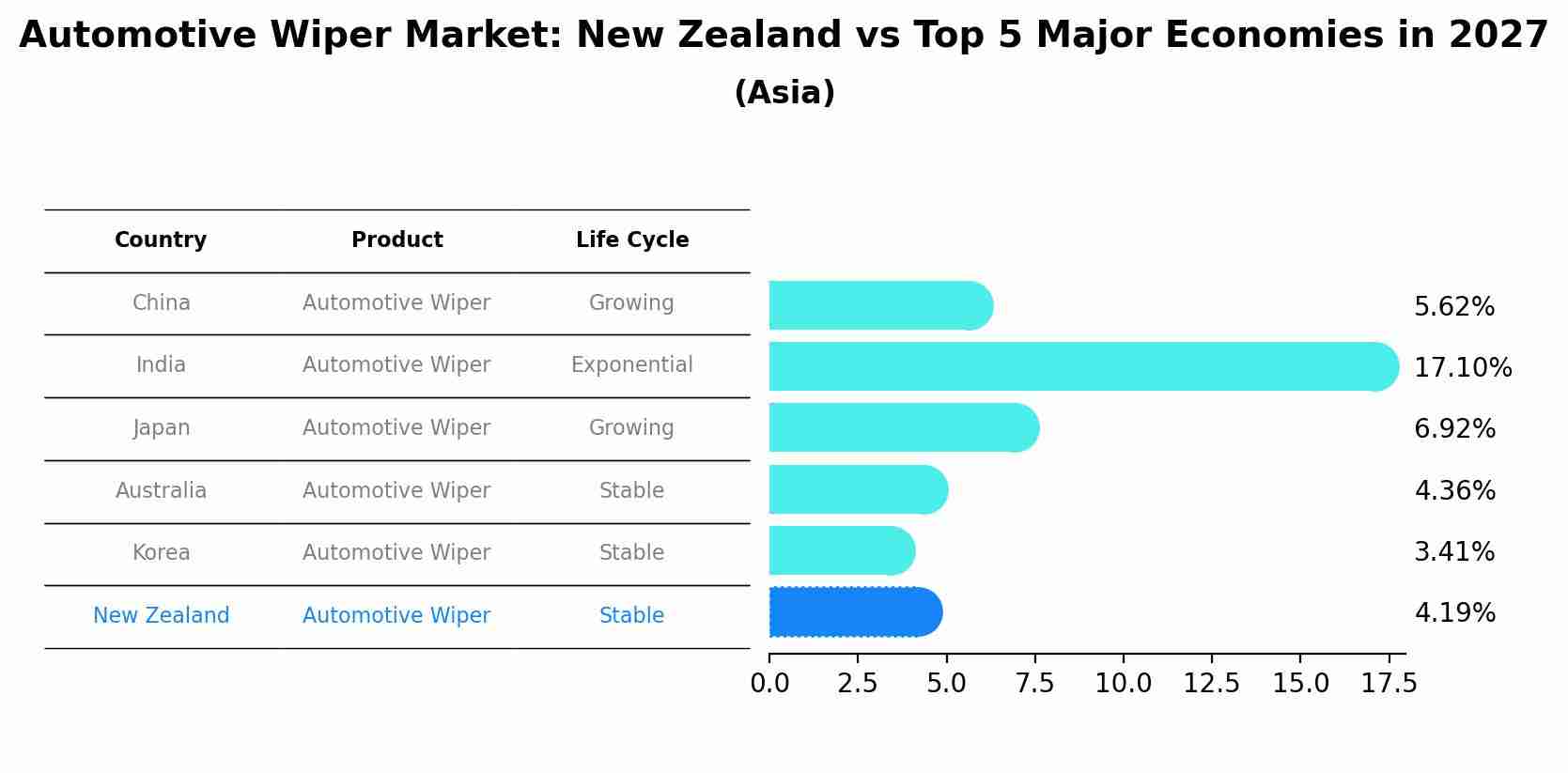
Automotive Wiper Market: New Zealand vs Top 5 Major Economies in 2027 (Asia)
By 2027, the Automotive Wiper market in New Zealand is anticipated to reach a growth rate of 4.19%, as part of an increasingly competitive Asia region, where China remains at the forefront, supported by India, Japan, Australia and South Korea, driving innovations and market adoption across sectors.
Key Highlights of the Report:
- New Zealand Automotive Wiper Market Outlook
- Market Size of New Zealand Automotive Wiper Market, 2025
- Forecast of New Zealand Automotive Wiper Market, 2032
- Historical Data and Forecast of New Zealand Automotive Wiper Revenues & Volume for the Period 2022 - 2032F
- New Zealand Automotive Wiper Market Trend Evolution
- New Zealand Automotive Wiper Market Drivers and Challenges
- New Zealand Automotive Wiper Price Trends
- New Zealand Automotive Wiper Porter`s Five Forces
- New Zealand Automotive Wiper Industry Life Cycle
- Historical Data and Forecast of New Zealand Automotive Wiper Market Revenues & Volume By Blade Type for the Period 2022 - 2032F
- Historical Data and Forecast of New Zealand Automotive Wiper Market Revenues & Volume By Traditional Brackets for the Period 2022 - 2032F
- Historical Data and Forecast of New Zealand Automotive Wiper Market Revenues & Volume By Low-Profile Beam for the Period 2022 - 2032F
- Historical Data and Forecast of New Zealand Automotive Wiper Market Revenues & Volume By Hybrid Blade for the Period 2022 - 2032F
- Historical Data and Forecast of New Zealand Automotive Wiper Market Revenues & Volume By Application Type for the Period 2022 - 2032F
- Historical Data and Forecast of New Zealand Automotive Wiper Market Revenues & Volume By Windshield for the Period 2022 - 2032F
- Historical Data and Forecast of New Zealand Automotive Wiper Market Revenues & Volume By Rear for the Period 2022 - 2032F
- Historical Data and Forecast of New Zealand Automotive Wiper Market Revenues & Volume By Market Type for the Period 2022 - 2032F
- Historical Data and Forecast of New Zealand Automotive Wiper Market Revenues & Volume By OEM for the Period 2022 - 2032F
- Historical Data and Forecast of New Zealand Automotive Wiper Market Revenues & Volume By Aftermarket for the Period 2022 - 2032F
- Historical Data and Forecast of New Zealand Automotive Wiper Market Revenues & Volume By Vehicle Type for the Period 2022 - 2032F
- Historical Data and Forecast of New Zealand Automotive Wiper Market Revenues & Volume By Passenger Cars for the Period 2022 - 2032F
- Historical Data and Forecast of New Zealand Automotive Wiper Market Revenues & Volume By Light Commercial Vehicles for the Period 2022 - 2032F
- Historical Data and Forecast of New Zealand Automotive Wiper Market Revenues & Volume By Heavy Commercial Vehicles for the Period 2022 - 2032F
- New Zealand Automotive Wiper Import Export Trade Statistics
- Market Opportunity Assessment By Blade Type
- Market Opportunity Assessment By Application Type
- Market Opportunity Assessment By Market Type
- Market Opportunity Assessment By Vehicle Type
- New Zealand Automotive Wiper Top Companies Market Share
- New Zealand Automotive Wiper Competitive Benchmarking By Technical and Operational Parameters
- New Zealand Automotive Wiper Company Profiles
- New Zealand Automotive Wiper Key Strategic Recommendations






































