New Zealand Commercial Vehicles Market Growth Rate Analysis (2025 - 2031)
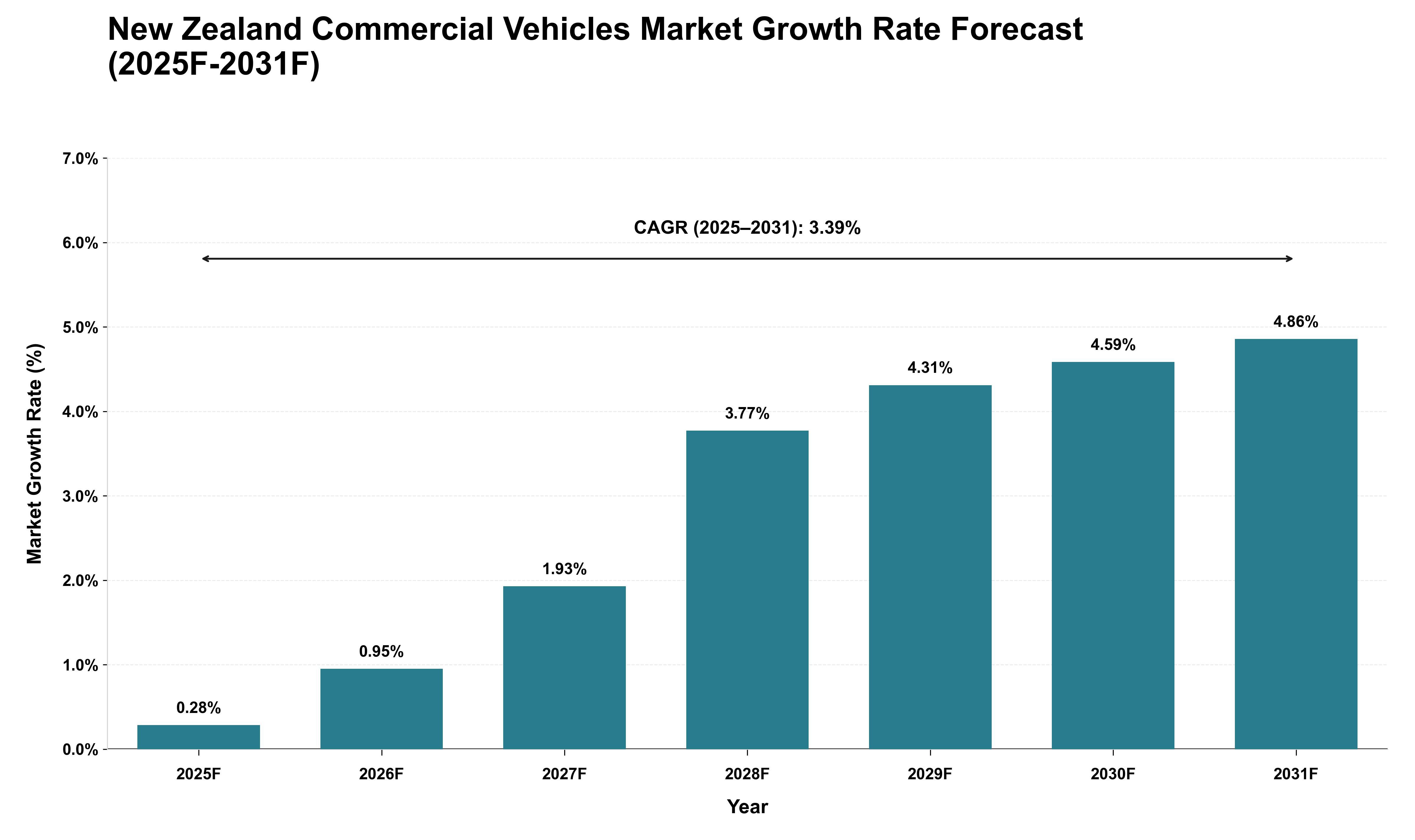
The forecast for the New Zealand commercial vehicles market indicates a notable acceleration in growth rates, transitioning from a modest 0.28% in 2025 to an anticipated 4.86% by 2031. This trajectory reflects an increasing end-use demand driven by factors such as urbanization, infrastructure development, and evolving logistics needs. As businesses adapt to changing consumer behaviors and supply chain dynamics, the demand for efficient commercial vehicles is expected to rise significantly. The projected CAGR of 3.39% underscores this shift, suggesting that import dependencies may also influence market dynamics as New Zealand seeks to enhance its fleet capabilities amidst global supply chain fluctuations. Additionally, cyclical trends in economic recovery post-pandemic will likely bolster investment in commercial transportation solutions, further propelling growth in this sector throughout the forecast period.
Key Highlights of the Report:
- New Zealand Commercial vehicles Market Outlook
- Market Size of New Zealand Commercial vehicles Market, 2025
- Forecast of New Zealand Commercial vehicles Market, 2032
- Historical Data and Forecast of New Zealand Commercial vehicles Revenues & Volume for the Period 2022 - 2032F
- New Zealand Commercial vehicles Market Trend Evolution
- New Zealand Commercial vehicles Market Drivers and Challenges
- New Zealand Commercial vehicles Price Trends
- New Zealand Commercial vehicles Porter`s Five Forces
- New Zealand Commercial vehicles Industry Life Cycle
- Historical Data and Forecast of New Zealand Commercial vehicles Market Revenues & Volume By Product for the Period 2022 - 2032F
- Historical Data and Forecast of New Zealand Commercial vehicles Market Revenues & Volume By Light Commercial Vehicles (LCVs) for the Period 2022 - 2032F
- Historical Data and Forecast of New Zealand Commercial vehicles Market Revenues & Volume By Heavy Trucks for the Period 2022 - 2032F
- Historical Data and Forecast of New Zealand Commercial vehicles Market Revenues & Volume By Buses & Coaches for the Period 2022 - 2032F
- Historical Data and Forecast of New Zealand Commercial vehicles Market Revenues & Volume By End-Users for the Period 2022 - 2032F
- Historical Data and Forecast of New Zealand Commercial vehicles Market Revenues & Volume By Industrial for the Period 2022 - 2032F
- Historical Data and Forecast of New Zealand Commercial vehicles Market Revenues & Volume By Mining & Construction for the Period 2022 - 2032F
- Historical Data and Forecast of New Zealand Commercial vehicles Market Revenues & Volume By Logistics for the Period 2022 - 2032F
- Historical Data and Forecast of New Zealand Commercial vehicles Market Revenues & Volume By Passenger Transportation for the Period 2022 - 2032F
- Historical Data and Forecast of New Zealand Commercial vehicles Market Revenues & Volume By Others for the Period 2022 - 2032F
- New Zealand Commercial vehicles Import Export Trade Statistics
- Market Opportunity Assessment By Product
- Market Opportunity Assessment By End-Users
- New Zealand Commercial vehicles Top Companies Market Share
- New Zealand Commercial vehicles Competitive Benchmarking By Technical and Operational Parameters
- New Zealand Commercial vehicles Company Profiles
- New Zealand Commercial vehicles Key Strategic Recommendations






































