New Zealand Fuel Oil Market Top 5 Importing Countries and Market Competition (HHI) Analysis
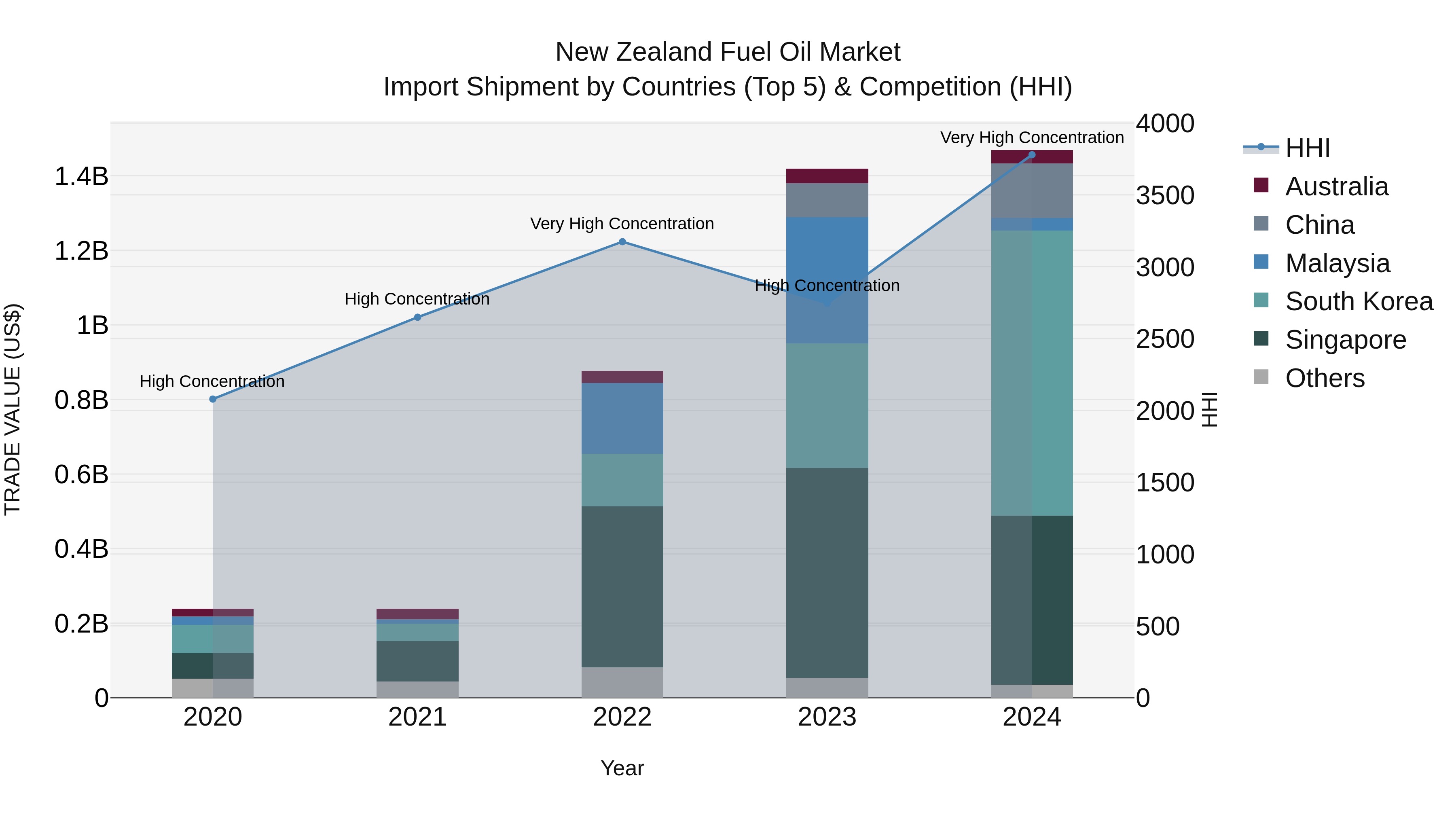
New Zealand`s fuel oil import market saw significant concentration in 2024, with South Korea, Singapore, China, Australia, and Malaysia emerging as the top exporting countries. The high Herfindahl-Hirschman Index (HHI) indicates market dominance by key players. The impressive compound annual growth rate (CAGR) of 57.54% from 2020 to 2024 reflects robust market expansion, while the growth rate of 3.48% from 2023 to 2024 indicates steady development. These trends suggest a dynamic and competitive landscape in the New Zealand fuel oil import sector, with opportunities for strategic partnerships and market positioning.
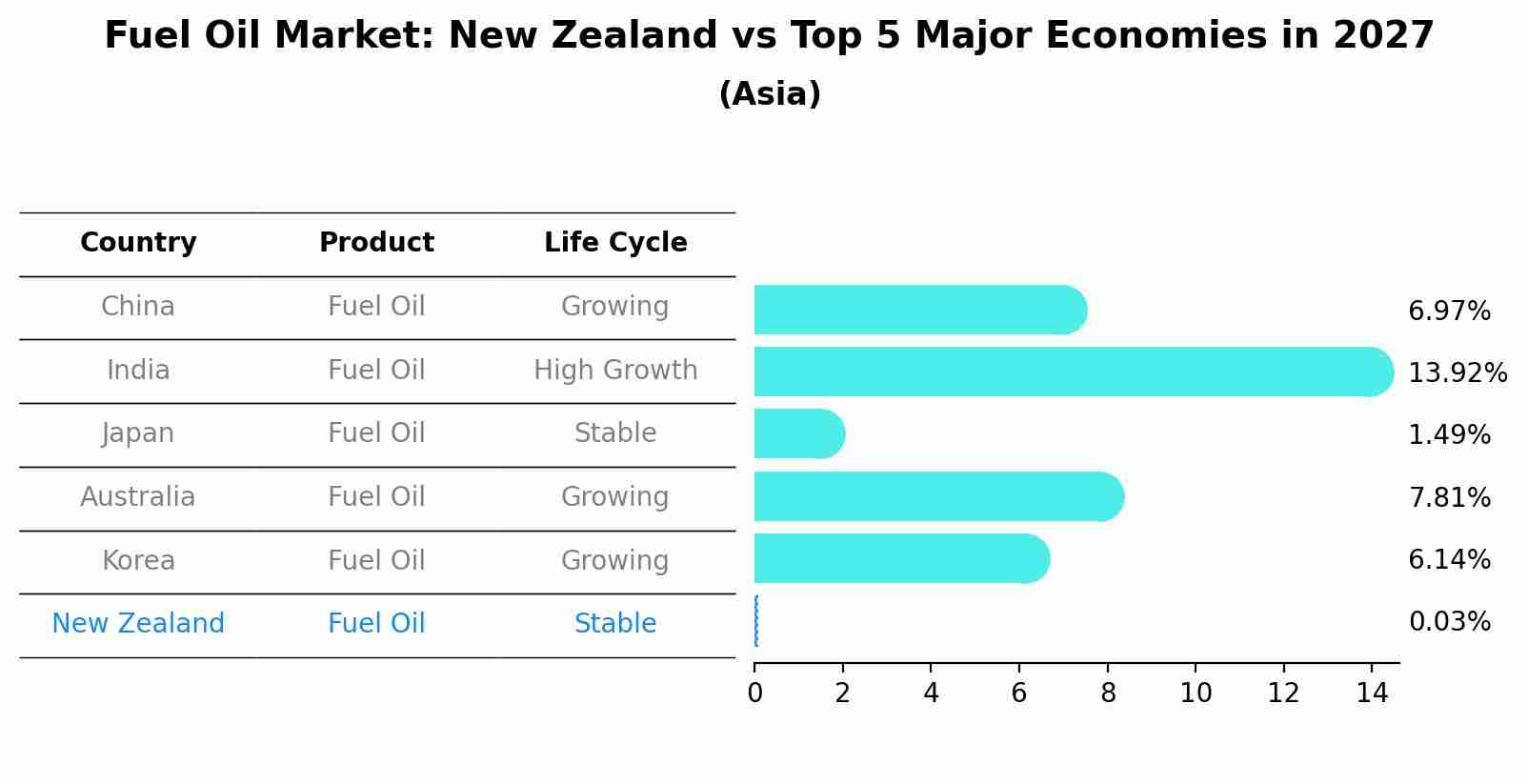
Fuel Oil Market: New Zealand vs Top 5 Major Economies in 2027 (Asia)
The Fuel Oil market in New Zealand is projected to grow at a stable growth rate of 0.03% by 2027, within the Asia region led by China, along with other countries like India, Japan, Australia and South Korea, collectively shaping a dynamic and evolving market environment driven by innovation and increasing adoption of emerging technologies.
New Zealand Fuel Oil Market Overview
New Zealand fuel oil market reflects a significant aspect of the nation`s energy landscape. With a focus on both traditional and alternative energy sources, the market is influenced by factors such as global oil prices, environmental regulations, and shifts towards renewable energy sources. The demand for fuel oil is primarily driven by transportation, industrial, and residential sectors, with a growing emphasis on sustainability and efficiency.
Drivers of the market
The New Zealand fuel oil market is primarily driven by the country`s energy consumption patterns, economic growth, and government policies regarding energy production and consumption. Fuel oil is used in various applications such as power generation, heating, and transportation, and its demand is influenced by factors such as fuel prices, environmental regulations, and technological advancements in alternative energy sources.
Challenges of the market
In the fuel oil market, challenges stem from fluctuating oil prices, regulatory changes, and the transition towards cleaner energy sources. Adapting to market dynamics, optimizing supply chain logistics, and diversifying product offerings are essential strategies in addressing these challenges and maintaining competitiveness.
Government Policy of the market
In the fuel oil market, the New Zealand government regulates the production, distribution, and use of fuel oils to ensure safety, reliability, and environmental protection. Standards address fuel quality, storage requirements, and emissions control to minimize air and water pollution. Regulatory agencies monitor compliance with regulations and enforce penalties for non-compliance to safeguard public health and the environment.
Key Highlights of the Report:
- New Zealand Fuel Oil Market Outlook
- Market Size of New Zealand Fuel Oil Market, 2024
- Forecast of New Zealand Fuel Oil Market, 2031
- Historical Data and Forecast of New Zealand Fuel Oil Revenues & Volume for the Period 2021-2031
- New Zealand Fuel Oil Market Trend Evolution
- New Zealand Fuel Oil Market Drivers and Challenges
- New Zealand Fuel Oil Price Trends
- New Zealand Fuel Oil Porter`s Five Forces
- New Zealand Fuel Oil Industry Life Cycle
- Historical Data and Forecast of New Zealand Fuel Oil Market Revenues & Volume By Application for the Period 2021-2031
- Historical Data and Forecast of New Zealand Fuel Oil Market Revenues & Volume By Marine for the Period 2021-2031
- Historical Data and Forecast of New Zealand Fuel Oil Market Revenues & Volume By Industrial for the Period 2021-2031
- Historical Data and Forecast of New Zealand Fuel Oil Market Revenues & Volume By Others for the Period 2021-2031
- New Zealand Fuel Oil Import Export Trade Statistics
- Market Opportunity Assessment By Application
- New Zealand Fuel Oil Top Companies Market Share
- New Zealand Fuel Oil Competitive Benchmarking By Technical and Operational Parameters
- New Zealand Fuel Oil Company Profiles
- New Zealand Fuel Oil Key Strategic Recommendations






































