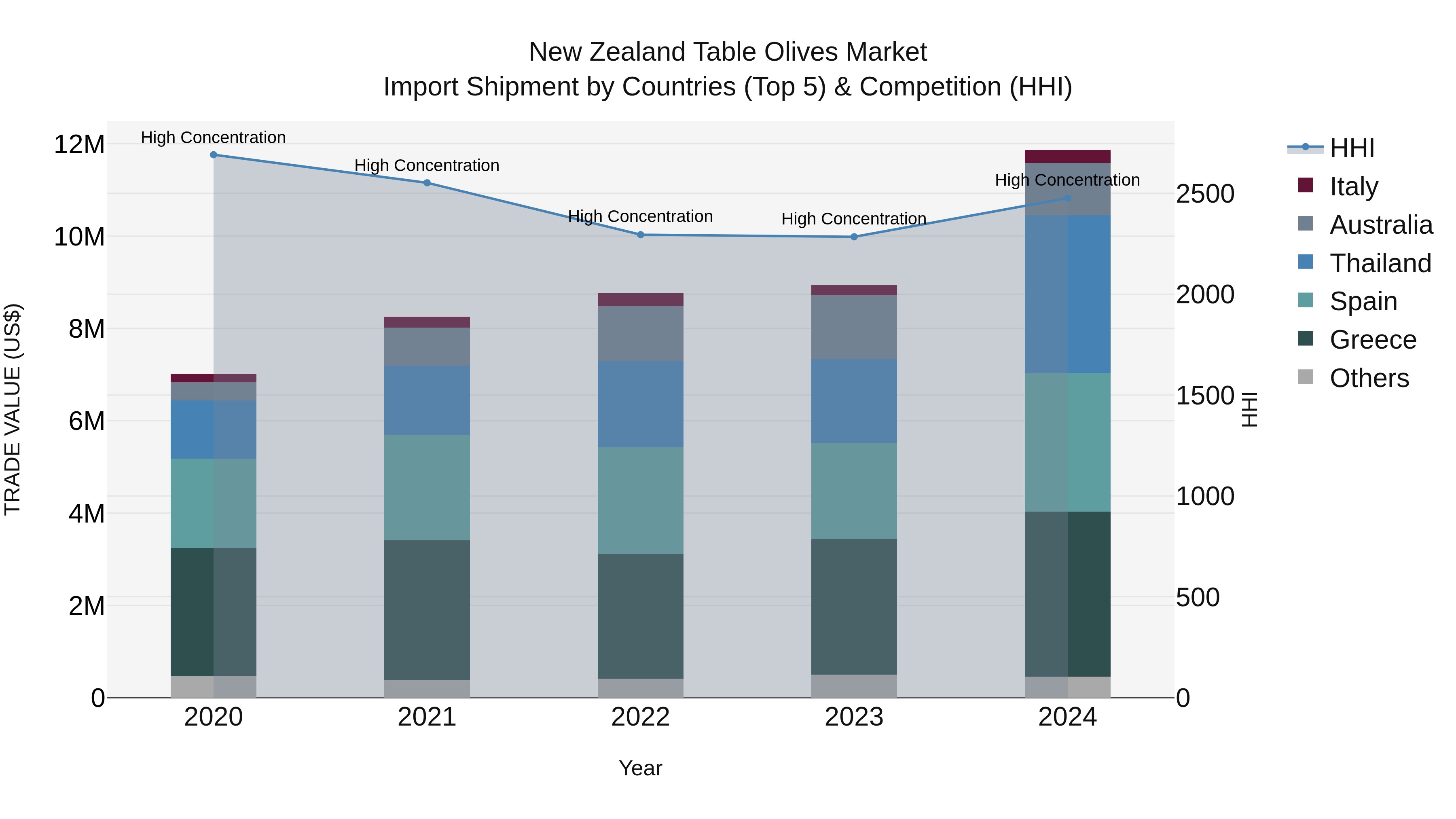
New Zealand Table Olives Market Top 5 Importing Countries and Market Competition (HHI) Analysis
New Zealand`s table olives import market continues to thrive, with Greece, Thailand, Spain, Australia, and Italy emerging as key exporting countries in 2024. The high Herfindahl-Hirschman Index (HHI) signifies market concentration, while the impressive Compound Annual Growth Rate (CAGR) of 14.0% (2020-24) and notable growth rate of 32.75% (2023-24) highlight the increasing demand for imported table olives in New Zealand. This trend underscores opportunities for suppliers to capitalize on the growing market and meet consumer preferences for quality olives from diverse origins.
New Zealand Table Olives Market Synopsis
The New Zealand Table Olives Market is experiencing steady growth driven by increasing consumer interest in healthy and gourmet food options. With a focus on quality and sustainability, local olive growers are producing a variety of premium table olives known for their unique flavors and textures. The market is characterized by a mix of small boutique producers and larger commercial farms, offering consumers a wide range of options to choose from. In recent years, there has been a growing trend towards organic and artisanal table olives, reflecting a shift towards more natural and authentic food products. As the awareness of the health benefits of olives continues to rise, and with a strong emphasis on supporting local producers, the New Zealand Table Olives Market is poised for further expansion in the coming years.
New Zealand Table Olives Market Trends
The New Zealand table olives market is experiencing a growing demand for artisanal and high-quality olive products, driven by the increasing consumer interest in healthy and gourmet food options. There is a trend towards unique flavor profiles, organic and locally-sourced ingredients, and sustainable production practices. Opportunities lie in diversifying product offerings to cater to changing consumer preferences, such as flavored olives, olive tapenades, and olive oils. Additionally, there is potential for market expansion through increased marketing efforts, online sales channels, and partnerships with local restaurants and specialty stores. Collaborating with local olive growers and focusing on premium quality products can help businesses capitalize on the growing popularity of table olives in New Zealand.
New Zealand Table Olives Market Challenges
In the New Zealand Table Olives Market, challenges are primarily related to competition from imported olives, limited domestic production capacity, and the high costs of production due to the country`s geographic isolation. Imported olives, particularly from Mediterranean countries, often have a cost advantage due to economies of scale and established brand reputation. This poses a challenge for local producers in terms of pricing competitiveness. Additionally, the limited availability of suitable land for olive cultivation and the relatively small scale of production in New Zealand hinder the industry`s growth potential. Furthermore, the country`s geographical isolation results in higher transportation costs for both raw materials and finished products, impacting the overall cost structure of the industry. Overcoming these challenges will require strategic marketing efforts, innovation in production techniques, and possibly collaboration among local producers to increase efficiency and competitiveness in the market.
New Zealand Table Olives Market Investment Opportunities
The New Zealand Table Olives market is primarily driven by increasing consumer awareness about the health benefits of olives, such as their high content of antioxidants and healthy fats. The growing trend towards healthy eating habits and the rising popularity of Mediterranean cuisine in the region are also contributing to the market growth. Additionally, the expansion of retail channels, including supermarkets, specialty stores, and online platforms, is making table olives more accessible to consumers. Furthermore, the emphasis on locally sourced and sustainable food products is driving the demand for domestically produced table olives, supporting the growth of the New Zealand market. Overall, factors such as health consciousness, culinary trends, retail availability, and sustainability are key drivers shaping the New Zealand Table Olives market.
New Zealand Table Olives Market Government Polices
The New Zealand Table Olives Market is regulated by the Ministry for Primary Industries (MPI), which oversees the standards and regulations for producing, importing, and selling table olives in the country. The MPI ensures that table olives meet food safety and quality standards through compliance with the Food Act 2014 and the Australia New Zealand Food Standards Code. Producers are required to follow good agricultural practices, processing guidelines, and labeling requirements to maintain the integrity of the market. Additionally, the MPI works to promote innovation and sustainability within the industry, supporting research and development initiatives to enhance the competitiveness of New Zealand table olive products both domestically and internationally.
New Zealand Table Olives Market Future Outlook
The New Zealand Table Olives Market is expected to witness steady growth in the coming years due to increasing consumer awareness about the health benefits of olives. There is a growing trend towards healthy eating habits and Mediterranean diets, which include olives as a key component. Additionally, the rising popularity of gourmet and specialty food products is driving demand for high-quality table olives in the country. New Zealand`s favorable climate conditions for olive cultivation further support the growth of the market. As consumers continue to prioritize health and wellness, the demand for table olives is expected to remain strong, leading to a positive outlook for the New Zealand Table Olives Market in the future.
Key Highlights of the Report:
- New Zealand Table Olives Market Outlook
- Market Size of New Zealand Table Olives Market, 2024
- Forecast of New Zealand Table Olives Market, 2031
- Historical Data and Forecast of New Zealand Table Olives Revenues & Volume for the Period 2021- 2031
- New Zealand Table Olives Market Trend Evolution
- New Zealand Table Olives Market Drivers and Challenges
- New Zealand Table Olives Price Trends
- New Zealand Table Olives Porter's Five Forces
- New Zealand Table Olives Industry Life Cycle
- Historical Data and Forecast of New Zealand Table Olives Market Revenues & Volume By Type for the Period 2021- 2031
- Historical Data and Forecast of New Zealand Table Olives Market Revenues & Volume By Black Olive for the Period 2021- 2031
- Historical Data and Forecast of New Zealand Table Olives Market Revenues & Volume By Green Olive for the Period 2021- 2031
- Historical Data and Forecast of New Zealand Table Olives Market Revenues & Volume By Application for the Period 2021- 2031
- Historical Data and Forecast of New Zealand Table Olives Market Revenues & Volume By Online Store for the Period 2021- 2031
- Historical Data and Forecast of New Zealand Table Olives Market Revenues & Volume By Supermarket for the Period 2021- 2031
- Historical Data and Forecast of New Zealand Table Olives Market Revenues & Volume By Convenience Store for the Period 2021- 2031
- Historical Data and Forecast of New Zealand Table Olives Market Revenues & Volume By Other for the Period 2021- 2031
- New Zealand Table Olives Import Export Trade Statistics
- Market Opportunity Assessment By Type
- Market Opportunity Assessment By Application
- New Zealand Table Olives Top Companies Market Share
- New Zealand Table Olives Competitive Benchmarking By Technical and Operational Parameters
- New Zealand Table Olives Company Profiles
- New Zealand Table Olives Key Strategic Recommendations






































