Nigeria Cyber Security Market Growth Rate
According to 6Wresearch internal database and industry insights, the Nigeria Cyber Security Market is expected to grow at an approximate compound annual growth rate (CAGR) of around 10.9% during the forecast period (2026–2032).
Nigeria Cyber Security Market Year-wise Growth Rate and Key Drivers (2022–2032)
This graph illustrates the annual growth rates of the Nigeria Cyber Security Market from 2022 to 2032, highlighting a steady upward trajectory and projected market expansion over the forecast period.
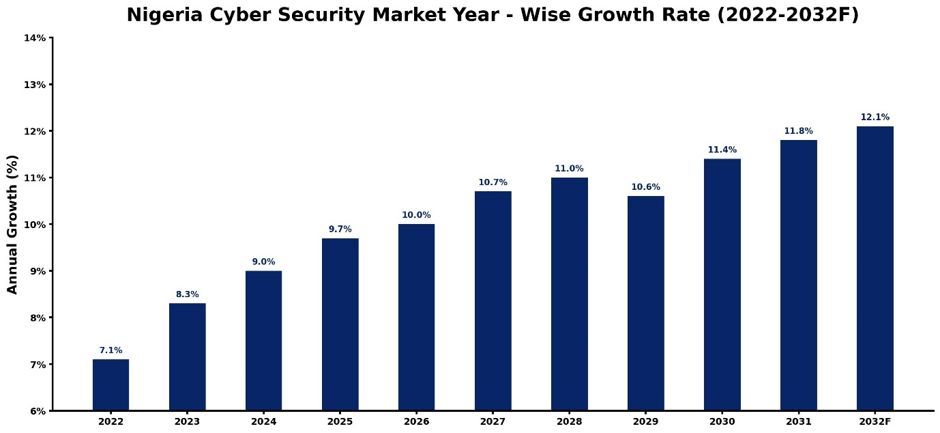
The following table summarizes the historical and forecasted growth rates of the Nigeria Cyber Security Market, along with the rationale behind each year’s performance.
| Year | Estimated Growth (%) | Market Rationale |
| 2022 | 7.1% | Early-stage cybersecurity adoption, and rise in the digital banking activity. |
| 2023 | 8.3% | Growth in the fintech ecosystem, and increase in the cyber fraud incidents. |
| 2024 | 9% | Expansion of cloud adoption, and rise in enterprise security awareness. |
| 2025 | 9.7% | Surge in ransomware attacks, and high BFSI cybersecurity spending. |
| 2026 | 10% | Market acceleration is driven by the digital transformation, and regulatory enforcement. |
| 2027 | 10.7% | Increased adoption of the managed security services due to skill shortage. |
| 2028 | 11% | Rise in the deployment of AI-driven threat detection, and automation tools. |
| 2029 | 10.6% | Slight moderation due to the SME budget constraints, and infrastructure gaps. |
| 2030 | 11.4% | 5G rollout, and telecom sector security upgrades will boost the demand. |
| 2031 | 11.8% | Wider adoption of the zero-trust architecture across enterprises. |
| 2032 | 12.1% | Market will mature with strong compliance-driven cybersecurity investments. |
Topics Covered in the Nigeria Cyber Security Market Report
The Nigeria Cyber Security Market report covers the market by components, offerings, deployments, and verticals. The report provides an in-depth analysis of ongoing market trends, opportunities, and growth drivers, enabling stakeholders to align strategies with current and future market dynamics.
Nigeria Cyber Security Market Highlights
| Report Name | Nigeria Cyber Security Market |
| Forecast period | 2026–2032 |
| CAGR | 10.9% |
| Growing Sector | IT & Telecom |
Nigeria Cyber Security Market Synopsis
The Nigeria Cyber Security Industry is anticipated to witness strong growth during the forecast period on account of rise in cyber threats, and rapid adoption of cloud-based services across institutions. The expansion of digital banking, and e-governance platforms are significantly increasing the demand for advanced security solutions. The growing internet penetration, and the acceleration of digital payments are further exposing the organizations to cybersecurity risks such as phishing, and data breaches. As a result, investments in network security, and cloud security solutions are rising steadily across the country.
Evaluation of Growth Drivers in Nigeria Cyber Security Market (2026–2032)
Below are some major drivers and their influence on the market dynamics:
| Drivers | Primary Segment Affected | Why It Matters (Evidence) |
| Cyber Threat Landscape | BFSI, Government, Enterprises | The increase in the frequency of ransomware, and data breaches is driving the demand for advanced security systems. |
| Digital Transformation | IT, Telecom, Government | The expansion of digital services requires robust security frameworks for data protection. |
| Fintech Ecosystem | BFSI & Payments | Rapid adoption of mobile banking increases the exposure to cyber risks. |
| Cloud Adoption | Enterprises & SMEs | Migration to cloud infrastructure increases the need for cloud security solutions. |
| Government Digital Initiatives | Public Sector | Expansion of e-governance services increases the demand for secure digital infrastructure. |
The Nigeria Cyber Security Market is projected to grow at a CAGR of 10.9% during 2026–2032 on account of rise in the cybercrime incidents, increase in enterprise digitization, and strong demand for secure digital infrastructure. The expanding cloud adoption, improved regulatory focus on data protection, and increase in awareness of cybersecurity risks are expected to further accelerate the market growth. The expanding adoption of AI-driven cybersecurity solutions, and advanced threat intelligence platforms is further expected to strengthen the enterprise resilience, and drive the long-term market maturity across digital ecosystem.
Evaluation of Restraints in Nigeria Cyber Security Market
Below are some major restraints and their influence on the market dynamics:
| Restraints | Primary Segment Affected | What This Means (Evidence) |
| High Implementation Cost | SMEs & Start-ups | Advanced cybersecurity solutions require significant investment, limiting the adoption among small firms. |
| Lack of Skilled Professionals | IT & Security Operations | Shortage of trained cybersecurity experts slows the deployment, and incident response. |
| Low Awareness Levels | SMEs & Traditional Businesses | Limited understanding of cyber risks leads to the delayed adoption of security solutions. |
| Infrastructure Limitations | Nationwide IT Ecosystem | The inconsistent IT infrastructure reduces the effectiveness of the advanced security systems. |
| Regulatory Complexity | Cross-sector Organizations | Evolving compliance requirements increase the operational complexity. |
Nigeria Cyber Security Market Challenges
Despite strong growth prospects, Nigeria Cyber Security Market is facing several challenges such as talent shortage, limited cybersecurity awareness, and budget constraints. Companies can address these challenges by investing in cybersecurity training programs, and adopting the AI-driven threat detection systems. Government initiatives focused on digital security awareness are also expected to play a key role in improving the cybersecurity landscape. With increase in digital adoption, and cyber risk exposure, Nigeria is positioned to become one of the fastest-growing cybersecurity markets in the African region.
Nigeria Cyber Security Market Trends
Principal trends driving the Nigeria Cyber Security Market Growth are outlined below:
- Rapid Adoption of Cloud Security Solutions: Organizations deploy the cloud-based security tools to protect the distributed data, driven by fast cloud migration, and hybrid IT environments across sectors.
- Rise in AI and Automation for Threat Detection: Businesses are adopting the AI-driven cybersecurity tools to identify anomalies, reduce response time, and manage the large-scale cyber threats with minimal human intervention.
- Increasing Focus on Data Protection Regulations: Strong enforcement of the data privacy laws is pushing enterprises to invest in compliance-driven security frameworks, and improve the governance over sensitive digital information.
Investment Opportunities in the Nigeria Cyber Security Market
Major investment opportunities in the Nigeria Cyber Security Market are presented below:
- Cloud Security Solutions Development: The growth in cloud adoption creates the demand for secure cloud infrastructure, opening investment opportunities for cloud security platforms, encryption tools, and identity management solutions.
- Managed Security Services Expansion: The high demand for outsourced cybersecurity creates strong investment opportunities in the MSSPs offering monitoring, threat detection, and compliance services for enterprises, and SMEs.
- Fintech Security Infrastructure: The rapid fintech growth drives the demand for fraud detection, secure payment gateways, and real-time transaction monitoring systems to protect the digital financial ecosystems.
Top Players in Nigeria Cyber Security Market
A comprehensive list of major companies holding majority of Nigeria Cyber Security Market Share is provided below:
1. Digital Encode Limited
| Company Name | Digital Encode Limited |
|---|---|
| Established Year | 2003 |
| Headquarters | Lagos, Nigeria |
| Official Website | Click Here |
Digital Encode Limited is a leading Nigerian cybersecurity consulting firm specializing in risk management, penetration testing, and security advisory for BFSI, telecom, and government sectors.
2. CyberSOC Africa
| Company Name | CyberSOC Africa |
|---|---|
| Established Year | 2015 |
| Headquarters | Lagos, Nigeria |
| Official Website | Click Here |
CyberSOC Africa provides managed security operations center services, threat monitoring, and incident response, supporting enterprise cybersecurity resilience across West Africa.
3. Microsoft
| Company Name | Microsoft |
|---|---|
| Established Year | 1975 |
| Headquarters | Redmond, Washington, USA |
| Official Website | Click Here |
Microsoft is a major provider of cloud security, identity protection, endpoint security, and enterprise cybersecurity solutions adopted by Nigerian enterprises, and government digital platforms.
4. Cisco Systems Inc.
| Company Name | Cisco Systems Inc. |
|---|---|
| Established Year | 1984 |
| Headquarters | San Jose, California, USA |
| Official Website | Click Here |
Cisco is a key provider of network security infrastructure, firewalls, secure networking, and cybersecurity architecture for telecom operators, and large enterprises in Nigeria.
5. Fortinet
| Company Name | Fortinet |
|---|---|
| Established Year | 2000 |
| Headquarters | Sunnyvale, California, USA |
| Official Website | Click Here |
Fortinet is a leading cybersecurity vendor offering unified threat management, firewall solutions, and security fabric architecture used across BFSI, government, and enterprise sectors in Nigeria.
Government Initiatives being implemented in the Nigeria Cyber Security Market
According to Nigerian government data, the authorities have strengthened its cybersecurity ecosystem through digital protection frameworks, and regulatory enforcement. Key policies include the Cybercrimes (Prohibition, Prevention, etc.) Act 2015, which criminalizes the cyber offenses, and strengthens the prosecution. The Nigeria Data Protection Regulation 2019, which ensures the data privacy, and compliance, and the National Cybersecurity Policy and Strategy 2021, which provides the coordinated national framework for cyber defense, and resilience across critical sectors.
Future Insights of the Nigeria Cyber Security Market
The Nigeria Cyber Security Market is expected to grow strongly on account of rise in cyber threats, expanding digital banking, and rapid cloud adoption across enterprises. The increased investment in AI-driven security, managed services, and zero-trust frameworks will shape the future landscape. The strong regulatory enforcement, and digital transformation initiatives will further boost the demand of the cyber security infrastructure.
Market Segmentation Analysis
This report presents a detailed analysis of the Nigeria Cyber Security Market segments along with their leading categories.
By Components - Market Dominated by Solutions Segment, Services Set for Rapid Expansion
According to Sachin, Senior Research Analyst, 6Wresearch, solutions segment dominated the market till 2025, accounting for an estimated 63% market share, driven by strong demand for endpoint security, and identity management tools across enterprises. However, during 2026–2032, the services segment is expected to dominate the market, expanding at a CAGR of 13.1%, as organizations rely on managed security, consulting, and incident response services due to acute cybersecurity skill shortage, and rising attack complexity.
By Offerings - Infrastructure Security Leads the Market, Identity and Access Management to Show Rapid Growth
The infrastructure security segment dominated the market till 2025 with 29% market share, supported by rising investments in securing networks, and critical IT systems. From 2026 to 2032, the identity and access management is projected to dominate the market, registering a CAGR of 12.4%, driven by rapid cloud adoption, remote workforce expansion, and increasing need for zero-trust security frameworks across sectors.
By Deployment - Market Dominated by On-Premises, Cloud Deployment Set for Rapid Expansion
The on-premises deployment segment dominated the market till 2025 with 56% market share, due to legacy systems in banking, government, and large enterprises requiring localized control, and compliance. However, the cloud deployment segment is expected to dominate the market from 2026 to 2032, growing at a CAGR of 15.2%, fueled by accelerating digital transformation, and demand for scalable, and cost-efficient security infrastructure.
By Verticals - BFSI Leads the Market, IT and Telecom to Show Rapid Growth
The BFSI (Banking, Financial Services, and Insurance) segment dominated the market till 2025 with 32% market share, driven by high-value digital transactions, fintech expansion, and strict regulatory requirements. During 2026–2032, the IT and Telecom segment is expected to dominate the market, expanding at a CAGR of 10.8%, supported by rapid 5G rollout, data traffic surge, cloud migration, and increasing cybersecurity investments by telecom operators, and digital service providers.
Note: Market size estimations and growth projections presented in this report are based on 6Wresearch's proprietary forecasting methodology, utilizing the latest available industry data, government publications, and primary research inputs.
Key Attractiveness of the Report:
- 10 Years of Market Numbers
- Historical Data Starting from 2022 to 2025
- Base Year: 2025
- Forecast Data until 2032
- Key Performance Indicators Impacting the Market
- Major Upcoming Developments and Projects
Key Highlights of the Report:
- Nigeria Cyber Security Market Outlook
- Market Size of Nigeria Cyber Security Market, 2025
- Forecast of Nigeria Cyber Security Market, 2032
- Historical Data and Forecast of Nigeria Cyber Security Market Revenues & Volume for the Period 2022-2032
- Nigeria Cyber Security Market Trend Evolution
- Nigeria Cyber Security Market Drivers and Challenges
- Nigeria Cyber Security Market Pricing Trends
- Nigeria Cyber Security Market Porter’s Five Forces
- Nigeria Cyber Security Market Industry Life Cycle
- Historical Data and Forecast of Nigeria Cyber Security Market Revenues & Volume By Component for the Period 2022-2032
- Historical Data and Forecast of Nigeria Cyber Security Market Revenues & Volume By Solutions for the Period 2022-2032
- Historical Data and Forecast of Nigeria Cyber Security Market Revenues & Volume By Services for the Period 2022-2032
- Historical Data and Forecast of Nigeria Cyber Security Market Revenues & Volume By Offerings for the Period 2022-2032
- Historical Data and Forecast of Nigeria Cyber Security Market Revenues & Volume By Identity And Access Management for the Period 2022-2032
- Historical Data and Forecast of Nigeria Cyber Security Market Revenues & Volume By Infrastructure Security for the Period 2022-2032
- Historical Data and Forecast of Nigeria Cyber Security Market Revenues & Volume By Governance, Risk And Compliance for the Period 2022-2032
- Historical Data and Forecast of Nigeria Cyber Security Market Revenues & Volume By Unified Vulnerability Management Service for the Period 2022-2032
- Historical Data and Forecast of Nigeria Cyber Security Market Revenues & Volume By Data Security And Privacy Services for the Period 2022-2032
- Historical Data and Forecast of Nigeria Cyber Security Market Revenues & Volume By Deployment for the Period 2022-2032
- Historical Data and Forecast of Nigeria Cyber Security Market Revenues & Volume By Cloud for the Period 2022-2032
- Historical Data and Forecast of Nigeria Cyber Security Market Revenues & Volume By On-Premises for the Period 2022-2032
- Historical Data and Forecast of Nigeria Cyber Security Market Revenues & Volume By Vertical for the Period 2022-2032
- Historical Data and Forecast of Nigeria Cyber Security Market Revenues & Volume By BFSI (Banking Financial Services & Insurance) for the Period 2022 - 2032
- Historical Data and Forecast of Nigeria Cyber Security Market Revenues & Volume By IT & Telecom for the Period 2022-2032
- Historical Data and Forecast of Nigeria Cyber Security Market Revenues & Volume By Retail for the Period 2022-2032
- Historical Data and Forecast of Nigeria Cyber Security Market Revenues & Volume By Healthcare And Hospitality for the Period 2022-2032
- Historical Data and Forecast of Nigeria Cyber Security Market Revenues & Volume By Energy And Utilities for the Period 2022-2032
- Historical Data and Forecast of Nigeria Cyber Security Market Revenues & Volume By Manufacturing for the Period 2022-2032
- Historical Data and Forecast of Nigeria Cyber Security Market Revenues & Volume By Aerospace And Defense for the Period 2022-2032
- Historical Data and Forecast of Nigeria Cyber Security Market Revenues & Volume By Commercial Offices for the Period 2022-2032
- Historical Data and Forecast of Nigeria Cyber Security Market Revenues & Volume By Others for the Period 2022-2032
- Nigeria Cyber Security Import Export Trade Statistics
- Market Opportunity Assessment By Component
- Market Opportunity Assessment By Offerings
- Market Opportunity Assessment By Deployment
- Market Opportunity Assessment By Vertical
- Nigeria Cyber Security Top Companies Market Share
- Nigeria Cyber Security Competitive Benchmarking By Technical and Operational Parameters
- Nigeria Cyber Security Company Profiles
- Nigeria Cyber Security Key Strategic Recommendations
Market Covered
The report offers an extensive study of the following market segments:
By Components
- Solutions
- Services
By Offerings
- Identity And Access Management
- Infrastructure Security
- Governance
- Risk And Compliance
- Unified Vulnerability Management Service
- Data Security and Privacy Service And others
By Deployments
- Cloud
- On-Premises
By Verticals
- Aerospace And Defense
- BFSI (Banking Finance Services And Insurance)
- Retail
- Healthcare And Hospitality
- IT And Telecom
- Energy And Utilities
- Manufacturing
- Commercial Offices and Others






































