Nigeria Decaffeinated Coffee Market Top 5 Importing Countries and Market Competition (HHI) Analysis
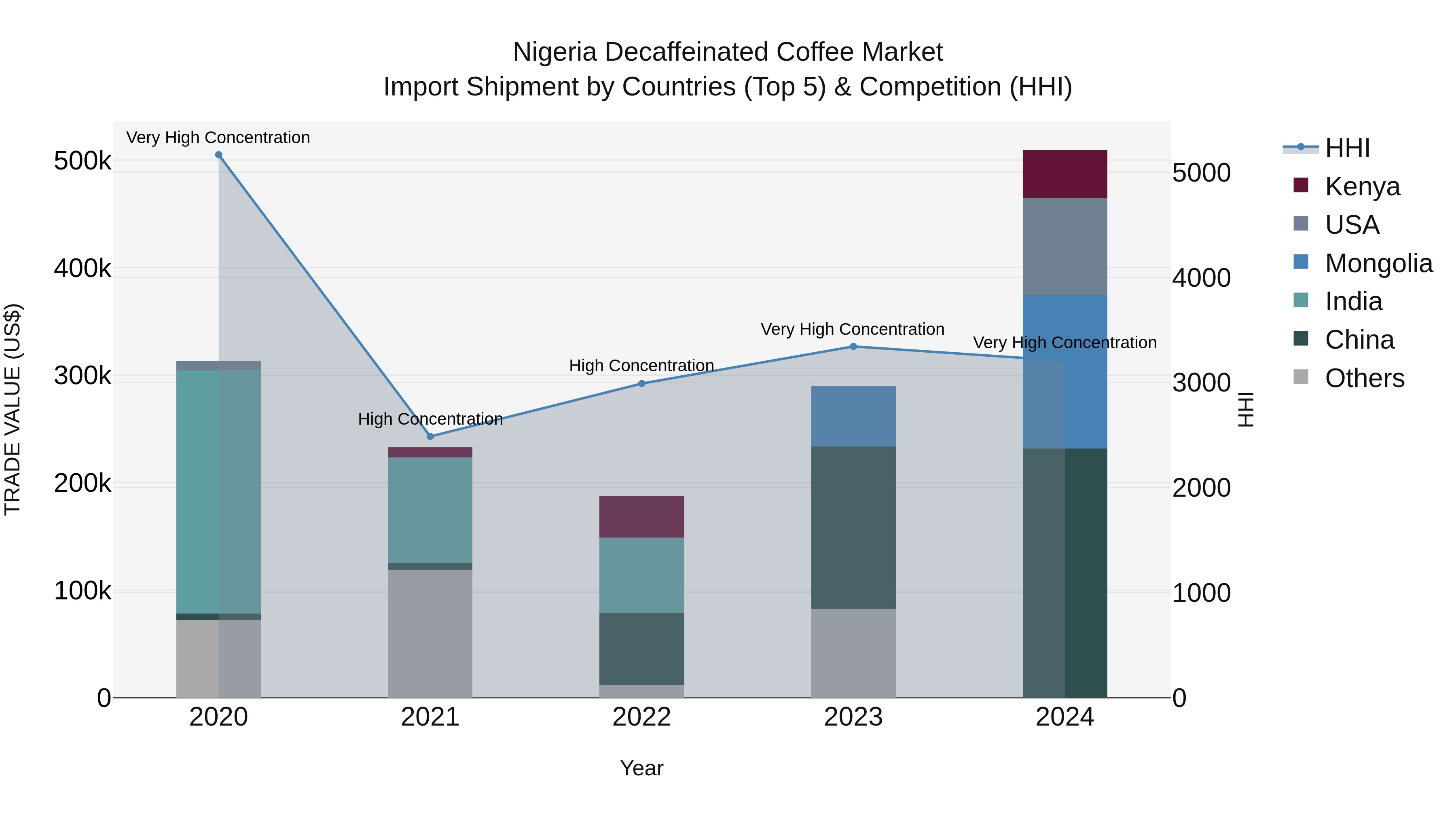
Nigeria`s decaffeinated coffee import market saw significant growth in 2024, with top exporters being China, Mongolia, USA, Kenya, and the UK. The high Herfindahl-Hirschman Index (HHI) indicates a concentrated market. The compound annual growth rate (CAGR) from 2020 to 2024 was robust at 12.92%, while the growth rate from 2023 to 2024 spiked at an impressive 75.63%. This data suggests a strong demand for decaffeinated coffee in Nigeria, with key suppliers from various regions contributing to the market`s growth.
Nigeria Decaffeinated Coffee Market Overview
The Nigeria decaffeinated coffee market is experiencing steady growth due to the increasing awareness about the health benefits of decaffeinated coffee. Consumers are becoming more health-conscious and are opting for decaf coffee to reduce their caffeine intake. Additionally, the growing trend of specialty coffee consumption in Nigeria is further driving the demand for decaf coffee. The market is witnessing the entry of new players offering a variety of decaffeinated coffee products to cater to the evolving preferences of consumers. Key players in the market are focusing on product innovation and marketing strategies to attract a wider customer base. With a young and increasingly urban population showing a preference for premium coffee products, the Nigeria decaffeinated coffee market is poised for continued growth in the coming years.
Nigeria Decaffeinated Coffee Market Trends
The Nigeria decaffeinated coffee market is experiencing a growing trend driven by increasing awareness of the health benefits of consuming decaffeinated coffee. Consumers are seeking alternatives to regular coffee to reduce caffeine intake while still enjoying the flavor and aroma of coffee. The market is also witnessing a rise in demand for decaffeinated coffee among health-conscious individuals, pregnant women, and those with caffeine sensitivity. Additionally, the availability of a variety of decaffeinated coffee products, including instant decaf coffee and decaf coffee capsules, is further fueling market growth. As more consumers prioritize health and wellness, the Nigeria decaffeinated coffee market is expected to continue its upward trajectory in the coming years.
Nigeria Decaffeinated Coffee Market Challenges
In the Nigeria Decaffeinated Coffee market, several challenges are faced including limited consumer awareness and understanding of decaffeinated coffee, high production costs associated with the decaffeination process, and the relatively low availability of decaffeinated coffee options compared to regular coffee. Additionally, there is a lack of consistent quality standards and certifications for decaffeinated coffee in Nigeria, leading to concerns about the authenticity and health implications of these products. Furthermore, the limited distribution channels and market penetration for decaffeinated coffee brands pose a challenge in reaching a wider customer base. Overall, overcoming these challenges will require increased education and marketing efforts, improved supply chain efficiency, and a focus on enhancing product quality and credibility in the Nigeria Decaffeinated Coffee market.
Nigeria Decaffeinated Coffee Market Investment Opportunities
The Nigeria Decaffeinated Coffee Market presents promising investment opportunities due to the increasing consumer demand for healthier options and specialty coffee products. With a growing middle class and rising awareness about the health benefits of decaffeinated coffee, there is a potential for market expansion and profitability. Investors can consider opportunities in establishing decaffeination facilities within the country to reduce import costs and cater to the local market. Additionally, investing in marketing and distribution channels to promote decaffeinated coffee products to a wider audience can yield significant returns. Collaborating with local coffee producers and suppliers to source high-quality beans for decaffeination can also be a strategic investment move in this emerging market segment.
Nigeria Decaffeinated Coffee Market Government Policy
The Nigerian government has implemented various policies to support and regulate the decaffeinated coffee market in the country. These policies include quality control measures to ensure that decaffeinated coffee products meet health and safety standards, as well as regulations to promote fair trade practices within the industry. Additionally, the government has provided support for research and development initiatives aimed at improving the production and processing techniques of decaffeinated coffee in Nigeria. Furthermore, there are policies in place to encourage sustainable farming practices and environmental conservation efforts within the coffee industry. Overall, the government`s policies aim to foster growth and competitiveness in the Nigerian decaffeinated coffee market while ensuring consumer protection and environmental sustainability.
Nigeria Decaffeinated Coffee Market Future Outlook
The Nigeria Decaffeinated Coffee Market is expected to witness steady growth in the coming years due to increasing consumer awareness about health benefits and the growing trend of premium coffee consumption. With more people seeking healthier alternatives and a rise in disposable income, there is a growing demand for decaffeinated coffee in Nigeria. Additionally, the evolving coffee culture in urban areas, coupled with the influence of global coffee trends, is expected to drive market growth. As more players enter the market with innovative products and marketing strategies, competition is likely to intensify, leading to a wider variety of decaffeinated coffee options for consumers. Overall, the Nigeria Decaffeinated Coffee Market is poised for expansion and is likely to experience a positive trajectory in the foreseeable future.
Key Highlights of the Report:
- Nigeria Decaffeinated Coffee Market Outlook
- Market Size of Nigeria Decaffeinated Coffee Market, 2024
- Forecast of Nigeria Decaffeinated Coffee Market, 2031
- Historical Data and Forecast of Nigeria Decaffeinated Coffee Revenues & Volume for the Period 2021 - 2031
- Nigeria Decaffeinated Coffee Market Trend Evolution
- Nigeria Decaffeinated Coffee Market Drivers and Challenges
- Nigeria Decaffeinated Coffee Price Trends
- Nigeria Decaffeinated Coffee Porter's Five Forces
- Nigeria Decaffeinated Coffee Industry Life Cycle
- Historical Data and Forecast of Nigeria Decaffeinated Coffee Market Revenues & Volume By Product for the Period 2021 - 2031
- Historical Data and Forecast of Nigeria Decaffeinated Coffee Market Revenues & Volume By Roasted for the Period 2021 - 2031
- Historical Data and Forecast of Nigeria Decaffeinated Coffee Market Revenues & Volume By Raw for the Period 2021 - 2031
- Historical Data and Forecast of Nigeria Decaffeinated Coffee Market Revenues & Volume By Species for the Period 2021 - 2031
- Historical Data and Forecast of Nigeria Decaffeinated Coffee Market Revenues & Volume By Arabica for the Period 2021 - 2031
- Historical Data and Forecast of Nigeria Decaffeinated Coffee Market Revenues & Volume By Robusta for the Period 2021 - 2031
- Historical Data and Forecast of Nigeria Decaffeinated Coffee Market Revenues & Volume By Distribution Channel for the Period 2021 - 2031
- Historical Data and Forecast of Nigeria Decaffeinated Coffee Market Revenues & Volume By Online for the Period 2021 - 2031
- Historical Data and Forecast of Nigeria Decaffeinated Coffee Market Revenues & Volume By Offline for the Period 2021 - 2031
- Nigeria Decaffeinated Coffee Import Export Trade Statistics
- Market Opportunity Assessment By Product
- Market Opportunity Assessment By Species
- Market Opportunity Assessment By Distribution Channel
- Nigeria Decaffeinated Coffee Top Companies Market Share
- Nigeria Decaffeinated Coffee Competitive Benchmarking By Technical and Operational Parameters
- Nigeria Decaffeinated Coffee Company Profiles
- Nigeria Decaffeinated Coffee Key Strategic Recommendations






































