Nigeria Instrumentation Valves and Fittings Market Size, Share & Growth Rate
The Nigeria Instrumentation Valves and Fittings Market was estimated at USD 466 Million in 2025 and is projected to reach USD 625 Million by 2032, growing at a CAGR of 4.3% from 2026 to 2032. This robust growth is primarily fueled by an upsurge in demand from the oil and gas industry, driven by Nigeria's status as a leading oil producer in Africa. Furthermore, the ongoing expansion and modernization efforts across various industrial sectors are contributing significantly to the need for reliable instrumentation solutions.
Nigeria Instrumentation Valves and Fittings Market Year-wise Growth Rate and Key Drivers
This graph highlights how the Nigeria Instrumentation Valves and Fittings Market has steadily grown over the years, supported by major growth factors.
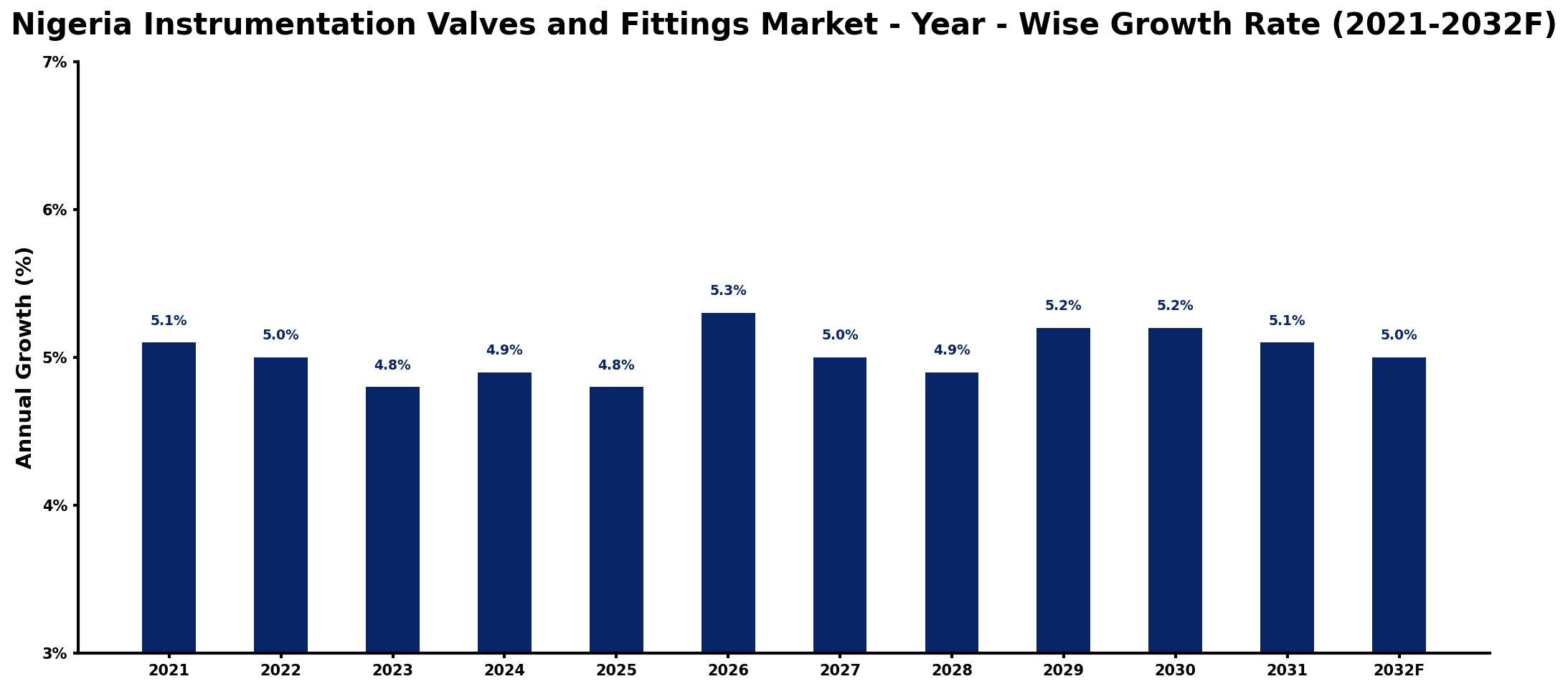
The table below presents the year‑wise growth rates along with the key drivers influencing the market
| Year | Growth Rate | Major Drivers |
| 2021 | 5.1% | Rising oil and gas investments |
| 2022 | 5.0% | Increased infrastructure development projects |
| 2023 | 4.8% | Growing demand for automation solutions |
| 2024 | 4.9% | Expansion of renewable energy sector |
| 2025 | 4.8% | Investment in water management systems |
| 2026 | 5.3% | Surge in industrial manufacturing activities |
| 2027 | 5.0% | Growth in telecommunications infrastructure |
| 2028 | 4.9% | Rising need for safety regulations |
| 2029 | 5.2% | Increasing focus on process optimization |
| 2030 | 5.2% | expanding industrial usage applications |
| 2031 | 5.1% | Development of smart city initiatives |
| 2032 | 5.0% | Growing emphasis on environmental sustainability |
Note: Market size estimations and growth projections presented in this report are based on 6Wresearch's proprietary forecasting methodology, utilizing the latest available industry data, government publications, and primary research inputs.
Nigeria Instrumentation Valves and Fittings Market Synopsis
The strongest force currently shaping the Nigeria Instrumentation Valves and Fittings Market is the surging demand for automation in the oil and gas sector. As industries strive to enhance operational efficiency, the need for high-quality valves and fittings becomes ever more critical.
Moreover, the trend towards safety and compliance is pivotal in shaping market dynamics. With industrial processes becoming increasingly sophisticated, the demand for reliable instrumentation solutions that ensure safety and operational integrity continues to rise.
Nigeria Instrumentation Valves and Fittings Market Key Takeaways
- The market is driven by the oil and gas industry's growth, necessitating high-quality instrumentation solutions.
- Modernization of existing infrastructure is a significant contributor to market demand.
- Government policies promoting local manufacturing are reshaping the competitive landscape.
- The emphasis on safety and reliability is influencing consumer preferences in product selection.
- Challenges related to quality standards and counterfeit products need addressing for sustainable growth.
Evaluation of Restraints in Nigeria Instrumentation Valves and Fittings Market
The Nigeria Instrumentation Valves and Fittings Market faces considerable restraints that could impact its growth trajectory. Inconsistent quality standards and regulatory compliance pose significant challenges for manufacturers and consumers alike. The absence of a unified regulatory framework can lead to confusion regarding product quality and safety, further compounded by the prevalence of counterfeit products that undermine trust in the market. Additionally, inadequate infrastructure for distribution creates logistical challenges that hinder accessibility and efficiency, necessitating focused efforts from stakeholders to establish clear standards and improve overall market conditions.
Nigeria Instrumentation Valves and Fittings Market Trends
Several trends are currently shaping the Nigeria Instrumentation Valves and Fittings Market. Notably, there is a strong push towards smart instrumentation solutions, incorporating advanced technologies such as IoT and automation. This trend is fostering increased operational efficiency and real-time monitoring capabilities, essential for sectors like oil and gas. Furthermore, a growing emphasis on sustainability is influencing product development, with companies increasingly seeking environmentally friendly materials and practices.
Nigeria Instrumentation Valves and Fittings Market Opportunities
The market is ripe with genuine growth opportunities, particularly in the realm of local manufacturing. As government policies favor domestic production, companies can leverage this landscape to create competitive advantages through lower operational costs and improved supply chain management. Additionally, the ongoing modernization of infrastructure presents a unique opportunity for providers to offer tailored solutions that meet the evolving demands of various industrial sectors. By focusing on innovation and quality, businesses can position themselves effectively within this expanding market.
Government Initiatives in the Nigeria Instrumentation Valves and Fittings Market
The Nigerian government has introduced several initiatives aimed at fostering local manufacturing and assembly of instrumentation valves and fittings. These include tax incentives to encourage domestic production, as well as import tariffs designed to protect local industries from foreign competition. Furthermore, the government actively supports technology transfer partnerships between local and international firms, emphasizing the importance of compliance with international safety standards throughout the manufacturing process.
Future Insights of the Nigeria Instrumentation Valves and Fittings Market
Looking ahead to the period from 2026 to 2032, the Nigeria Instrumentation Valves and Fittings Market is poised for substantial growth, driven by ongoing advancements in technology and a heightened focus on safety and efficiency. As industries adapt to evolving standards and consumer expectations, the demand for innovative, high-quality instrumentation solutions will only continue to rise. Coupled with supportive government policies, the market's trajectory suggests a promising environment for both established players and new entrants seeking to capitalize on these emerging opportunities.
Nigeria Instrumentation Valves and Fittings Market Latest Developments (2025 - 2026)
Recent industry developments indicate a shift towards enhanced product offerings that incorporate smart technologies. Companies are increasingly focusing on integrating automation and IoT solutions into their instrumentation products, responding to market demands for improved operational efficiency. Furthermore, there is a notable uptick in collaborative efforts between domestic manufacturers and international technology providers, aimed at fostering innovation and expanding product portfolios to meet evolving market needs.
Nigeria Instrumentation Valves and Fittings Market - Key Attractiveness of the Report
- 10 Years of Market Numbers
- Historical Data Starting from 2022 to 2025
- Base Year: 2025
- Forecast Data until 2032
- Key Performance Indicators Impacting the Market
- Major Upcoming Developments and Projects
Key Highlights of the Report:
- Nigeria Instrumentation Valves and Fittings Market Outlook
- Market Size of Nigeria Instrumentation Valves and Fittings Market, 2025
- Forecast of Nigeria Instrumentation Valves and Fittings Market, 2032
- Historical Data and Forecast of Nigeria Instrumentation Valves and Fittings Revenues & Volume for the Period 2022-2032F
- Nigeria Instrumentation Valves and Fittings Market Trend Evolution
- Nigeria Instrumentation Valves and Fittings Market Drivers and Challenges
- Nigeria Instrumentation Valves and Fittings Price Trends
- Nigeria Instrumentation Valves and Fittings Porter's Five Forces
- Nigeria Instrumentation Valves and Fittings Industry Life Cycle
- Historical Data and Forecast of Nigeria Instrumentation Valves and Fittings Market Revenues & Volume By Types for the Period 2022-2032F
- Historical Data and Forecast of Nigeria Instrumentation Valves and Fittings Market Revenues & Volume By Tube for the Period 2022-2032F
- Historical Data and Forecast of Nigeria Instrumentation Valves and Fittings Market Revenues & Volume By Pipe for the Period 2022-2032F
- Historical Data and Forecast of Nigeria Instrumentation Valves and Fittings Market Revenues & Volume By Biopharm for the Period 2022-2032F
- Historical Data and Forecast of Nigeria Instrumentation Valves and Fittings Market Revenues & Volume By Hose for the Period 2022-2032F
- Historical Data and Forecast of Nigeria Instrumentation Valves and Fittings Market Revenues & Volume By Weld for the Period 2022-2032F
- Historical Data and Forecast of Nigeria Instrumentation Valves and Fittings Market Revenues & Volume By Others for the Period 2022-2032F
- Historical Data and Forecast of Nigeria Instrumentation Valves and Fittings Market Revenues & Volume By Applications for the Period 2022-2032F
- Historical Data and Forecast of Nigeria Instrumentation Valves and Fittings Market Revenues & Volume By Oil & Gas for the Period 2022-2032F
- Historical Data and Forecast of Nigeria Instrumentation Valves and Fittings Market Revenues & Volume By Marine & Shipbuilding for the Period 2022-2032F
- Historical Data and Forecast of Nigeria Instrumentation Valves and Fittings Market Revenues & Volume By Industrial for the Period 2022-2032F
- Historical Data and Forecast of Nigeria Instrumentation Valves and Fittings Market Revenues & Volume By Others for the Period 2022-2032F
- Historical Data and Forecast of Nigeria Instrumentation Valves and Fittings Market Revenues & Volume By Products for the Period 2022-2032F
- Historical Data and Forecast of Nigeria Instrumentation Valves and Fittings Market Revenues & Volume By Instrumentation Valves for the Period 2022-2032F
- Historical Data and Forecast of Nigeria Instrumentation Valves and Fittings Market Revenues & Volume By Instrumentation Fittings for the Period 2022-2032F
- Nigeria Instrumentation Valves and Fittings Import Export Trade Statistics
- Market Opportunity Assessment By Types
- Market Opportunity Assessment By Applications
- Market Opportunity Assessment By Products
- Nigeria Instrumentation Valves and Fittings Top Companies Market Share
- Nigeria Instrumentation Valves and Fittings Competitive Benchmarking By Technical and Operational Parameters
- Nigeria Instrumentation Valves and Fittings Company Profiles
- Nigeria Instrumentation Valves and Fittings Key Strategic Recommendations






































