Nigeria IoT in Manufacturing Market Size & Growth Rate (2026-2032)
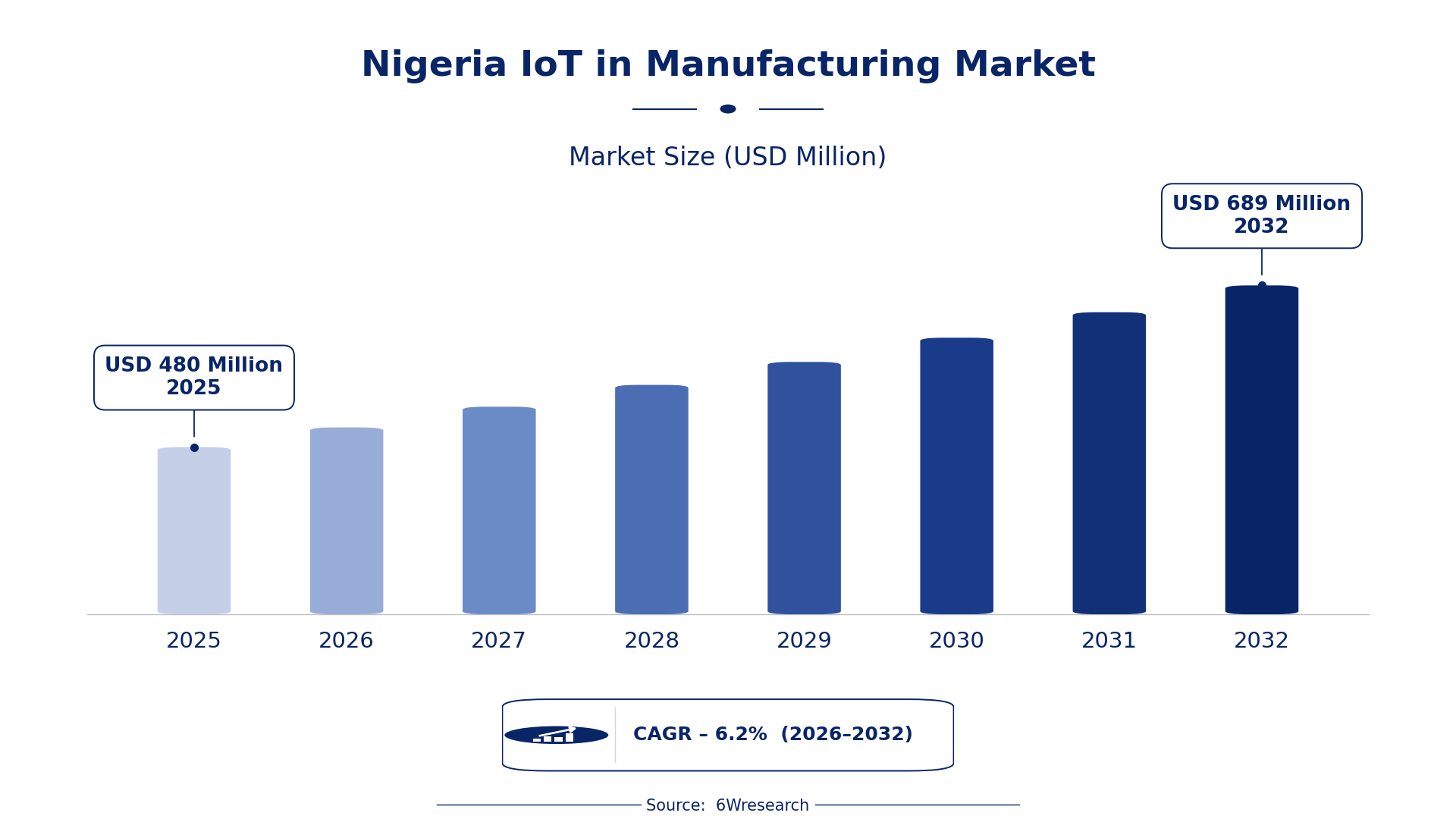
The Nigeria IoT in Manufacturing Market was estimated at USD 480 Million in 2025 and is projected to reach USD 689 Million by 2032, growing at a CAGR of 6.2% from 2026 to 2032.
Nigeria IoT in Manufacturing Market Synopsis
The Nigeria IoT in Manufacturing Market is currently experiencing an impressive surge, driven by the urgent need for manufacturers to modernize operations. With the rising adoption of IoT solutions, businesses are leveraging technology to streamline processes, enhance efficiency, and cut costs.
Manufacturers are increasingly recognizing the value of IoT-enabled technologies such as predictive maintenance and smart inventory management. These innovations not only drive productivity but also position Nigerian manufacturers to compete effectively in a global market increasingly defined by technological advancement.
Nigeria IoT in Manufacturing Market Year-wise Growth Rate and Key Drivers
This graph illustrates the annual growth rates of the Nigeria IoT in Manufacturing Market from 2021 to 2032, highlighting a steady upward trajectory and projected expansion over the forecast period.
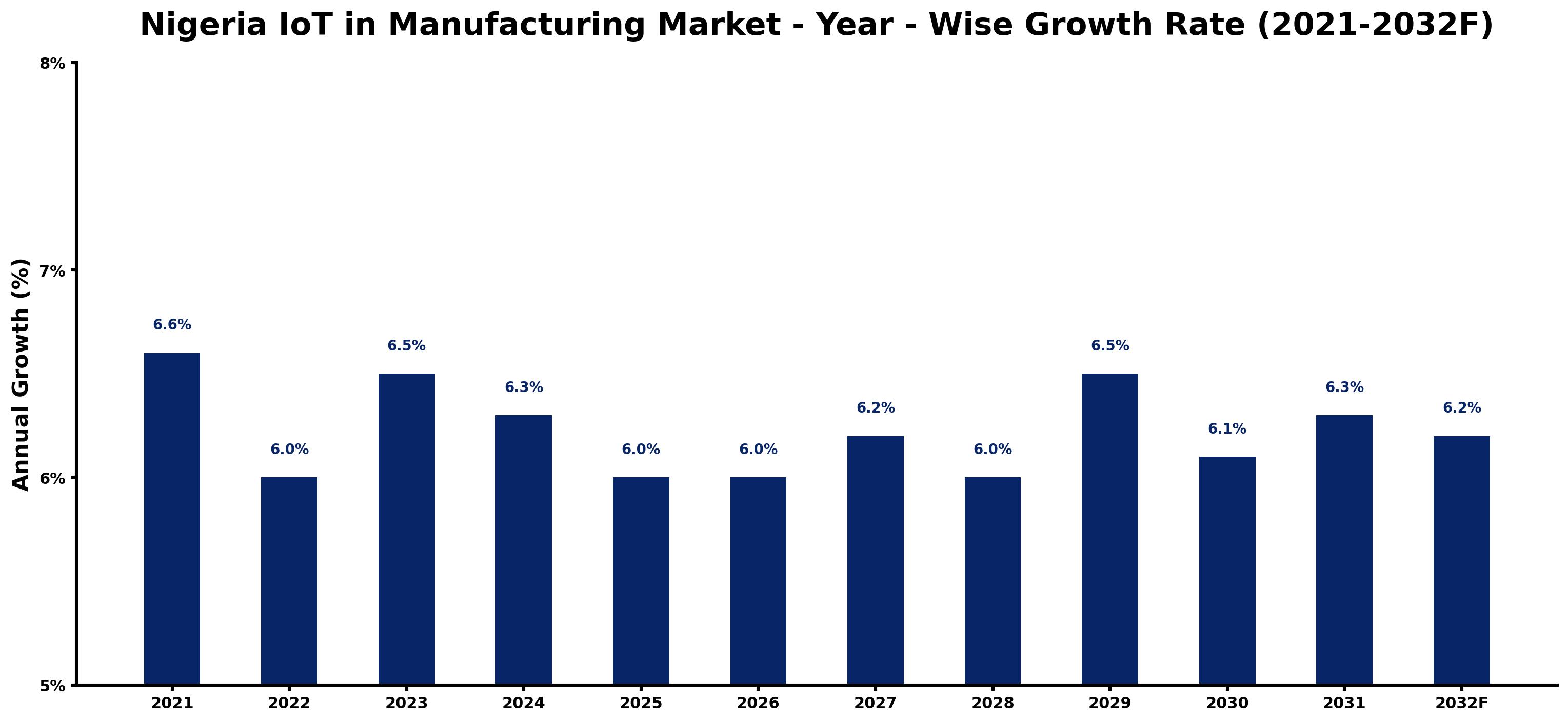
The table below presents the year‑wise growth rates along with the key drivers influencing the market
| Year | Growth Rate | Major Drivers |
| 2021 | 6.6% | Nigerian manufacturing adoption of smart factory technologies |
| 2022 | 6.0% | Government funding for IoT infrastructure development initiatives |
| 2023 | 6.5% | Increased demand for real-time supply chain monitoring solutions |
| 2024 | 6.3% | Local universities partnering for IoT research and innovation |
| 2025 | 6.0% | Rise in productivity due to predictive maintenance tools |
| 2026 | 6.0% | Enhanced connectivity from the National Broadband Plan |
| 2027 | 6.2% | Manufacturers integrating IoT for quality control improvements |
| 2028 | 6.0% | Growing awareness of IoT benefits among local enterprises |
| 2029 | 6.5% | Emergence of local IoT startups enhancing industry solutions |
| 2030 | 6.1% | Investment in digital skills for IoT implementation growth |
| 2031 | 6.3% | Support from Nigerian Industrial Revolution Plan programs |
| 2032 | 6.2% | Positive regulatory environment for technology adoption in manufacturing |
Note: Market size estimations and growth projections presented in this report are based on 6Wresearch's proprietary forecasting methodology, utilizing the latest available industry data, government publications, and primary research inputs.
Nigeria IoT in Manufacturing Market Key Takeaways
Below are some of the specific key takeaways from the market, including:
- The market is shifting towards Industry 4.0, with IoT technologies becoming integral to production processes.
- There is a growing demand for solutions that enhance operational efficiency and reduce downtime.
- Data security and interoperability challenges remain major hurdles for manufacturers adopting IoT technologies.
- The Nigerian government is actively promoting IoT adoption through various supportive policies and initiatives.
- Skilled professionals in IoT deployment are in high demand, yet the talent pool remains limited.
Evaluation of Restraints in Nigeria IoT in Manufacturing Market
Despite the promising growth trajectory, several factors are hindering the Nigeria IoT in Manufacturing Market. Many manufacturers face significant challenges when integrating IoT technologies with their existing systems. Data security is a pressing concern, as companies often lack robust measures to protect sensitive information. Additionally, the interoperability of various IoT devices with traditional industrial systems presents compatibility issues that can disrupt operations. The high costs associated with the implementation and maintenance of IoT solutions further complicate the situation, deterring some manufacturers from making the switch. Finally, the shortage of skilled professionals capable of managing these advanced technologies continues to impede innovation and growth in the sector.
Nigeria IoT in Manufacturing Market Trends
Several notable trends are influencing the Nigeria IoT in Manufacturing Market. Manufacturers are increasingly adopting predictive analytics to preemptively address equipment failures, thereby minimizing downtime. The push for real-time data monitoring is also gaining traction, as companies seek immediate insights into their operations. on top of that, smart inventory management is emerging as a critical focus area, enabling firms to optimize stock levels and reduce waste. As manufacturers strive for operational excellence, the integration of IoT technologies is expected to become more sophisticated, incorporating AI and machine learning for enhanced decision-making capabilities.
Nigeria IoT in Manufacturing Market Opportunities
The Nigeria IoT in Manufacturing Market presents numerous growth opportunities for stakeholders. As the demand for automation increases, there is a clear market for innovative IoT solutions that can enhance productivity and streamline operations. Companies focusing on developing secure IoT platforms stand to gain a competitive edge, especially in an environment where data security is paramount. Additionally, as the government continues to incentivize smart manufacturing, partnerships between technology providers and manufacturers can lead to successful implementations of IoT solutions. The rising focus on sustainability and efficiency also opens avenues for green IoT technologies that can help manufacturers meet regulatory requirements and reduce their carbon footprint.
Government Initiatives in the Nigeria IoT in Manufacturing Market
The Nigerian government is actively fostering the growth of the IoT in Manufacturing Market through various initiatives. Regulatory policies are being implemented to support the development of IoT infrastructure, aiming to enhance the overall efficiency of the manufacturing sector. By providing incentives for smart manufacturing investments, the government is encouraging manufacturers to adopt cutting-edge technologies that align with Industry 4.0 standards.
- A recently completed initiative introduced incentives for manufacturers investing in IoT technologies to enhance production efficiency.
- A current programme is underway to develop national IoT infrastructure, focusing on connectivity and data security improvements.
- A planned public-private partnership aims to establish a comprehensive training programme for IoT professionals, expected to roll out by late 2026.
- Regulatory frameworks are being drafted to ensure data security and interoperability standards across IoT devices in the manufacturing sector.
- A strategic roadmap for digital transformation in manufacturing is set to be launched, targeting the integration of advanced technologies by 2028.
Future Insights of the Nigeria IoT in Manufacturing Market
Looking ahead to 2026-2032, the Nigeria IoT in Manufacturing Market is likely to witness accelerated growth as technology adoption becomes a necessity rather than an option. As manufacturers increasingly focus on achieving operational excellence and meeting customer demands, the integration of IoT solutions will become even more crucial. The emphasis on real-time data analytics and predictive maintenance will drive further innovation, positioning Nigeria as a competitive player in the global manufacturing arena. With continued governmental support and investment in infrastructure, the market is set for substantial advancements.
Nigeria IoT in Manufacturing Market Latest Developments
Recent developments in the Nigeria IoT in Manufacturing Market indicate a strong commitment to technological advancement and innovation. Over the past year, manufacturers have increasingly embraced IoT solutions to optimize their operations and enhance productivity. This trend reflects a broader recognition of the transformative potential of IoT technologies within the sector.
- A major technology vendor launched an IoT platform tailored for the manufacturing sector, designed to improve predictive maintenance capabilities, in early 2025.
- An ongoing collaboration between local universities and industry leaders aims to establish research initiatives focused on developing IoT applications for manufacturing.
- A partnership between a leading regional operator and manufacturers is currently underway to enhance connectivity solutions across industrial zones, expected to be completed by mid-2026.
- Plans for a nationwide workshop series are being developed to educate manufacturers about IoT technologies, set to kick off in Q4 2025.
- A pilot programme for integrating AI with IoT solutions in manufacturing processes is expected to launch in early 2026, aiming to enhance data analytics capabilities.
Nigeria IoT in Manufacturing Market - Key Attractiveness of the Report
- 10 Years of Market Numbers
- Historical Data Starting from 2022 to 2025
- Base Year: 2025
- Forecast Data until 2032
- Key Performance Indicators Impacting the Market
- Major Upcoming Developments and Projects
Key Highlights of the Report:
- Nigeria IoT in Manufacturing Market Outlook
- Market Size of Nigeria IoT in Manufacturing Market, 2025
- Forecast of Nigeria IoT in Manufacturing Market, 2032
- Historical Data and Forecast of Nigeria IoT in Manufacturing Revenues & Volume for the Period 2022-2032F
- Nigeria IoT in Manufacturing Market Trend Evolution
- Nigeria IoT in Manufacturing Market Drivers and Challenges
- Nigeria IoT in Manufacturing Price Trends
- Nigeria IoT in Manufacturing Porter's Five Forces
- Nigeria IoT in Manufacturing Industry Life Cycle
- Historical Data and Forecast of Nigeria IoT in Manufacturing Market Revenues & Volume By Component for the Period 2022-2032F
- Historical Data and Forecast of Nigeria IoT in Manufacturing Market Revenues & Volume By Solutions Network Management for the Period 2022-2032F
- Historical Data and Forecast of Nigeria IoT in Manufacturing Market Revenues & Volume By Data Management for the Period 2022-2032F
- Historical Data and Forecast of Nigeria IoT in Manufacturing Market Revenues & Volume By Vertical for the Period 2022-2032F
- Historical Data and Forecast of Nigeria IoT in Manufacturing Market Revenues & Volume By Process for the Period 2022-2032F
- Historical Data and Forecast of Nigeria IoT in Manufacturing Market Revenues & Volume By Discrete for the Period 2022-2032F
- Historical Data and Forecast of Nigeria IoT in Manufacturing Market Revenues & Volume By Services for the Period 2022-2032F
- Historical Data and Forecast of Nigeria IoT in Manufacturing Market Revenues & Volume By Professional for the Period 2022-2032F
- Historical Data and Forecast of Nigeria IoT in Manufacturing Market Revenues & Volume By Managed for the Period 2022-2032F
- Historical Data and Forecast of Nigeria IoT in Manufacturing Market Revenues & Volume By Application for the Period 2022-2032F
- Historical Data and Forecast of Nigeria IoT in Manufacturing Market Revenues & Volume By Predictive maintenance for the Period 2022-2032F
- Historical Data and Forecast of Nigeria IoT in Manufacturing Market Revenues & Volume By Business process optimization for the Period 2022-2032F
- Historical Data and Forecast of Nigeria IoT in Manufacturing Market Revenues & Volume By Asset tracking and management for the Period 2022-2032F
- Historical Data and Forecast of Nigeria IoT in Manufacturing Market Revenues & Volume By Logistics and supply chain management for the Period 2022-2032F
- Historical Data and Forecast of Nigeria IoT in Manufacturing Market Revenues & Volume By Real-time workforce tracking and management for the Period 2022-2032F
- Historical Data and Forecast of Nigeria IoT in Manufacturing Market Revenues & Volume By Automation control and management for the Period 2022-2032F
- Historical Data and Forecast of Nigeria IoT in Manufacturing Market Revenues & Volume By Emergency and incident management and business communication for the Period 2022-2032F
- Historical Data and Forecast of Nigeria IoT in Manufacturing Market Revenues & Volume By Deployment Mode for the Period 2022-2032F
- Historical Data and Forecast of Nigeria IoT in Manufacturing Market Revenues & Volume By On-premises for the Period 2022-2032F
- Historical Data and Forecast of Nigeria IoT in Manufacturing Market Revenues & Volume By Cloud for the Period 2022-2032F
- Historical Data and Forecast of Nigeria IoT in Manufacturing Market Revenues & Volume By Organization Size for the Period 2022-2032F
- Historical Data and Forecast of Nigeria IoT in Manufacturing Market Revenues & Volume By Small and Medium Enterprises for the Period 2022-2032F
- Historical Data and Forecast of Nigeria IoT in Manufacturing Market Revenues & Volume By Large Enterprises for the Period 2022-2032F
- Nigeria IoT in Manufacturing Import Export Trade Statistics
- Market Opportunity Assessment By Component
- Market Opportunity Assessment By Vertical
- Market Opportunity Assessment By Services
- Market Opportunity Assessment By Application
- Market Opportunity Assessment By Deployment Mode
- Market Opportunity Assessment By Organization Size
- Nigeria IoT in Manufacturing Top Companies Market Share
- Nigeria IoT in Manufacturing Competitive Benchmarking By Technical and Operational Parameters
- Nigeria IoT in Manufacturing Company Profiles
- Nigeria IoT in Manufacturing Key Strategic Recommendations






































