Nigeria Ornamental Fish Market Size, Share & Growth Rate
The Nigeria Ornamental Fish Market was estimated at USD 1215 Million in 2025 and is projected to reach USD 1769 Million by 2032, growing at a CAGR of 5.5% from 2026 to 2032. This robust growth trajectory is underpinned by a rising population of fish enthusiasts, increasing disposable incomes, and a marked shift towards aquaculture and sustainable practices. Urbanization further fuels demand as more consumers embrace aquarium keeping as both a hobby and a decorative element in homes and offices.
Nigeria Ornamental Fish Market Year-wise Growth Rate and Key Drivers
This graph highlights how the Nigeria Ornamental Fish Market has steadily grown over the years, supported by major growth factors.
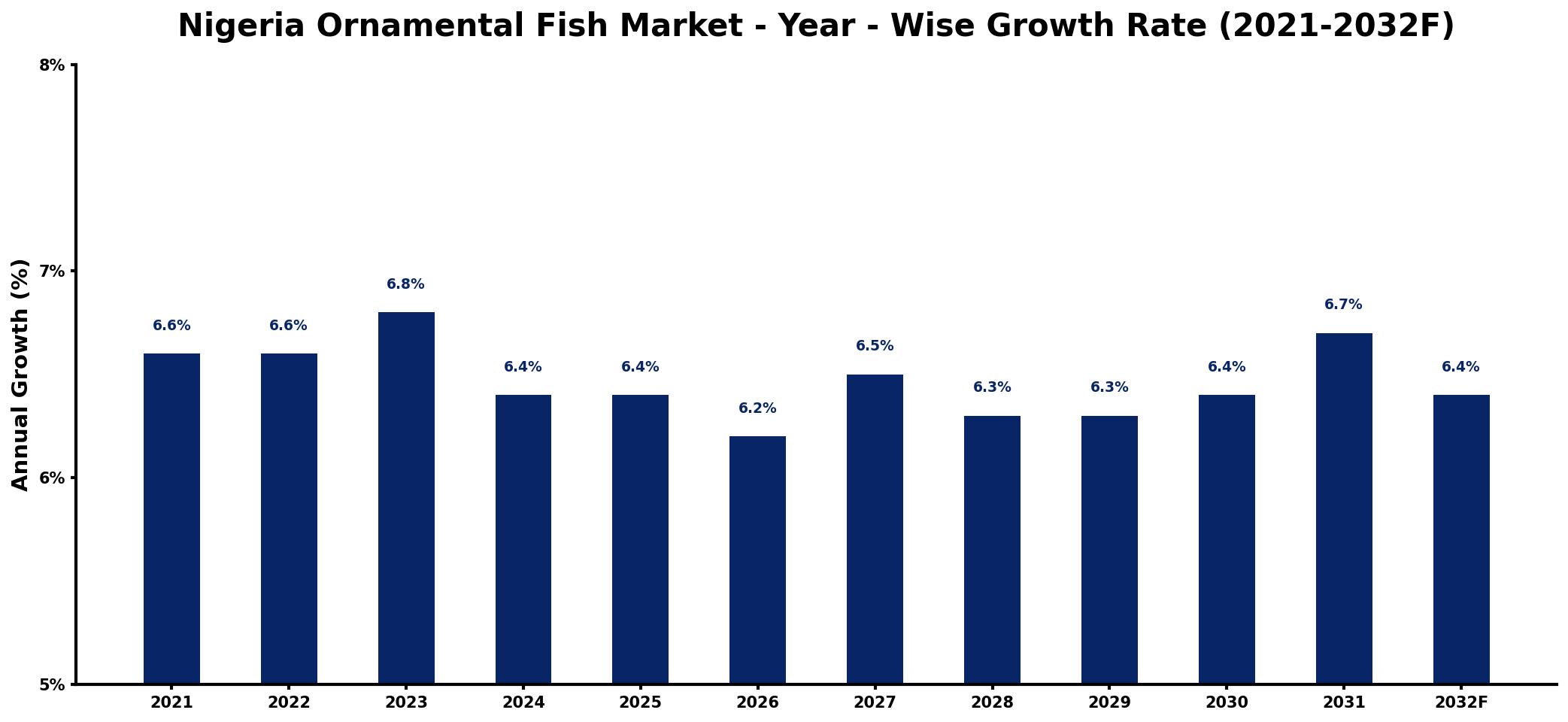
The table below presents the year‑wise growth rates along with the key drivers influencing the market
| Year | Growth Rate | Major Drivers |
| 2021 | 6.6% | Increased consumer interest in aquaculture |
| 2022 | 6.6% | Expansion of retail distribution channels |
| 2023 | 6.8% | Rise in home aquarium popularity |
| 2024 | 6.4% | Growth in eco-friendly initiatives |
| 2025 | 6.4% | Increased investment in breeding facilities |
| 2026 | 6.2% | Surge in online sales platforms |
| 2027 | 6.5% | Emergence of new hobbyist communities |
| 2028 | 6.3% | Development of advanced filtration technologies |
| 2029 | 6.3% | Increase in educational programs offered |
| 2030 | 6.4% | Collaboration with tourism industry stakeholders |
| 2031 | 6.7% | Growing demand for sustainable practices |
| 2032 | 6.4% | Enhanced marketing strategies implemented |
Note: Market size estimations and growth projections presented in this report are based on 6Wresearch's proprietary forecasting methodology, utilizing the latest available industry data, government publications, and primary research inputs.
Nigeria Ornamental Fish Market Synopsis
The Nigeria Ornamental Fish Market has shown remarkable momentum, primarily driven by a burgeoning interest in fishkeeping among various demographic segments. However, as the market evolves, it faces the dual challenge of maintaining quality supply chains while addressing infrastructural deficiencies. The anticipated growth trajectory suggests a bright future, provided that key hurdles are effectively navigated.
Amidst this backdrop, the market is diversifying with a plethora of species and sizes available to cater to varying consumer preferences. Local breeders and retailers are adapting to this demand, fostering a competitive landscape that encourages innovation and sustainability. As awareness around the importance of responsible fish care rises, educational resources are becoming an integral part of the market's ecosystem.
Nigeria Ornamental Fish Market Key Takeaways
- Growing interest in aquarium keeping among hobbyists and corporate entities is driving market growth.
- Diverse species availability, coupled with urbanization and rising disposable incomes, supports increasing consumer demand.
- The market is seeing a shift towards sustainable practices in breeding and aquaculture.
- Online retail platforms are becoming essential for reaching a broader audience effectively.
- Investment in quality infrastructure and education about fish care can unlock further market potential.
Evaluation of Restraints in Nigeria Ornamental Fish Market
Despite the promising prospects of the Nigeria Ornamental Fish Market, several constraints impede its full potential. Inadequate infrastructure for breeding and transportation contributes to high fish mortality rates, compromising the supply chain. Furthermore, limited access to quality feed and technical expertise creates barriers for both producers and retailers. Government regulations can be inconsistent, leading to uncertainty in investment and growth for market players. The fragmented nature of the industry also makes it challenging to establish uniform standards that could enhance market quality and reliability.
Nigeria Ornamental Fish Market Trends
Key trends shaping the Nigeria Ornamental Fish Market include a heightened demand for unique and exotic species, particularly among serious hobbyists and collectors. The market is witnessing an increasing emphasis on sustainable practices, with responsible breeding methods gaining traction. Additionally, the rise of e-commerce is transforming how consumers purchase ornamental fish, facilitating access to a wider array of species. This shift is complemented by the growing popularity of custom-designed aquariums and a focus on aquascaping, indicating a more engaged consumer base eager to enhance their aquatic environments.
Nigeria Ornamental Fish Market Opportunities
The Nigeria Ornamental Fish Market offers a wealth of investment opportunities driven by the rising interest in decorative fish species. With a significant number of aquarium enthusiasts in Nigeria, businesses can capitalize by investing in breeding facilities and establishing robust distribution networks. Value-added services, such as fish tank maintenance and specialized healthcare products, are also areas ripe for development. Collaborations with local breeders to source unique species can provide a competitive advantage and meet the diverse preferences of consumers.
Government Initiatives in the Nigeria Ornamental Fish Market
The Nigerian government has introduced several policies to promote sustainable practices within the ornamental fish sector. Agencies like the National Agricultural Quarantine Service (NAQS) enforce strict guidelines to regulate the importation and exportation of fish, aiming to prevent disease outbreaks. The Federal Department of Fisheries is actively involved in regulating breeding and farming practices to uphold quality standards. In addition, various funding and training programs are designed to support local farmers in enhancing production capabilities, thereby driving market growth.
Future Insights of the Nigeria Ornamental Fish Market
Looking ahead to the period between 2026 and 2032, the Nigeria Ornamental Fish Market is poised for sustained growth, fueled by increasing urbanization and disposable incomes. The trend of incorporating ornamental fish into home décor and office environments will likely continue to thrive. E-commerce platforms are expected to further shape distribution dynamics, improving access to a diverse range of species. Nevertheless, the future success of the market hinges on addressing existing challenges such as infrastructure inadequacies and enhancing public knowledge on responsible fish care.
Nigeria Ornamental Fish Market Latest Developments (2025 - 2026)
Recent developments in the Nigeria Ornamental Fish Market indicate a strong shift towards online retailing, as consumers increasingly prefer the convenience of purchasing fish through digital platforms. Efforts are also being made to enhance fish care education, with workshops and informational resources being made available for enthusiasts. Additionally, local breeding initiatives are being prioritized to boost sustainable practices and reduce reliance on imports, highlighting a collective move towards enhancing the overall health of the market.
Nigeria Ornamental Fish Market - Key Attractiveness of the Report
- 10 Years of Market Numbers
- Historical Data Starting from 2022 to 2025
- Base Year: 2025
- Forecast Data until 2032
- Key Performance Indicators Impacting the Market
- Major Upcoming Developments and Projects
Key Highlights of the Report:
- Nigeria Ornamental Fish Market Outlook
- Market Size of Nigeria Ornamental Fish Market, 2025
- Forecast of Nigeria Ornamental Fish Market, 2032
- Historical Data and Forecast of Nigeria Ornamental Fish Revenues & Volume for the Period 2022-2032F
- Nigeria Ornamental Fish Market Trend Evolution
- Nigeria Ornamental Fish Market Drivers and Challenges
- Nigeria Ornamental Fish Price Trends
- Nigeria Ornamental Fish Porter's Five Forces
- Nigeria Ornamental Fish Industry Life Cycle
- Historical Data and Forecast of Nigeria Ornamental Fish Market Revenues & Volume By Product for the Period 2022-2032F
- Historical Data and Forecast of Nigeria Ornamental Fish Market Revenues & Volume By Tropical Freshwater for the Period 2022-2032F
- Historical Data and Forecast of Nigeria Ornamental Fish Market Revenues & Volume By Temperate for the Period 2022-2032F
- Historical Data and Forecast of Nigeria Ornamental Fish Market Revenues & Volume By Marine for the Period 2022-2032F
- Historical Data and Forecast of Nigeria Ornamental Fish Market Revenues & Volume By Application for the Period 2022-2032F
- Historical Data and Forecast of Nigeria Ornamental Fish Market Revenues & Volume By Commercial for the Period 2022-2032F
- Historical Data and Forecast of Nigeria Ornamental Fish Market Revenues & Volume By Household for the Period 2022-2032F
- Nigeria Ornamental Fish Import Export Trade Statistics
- Market Opportunity Assessment By Product
- Market Opportunity Assessment By Application
- Nigeria Ornamental Fish Top Companies Market Share
- Nigeria Ornamental Fish Competitive Benchmarking By Technical and Operational Parameters
- Nigeria Ornamental Fish Company Profiles
- Nigeria Ornamental Fish Key Strategic Recommendations






































